Berkshire Hathaway's Q2 13F Portfolio Reshuffle: Increased Stakes in Google and Delta Air Lines, Consecutive Quarter of Cutting Bank of America

marsbitОпубліковано о 2026-08-16Востаннє оновлено о 2026-08-16

Анотація

Berkshire Hathaway's second-quarter 13F filing, released August 14th, reveals significant portfolio shifts under new leadership. The total portfolio value rose to approximately $299.3 billion. Key highlights include a major increase in Alphabet (Google) holdings. Berkshire's stake in Google-A surged 45.24% to $28.16 billion, while its Google-C holdings jumped 658% to $9.61 billion, making Alphabet the firm's third-largest combined holding after Apple and American Express. Conversely, Bank of America was the largest reduction, with shares cut by 5.89% for the second consecutive quarter, though it remains the fifth-largest holding. Berkshire also increased positions in Delta Air Lines (up 44%) and homebuilder Lennar, while initiating a small new position in D.R. Horton. The consumer sector saw Constellation Brands completely sold off. Overall, the portfolio reflects a continued move toward technology and specific cyclical sectors like housing and airlines, while trimming some financial and consumer stakes. Apple remains the top holding at 22% of the portfolio.

Author: Wall Street News

Following 'Oracle of Omaha' Warren Buffett's resignation as CEO, Berkshire Hathaway has released its second 13F filing.

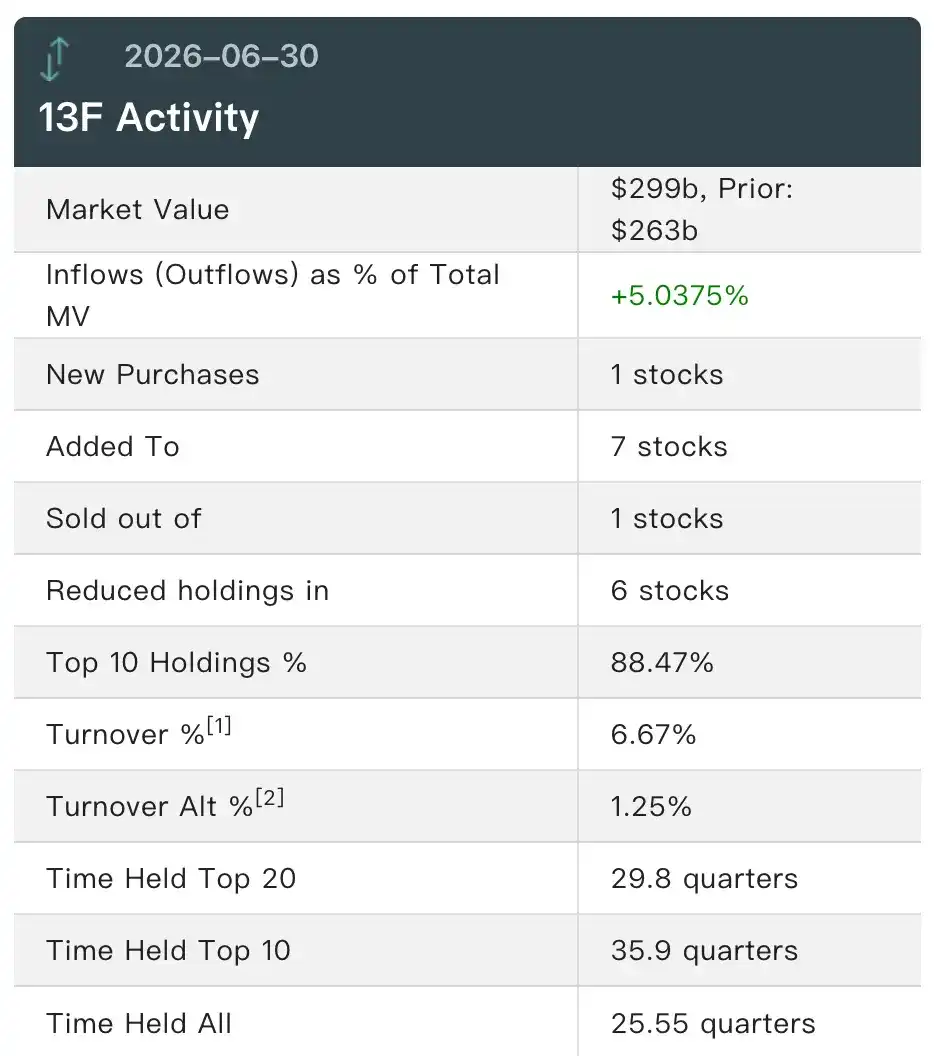
According to documents disclosed on August 14, Eastern Time, Berkshire's 13F equity portfolio value was approximately $299.3 billion at the end of the second quarter, an increase of 12.09% from approximately $263.1 billion at the end of the first quarter. Overall, Berkshire initiated a position in 1 new stock, added to 7 stocks, reduced holdings in 6 stocks, and completely exited 1 stock in the second quarter.

It is evident that under the leadership of Greg Abel, Berkshire has been continuously increasing its bets on Alphabet, housing, and airlines, while gradually trimming traditional financials and some consumer holdings.
When consolidating Alphabet's two share classes, Berkshire's current top ten holdings are Apple, American Express, Alphabet, Coca-Cola, Bank of America, Chevron, Occidental Petroleum, Chubb, Moody's, and Kraft Heinz.
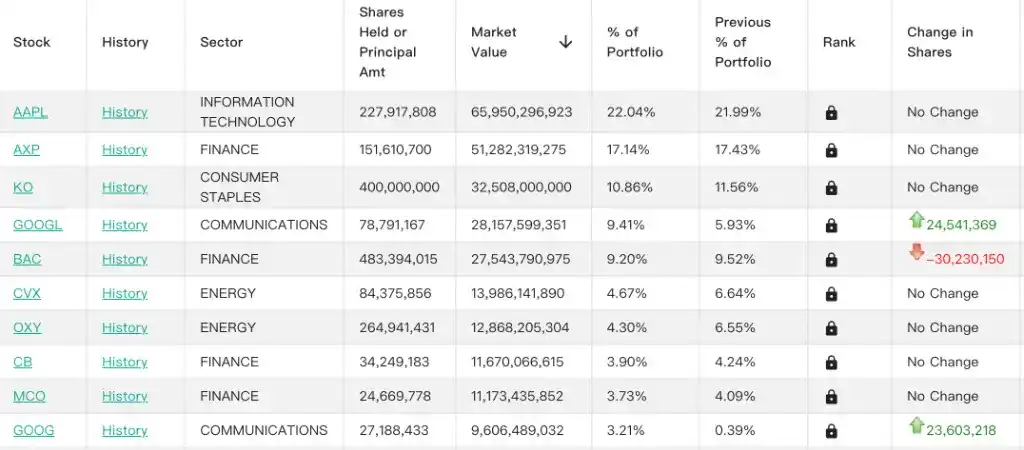
Apple remains Berkshire's largest holding, with a portfolio value of approximately $65.950 billion, accounting for about 22% of the 13F portfolio value. American Express ranks second with a value of approximately $51.282 billion, a 17.14% share. The combined Alphabet holds the third position. Coca-Cola and Bank of America rank fourth and fifth, respectively.

In the second quarter of this year, Berkshire continued to significantly increase its stake in Alphabet (Google's parent company). Berkshire added approximately 24.54 million shares of Alphabet-A, an increase of 45.24%, bringing the total holding to about 78.79 million shares valued at approximately $28.158 billion. It also added approximately 23.60 million shares of Alphabet-C, a staggering increase of 658.35%, bringing the total holding to about 27.19 million shares valued at approximately $9.606 billion.

This brings the combined value of Alphabet-A and Alphabet-C to approximately $37.764 billion at the end of Q2, representing about 12.62% of the 13F portfolio value, surpassing Coca-Cola to become Berkshire's third-largest holding after Apple and American Express on a consolidated basis.

Additionally, among the top ten holdings, the only stock that was reduced was Bank of America. In the quarter, Berkshire sold approximately 30.20 million shares (based on the period-end price, the reduction was about 30.23 million shares), a decrease of 5.89%, representing a reduction in value of approximately $1.72 billion. This made Bank of America the largest reduction for the quarter. At quarter-end, Berkshire still held 483 million shares of Bank of America valued at approximately $27.544 billion, accounting for 9.2% of the 13F portfolio value, making it the fifth-largest holding. Bank of America remains a significant investment for Berkshire but has now been reduced for two consecutive quarters.

Otherwise, Berkshire's holdings in the remaining top ten stocks remained unchanged in the second quarter.

Regarding other additions, in the second quarter of this year, Berkshire increased its stake in Delta Air Lines by approximately 17.51 million shares, an increase of about 44%, bringing the total holding to 57.32 million shares valued at approximately $5.369 billion. It added about 3.01 million shares of Lennar Corporation Class A, an increase of nearly 30%, and also added about 60,000 shares of Lennar Corporation Class B. Berkshire increased its stake in Macy's by approximately 4.31 million shares, a 141.82% increase. It slightly added about 550,000 shares of The New York Times Company.

The only new position initiated by Berkshire in the second quarter was D.R. Horton, with a small initiation of 3,564 shares worth approximately $580,000.

Regarding reductions, apart from Bank of America, Berkshire also reduced holdings in Ally Financial, Capital One Financial, kidney dialysis service provider DaVita, grocer Kroger, and steel manufacturer Nucor. The alcoholic beverage producer Constellation Brands, which was significantly reduced in the first quarter, was completely sold off by Berkshire in the second quarter.


Трендові криптовалюти

Пов'язані питання

QAccording to the 13F filing, which company became Berkshire Hathaway's third largest holding when Google's Class A and C shares are combined?

AAlphabet (Google's parent company) became Berkshire Hathaway's third largest holding, with a combined value of approximately $37.764 billion, surpassing Coca-Cola.

QWhat were the main categories of stocks that saw increased investment from Berkshire Hathaway in Q2 under Greg Abel's leadership?

AUnder Greg Abel's leadership, Berkshire Hathaway increased investments in technology (Alphabet), housing (Lennar, Horton), and airlines (Delta Air Lines).

QWhich stock was the largest reduction for Berkshire Hathaway in Q2 2024, and was this part of a trend?

ABank of America was the largest reduction, with approximately 30.23 million shares sold (worth about $1.72 billion). This was part of a trend, as it was the second consecutive quarter of减持.

QWhat was the total market value of Berkshire Hathaway's 13F stock portfolio at the end of Q2 2024, and how did it change from the previous quarter?

AThe total market value was approximately $299.3 billion at the end of Q2 2024, representing an increase of 12.09% from the approximately $263.1 billion at the end of Q1.

QWhich company did Berkshire Hathaway completely exit (sell its entire position in) during the second quarter of 2024?

ABerkshire Hathaway completely exited its position in Constellation Brands during the second quarter of 2024.

Пов'язані матеріали

Upbit is Anxious: A Hasty Counterattack Aimed at Regaining Stablecoin Market Share

Title: Upbit's Rushed Counterattack to Reclaim Stablecoin Market Share Facing a dramatic shift in South Korea's stablecoin market, leading exchange Upbit launched a promotional campaign from July 26 to August 9, waiving the 0.05% trading fee for stablecoins paired with the Korean Won (KRW) and rapidly listing new stablecoins like RLUSD and USDG. This move is a direct response to its plummeting market share in this sector. Historically a duopoly with Bithumb, the market has been reshaped since October 2025 when Coinone permanently removed fees for USDC trading. By June 2026, Coinone led with 34.8% of stablecoin volume, followed by Bithumb (31.1%) and Upbit (30.1%). This contrasts sharply with the overall crypto market, where Upbit commands 60%. The data shows stablecoin demand is highly sensitive to fees, as users primarily buy them to transfer capital overseas for derivatives trading or forex arbitrage. South Korean exchanges have seen a net outflow of stablecoins for 18 consecutive months, totaling approximately 14.9 trillion KRW, underscoring their role as a cross-border capital conduit. Upbit's limited-time promotion initially boosted its daily stablecoin volume by 162%, but the surge was almost entirely in USDT (98.1% of volume). The newly listed stablecoins saw negligible, fleeting interest. Furthermore, the promotional effect quickly waned in the second week, with volume dropping 33% on weekdays. A concurrent weakening of the KRW also contributed to the trading spike, independent of the fee waiver. The analysis suggests that once the promotion ends, Upbit is unlikely to retain its temporary gains unless it matches Coinone's permanent zero-fee policy, forcing a choice between market share and fee revenue. Upbit's strategic push may be less about immediate profit and more about preparing for future regulatory shifts. With South Korea's *Digital Asset Basic Act* on the horizon, which will regulate KRW-backed stablecoins, and following Dunamu's (Upbit's parent) integration into Naver Financial to build a payment ecosystem, securing a dominant position in the dollar stablecoin distribution channel holds long-term strategic value. However, potential regulatory conflicts could prevent Upbit from listing a future Naver-issued KRW stablecoin, making the current fight for dollar stablecoin flow even more critical.

marsbit8 хв тому

Upbit is Anxious: A Hasty Counterattack Aimed at Regaining Stablecoin Market Share

marsbit8 хв тому

Michael Saylor Compares Bitcoin and Gold!

Michael Saylor, founder of MicroStrategy, argues that Bitcoin fundamentally changes how wealth is stored and transferred by transforming digital scarcity into economic value. He describes Bitcoin as the first digital monetary network, combining computers, digital networks, and cryptography. It digitizes monetary assets, allowing their supply to be controlled by public protocols rather than institutions, thus converting economic value into information transmissible over global networks. Comparing Bitcoin to gold, Saylor states that while increasing Bitcoin's supply is harder, its integration with software and transfer is easier. He highlights Bitcoin's proof-of-work mechanism, which ties it to the physical world by consuming real energy to secure the ledger, making past transactions immutable. This creates a shared security system involving miners, energy companies, and investors. Saylor suggests "digital monetary energy" is a more accurate term than "digital gold." He emphasizes that the Bitcoin network is an adaptive ecosystem of miners, nodes, developers, and users. Its core design is intentionally simple, focused on maintaining a secure ledger for scarce digital assets, with complex functionalities built in higher-layer applications. This architecture allows Bitcoin to serve as a foundation for transmitting value and fostering innovation in payments and financial services. Saylor notes Bitcoin's deeper impact lies in creating digital sovereignty, where private keys give individuals permissionless control over their economic power, with ownership verified mathematically, not by institutions. He concludes that while gold's physical scarcity makes it money, Bitcoin's digital scarcity does the same, characterizing Bitcoin as the monetary energy of the digital age.

cryptonews.ru1 год тому

Michael Saylor Compares Bitcoin and Gold!

cryptonews.ru1 год тому

Торгівля

Спот

Популярні статті

Що таке $BANK

Bank AI: Революційний крок у майбутнє банківської справи Вступ В епоху, що характеризується швидкими технологічними змінами, Bank AI знаходиться на перетині штучного інтелекту (ШІ) та банківських послуг. Цей інноваційний проєкт прагне переосмислити фінансовий ландшафт, підвищуючи ефективність роботи, заходи безпеки та досвід клієнтів завдяки потужності ШІ. Розпочинаючи дослідження Bank AI, ми заглибимося в суть проєкту, його операційні динаміки, історичний контекст і значущі етапи. Що таке Bank AI? У своїй основі Bank AI представляє собою трансформаційну ініціативу, спрямовану на інтеграцію штучного інтелекту в різні банківські операції. Цей проєкт використовує можливості ШІ для автоматизації процесів, покращення протоколів управління ризиками та підвищення взаємодії з клієнтами через персоналізовані послуги. Основні цілі Bank AI включають: Автоматизація банківських функцій: Використовуючи технології ШІ, Bank AI прагне автоматизувати рутинні завдання, зменшуючи навантаження на людські ресурси та підвищуючи ефективність. Покращене управління ризиками: Проєкт використовує алгоритми ШІ для прогнозування та виявлення ризиків, тим самим зміцнюючи заходи безпеки проти шахрайства та інших загроз. Персоналізація банківських послуг: Bank AI зосереджується на пропозиції індивідуальних фінансових продуктів і послуг, аналізуючи дані і поведінку клієнтів. Покращення досвіду клієнтів: Впровадження рішень на основі ШІ, таких як чат-боти та віртуальні асистенти, має на меті забезпечити користувачам більш природну взаємодію, революціонізуючи спосіб, яким клієнти спілкуються з банками. З цими цілями Bank AI займає важливу роль в робленні банківської справи більш ефективною, безпечною та орієнтованою на користувача. Хто є творцем Bank AI? Деталі стосовно творця Bank AI залишаються невідомими. Таким чином, жодна конкретна особа або організація не були ідентифіковані в доступній інформації. Анонімність навколо створення проєкту піднімає питання, але це не зменшує його амбітного бачення та цілей. Хто є інвесторами Bank AI? Аналогічно творцеві проєкту, конкретна інформація стосовно інвесторів або організацій, що підтримують Bank AI, не була розкрито. Без цієї інформації важко окреслити фінансову підтримку та інституційну підтримку, які могли б сприяти розвитку проєкту. Тим не менше, важливість наявності міцної інвестиційної бази є вирішальною для забезпечення розвитку в такій інноваційній сфері. Як працює Bank AI? Bank AI функціонує на кількох інноваційних фронтах, фокусуючись на унікальних факторах, які відрізняють його від традиційних банківських структур. Нижче наведено ключові операційні характеристики: Автоматизація: Застосовуючи алгоритми машинного навчання, Bank AI автоматизує різні ручні процеси в банках. Це призводить до зниження операційних витрат і дозволяє працівникам перенаправити свої зусилля на більш стратегічні завдання. Покращене управління ризиками: Інтеграція ШІ в практики управління ризиками забезпечує банки інструментами для точного прогнозування потенційних загроз, таких як шахрайство, забезпечуючи при цьому безпеку інформації і активів клієнтів. Індивідуальні фінансові рекомендації: Завдяки безперервному навчанню з інтерaktionen з клієнтами, системи ШІ розвивають тонке розуміння потреб користувачів, що дозволяє їм пропонувати персоналізовані поради щодо фінансових рішень. Покращені взаємодії з клієнтами: Використовуючи чат-ботів і віртуальних асистентів на базі ШІ, Bank AI дозволяє створити більш залучений досвід для клієнтів, дозволяючи користувачам швидше отримувати відповіді на свої запитання, зменшуючи час очікування та підвищуючи рівень задоволеності. Разом ці операційні характеристики позиціонують Bank AI як піонера в банківському секторі, встановлюючи нові стандарти для надання послуг і операційної досконалості. Хронологія Bank AI Для розуміння траєкторії Bank AI необхідно ознайомитися з його історичним контекстом. Нижче наведено хронологію, що підкреслює важливі етапи та розробки: Ранні 2010-ті: Концептуалізація інтеграції ШІ в банківські послуги почала привертати увагу, коли банківські установи визнали потенційні переваги. 2018: Відбулося помітне збільшення впровадження технологій ШІ, коли банки почали використовувати інструменти ШІ, такі як чат-боти для базового обслуговування клієнтів та системи управління ризиками для покращення безпеки. 2023: Софістикація ШІ продовжувала розвиватися, з введенням генеративного ШІ для більш складних завдань, таких як обробка документів і аналіз інвестицій в реальному часі. Цей рік став важливим стрибком у можливостях, які забезпечує технологія ШІ для банків. 2024-актуальний статус: Станом на цей рік, Bank AI знаходиться на зростаючій траєкторії, з постійними дослідженнями та розробками, які готові подальше покращити можливості в банківських операціях. Продовження дослідження застосувань ШІ натякає на захоплюючі події, які ще попереду. Ключові моменти про Bank AI Інтеграція ШІ в банківську справу: Bank AI зосереджується на прийнятті штучного інтелекту для оптимізації банківських процесів та покращення досвіду користувачів. Автоматизація та фокус на управлінні ризиками: Проєкт сильного підкреслює ці сфери, прагнучи зshift тягар рутинних завдань, водночас підвищуючи безпеку через прогнозну аналітику. Персоналізовані банківські рішення: Завдяки використанню даних клієнтів, Bank AI забезпечує персоналізовані банківські послуги, що відповідають потребам окремих користувачів. Прихильність до розвитку: Bank AI залишається відданим постійним дослідженням і розробкам, що забезпечують його адаптацію та постійну актуальність у міру того, як технології продовжують розвиватися. Висновок Підсумовуючи, Bank AI є важливим кроком вперед у банківській індустрії, використовуючи штучний інтелект для переформатування операційних парадигм, підвищення безпеки та сприяння задоволеності клієнтів. Незважаючи на прогалини в інформації щодо творця та інвесторів, чіткі цілі і функціональні механізми Bank AI забезпечують міцну основу для його подальшої еволюції. Оскільки технологія ШІ продовжує розвиватися та інтегруватися в банківський сектор, Bank AI має всі шанси суттєво вплинути на майбутнє фінансових послуг, покращуючи спосіб, яким ми розуміємо та взаємодіємо з банківською справою.

303 переглядів усьогоОпубліковано 2024.04.06Оновлено 2024.12.03

Що таке $BANK

Як купити BANK

Ласкаво просимо до HTX.com! Ми зробили покупку Lorenzo Protocol (BANK) простою та зручною. Дотримуйтесь нашої покрокової інструкції, щоб розпочати свою криптовалютну подорож.Крок 1: Створіть обліковий запис на HTXВикористовуйте свою електронну пошту або номер телефону, щоб зареєструвати обліковий запис на HTX безплатно. Пройдіть безпроблемну реєстрацію й отримайте доступ до всіх функцій.ЗареєструватисьКрок 2: Перейдіть до розділу Купити крипту і виберіть спосіб оплатиКредитна/дебетова картка: використовуйте вашу картку Visa або Mastercard, щоб миттєво купити Lorenzo Protocol (BANK).Баланс: використовуйте кошти з балансу вашого рахунку HTX для безперешкодної торгівлі.Треті особи: ми додали популярні способи оплати, такі як Google Pay та Apple Pay, щоб підвищити зручність.P2P: Торгуйте безпосередньо з іншими користувачами на HTX.Позабіржова торгівля (OTC): ми пропонуємо індивідуальні послуги та конкурентні обмінні курси для трейдерів.Крок 3: Зберігайте свої Lorenzo Protocol (BANK)Після придбання Lorenzo Protocol (BANK) збережіть його у своєму обліковому записі на HTX. Крім того, ви можете відправити його в інше місце за допомогою блокчейн-переказу або використовувати його для торгівлі іншими криптовалютами.Крок 4: Торгівля Lorenzo Protocol (BANK)Легко торгуйте Lorenzo Protocol (BANK) на спотовому ринку HTX. Просто увійдіть до свого облікового запису, виберіть торгову пару, укладайте угоди та спостерігайте за ними в режимі реального часу. Ми пропонуємо зручний досвід як для початківців, так і для досвідчених трейдерів.

927 переглядів усьогоОпубліковано 2025.05.09Оновлено 2026.06.02

Як купити BANK

Обговорення

Ласкаво просимо до спільноти HTX. Тут ви можете бути в курсі останніх подій розвитку платформи та отримати доступ до професійної ринкової інформації. Нижче представлені думки користувачів щодо ціни BANK (BANK).

活动图片