# Пов'язані статті щодо Protest

Центр новин HTX надає останні статті та поглиблений аналіз на тему "Protest", що охоплює ринкові тренди, оновлення проєктів, технологічні розробки та регуляторну політику в криптоіндустрії.

70% of the Public Opposes AI, Americans Hope the U.S. Loses the AI War

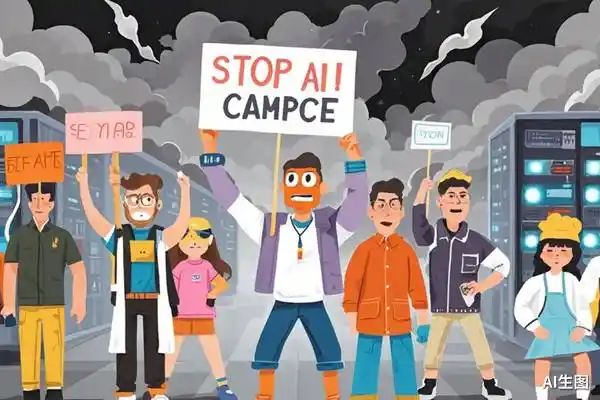
70% of Americans believe AI development is moving too fast, with growing public resistance evolving from online criticism to real-world protests and violence. This widespread anti-AI sentiment stems from fears of job losses, rising utility costs, environmental damage, threats to democracy, and financial instability. Key incidents illustrate the backlash: Google's former CEO Eric Schmidt was loudly booed at a graduation for promoting AI; AI company ads are vandalized; protests and even violent attacks target AI firms and data centers. Polls show deep public pessimism and strong local opposition to data center construction, often surpassing resistance to nuclear power plants. The core grievances are economic and practical: AI is seen as automating jobs, concentrating wealth, and increasing household electricity and water bills due to massive data center resource demands. Environmentalists also oppose AI's high energy use and carbon emissions. This opposition has turned AI into a major political issue in the US. While the Trump administration prioritizes AI innovation for global competition, bipartisan pushback is growing. Democrats and factions within the MAGA movement are forming temporary alliances to support stricter regulations and local bans on new data centers, pressuring the administration to choose between its tech industry backers and its voter base. The situation highlights a profound national divide over AI's future.

marsbit06/06 05:14

70% of the Public Opposes AI, Americans Hope the U.S. Loses the AI War

marsbit06/06 05:14

The Era Has Arrived Where Human Writers Must Prove They Are Not Machines

The article describes an era where AI-generated content is flooding the market, forcing human authors to prove they are not machines. It begins with the example of dozens of AI-written, error-ridden biographies of Henry Kissinger appearing on Amazon within hours of his death, a pattern repeated for other deceased celebrities and even living experts who find fraudulent books under their names. This spam content has exploded, with monthly new book releases on platforms like Amazon reaching 300,000 by late 2025. The issue spans genres, from suspiciously high proportions of AI-written teen romance and self-help books to dangerous, AI-generated foraging guides containing lethal advice. The platforms' automated review systems, designed to catch plagiarism and banned words, are ill-equipped to detect AI-generated text that avoids these pitfalls while being nonsensical or fraudulent. The problem has infiltrated traditional publishing. A major publisher, Hachette, had to recall a bestselling horror novel after AI detection tools suggested 78% of its content was machine-generated. An acclaimed European philosophy book was later revealed to be entirely written by AI under a fake author persona. In response, authors are fighting back. At the 2026 London Book Fair, 10,000 writers published a blank book titled "Don't Steal This Book" containing only their signatures—using emptiness as a protest weapon in an age of AI overproduction. Initiatives like the "Human Author Certification" program have emerged, ironically placing the burden on humans to prove their work is not machine-made. The article warns of a vicious cycle: AI-generated low-quality books pollute the data used to train future AI models, leading to "model collapse" and an ever-worsening flood of digital waste, eroding trust in publishing and devaluing human creativity.

marsbit05/11 11:48

The Era Has Arrived Where Human Writers Must Prove They Are Not Machines

marsbit05/11 11:48

The Person Building Robots for OpenAI Sees a Terrifying Future

Caitlin Kalinowski, head of hardware and robotics engineering at OpenAI, resigned in March 2026 in protest against the company's contract with the U.S. Department of Defense, which she believed could enable domestic surveillance and autonomous weapon applications. Her departure came shortly after OpenAI signed a deal allowing the Pentagon to use its AI models in classified networks—a contract that rival Anthropic had previously refused on ethical grounds. The announcement triggered a #QuitGPT movement, causing a 295% surge in ChatGPT uninstalls and boosting Anthropic’s Claude to the top of app stores. Under public pressure, CEO Sam Altman revised the contract to include wording against "intentional" use in domestic surveillance, though experts noted legal loopholes remained. Kalinowski’s role involved developing physical AI systems, making her particularly concerned about the potential militarization of embodied AI. Her resignation reflects broader internal dissent at OpenAI, where ethics and safety teams have seen a 37% attrition rate due to disagreements over military use and company values. The situation highlights a growing tension in Silicon Valley between commercial expansion and ethical boundaries. While Anthropic chose principle over partnership—and gained user trust—OpenAI’s acceptance of the contract signals a strategic shift that risks alienating talent and compromising transparency. Kalinowski’s exit poses a fundamental question to the industry: How far are builders willing to go in taking responsibility for what they create?

marsbit03/09 08:45

The Person Building Robots for OpenAI Sees a Terrifying Future

marsbit03/09 08:45

活动图片