# Пов'язані статті щодо Open Source

Центр новин HTX надає останні статті та поглиблений аналіз на тему "Open Source", що охоплює ринкові тренди, оновлення проєктів, технологічні розробки та регуляторну політику в криптоіндустрії.

Black Whale Emerges, DeepSeek's Second Half Begins

DeepSeek has unveiled its V4 Pro model and officially launched DeepSeek Harness, a developer-preview agent framework released as open-source under the MIT license. The article highlights that while model capabilities set the upper limit, the execution system (or "Harness") significantly determines real-world task success rates and cost efficiency, as demonstrated by tests where the same DeepSeek V4-Flash model performed differently across various harnesses. DeepSeek Harness is built on a "Everything is a plugin" philosophy using the Cordis system, allowing developers to modularly replace or extend core components like the model, tools, and UI without modifying the core code. It emphasizes full traceability with an append-only session log and is designed for stable, long-running tasks. Notably, it supports integration with nearly 40 external LLMs, including Kimi, OpenAI, and Anthropic, positioning itself not as a fixed agent but as a customizable platform. The release signals a strategic shift for DeepSeek from merely selling computational tokens (inference) to delivering actionable results (task completion). However, the v0.1 Harness faces challenges, including competing with established players like Claude Code, building a robust plugin ecosystem, and adapting to a potential "pay-for-result" business model. The article concludes that while both V4 Pro and Harness are early-stage with gaps to top models, DeepSeek's consistent direction is to make advanced AI capabilities affordable and operable within practical systems, with its long-term success now tied to the open-source community.

marsbit08/13 23:56

Black Whale Emerges, DeepSeek's Second Half Begins

marsbit08/13 23:56

Cryptocurrency Companies Urge AI Labs to 'Arm' Bitcoin Defenders with the Most Powerful Models

Over thirty Bitcoin and cryptocurrency companies have called on leading AI labs to provide open-source developers with early access to the most powerful cybersecurity models. In an open letter organized by the Bitcoin Policy Institute, signatories including Coinbase, Block, BitGo, Blockstream, ARK Invest, and Foundry argue that developers of critical financial infrastructure like Bitcoin Core are at a disadvantage, using less capable AI tools than potential attackers. They contend that the safety restrictions of public AI models can hinder legitimate vulnerability research. The letter requests that AI labs establish trusted access programs offering early model access, sufficient computing resources for audits, secure environments for private code analysis, and inclusion for small teams and independent developers. The signatories warn that the Bitcoin network secures over $1 trillion in assets, and infrastructure vulnerabilities pose significant risks. They cite recent incidents like the exploitation of a critical vulnerability in BTCPay Server and a major attack on Coldcard wallets, where a configuration error led to the theft of approximately 1,719 BTC ($111 million). The call comes amid a series of high-value crypto infrastructure attacks in 2026, including multimillion-dollar losses from protocols like Ostium, AFX, Summer.fi, and Bonzo Lend due to logic flaws and oracle manipulation. The companies believe advanced AI could strengthen defenses by analyzing large codebases, detecting atypical exploit scenarios, and helping developers identify issues before malicious actors can exploit them.

cryptonews.ru08/13 12:33

Cryptocurrency Companies Urge AI Labs to 'Arm' Bitcoin Defenders with the Most Powerful Models

cryptonews.ru08/13 12:33

Bitcoin Policy Institute Calls on AI Developers to Provide Crypto Infrastructure Defenders with Access to Advanced Models

The Bitcoin Policy Institute (BPI) has issued an open letter urging leading AI developers to grant trusted access to advanced AI models for defenders of critical crypto infrastructure. Analysts warn that sophisticated AI systems, capable of analyzing large codebases and finding vulnerabilities, could be leveraged by malicious actors before open-source defenders can use them, posing a significant risk to the trillion-dollar digital asset ecosystem. Vulnerable points include wallets, signing devices, cryptographic libraries, node software, exchanges, and payment networks. BPI highlights that developers of key open-source projects like Bitcoin Core currently lack access to the specialized cybersecurity programs and most powerful AI models available to leading AI labs and their partners. This creates a dangerous asymmetry. The institute calls on AI labs to establish or expand permanent trusted access programs, providing qualified developers and researchers with early, supervised access to cutting-edge models, sufficient computing resources for security audits, secure environments for analyzing sensitive code, and direct channels for vulnerability disclosure and coordinated fixes. The goal is to enable defenders to identify and patch security flaws before attackers can exploit them. BPI also urges the crypto industry to assist AI labs in identifying reliable participants for such access programs and coordinating response efforts.

cryptonews.ru08/12 12:14

Bitcoin Policy Institute Calls on AI Developers to Provide Crypto Infrastructure Defenders with Access to Advanced Models

cryptonews.ru08/12 12:14

OpenClaw Founder Peter Steinberg's Latest Speech: The Life and Death Revelation of an Open Source Project, How OpenClaw Emerged from the Eye of the Storm

Peter Steinberg, founder of the wildly popular open-source AI agent project OpenClaw, reflects on its turbulent journey from creation to near-collapse and resurgence. It began in late 2024 from his personal frustration with sending prompts from phone to computer. He built a WhatsApp relay that felt "magical," but initial excitement was limited to friends. After adding Discord support and launching a public server, the project exploded virally overnight, attracting massive attention, rebranding requests (from "Claudis" to OpenClaw), and even praise from NVIDIA's CEO. The intense scrutiny and pressure nearly broke Steinberg. The biggest technical crisis came from over-optimizing for a specific AI model provider, which suddenly canceled subscriptions, forcing a rushed shift to open-weight models. OpenClaw's weekly downloads plummeted before surging to a record high after being "declared dead." Steinberg realized he had stopped enjoying the build process and using his own product, making it a duty rather than a passion. His key lesson: "Fun is speed." Recovery came by refocusing on building for himself, forming a non-profit, and receiving crucial support (e.g., from NVIDIA for security). The team is now using OpenClaw to build OpenClaw itself, emphasizing its core value: a private, open alternative where "your agent, your machine, your life." He shares insights: the first user should be yourself; balance bug fixes with new features to maintain interest; the current bottleneck is reliable toolchains, especially for Mac testing. His story underscores that creation thrives on personal need, endures through storms when the joy of building returns, and persists by "living in the future and building what's missing."

marsbit08/12 09:07

OpenClaw Founder Peter Steinberg's Latest Speech: The Life and Death Revelation of an Open Source Project, How OpenClaw Emerged from the Eye of the Storm

marsbit08/12 09:07

Cache hit rate reaches 99.93%, the best Harness for DeepSeek is here, GitHub pulls in 86k Stars

The open-source programming agent "Pi" has surged in popularity on GitHub, amassing around 86,000 stars, largely due to its exceptional efficiency when paired with DeepSeek's models. A key highlight is its remarkably high cache hit rate of approximately 99.93% for input tokens when using DeepSeek. This minimal cache miss rate of 0.07% means most repeated context is reused, drastically reducing computational costs. In a benchmark test by Composio comparing eight major agent harnesses running DeepSeek V4 Flash, Pi achieved the lowest average cost per successful task at about $0.028, significantly outperforming others like Claude Code, which was nearly seven times more expensive. Pi functions as a streamlined "harness" or workspace for AI models, providing core tools like file read/write and command execution while allowing users to add extensions. Its simplicity and specific adaptation for DeepSeek's API—handling its unique reasoning content and tool call formats—make it highly compatible. This design maximizes the efficiency of DeepSeek's low-cost tokens and powerful caching mechanism, as the agent's linear workflow avoids unnecessary changes to earlier prompt sections. While DeepSeek has officially announced its own harness project targeting Claude Code, Pi remains a versatile, user-customizable platform supporting multiple AI providers. It offers developers a cost-effective and flexible alternative, setting a high bar for future official solutions.

marsbit08/11 01:11

Cache hit rate reaches 99.93%, the best Harness for DeepSeek is here, GitHub pulls in 86k Stars

marsbit08/11 01:11

OpenAI Researcher: We Don't Read Papers Anymore

An OpenAI researcher's remark that top AI labs "no longer read papers" sparked widespread discussion, highlighting a deepening crisis of trust in academic publishing. This sentiment followed exposure of questionable practices in an ICLR paper, where exceptional results were linked to undisclosed "tricks." A large-scale "experimental review" by SAI of 168 Oral papers from ICML 2026 revealed severe reproducibility issues. Of the 105 papers fully replicated, only 8 successfully verified over 80% of their claims, with a median verification rate of just 28-30%. Common problems included non-runnable code, missing files, incomplete documentation, and results mismatching those reported. Some papers even relied on now-offline models, making verification impossible. Specific cases involved an 8x inflation in claimed trained parameters and missing evaluation models from released code. Verifying a single ICML Oral paper had a median cost of around $8,900, with 17 exceeding $100,000. This creates a perverse incentive: flawed research carries high rewards (citations, jobs) with minimal risk of exposure, as verification is prohibitively expensive or impossible without code. While industry researchers at well-resourced labs may rely less on papers due to internal experiments and resources, academic and early-career researchers remain heavily dependent on publications for PhD applications, faculty positions, and entry into top labs. This creates a paradoxical system where papers are increasingly distrusted as reliable knowledge sources yet retain their gatekeeping value in career advancement. The situation underscores a critical need for systemic reforms to ensure scientific integrity and reproducibility in AI research.

marsbit08/09 23:31

OpenAI Researcher: We Don't Read Papers Anymore

marsbit08/09 23:31

Bitcoin 'Red Team' Uncovers 4,962 Vulnerabilities Following Coldcard Hack

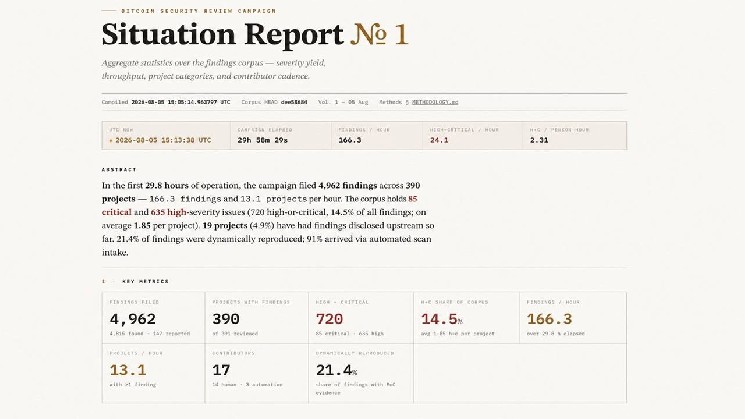
A security vulnerability in the Coldcard hardware wallet led to the theft of over 1,800 BTC (worth more than $116 million at the time) from long-term holders, stemming from a firmware bug first identified in March 2021. This incident prompted the formation of the volunteer 'Bitcoin Red Team,' led by developer Calle and Rob Hamilton, CEO of custody insurance firm Anchorwatch. The team conducted an emergency audit of the broader open-source Bitcoin ecosystem. Sixteen security researchers spent 27.5 hours analyzing 390 Bitcoin-related open-source repositories, combining AI-assisted analysis with manual review. They documented a total of 4,962 vulnerabilities, including 85 classified as critical and 635 as high severity. Funding was provided by the non-profit OpenSats. The team described the ecosystem's security state as "extremely poor," though only about one-fifth of the findings have been independently reproduced so far. The highest concentration of critical issues was found in privacy and coinjoin tools, accounting for 24% of critical finds. Cryptographic libraries had the highest absolute number of issues (1,101) but a lower proportion of high-severity ones. Most analyzed projects had few or no critical problems, with the real danger concentrated in a small group of tools handling private key generation, signing, and privacy-preserving transactions—the same category responsible for the original Coldcard failure. The audit is the first phase of an ongoing effort. The next steps involve verifying which vulnerabilities are actually exploitable and coordinating responsible disclosure with affected projects. For the self-custody community, the audit shows white-hat researchers are now scaling their efforts to match the pace of potential attackers.

cryptonews.ru08/07 13:40

Bitcoin 'Red Team' Uncovers 4,962 Vulnerabilities Following Coldcard Hack

cryptonews.ru08/07 13:40

活动图片