# Пов'язані статті щодо Investment Strategy

Центр новин HTX надає останні статті та поглиблений аналіз на тему "Investment Strategy", що охоплює ринкові тренди, оновлення проєктів, технологічні розробки та регуляторну політику в криптоіндустрії.


Podcast Notes | U.S. Stocks Hit Another Record High: Senior Fund Manager Nancy Tengler's Portfolio Picks for the Second Half of the Year

Podcast Summary: Veteran fund manager Nancy Tengler (CEO/CIO of Laffer Tengler Investments) discusses her investment outlook for the second half of the year, amidst the S&P 500 reaching new highs. She is bullish on the market, citing strong, productivity-driven earnings growth and the current economic transformation. Tengler emphasizes that this rally differs from the 1990s bubble, as fundamentals (earnings) and price appreciation have been aligned. She outlines four key investment themes: 1. **AI Infrastructure:** Companies like Quanta Services (PWR), GE Vernova (GEV), Williams (WMB), and Deere (DE) to benefit from massive capital expenditures ($7.5 trillion over five years) in data centers and electrification. 2. **Growth Stocks at Value Prices:** Names like Nvidia (NVDA) and Amazon (AMZN), which she views as undervalued based on forward earnings and growth rates (e.g., NVDA's PEG ratio of 0.25). 3. **Cybersecurity:** Prefers CrowdStrike (CRWD) over Palo Alto Networks (PANW) while acknowledging growing competition. 4. **Financials & Consumer Discretionary:** Sees catch-up potential in Goldman Sachs (GS), JPMorgan (JPM), Brookfield Asset Management (BAM), Starbucks (SBUX), and Home Depot (HD). She avoids sectors like consumer staples, utilities, and most REITs in this strong growth environment. Key risks are a potential credit market breakdown or a resurgence of inflation. Tengler believes market leadership will broaden beyond mega-cap tech and advises long-term investors to stay invested.

marsbitВчора 05:21

Podcast Notes | U.S. Stocks Hit Another Record High: Senior Fund Manager Nancy Tengler's Portfolio Picks for the Second Half of the Year

marsbitВчора 05:21

Why Every Investor Needs to Pay Attention to the Federal Reserve

Why Every Investor Should Follow the Federal Reserve Key developments on August 12, 2026, demonstrate how crucial the Fed is. Following the CPI report that matched expectations, markets instantly repriced stocks, bonds, and currencies, adjusting the probability of a September Fed rate hike. The Federal Reserve controls the federal funds rate, the anchor for all borrowing costs. Its "dual mandate" is to maintain stable prices and maximum employment. The current policy rate is 3.50%-3.75% after a series of cuts from 2024-2025. Understanding Fed actions is vital for your portfolio: - **Rate Hikes:** Slow the economy to fight inflation. They pressure growth/tech stocks (due to higher discount rates) and lower bond prices but can initially benefit banks. - **Rate Cuts:** Stimulate the economy. They typically boost growth stocks and bond prices while lowering borrowing costs for consumers and businesses. - **Holding Steady:** Still impactful. Current restrictive policy, with positive real interest rates, continues to weigh on the economy. Market-moving signals now come more from economic data than official guidance. A key change is new Fed Chair Kevin Warsh, who has reduced forward guidance, making each data release (CPI, PCE, jobs reports, GDP) more critical for predicting Fed moves. In this environment, investors should track key reports, compare data to market expectations, and understand what is already "priced in." The focus now is on the September 15-16 FOMC meeting. The August CPI (due Sep 11) and jobs report (Sep 5) will be decisive. Ultimately, interest rates are a powerful, continuous force on all assets. Learning to interpret the data that drives Fed policy is an essential skill for navigating today's markets.

marsbit2 дні тому 10:27

Why Every Investor Needs to Pay Attention to the Federal Reserve

marsbit2 дні тому 10:27

Strong Growth, Moderate Rate Hikes, Controllable Oil Prices: The Market is Pricing a Non-existent Perfection

The global market is currently pricing in a contradictory "Goldilocks" scenario of robust growth, limited interest rate hikes, manageable energy supply shocks, and declining oil prices. Deutsche Bank strategist Henry Allen warns this leaves little room for error regarding policy, inflation, or geopolitics. While U.S. equities hit record highs and credit spreads are tight, signaling strong growth, interest rate markets price in only minimal Fed tightening ahead, despite inflation remaining above target. This combination is difficult to sustain. Historically, starting inflation levels suggest a much more aggressive Fed hiking cycle than currently anticipated, as seen in 2022. Furthermore, oil price declines contradict ongoing supply risks, with the Strait of Hormuz still disrupted. Market expectations for future supply recovery and lower prices depend on resolutions not yet achieved. Energy volatility and potential new inflationary pressures from AI-driven demand highlight persistent inflation risks. The core risk is that the multiple optimistic assumptions underpinning current asset prices fail to materialize simultaneously. Strong growth with loose financial conditions could force more aggressive Fed action, while prolonged energy disruptions could undermine disinflation. Markets have priced a near-perfect outcome with minimal margin for deviation, meaning any single factor disappointing expectations could trigger a broad repricing of growth, rates, and risk assets.

marsbit08/12 05:06

Strong Growth, Moderate Rate Hikes, Controllable Oil Prices: The Market is Pricing a Non-existent Perfection

marsbit08/12 05:06

Opinion: Altcoins Might Still Have a Chance, but VC-Backed Coins Are Truly Hopeless

Author: Haotian. Through deep discussions with experienced on-chain investors, a consensus has emerged on survival strategies for the current market cycle: the focus has decisively shifted from "narratives and speculation" to "cash flow and tangible validation." Several key principles are outlined: 1) Prioritize assets with genuine value capture. In a bear market, sustainable protocol fees and a proven record of using them for token buybacks, burns, or dividends are essential. Examples include launchpad tokens like $UNI, $PUMP, $PONS, and the notable buyback token $HYPE. 2) Choose only projects with proven Product-Market Fit (PMF) and a complete operational loop. The next cycle's narratives, likely around "real-world asset tokenization" and the "Agentic Economy," will favor practical validation over technical roadmaps. Projects must demonstrate real users, transaction volume, and revenue. Examples such as $ONDO, $VVV, and $VIRTUAL will be evaluated on metrics like Assets Under Management (AUM) and fee generation. 3) Opt for assets with strong, organically developed "consensus." True consensus is market-driven and survives multiple cycles, not manufactured through marketing. Examples include enduring meme coins like $DOGE, $PEPE, $PEOPLE, or established sector leaders like $ZEC and $TAO, which benefit from resilient communities and sustained liquidity. 4) Avoid purely venture-capital (VC)-backed tokens. Unlike general altcoins which may cycle back, VC coins are seen as particularly problematic. Their typical high Fully Diluted Valuation (FDV), low circulating supply, and continuous large unlock schedules often lead to post-unlock sell pressure, especially if the project lacks inherent value capture. This dynamic is a key factor in the current cycle's restrained rallies and deep corrections, discouraging retail participation. *Note: This is a summary of personal discussions. Mentioned tokens are examples only, not investment advice.*

marsbit08/11 05:21

Opinion: Altcoins Might Still Have a Chance, but VC-Backed Coins Are Truly Hopeless

marsbit08/11 05:21

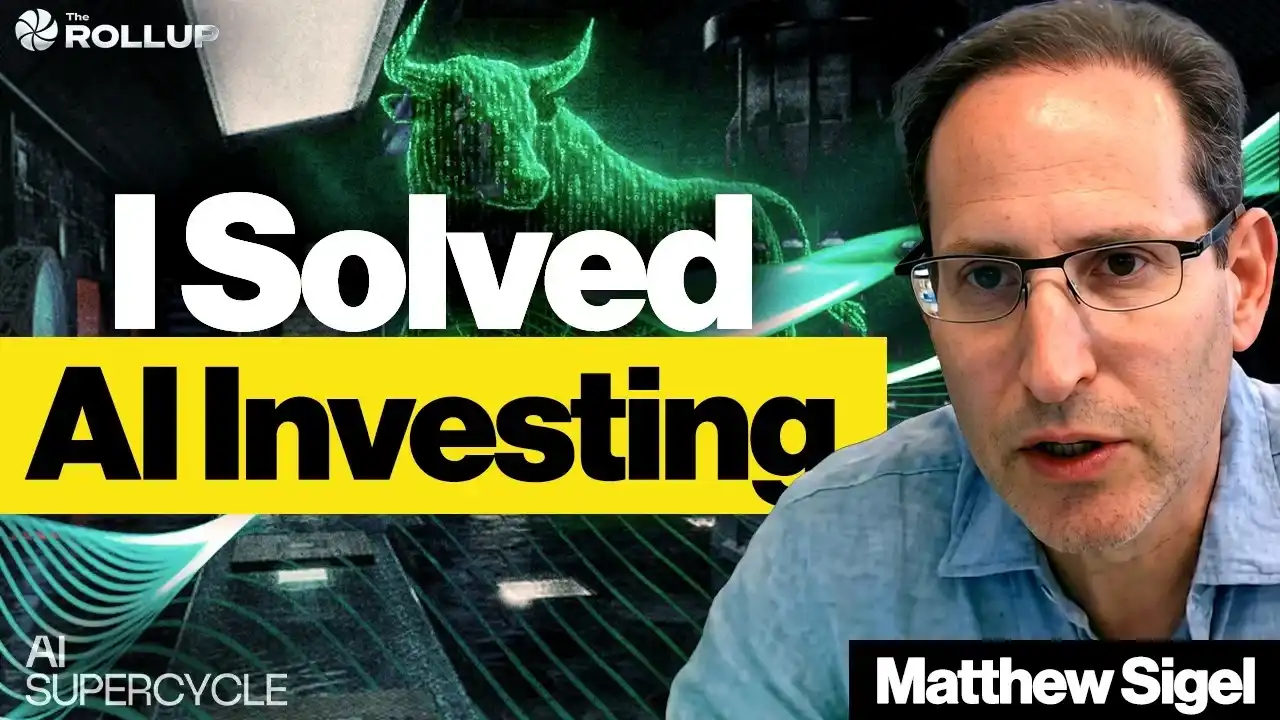
Podcast Notes | VanEck Digital Asset Research Head: Current AI Infrastructure Rally Not a Bubble; Crypto Market Quiet Due to Institutional Disappointment in L1s

In this podcast, VanEck's Head of Digital Asset Research Matthew Sigel discusses the current market dynamics. He argues the ongoing AI infrastructure boom is not a bubble, contrasting it with the 19th-century railroad mania. Unlike railroads funded by speculative land grants and government bonds, today's AI data centers are backed by long-term private contracts and significant customer prepayments, making the investment cycle more sustainable. Sigel notes a recent market shift: companies with high capital expenditures (capex) were rewarded in early 2024 but are now being punished. Cryptocurrencies, categorized as software assets, have suffered alongside the broader software sector. His NODE ETF has outperformed Bitcoin by nearly 100 percentage points over 15 months, largely by betting on Bitcoin miners transitioning into AI data centers. He highlights the value of miners' key assets—power and land—and their new ability to fund growth through debt instead of diluting shareholders. Regarding the crypto market's weakness, Sigel points to institutional disappointment with major Layer-1 (L1) blockchains like Ethereum and Solana. Post-election rallies lacked breakout applications, and regulated entities are increasingly building their own private, permissioned chains (e.g., by Circle, Stripe, Wells Fargo), diluting the "winner-takes-all" potential of public L1s. He believes a regulatory catalyst like the CLARITY Act, which would enforce disclosure standards, could trigger a significant relief rally for some tokens, but remains cautious until then. He also views proposals by ETH, Solana, and NEAR to reduce token inflation as a positive, necessary adjustment for the maturing sector.

marsbit08/11 04:11

Podcast Notes | VanEck Digital Asset Research Head: Current AI Infrastructure Rally Not a Bubble; Crypto Market Quiet Due to Institutional Disappointment in L1s

marsbit08/11 04:11

The S&P 500 Hits Another Record High, But Your Tech Stocks Are Still 'Unwinding'?

The S&P 500 reached a new all-time high on August 4, 2026, closing at 7,736.52 points. However, while major market indices like the Dow Jones also hit records, many prominent technology and semiconductor stocks, such as Nvidia, remained significantly below their recent peaks. This divergence highlights the crucial investing principle of diversification. The S&P 500 is a market-cap-weighted index comprising 500 large U.S. companies across eleven sectors. While Information Technology is the largest sector (~30% weight), the remaining ~70% is distributed across Financials, Healthcare, Industrials, and others. In June and July 2026, as tech and AI-related stocks faced sell-offs due to events like the CXMT IPO and concerns over AI capital returns, other sectors like Healthcare and Financials outperformed. This sector rotation allowed the broader S&P 500 index to advance even as the tech-heavy Nasdaq lagged. The article explains that true diversification means losses in one area (e.g., semiconductors) can be offset by gains in others (e.g., banks, hospitals). It also notes a current concentration risk: the top 10 S&P 500 companies now make up over 37% of the index's weight—a modern high—meaning a few giants like Nvidia, Apple, and Microsoft have an outsized influence. An alternative, the equal-weight S&P 500 (RSP), reduces this tech dominance and has outperformed the cap-weighted version year-to-date in 2026. The key takeaway is that a market index hitting new highs reflects the aggregate performance of its constituents, not every individual stock. For investors concentrated in tech stocks, their experience differs sharply from those holding a broad index fund. The recent market action serves as a practical lesson: diversification is not just a theory but a built-in mechanism that helps cushion a portfolio when specific sectors struggle.

marsbit08/06 09:51

The S&P 500 Hits Another Record High, But Your Tech Stocks Are Still 'Unwinding'?

marsbit08/06 09:51

活动图片