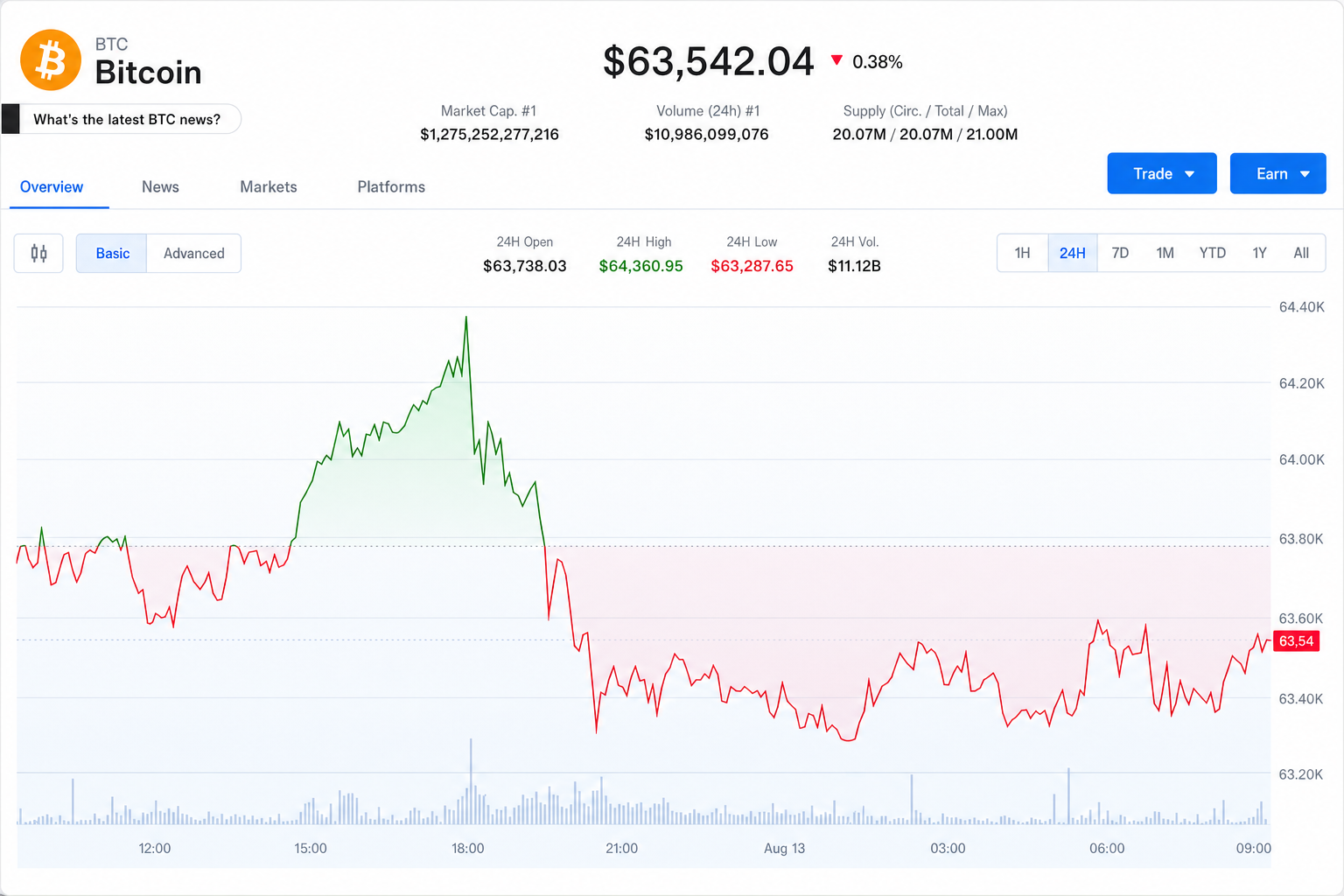
At the time of publication on Thursday, the price of bitcoin had fallen to around $63,500: Bitcoin lost more than 0.5% for the day and nearly 2% over the week, although the fresh US inflation report matched forecasts and alleviated some market tension.
In Short
- Bitcoin fell to around $63,500 following the expected US inflation report: the data calmed the market but did not provide a strong catalyst for cryptocurrencies to rally.
- July inflation matched forecasts, causing traders to reduce the probability they are pricing in for a Fed rate hike in September.
- Stock markets reacted more briskly than cryptocurrencies: the MSCI Asia Pacific index rose nearly 1%, while South Korea's Kospi gained about 4%.
Inflation Removed Risk But Didn't Spark a Rally
The July figures almost exactly matched economists' expectations. Overall inflation rose 0.1% for the month and 3.4% year-over-year. The core index, which excludes food and energy, added 0.2%, while the annual pace slowed to 2.5%.
This was enough to reduce fears of another rate hike. Following the data release, the futures market priced the probability of a September Fed move at approximately 38%, down from 46% before the statistics were published.
The asset reaction was subdued. Gold rose 1.3%, Ether added just over 1%, Bitcoin rose roughly half a percent after the data, and S&P 500 futures gained 0.2%. However, the crypto market failed to receive a sustained impulse.
At a practical level, this is visible in the BTC/USD pair: the Bitcoin Price is considered in terms of the United States dollar, so expectations for dollar interest rates are quickly reflected in quotes. For Cryptocurrency exchanges, including Coinbase, such periods become a test of Market liquidity: when there is no major surprise, Trade proceeds more cautiously, and the Market capitalization of the sector changes without a clear trend.
Altcoins Traded in Mixed Directions
Against the general backdrop, HYPE from Hyperliquid stood out: the token rose more than 3% to reach $56, though it remained almost unchanged for the week. Tron added slightly and traded just below 34 cents, maintaining a weekly gain of about 2%.
The picture for the largest coins looked as follows:
- Dogecoin: around 7 cents, down nearly 3% for the day.
- XRP: $1, down more than 1% for the day and nearly 5% for the week.
- BNB: $610, down more than 1% for the day.
- Solana: around $76, down less than 1% for the day.
- Ether: around $1,880, almost flat for the day.
In such conditions, cryptocurrency remains dependent not only on its own factors. The Bitcoin blockchain, mining, transaction authentication, and the network's role as a payment system do not change because of one CPI report, but the market's valuation of Bitcoin as an Asset depends on interest rates, liquidity, and risk appetite. In terms of Market (economics), this is a typical situation where a macro signal is more important than the internal dynamics of the Cryptocurrency sector.
Next Market Landmarks
Gabe Selby, Head of Research at CF Benchmarks, believes that Bitcoin reacts most strongly to inflation data when it forces the market to revise its interest rate expectations. According to his assessment, in three out of the last nine releases when inflation came in below forecasts, Bitcoin's average gain was 3.25%.
The market compensated for the negative surprise on July 14 with a 4.24% rally. Selby emphasizes: a report in line with expectations can remove the risk of a worst-case scenario, but a real move requires an unexpected factor.
A report that matches forecasts can remove tail risk. But to see a catalyst, the market needs a real surprise.
In Selby's view, the Fed can now afford a pause. Housing expenses rose only 0.1%, energy prices fell 1.5%, gasoline became cheaper by 2.9%, and part of the goods categories are now being compared to last year's price spikes caused by tariffs.
Upcoming events traders will be watching:
- The Jackson Hole central bankers' meeting at the end of the month.
- The Employment Report on September 4.
- The Consumer Price Index publication on September 11.
Stock Markets Reacted More Confidently
Stocks perceived the statistics noticeably better than cryptocurrencies. The MSCI Asia Pacific index rose nearly 1%, mainly thanks to Samsung Electronics and SK Hynix. South Korea's Kospi jumped almost 4%, entering a technical bull market, having gained 22% over ten days.
But the overall picture remained uneven. Cisco shares fell more than 4% in after-hours trading following weak financial results. Cerebras Systems stock lost 17% due to a decline in equipment sales.
Brent oil broke a six-day winning streak and retreated from levels where it had previously approached $90 per barrel. Pressure intensified after a statement by the advisor to the Islamic Revolutionary Guard Corps, General Mohammad Reza Naqdi, that Iran is preparing to conduct operations on US territory as part of a new military doctrine.
end-content