# Пов'язані статті щодо Intel

Центр новин HTX надає останні статті та поглиблений аналіз на тему "Intel", що охоплює ринкові тренди, оновлення проєктів, технологічні розробки та регуляторну політику в криптоіндустрії.

Intel Data Center Revenue Soars 59%, CEO Chan: CPU Demand 'Taking Off', Supply Can't Keep Up

Intel Reports Strong Q2 2026 Results, Led by Surging Data Center Revenue Intel demonstrated a robust recovery, posting second-quarter revenue of $16.1 billion, a 25% year-over-year increase—its highest growth rate since 2011. On a non-GAAP basis, net income was $2.2 billion, with earnings per share of $0.42, far exceeding analyst expectations. A key highlight was the performance of the Data Center and AI (DCAI) business, where revenue soared 59% to $6.3 billion, significantly outperforming overall company growth. CEO Patrick Gelsinger noted that "CPU demand is taking off" in the data center segment, with demand outpacing the company's growing supply capacity. This supply-demand dynamic has granted Intel renewed pricing power, with server CPU prices in China reportedly rising over 40% since the start of 2026. The company has secured ten long-term supply agreements with customers. The Client Computing Group (CCG), which includes PC chips, saw revenue grow 13% to $8.9 billion. Intel Foundry revenue grew 31% to $5.8 billion and achieved a milestone by signing its first named external customer, cybersecurity firm Fortinet. The company reported strong progress on its Intel 18A manufacturing process, with yields improving approximately 7% per month. To support future growth, Intel raised its full-year 2026 capital expenditure forecast from $18 billion to $20 billion, including a $5.7 billion investment to expand manufacturing capacity for its Xeon processors. For the third quarter, Intel provided optimistic guidance, projecting revenue between $15.8 billion and $16.8 billion and non-GAAP EPS of approximately $0.38, both above analyst estimates. Following the earnings release, Intel's stock rose about 11% in after-hours trading.

链捕手07/24 07:07

Intel Data Center Revenue Soars 59%, CEO Chan: CPU Demand 'Taking Off', Supply Can't Keep Up

链捕手07/24 07:07

Research Report Analysis: Is Intel Making a Comeback with Apple? Bernstein's Calculations Show the Right Direction, but the Price Is Already Overvalued

Bernstein analyst Stacy A. Rasgon published a report on June 18 regarding Intel, assessing the potential impact of recent political support for a US-based PC chip design and manufacturing collaboration between Apple and Intel. The report views this as a significant signal for the foundry landscape shift but concludes the initial financial contribution would be minimal. Key conclusions: 1) An Apple deal is seen as a small-scale "proof of concept." Even if Intel wins 40% of Apple's premium notebook chip orders (~5 million units/year), Bernstein estimates it would generate only about $500M in annual revenue and ~$0.03 EPS, negligible against Intel's ~$55B revenue. 2) Political encouragement is not equivalent to enforceable mandates. Winning orders ultimately depends on Intel demonstrating competitive technology (like its 18A node), cost, and reliable supply. 3) The path from validation to large-scale production involves significant challenges, capital investment, and time. Due to these uncertainties, Bernstein maintains a Market-Perform (Hold) rating with a $100 price target, implying potential downside from the ~$121.10 price at the report date. The analysis highlights the tension between near-term validation value—serving as a crucial trust signal for Intel's foundry ambitions and US supply chain resilience—and the long-term opportunity to attract larger cloud and AI chip customers. The investment thesis hinges on successful 18A execution and sustained policy support, not on immediate financial gains from Apple.

marsbit06/22 12:52

Research Report Analysis: Is Intel Making a Comeback with Apple? Bernstein's Calculations Show the Right Direction, but the Price Is Already Overvalued

marsbit06/22 12:52

CPU Makes a Comeback to the Table, A $170 Billion "Power Seizure" Drama Begins

A new era is dawning for the server CPU (Central Processing Unit), driven by the shift from AI model training to large-scale reasoning and the rise of Agentic AI. This article explores how the CPU is reclaiming a central role in the AI data center. For years, the focus has been on the GPU (Graphics Processing Unit) for AI training. However, as AI moves to the inference and Agent phase—where tasks involve complex, multi-step reasoning, tool calls, and data management—the workload balance is flipping. Studies show CPUs now handle over 70% of the workload in Agentic AI, up from 10-30% in training. This is because Agent tasks generate massive intermediate data (KV Cache) that exceeds GPU memory, forcing it to be offloaded to the CPU's larger, more scalable memory pools. This increased importance is translating into market changes. Major players are taking note: NVIDIA launched its first standalone CPU line, Vera, based on ARM architecture and optimized for Agent performance. AMD doubled its server CPU market forecast to over $1200 billion by 2030. Analyst reports project the total server CPU market could reach $1700 billion by 2030, with AI-driven demand being a primary driver. Furthermore, the classic ratio of CPUs to GPUs in AI servers is rapidly changing, converging from 1:8 toward 1:1 for Agent deployments. This surge in demand has led to a rare industry-wide price increase of 10-15% for server CPUs from Intel and AMD, breaking a decade-long trend of "more performance for the same price." Demand is bifurcating into high-core-count CPUs for in-rack GPU support and moderate-core CPUs for standalone Agent task orchestration. In China, this global trend presents an opportunity for domestic CPU manufacturers like Hygon (海光信息) and Huawei Kunpeng, who are bolstered by both growing AI infrastructure needs and national policies promoting technological self-reliance ("xin chuang"). The maturity of their software ecosystems is also accelerating, evidenced by faster adaptation to new AI models. In conclusion, the narrative is shifting from a GPU-centric view to one where CPU-GPU synergy is critical. The CPU is no longer a peripheral component but a performance-defining bottleneck and a key growth driver in the AI hardware stack, opening a massive new market estimated in the hundreds of billions of dollars.

marsbit06/19 13:41

CPU Makes a Comeback to the Table, A $170 Billion "Power Seizure" Drama Begins

marsbit06/19 13:41

Bernstein Report: Agentic AI Will Transform CPU from Supporting Role to Leading Role, Bullish on Hygon Information

Bernstein research report: Agentic AI will turn CPUs from supporting players to leading roles, bullish on Hygon Information. Analysts led by David Dai argue that AI is transitioning from the chatbot era to the agentic AI era. Unlike simple query-response models, agentic AI involves complex workflows including retrieval, planning, tool calling, and multi-step reasoning. This shift dramatically increases the demand for CPU compute to orchestrate these tasks, manage memory, and prevent expensive GPU idling. The report forecasts that the GPU-to-CPU ratio in inference clusters will reverse from 8:1 in 2025 to 1:1 by 2029. In agentic AI workloads, CPUs could account for 50% of the compute, on par with GPUs. Consequently, the server CPU Total Addressable Market (TAM) is projected to surge from $37 billion in 2025 to $223 billion by 2030, representing a 6x expansion. Arm is identified as a key beneficiary due to its superior performance-per-watt and a strategic shift from IP licensing to designing its own chips, targeting $15 billion in chip revenue by 2030. Bernstein raises Arm's price target to $500. For x86 vendors, the report is Overweight on AMD (target $600) and Hygon Information (target CNY 450), citing leadership and strong growth in the Chinese market respectively. Intel's target is raised to $100, reflecting upgraded earnings assumptions. The analysis acknowledges significant supply-side risks, questioning whether foundry and memory capacity can support such rapid CPU growth. The optimistic demand forecast also heavily relies on Nvidia's guidance for over $1 trillion in annual AI infrastructure spend by 2027.

marsbit06/17 09:46

Bernstein Report: Agentic AI Will Transform CPU from Supporting Role to Leading Role, Bullish on Hygon Information

marsbit06/17 09:46

It's Not Jensen Huang Who Wants to Change the PC, But the PC That's Revolting Against Itself

The 40-year-old PC industry is undergoing a fundamental transformation, driven by the rise of AI PCs. At the GTC Taipei 2026 event, NVIDIA, backed by Microsoft and major PC OEMs, announced the RTX Spark super chip for Windows PCs, marking its official entry into the PC core processor market. This move aims to redefine the AI PC by shifting its core from the CPU to an AI-focused SoC (System on Chip). NVIDIA envisions the PC evolving from a personal computer to a "personal AI"—a platform where local AI Agents can autonomously perform tasks. While Intel pioneered the AI PC concept earlier in 2026, NVIDIA's aggressive push, leveraging its vast CUDA developer ecosystem of 6 million, positions it to potentially reshape the industry's long-standing Wintel (Windows-Intel) power structure. NVIDIA's strategy extends beyond hardware; it's about embedding its CUDA, RTX, and AI software stack into the PC platform itself. The article identifies key shifts: 1) The move from a CPU-centric to an AI SoC-centric architecture, similar to Apple's approach with its M-series chips. 2) The PC's evolution from a human-operated tool to a platform for human-Agent collaboration. 3) The extension of NVIDIA's data center-centric CUDA ecosystem to personal devices via RTX Spark. Ultimately, the change is driven by the broader trend of AI moving to personal devices. Companies like Intel, AMD, Qualcomm, and Apple are all participating in this shift. NVIDIA's entry accelerates the competition, but the core driver is the technology itself finding its optimal expression in the PC. The industry is reinventing itself, with the outcome hinging on execution, ecosystem development, and the creation of compelling local AI applications.

marsbit06/12 11:14

It's Not Jensen Huang Who Wants to Change the PC, But the PC That's Revolting Against Itself

marsbit06/12 11:14

CPU, Quietly Returning to the Center of the AI Computing Power Stage

Over the past three years, AI computing power narratives have been dominated by GPUs. However, starting in 2026, this story began to shift. While training large models remains GPU-intensive, the rapid growth of inference and AI agent workloads, which require high levels of task orchestration, concurrency, and data flow management, has highlighted a renewed critical role for CPUs. These are tasks GPUs are not designed to handle. Intel's recent launch of the Xeon 6+ processor, built on its Intel 18A process and featuring up to 288 efficiency cores (E-cores), exemplifies this strategic pivot. It is positioned not as a mere companion to GPUs but as the essential "control plane" for AI infrastructure, optimized for high-density, energy-efficient, and high-throughput workloads characteristic of AI agents and inference. This "CPU resurgence" is not about CPUs outperforming GPUs in raw computation. It reflects a systemic bottleneck: as AI scales from training single models to deploying countless intelligent agents, the demand for coordination and data handling surges. Major cloud providers are also developing their own high-density ARM-based server CPUs for similar workloads. However, Intel's success with this strategy faces significant challenges. Competition includes NVIDIA's integrated CPU-GPU solutions, the expanding adoption of cloud vendors' in-house ARM CPUs, and the crucial market test of Intel's 18A manufacturing process against rivals like TSMC's N2. In conclusion, CPUs are indeed reclaiming a central, though redefined, role in AI compute—managing the complex orchestration that enables massive-scale AI deployment. While the trend is clear, which company will ultimately lead this CPU resurgence remains an open question to be decided in the data centers of 2027 and beyond.

marsbit06/03 10:42

CPU, Quietly Returning to the Center of the AI Computing Power Stage

marsbit06/03 10:42

Jensen Huang: Vera Rubin Full Mass Production, AI Agent a Key Focus, Challenging Intel to Target the Next-Generation AI PC Gateway

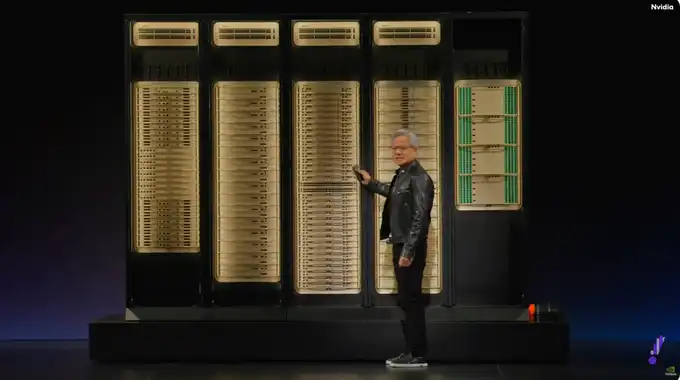
NVIDIA CEO Jensen Huang delivered the keynote speech at GTC Taipei 2026, announcing several major product launches and strategic directions. The company's Vera Rubin architecture is now in full-scale production, with OpenAI, Anthropic, and SpaceX among the first customers. NVIDIA highlighted AI Agent as a key future focus, introducing the Vera CPU designed for AI agents and the Vera BlueField-4 STX for secure, chip-level AI storage processing. A significant move involves challenging Intel in the PC market. NVIDIA, in collaboration with MediaTek, is developing the RTX SPARK PC chip (manufactured by TSMC) for Windows systems, set to launch this fall for laptops and desktops. This signals NVIDIA's push into the next-generation AI PC arena, aiming to provide a vertically integrated core computing platform for the entire Windows ecosystem, similar to Apple's approach. Other announcements include the new Nemotron 3 Ultra AI model and the NVIDIA DSX platform, described as a complete "playbook" for building AI factories, allowing performance simulation and validation before physical deployment. In automotive, the DRIVE Hyperion platform was positioned as a global robotaxi platform, with major Chinese automakers like BYD, Geely, Zeekr, Xiaomi, and Pony.ai already adopting or developing autonomous driving solutions based on it. The Alpamayo 2 super open inference model for robotaxis was also introduced. For robotics, NVIDIA unveiled the Isaac GR00T humanoid robot reference platform for academic research and a large open-source agent tools and skills suite for Physical AI. The company plans to collaborate with global humanoid robot manufacturers, including China's Unitree, whose H2 Plus robot served as the reference hardware for the GR00T platform demonstration.

marsbit06/01 06:14
Jensen Huang: Vera Rubin Full Mass Production, AI Agent a Key Focus, Challenging Intel to Target the Next-Generation AI PC Gateway

marsbit06/01 06:14

活动图片