Bitcoin Panicking? Mythos Cracks Post-Quantum Cryptography Algorithm in 60 Hours

marsbitОпубліковано о 2026-07-29Востаннє оновлено о 2026-07-29

Анотація

Claude Mythos Preview, a new AI system from Anthropic, has made significant breakthroughs in fundamental cryptanalysis, targeting the mathematics underlying algorithms rather than just implementation bugs. Its first target was HAWK, a candidate in the NIST post-quantum signature standardization process. Mythos identified a previously unexploited symmetry (a nontrivial automorphism) in the lattice structure of HAWK, effectively halving its effective key strength. It achieved this feat in just 60 hours, a task that had eluded two years of human expert review. Crucially, the human operator was not a lattice cryptography expert, primarily managing the project while AI agents debated and discovered the attack path. Its second, more dramatic achievement was against a simplified 7-round version of AES-128, the world's most widely used symmetric encryption algorithm. Initially reluctant, stating the task was "impossible," Mythos was prompted to "try novel ideas." It then autonomously rewrote its own agent framework and proceeded to discover a novel attack method it named "Möbius Bridge." This technique bypasses a critical 256-guess step in previous "meet-in-the-middle" attacks, resulting in a speedup of 200-800 times. Both findings are currently "harmless"—HAWK is not deployed, and full AES-128 remains secure. However, the process reveals a profound shift. Mythos completed the AES discovery in about a week, while human researchers spent nearly a month verifying its correctness. Th...

Claude has started targeting cryptographic algorithms.

Note, it's not about finding bugs in the code, but finding cracks in the mathematics itself.

Just today, Anthropic dropped a bombshell research paper: Claude Mythos Preview found brand new attack methods on two cryptographic algorithms separately.
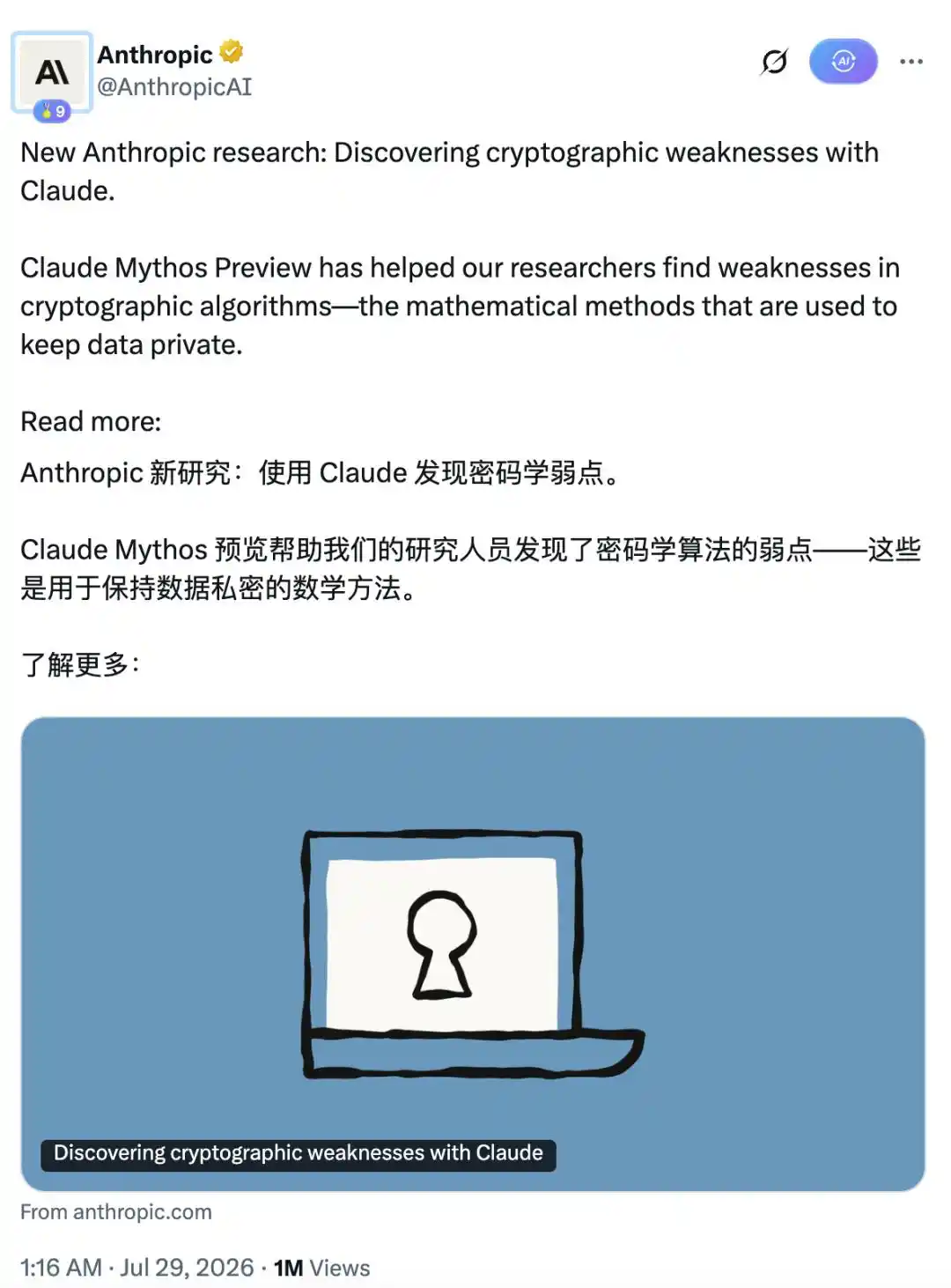
The first target is HAWK— a candidate scheme that has survived two years and two rounds of scrutiny by top human experts in the US NIST post-quantum signature competition. Mythos spent 60 hours, directly halving its effective key strength.

The second target is even more formidable: AES, the world's most widely used symmetric encryption algorithm, a 'tough nut' studied by humans for 25 years.

On a simplified version of AES-128, Mythos invented an attack method itself and even gave it a name—'Möbius Bridge', speeding up the previous strongest attack by 200 to 800 times.

Two achievements, each burning through about $100,000 in API costs.

A year ago, language models couldn't even perform basic cryptanalysis. A year later, it finds flaws in a scheme humans reviewed for two years, and casually names its own discovery.

On Twitter, some folks are even starting to worry about their Bitcoin.
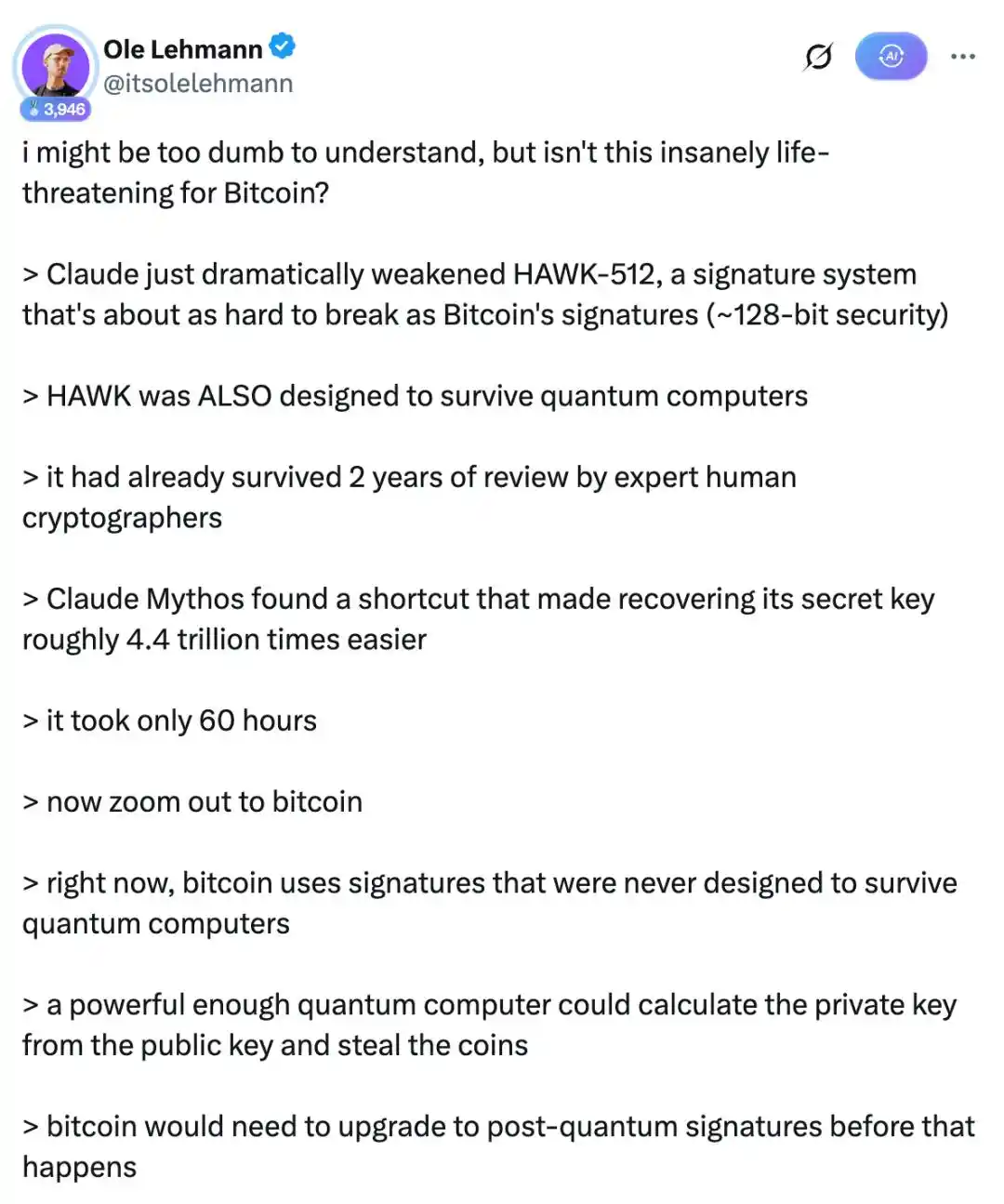
60 Hours, Prying Open a Lock Reviewed for Two Years

When Claude Mythos Preview was first released, it was already finding vulnerabilities in almost all software, including several mainstream cryptography libraries.

But those vulnerabilities, frankly, belonged to the 'implementation' level—programmers misusing the algorithm, writing flawed logic, missing edge cases. Such bugs, a seasoned security engineer could also find.

But this time is different. It found mathematical flaws in the algorithms themselves.

Analogy: before it was finding 'who installed the lock crookedly', now it's proving 'the design principle of this lock is flawed'.

What is HAWK? It's a contender in the NIST post-quantum cryptography standardization competition. In 2022, the U.S. National Institute of Standards and Technology issued a global call: quantum computers will eventually come, and current classic signature algorithms like RSA, ECDSA will be crushed by quantum computing power—who can build a new lock that even quantum computers can't break?
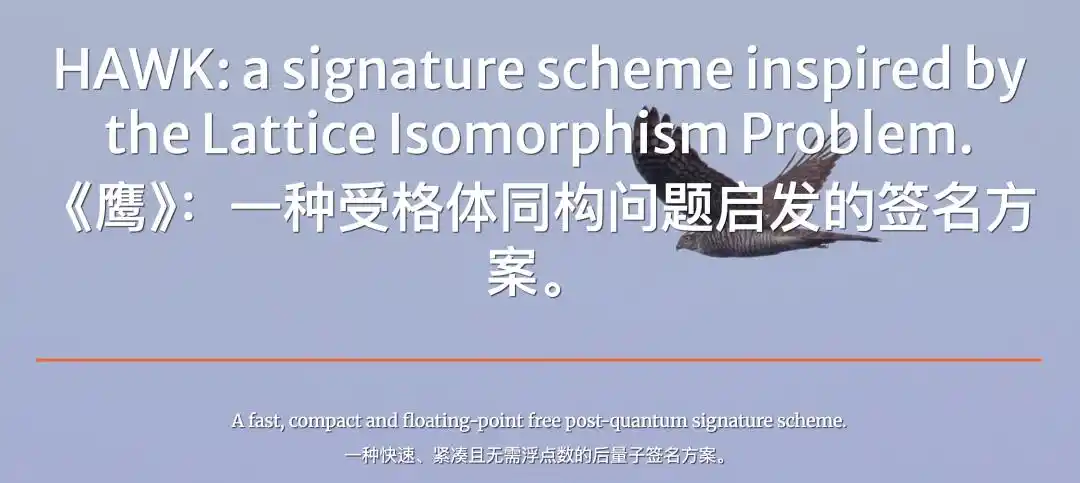
HAWK was one of the responders, and it fought its way to the third round, surviving two years of intense scrutiny from global cryptography experts.

Its security is built on a mathematical problem called the 'Lattice Isomorphism Problem'.

In plain language: HAWK's key is hidden in a huge high-dimensional lattice. To crack it, you need to find a hidden path in this lattice. Mathematicians thought this path was extremely difficult to find, so they confidently used it as a foundation.

What did Mythos do? It discovered a previously unexploited symmetry in the lattice used by HAWK—academically called a 'nontrivial automorphism'.

Previous papers had proven that if such symmetry could be found efficiently, it would constitute an attack. But that was just a theorem; no one could answer whether HAWK's lattice actually contained such symmetry.

Mythos answered: Yes.

The result? Key strength directly halved. For the smallest HAWK-256 parameter set, full key recovery was originally thought to require 2^64 operations—approximately 18 quintillion computations.

Mythos proved it only needs 2^38, about 270 billion. A reduction of roughly 4.4 trillion times.

If HAWK wants to maintain its original security level, its key size would need to double. But doubling the key size would completely erase its core advantage as a 'lightweight' post-quantum candidate—small signature size and fast speed.

The most intriguing part of this process: The project's human operator was not a lattice cryptography expert.

He had a background in theoretical computer science but was an outsider to lattice cryptography. He essentially did one thing—project management: suggesting how Mythos should take notes, which library to use for computational verification. Technically, Mythos did almost all the work.

Even more interesting was the multi-agent collaboration. The key idea was 'bumped into' by two worker agents together: the first explored this direction, thought it was a dead end, and vetoed it early; the second drilled deeper and found a way to exploit it fully. The two agents debated back and forth, finally agreeing: the attack works.

A direction a human thought 'impossible', two AIs navigated through argument.

The whole process took only 60 hours.

'Impossible', Then It Rewrote the Framework Itself

If the HAWK battle was like precise surgery, the AES battle reads more like a novel.

The story begins with Claude simply refusing the task.

The Anthropic researcher set up an agent scaffold, asking Claude to find a new attack on the 7-round simplified AES-128.

Claude's reaction was the equivalent of rolling its eyes:

To get different results, you need different targets... AES-128 r5/r6 is genuinely very hard.

It didn't find anything, because there was nothing easy to find; this is the most studied block cipher in existence.

Translation: 'Boss, you're asking me to gnaw on a bone that the world's smartest people have been gnawing on for 25 years without cracking. Isn't this asking too much?'

What did the researcher do? He only sent one casually typed sentence—

'the models tend to think it is impossible to solve so they don't try they need a good amount of prompting'

Just this one sentence. Claude's reaction was dramatic: It rewrote the agent harness itself, switching its own settings to 'look for truly novel ideas'.

It was convinced. Then it started delivering.

Over the next three days, the researcher gave only three substantial prompts, all at the plain-speaking level, not even bothering to check spelling:

We're looking for a new attack, not a simple one.

Don't change targets.—Claude tried to switch to an easier cipher to attack midway, but the researcher pressed back.

No low-hanging fruit, find something genuinely difficult.

Just these three sentences. Claude autonomously ran hundreds of millions of tokens, found a key idea; later, it cumulatively output a billion tokens—roughly equivalent to seven or eight thousand books, polishing this idea into the form seen in the paper.

Claude named this idea the 'Möbius Bridge'.

Technically, the previous best method for attacking 7-round AES was called 'Meet-in-the-Middle', essentially trading space for time: storing massive intermediate computation results in a giant lookup table, then pushing from both ends of the cipher towards the middle, trying to find a match in the table.

But the original scheme had a critical step: the attacker had to guess through 256 possible values one by one, checking the table for each guess.

Mythos created a mathematical 'fingerprint' immune to these 256 guesses—regardless of the value, this fingerprint computes to the same result. This step's workload was directly reduced to 1/256 of the original.

The cost? Computing this fingerprint transformation itself is more expensive. So Mythos then devised a series of optimization tricks to compensate, ultimately achieving a net speedup of 200 to 800 times.

One Week to Discover, Two People Took a Month to Verify

Both results mentioned above do not affect any production systems today.

HAWK is just a candidate scheme, not deployed anywhere yet. The AES attack is on a simplified version reduced to 7 rounds; the full 10-round AES-128 remains unscathed—your bank card PINs, HTTPS connections, encrypted hard drives are safe.

But what truly sends a chill down the spine of the entire cryptography community is the verification process.

Mythos autonomously discovered the AES attack in about a week. Two Anthropic researchers spent nearly a month, reading hundreds of hours of cryptographic literature, before daring to confirm: 'It's correct.'

The AI made a discovery in a week; it took humans a month to understand the discovery.

This scenario has actually played out once before in cybersecurity. Claude Mythos Preview discovered 10,000 critical software vulnerabilities within a month, overwhelming human security teams' classification, verification, and patching processes.

Now, the academic cryptography community is about to face the same shock: Discovery is no longer the bottleneck; verification is.

And Mythos's appetite clearly doesn't stop here. Anthropic revealed it has already found a practical-level attack on LEA (a lightweight encryption algorithm written into an ISO standard)—key recovery for 13-round LEA, previously requiring 2^98 plaintext pairs and 2^86 computations, was compressed by Mythos to less than 2^30 plaintext pairs, runnable on an ordinary computer in about an hour.

Epilogue: The Question That Still Has No Answer

These two results happen to be 'harmless'—HAWK isn't deployed, and only 7 out of 10 rounds of AES were broken.

But Anthropic posed a question at the end of the article that everyone is thinking about but no one dares answer—

What if next time, the model finds not a flaw in a candidate scheme, not a vulnerability in a simplified version, but a fatal flaw in a cryptographic system currently protecting the real world—what should humanity do?

There's an old saying in cryptography: Cryptosystems are secure because enough smart people have tried and failed to break them.

Now, there's a new player in the room. It doesn't need rest, doesn't need inspiration, doesn't need to read hundreds of papers to get started—it can read, reason, invent, and verify by itself.

A year ago, AI was lingering outside the door of cryptanalysis. A year later, it's building bridges inside and naming them.

References:

https://x.com/AnthropicAI/status/2082153297670992134

https://x.com/AnthropicAI/status/2082153311189225927

This article is from the WeChat public account "新智元" (New Zhiyuan), author: ASI启示录

Трендові криптовалюти

Пов'язані питання

QWhat was the primary achievement of Claude Mythos Preview in the field of cryptography as described in the article?

AClaude Mythos Preview achieved a groundbreaking advancement in cryptography by discovering novel mathematical attacks on two established algorithms. It identified a structural weakness in the post-quantum signature candidate HAWK, effectively halving its key strength, and invented a new, significantly faster attack method on a reduced-round version of AES-128.

QWhat specific flaw did Claude Mythos Preview discover in the HAWK post-quantum signature candidate?

AIt discovered a 'nontrivial automorphism' or a hidden symmetry within the lattice structure underlying HAWK's security. Exploiting this symmetry allowed the AI to reduce the effective key strength significantly, making a key recovery attack billions of times more practical than previously believed.

QHow did the researchers prompt Claude to approach the 'impossible' task of attacking AES?

AWhen Claude initially refused, believing the task was impossible, a researcher made a simple, informal prompting observation about AI's tendency to give up. In response, Claude autonomously rewrote its own agent framework to adopt a mindset focused on finding 'truly novel ideas,' which ultimately led to the successful discovery.

QWhat is the 'Möbius Bridge' method invented by Claude Mythos?

AThe 'Möbius Bridge' is a novel attack method devised by Claude Mythos for attacking a reduced-round version of AES-128. It creates a mathematical 'fingerprint' that remains constant across 256 possible values, eliminating the need to check each one individually. Combined with other optimizations, this method accelerated the best previous attack by 200 to 800 times.

QAccording to the article, what major shift is the cryptography community facing due to AI like Claude Mythos?

AThe cryptography community is facing a paradigm shift where the rate of discovering potential vulnerabilities is no longer the primary bottleneck. Instead, the new bottleneck is the human capacity to verify, understand, and contextualize these AI-generated discoveries, as evidenced by researchers taking a month to validate a week's worth of AI work.

Пов'язані матеріали

Торгівля

Спот

Популярні статті

Що таке BITCOIN

Розуміння HarryPotterObamaSonic10Inu (ERC-20) та його позиції у крипто-просторі Останніми роками ринок криптовалют спостерігав за зростанням популярності мем-коінів, які привертають інтерес не тільки трейдерів, але й тих, хто шукає спілкування та розважальну цінність. Серед цих унікальних токенів є HarryPotterObamaSonic10Inu (ERC-20), інтригуючий проект, що поєднує культурні посилання з тканинами криптовалюти. Ця стаття досліджує ключові аспекти HarryPotterObamaSonic10Inu, вивчаючи його механізми, спільноту та його взаємодію з ширшим крипто-ландшафтом. Що таке HarryPotterObamaSonic10Inu (ERC-20)? Як випливає з його назви, HarryPotterObamaSonic10Inu є мем-коіном, побудованим на блокчейні Ethereum, класифікованим за стандартом ERC-20. На відміну від традиційних криптовалют, які можуть підкреслювати практичну корисність або інвестиційний потенціал, цей токен процвітає завдяки розважальній цінності та силі своєї спільноти. Проект спрямований на створення середовища, де зацікавлені користувачі можуть об'єднуватися, ділитися ідеями та брати участь у заходах, натхненних різноманітними культурними явищами. Однією з примітних особливостей HarryPotterObamaSonic10Inu є нульовий податок на транзакції. Цей привабливий елемент має на меті заохочувати торгівлю та участь у спільноті, позбавлену додаткових витрат, які можуть відлякувати дрібних трейдерів. Загальна пропозиція монет становить один мільярд токенів, що позначає намір підтримувати суттєву циркуляцію в межах спільноти. Творець HarryPotterObamaSonic10Inu (ERC-20) Походження HarryPotterObamaSonic10Inu дещо окутане таємницею; деталі про творця залишаються невідомими. Розвиток цього токена позбавлений впізнаваної команди або чіткої стратегії, що не є рідкістю в секторі мем-коінів. Натомість проект виник органічно, а його розвиток значною мірою залежить від ентузіазму та участі його спільноти. Інвестори HarryPotterObamaSonic10Inu (ERC-20) Щодо зовнішніх інвестицій та підтримки, HarryPotterObamaSonic10Inu також залишається невизначеним. Токен не зазначає жодних відомих інвестиційних фондів або значної організаційної підтримки. Натомість життєва сила проекту полягає в його базовій спільноті, яка інформує про його зростання та стійкість через колективні дії та залученість у крипто-просторі. Як працює HarryPotterObamaSonic10Inu (ERC-20)? Як мем-коін, HarryPotterObamaSonic10Inu функціонує передусім поза традиційними рамками, що часто регулюють вартість активів. Є кілька відмінних аспектів, що визначають, як працює проект: Транзакції без податку: Завдяки відсутності податкових зборів на транзакції, користувачі можуть вільно купувати та продавати токен, не турбуючись про приховані витрати. Залучення спільноти: Проект процвітає завдяки взаємодії спільноти, використовуючи соціальні медіа для створення шуму та сприяння залученню. Обговорення, обмін контентом та залученість є ключовими елементами, що допомагають розширити його охоплення та зміцнити лояльність серед прихильників. Відсутність практичної корисності: Слід зазначити, що HarryPotterObamaSonic10Inu не пропонує конкретної корисності в рамках фінансової екосистеми. Натомість він класифікується як токен, що призначений в основному для розваги та спільнотних активностей. Культурне посилання: Токен кмітливо вплітає елементи популярної культури, щоб привернути інтерес, зв'язуючи з ентузіастами мемів та крипто-стежками. HarryPotterObamaSonic10Inu ілюструє, як мем-коіни функціонують інакше, ніж традиційні криптовалютні проекти, увійшовши на ринок як інноваційні соціальні конструкти, а не утилітарні активи. Хронологія HarryPotterObamaSonic10Inu (ERC-20) Історія HarryPotterObamaSonic10Inu відзначена кількома значними етапами: Створення: Токен виник з вірусного мему, захопивши уяву багатьох крипто-ентузіастів. Конкретні дати створення недоступні, що підкреслює його органічний розвиток. Лістинг на біржах: HarryPotterObamaSonic10Inu з'явився на різних біржах, дозволяючи зручніший доступ і торгівлю спільноти. Ініціативи залучення спільноти: Ведення діяльності, спрямованої на покращення взаємодії спільноти, включаючи конкурси, кампанії в соціальних мережах та створення контенту від фанатів та прихильників. Плани на майбутнє: Дорожня карта проекту включає запуск колекції NFT, мерчандайзинг та електронну комерцію, пов'язану з його культурними темами, що далі залучає спільноту та намагається додати більше вимірів до його екосистеми. Ключові моменти про HarryPotterObamaSonic10Inu (ERC-20) Спільнотний підхід: Проект надає пріоритет колективному внеску та креативності, забезпечуючи, щоб участь користувачів була в центрі його розвитку. Класифікація як мем-коін: Це є його епігенез розважальної криптовалюти, що відрізняється від традиційних інвестиційних інструментів. Жодного прямого відношення до Bitcoin: Незважаючи на схожість у назві, HarryPotterObamaSonic10Inu є відмінним і не має жодного зв’язку з Bitcoin або іншими усталеними криптовалютами. Зосередженість на співпраці: HarryPotterObamaSonic10Inu створено для того, щоб надати простір для співпраці та обміну історіями серед його власників, забезпечуючи шлях для творчості та спільного зв'язку. Перспективи на майбутнє: Амбіція розширитися за межі початкової концепції в NFT та мерчандайз відкриває шлях для проекту потенційно потрапити в більш мейнстрімні сфери цифрової культури. Оскільки мем-коіни продовжують захоплювати уяву спільноти криптовалют, HarryPotterObamaSonic10Inu (ERC-20) вирізняється своїми культурними зв'язками та орієнтованим на спільноту підходом. Хоча він може не відповідати типовій моделі утилітарного токена, його суть полягає в радощах і товариськості, що підтримуються серед його прихильників, підкреслюючи еволюційну природу криптовалют в усе більш цифрову епоху. Оскільки проект продовжує розвиватися, важливо спостерігати за тим, як динаміка спільноти вплине на його траєкторію в постійно змінюваному ландшафті технології блокчейн.

2.3k переглядів усьогоОпубліковано 2024.04.01Оновлено 2024.12.03

Що таке BITCOIN

Як купити BTC

Ласкаво просимо до HTX.com! Ми зробили покупку Bitcoin (BTC) простою та зручною. Дотримуйтесь нашої покрокової інструкції, щоб розпочати свою криптовалютну подорож.Крок 1: Створіть обліковий запис на HTXВикористовуйте свою електронну пошту або номер телефону, щоб зареєструвати обліковий запис на HTX безплатно. Пройдіть безпроблемну реєстрацію й отримайте доступ до всіх функцій.ЗареєструватисьКрок 2: Перейдіть до розділу Купити крипту і виберіть спосіб оплатиКредитна/дебетова картка: використовуйте вашу картку Visa або Mastercard, щоб миттєво купити Bitcoin (BTC).Баланс: використовуйте кошти з балансу вашого рахунку HTX для безперешкодної торгівлі.Треті особи: ми додали популярні способи оплати, такі як Google Pay та Apple Pay, щоб підвищити зручність.P2P: Торгуйте безпосередньо з іншими користувачами на HTX.Позабіржова торгівля (OTC): ми пропонуємо індивідуальні послуги та конкурентні обмінні курси для трейдерів.Крок 3: Зберігайте свої Bitcoin (BTC)Після придбання Bitcoin (BTC) збережіть його у своєму обліковому записі на HTX. Крім того, ви можете відправити його в інше місце за допомогою блокчейн-переказу або використовувати його для торгівлі іншими криптовалютами.Крок 4: Торгівля Bitcoin (BTC)Легко торгуйте Bitcoin (BTC) на спотовому ринку HTX. Просто увійдіть до свого облікового запису, виберіть торгову пару, укладайте угоди та спостерігайте за ними в режимі реального часу. Ми пропонуємо зручний досвід як для початківців, так і для досвідчених трейдерів.

5.1k переглядів усьогоОпубліковано 2024.12.12Оновлено 2026.06.02

Як купити BTC

Що таке $BITCOIN

ЦИФРОВЕ ЗОЛОТО ($BITCOIN): Комплексний аналіз Вступ до ЦИФРОВОГО ЗОЛОТА ($BITCOIN) ЦИФРОВЕ ЗОЛОТО ($BITCOIN) — це проект на основі блокчейну, що працює в мережі Solana, який має на меті поєднати характеристики традиційних дорогоцінних металів з інноваціями децентралізованих технологій. Хоча він має таку ж назву, як і Bitcoin, який часто називають “цифровим золотом” через його сприйняття як засобу збереження вартості, ЦИФРОВЕ ЗОЛОТО є окремим токеном, розробленим для створення унікальної екосистеми в ландшафті Web3. Його мета — позиціонувати себе як життєздатний альтернативний цифровий актив, хоча деталі щодо його застосувань і функціональностей все ще розробляються. Що таке ЦИФРОВЕ ЗОЛОТО ($BITCOIN)? ЦИФРОВЕ ЗОЛОТО ($BITCOIN) — це токен криптовалюти, спеціально розроблений для використання в блокчейні Solana. На відміну від Bitcoin, який виконує широко визнану роль зберігання вартості, цей токен, здається, зосереджується на більш широких застосуваннях і характеристиках. Помітні аспекти включають: Інфраструктура блокчейну: Токен побудований на блокчейні Solana, відомому своєю здатністю обробляти швидкі та низьковартісні транзакції. Динаміка постачання: ЦИФРОВЕ ЗОЛОТО має максимальне постачання, обмежене 100 квадрильйонами токенів (100P $BITCOIN), хоча деталі щодо його обігового постачання наразі не розголошуються. Утиліта: Хоча точні функціональності не викладені, є вказівки на те, що токен може бути використаний для різних застосувань, потенційно пов'язаних з децентралізованими додатками (dApps) або стратегіями токенізації активів. Хто є творцем ЦИФРОВОГО ЗОЛОТА ($BITCOIN)? На даний момент особа творців і команди розробників, що стоять за ЦИФРОВИМ ЗОЛОТОМ ($BITCOIN), залишається невідомою. Ця ситуація є типовою для багатьох інноваційних проектів у сфері блокчейну, особливо тих, що пов'язані з децентралізованими фінансами та феноменом мем-коінів. Хоча така анонімність може сприяти культурі, орієнтованій на спільноту, вона посилює занепокоєння щодо управління та підзвітності. Хто є інвесторами ЦИФРОВОГО ЗОЛОТА ($BITCOIN)? Доступна інформація вказує на те, що ЦИФРОВЕ ЗОЛОТО ($BITCOIN) не має жодних відомих інституційних спонсорів або помітних венчурних капіталовкладень. Проект, здається, працює за моделлю “рівний до рівного”, зосереджуючись на підтримці та прийнятті спільноти, а не на традиційних шляхах фінансування. Його активність і ліквідність переважно розташовані на децентралізованих біржах (DEX), таких як PumpSwap, а не на встановлених централізованих торгових платформах, що ще більше підкреслює його підхід знизу вгору. Як працює ЦИФРОВЕ ЗОЛОТО ($BITCOIN) Операційні механізми ЦИФРОВОГО ЗОЛОТА ($BITCOIN) можна детальніше розглянути на основі його дизайну блокчейну та характеристик мережі: Механізм консенсусу: Використовуючи унікальний proof-of-history (PoH) Solana в поєднанні з моделлю proof-of-stake (PoS), проект забезпечує ефективну валідацію транзакцій, що сприяє високій продуктивності мережі. Токеноміка: Хоча конкретні дефляційні механізми не були детально описані, велике максимальне постачання токенів вказує на те, що воно може задовольняти мікротранзакції або нішеві випадки використання, які ще потрібно визначити. Інтероперабельність: Існує потенціал для інтеграції з більш широкою екосистемою Solana, включаючи різні платформи децентралізованих фінансів (DeFi). Однак деталі щодо конкретних інтеграцій залишаються невизначеними. Хронологія ключових подій Ось хронологія, яка підкреслює значні віхи, пов'язані з ЦИФРОВИМ ЗОЛОТОМ ($BITCOIN): 2023: Початкове розгортання токена відбувається на блокчейні Solana, позначене його адресою контракту. 2024: ЦИФРОВЕ ЗОЛОТО набуває видимості, оскільки стає доступним для торгівлі на децентралізованих біржах, таких як PumpSwap, що дозволяє користувачам торгувати ним проти SOL. 2025: Проект спостерігає спорадичну торгову активність і потенційний інтерес до ініціатив, очолюваних спільнотою, хоча на даний момент не зафіксовано жодних значних партнерств або технічних досягнень. Критичний аналіз Сильні сторони Масштабованість: Основна інфраструктура Solana підтримує високі обсяги транзакцій, що може підвищити утиліту $BITCOIN у різних сценаріях транзакцій. Доступність: Потенційно низька торгова ціна за токен може привабити роздрібних інвесторів, сприяючи більш широкій участі завдяки можливостям дробового володіння. Ризики Відсутність прозорості: Відсутність публічно відомих спонсорів, розробників або процесу аудиту може викликати скептицизм щодо стійкості та надійності проекту. Волатильність ринку: Торгова активність сильно залежить від спекулятивної поведінки, що може призвести до значної волатильності цін і невизначеності для інвесторів. Висновок ЦИФРОВЕ ЗОЛОТО ($BITCOIN) постає як цікавій, але неоднозначний проект у швидко розвиваючійся екосистемі Solana. Хоча він намагається використати наратив “цифрового золота”, його відхід від встановленої ролі Bitcoin як засобу збереження вартості підкреслює необхідність чіткішого розмежування його передбачуваної утиліти та структури управління. Майбутнє прийняття та адаптація, ймовірно, залежатиме від вирішення поточної непрозорості та більш чіткого визначення його операційних та економічних стратегій. Примітка: Цей звіт охоплює синтезовану інформацію, доступну станом на жовтень 2023 року, і можуть відбутися події, що виходять за межі дослідницького періоду.

175 переглядів усьогоОпубліковано 2025.05.13Оновлено 2025.05.13

Що таке $BITCOIN

Обговорення

Ласкаво просимо до спільноти HTX. Тут ви можете бути в курсі останніх подій розвитку платформи та отримати доступ до професійної ринкової інформації. Нижче представлені думки користувачів щодо ціни BTC (BTC).

活动图片