# Пов'язані статті щодо Design

Центр новин HTX надає останні статті та поглиблений аналіз на тему "Design", що охоплює ринкові тренди, оновлення проєктів, технологічні розробки та регуляторну політику в криптоіндустрії.

This Might Be the Most Stunning Image at This Year's WAIC!

This article introduces Shangtang's newly released multimodal AI model, **SenseNova U1 Pro**, unveiled at WAIC 2026. The model is highlighted for its ability to generate **native 8K-resolution images** with exceptional detail and coherence, even in extremely wide-format compositions. It goes beyond simple image generation by employing a **"图文交错思维" (interleaved image-text reasoning)** workflow, where it can plan, sketch, refine, check, and correct its outputs to achieve a final, deliverable result. Key capabilities demonstrated include generating a long 8K scroll depicting the 9-year history of WAIC, a detailed 24 solar terms illustration, a complex academic poster, a琉璃 (colored glaze)-style landscape, and a ready-to-use movie poster. The model handles intricate prompts involving layout, text clarity, material textures, and stylistic consistency. The article draws a parallel between this evolution in image generation and the progression seen in AI coding—from simple code completion to autonomous project delivery. U1 Pro represents a shift from generating single images to providing **complete content delivery systems** for professional scenarios like infographics, urban planning, and commercial design. While challenges like generation time and professional workflow integration remain, the model signifies a move towards multimodal AI agents that are accountable for producing usable, high-quality outputs.

marsbit07/19 02:39

This Might Be the Most Stunning Image at This Year's WAIC!

marsbit07/19 02:39

Why Did Codex and ChatGPT Merge? What's Next for Codex? OpenAI Core Leader Answers Everything

In 2026, OpenAI's Codex saw explosive growth, with weekly active users surging over 5x to 5 million since January, driven largely by the February launch of its desktop app. Codex desktop lead Andrew Ambrosino explains key shifts behind its evolution. A core change is the inversion of development costs: implementation is now cheap, while curation and taste—judging which of many AI-generated prototypes is valuable—have become the new scarcities. Ambrosino defines taste as a blend of aesthetics, systems thinking, direction, and semantic coherence in interaction. He notes AI still struggles with design because evaluating it requires human cultural context and abstract reasoning about how components relate—capabilities beyond current models. Timing is critical: the same Codex app would have failed months earlier; success hinges on the model's capabilities at launch. Roles are blurring within his team, with engineers, designers, and PMs overlapping significantly. However, Ambrosino cautions against eliminating specialized roles entirely, as each field retains deep expertise. On AI-assisted development, the focus has shifted from measuring code written by AI to distinguishing between supervised and unsupervised generation. A current challenge is teaching models to simplify code, not just add complexity. The merger of Codex and ChatGPT stems from observed user behavior: non-developers adopted Codex for general knowledge work despite its developer-centric interface. This revealed a collapsing boundary between specialized tools and universal assistants. The vision is a "home base" that orchestrates tasks across external professional tools (like Excel or Premiere Pro) via connectors, rather than rebuilding everything internally. An internal example showed Codex helping edit video by interacting with Premiere Pro's files and even writing a plugin for it. The future direction is a unified, extensible platform that serves as a central hub for automating and managing work across any specialized tool the user employs.

marsbit07/05 05:26

Why Did Codex and ChatGPT Merge? What's Next for Codex? OpenAI Core Leader Answers Everything

marsbit07/05 05:26

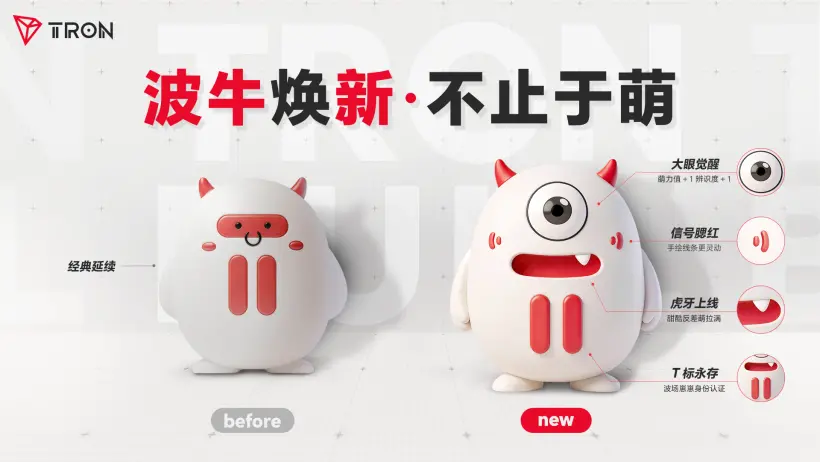
TRON Refreshes the Bull Image, Creating a More Approachable Brand Character

TRON's official mascot "BONiu" (Wave Bull) has received a comprehensive visual upgrade. Retaining its core red-and-white color scheme, horned silhouette, and brand DNA, the refreshed character features larger, brighter eyes, more expressive facial details including a mouth with a small fang, and enhanced emotive capabilities. The redesign aims to strengthen the mascot's亲和力, emotional expressiveness, and adaptability across various scenarios. Key updates include a clearer facial structure for instant recognition, a simplified and more intuitive五官 design, and the integration of subtle brand language. The cheek blushes are now inspired by a "signal" icon, while the smile and chest lines form a stable "T" structure, creating a cohesive超级符号 for the brand. The character has also been equipped with a 12-phoneme lip-sync system to support future动画 and interactive content. Beyond its visual role, BONiu's persona has been enriched. Now titled "TRON's Chief Luck Officer," it carries playful personality tags like "foodie enthusiast" and "full-of-tricks," allowing it to engage with the community in a more approachable and relatable manner. This update provides a lower-barrier, emotionally warm entry point for users amidst the often technical and abstract narratives of Web3. This mascot revamp is part of TRON's ongoing effort to refine its visual asset system, following the earlier logo update. By evolving from a static visual into a dynamic, expressive brand角色, the new BONiu is positioned to become a key asset for connecting with users, building brand记忆, and conveying TRON's personality across社交传播, community互动,线下活动, and merchandise.

链捕手06/23 06:30

TRON Refreshes the Bull Image, Creating a More Approachable Brand Character

链捕手06/23 06:30

How Difficult is Chip Making? A Division Error Costs 475 Million Dollars

How Hard Is It to Make a Chip? A Division Error Cost $475 Million Chip expert Shi Kan, a researcher at the Chinese Academy of Sciences and a popular tech creator, explains the immense challenges of chip development. Chips are foundational to modern technology, but their creation is extraordinarily difficult. The journey from sand to a functional chip involves complex design and manufacturing, but a critical bottleneck is verification—ensuring the design works flawlessly before costly production. A single, undetected bug can have catastrophic consequences, as illustrated by the infamous 1994 Intel Pentium FDIV bug. A flaw in the floating-point division unit forced a recall costing $475 million. Unlike software, chips cannot be easily patched after manufacture, making "first-time success" paramount. However, industry surveys show only 24% of chip projects achieve this; over three-quarters require at least one costly re-spin due to design flaws. Verification has thus become the dominant phase, consuming up to 70% of the design cycle. The core challenge is a "verification impossible triangle" between high performance, good debuggability, and low cost. Exhaustively verifying a modern CPU core could take 15,000 years with software simulation, or 30 years with advanced hardware emulation—timeframes utterly impractical for development. Despite being essential, verification is often seen as unglamorous "dirty work," receiving less academic attention than fields like AI. Shi and his team are tackling this by developing an agile verification research framework called ENCORE, based on FPGA technology, to improve verification efficiency and debug capability. Beyond research, Shi engages in public science communication through long-form video content, aiming to demystify chip technology, AI, and computer science. He argues for the value of pursuing "hard and long-term" endeavors, whether in the meticulous world of chip verification or in creating substantive educational content, believing such sustained effort is likely the right path forward.

marsbit06/15 10:31

How Difficult is Chip Making? A Division Error Costs 475 Million Dollars

marsbit06/15 10:31

The More Lifelike the Robot, the More Terrifying? Unveiling the 'Uncanny Valley Effect' in the Era of Humanoid Robots

As humanoid robots become increasingly lifelike, they confront a significant psychological barrier known as the "Uncanny Valley Effect," a concept proposed by Japanese roboticist Masahiro Mori in 1970. This phenomenon describes a dip in human comfort and acceptance when robots appear almost, but not perfectly, human. Minor imperfections in facial expressions, eye movements, or skin texture trigger a subconscious sense of unease, as the brain detects something trying, yet failing, to mimic a person. Examples range from the controversial human-like robot Sophia to animated characters in films like *The Polar Express*. The effect poses a key design challenge for robotics companies. Some, like Boston Dynamics, avoid it entirely by creating highly capable but visibly mechanical robots. Others, like Hanson Robotics, push for greater human likeness despite the risk. For consumer robots, especially in homes, most manufacturers opt for stylized or clearly mechanical designs to ensure broader acceptance. While the Uncanny Valley remains a powerful force, its impact may diminish over time through technological advancements that achieve near-perfect realism or through generational familiarity as people grow accustomed to interacting with humanoid machines. Ultimately, navigating this psychological frontier requires as much understanding of human perception as of robotics technology itself.

marsbit06/09 06:07

The More Lifelike the Robot, the More Terrifying? Unveiling the 'Uncanny Valley Effect' in the Era of Humanoid Robots

marsbit06/09 06:07

活动图片