On July 29, 2010, Satoshi Nakamoto posted a reply titled "Re: Scalability and transaction speed" on Bitcointalk. A user named bytemaster claimed that the 10-minute confirmation window was too slow and unfavorably compared it to credit card payments.
Satoshi referenced an earlier thread about vending machine payments, explaining that a payment processor with enough network connections could confirm a transaction with a fraud rate lower than credit cards in "about 10 seconds or less." This was followed by the phrase that has outlived almost everything else Satoshi wrote:
"If you don't believe me or don't get it, I don't have time to try to convince you, sorry."
Anyone who has taken the time to read Satoshi's emails and forum posts eventually notices how rarely irritation shows through. This exchange stands out precisely because it breaks this pattern. Taken in isolation, the quote can sound like the founder brushing off a skeptic. However, when viewed against the backdrop of years of measured and methodical correspondence, it becomes clear this was an exception rather than the rule, making Satoshi's usual patience and willingness to explain technical concepts even more striking.
The Trend Preceding the Outburst
By July 2010, Satoshi had already answered the same scalability criticism countless times, refining the explanation with each discussion rather than dismissing it. This reply reflected a consistent design philosophy evident throughout the correspondence: Bitcoin never assumed that every participant would need to run a full node.
Satoshi compared this expectation to requiring every Usenet user to run an NNTP server, explaining that most people would simply use the network, while a small number of specialized server farms would do the heavier work of generating blocks and supporting the system.
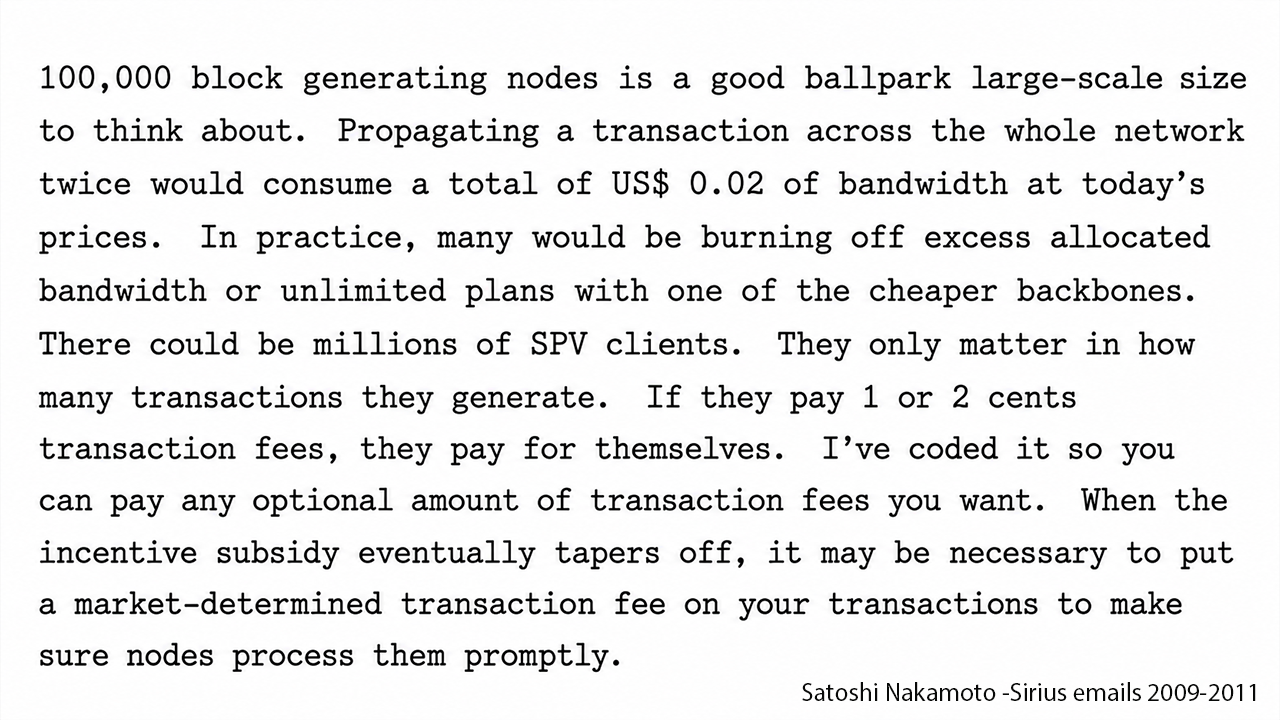
Furthermore, in private correspondence, Satoshi estimated that 100,000 block-generating nodes could coexist with millions of lightweight verification clients and noted that transmitting a transaction across the network twice would cost about two cents in bandwidth. When users expressed concerns that SHA-256 might be broken, Satoshi compared moving from 128-bit to 256-bit hashing to doubling the address space, adding that if a vulnerability appeared, the network could adopt a new hash function via consensus.
This pattern becomes obvious after sequentially studying Satoshi's correspondence. The same technical objections arise again and again, and the replies almost always rely on a specific mechanism, specific numbers, or an analogy that facilitates understanding of the design, rather than simply brushing off the criticism. That's why the reply to bytemaster stands out against the general backdrop. It differs from the tone characteristic of almost all other correspondence, making it one of the few moments when Satoshi's patience noticeably ran out.
Firmness Without Personal Attacks
Satoshi's emails show he was willing to express disagreement directly but avoided personal attacks. In an early email to Wei Dai, the author of the b-money proposal that preceded Bitcoin, Satoshi characterized critics of digital money as "fairly Neanderthal," but immediately softened his words, noting that these critics were simply accustomed to a world built on fiat money.
Satoshi also directly acknowledged Dai's early work, inquiring about the original publication date of the "b-money" proposal before eventually informing Dai that the released Bitcoin software fulfilled "almost all the goals" of that early project.
Satoshi treated his own simplifications in the project the same way: he acknowledged them rather than justified them. Years later, when asked why the main source file was named main.cpp instead of something more descriptive like core.cpp, Satoshi admitted the second name would have been better but said it was too late to change. He didn't try to justify that choice retroactively. Satoshi simply acknowledged it, said, "Sorry to be a killjoy," and moved on to another question.
A Mentor in Private, an Educator in Public
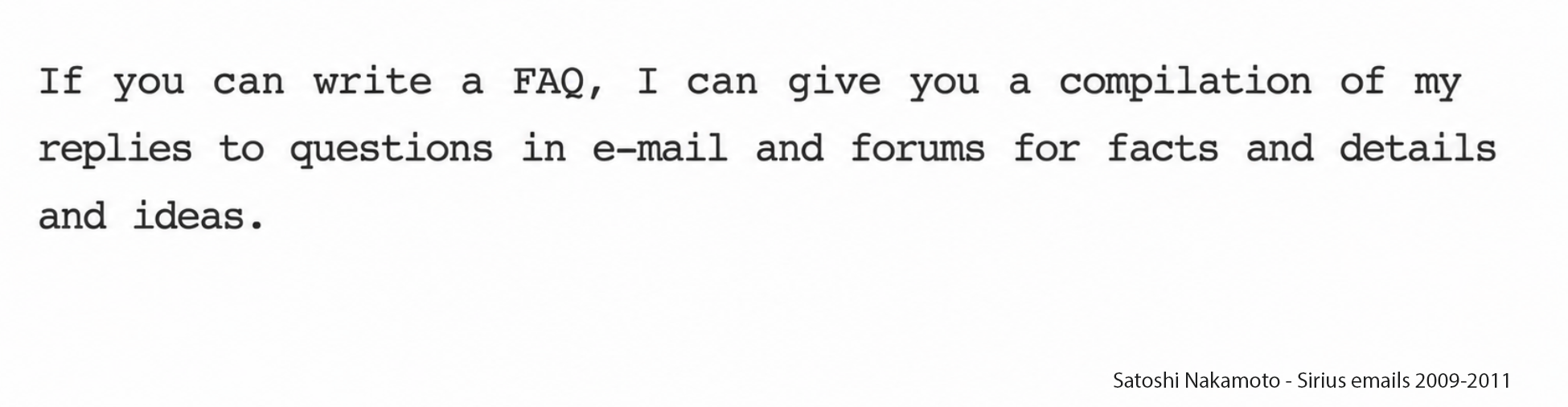
This contrast becomes even more evident in Satoshi's personal emails with one of the first collaborators, Martti "Sirius" Malmi. The messages are informal, permeated by a collaborative spirit, and sometimes self-deprecating. In one exchange, Satoshi admitted, "I'm not much of a writer," before asking Malmi to compile a public FAQ. Instead of simply delegating the task, Satoshi personally answered long lists of questions about server settings, port forwarding, and website text, working through the details with him rather than just giving instructions.
Satoshi's public posts read differently. In February 2009, in his introductory post on the P2P Foundation forum, Satoshi explained that traditional currency depends on trust in banks and central authorities and argued that Bitcoin replaces this trust with cryptographic proof, accessibly explaining digital signatures and the double-spending problem to a broad audience. In private correspondence, he negotiates and jokes. In public speeches, he teaches.
Satoshi also showed restraint regarding Bitcoin's public image. In his last known email, sent to Gavin Andresen in April 2011, Satoshi asked not to portray him as a "mysterious shadowy figure," instead urging Andresen to give credit to the broader group of developers contributing to the project.
Confidence Backed by Numbers, Not Boasting
Satoshi's confidence in Bitcoin's ability to scale never looked like empty hope. In correspondence with an early project participant, Mike Hearn, this argument was based on a specific assumption: that hardware performance, following Moore's Law, would grow faster than Bitcoin's transaction volume, allowing the network to surpass payment systems like Visa over time.
In the same correspondence with Hearn, Satoshi also acknowledged that transaction fees would likely be needed over time but argued competition would keep them low as users could choose which processors and fee levels to use. Even the 21 million coin limit was presented as a justified design decision, not an arbitrary rule. Satoshi characterized it as an informed guess, arguing scarcity would give bitcoin meaningful value in case of growing popularity, whereas a niche currency would naturally be worth much less per coin.
The same instinct of public justification manifested in Satoshi's reasoning about adoption. Instead of predicting instant demand, Satoshi pointed to virtual goods and gaming communities like World of Warcraft and Second Life as likely early use cases, arguing bitcoin needed a "killer app" to give it immediate utility before wider merchant adoption would follow.
Why This Still Defines Bitcoin
The scalability debates that spawned Satoshi's famous phrase never died down. They resurfaced during Bitcoin's block size wars and continue in current discussions about transaction fees and mining revenue, and recently, in what BIP-110 proponents call "spam."
Reading the original 2010 correspondence shows that the core trade-off described by Satoshi — full nodes for some and lightweight clients for most — was part of the plan from the beginning, not a later compromise. The correspondence with Malmi also presents a working template still traceable in Bitcoin's open-source development today: a founder who delegates, documents decisions in writing, and allows contributors to create materials for the public, rather than centralizing every response personally.
And the correspondence with bytemaster still serves as a useful reminder for anyone actively participating in Bitcoin communities now. Even the person who patiently explained cryptographic proofs, network incentives, and scarcity principles to newcomers for years had a limit to repeating an already given answer.
end-content

















