Design, Development, Legal, Sports... Polymarket Launches 'Full-Stack' Talent Grab

Odaily星球日报Опубліковано о 2026-04-15Востаннє оновлено о 2026-04-15

Анотація

Polymarket, a leading prediction market platform, is aggressively expanding its team across multiple domains following competitor Kalshi's recent $22 billion valuation funding round. Key hires and strategic acquisitions are central to its growth strategy. Design remains a priority, with the design lead actively recruiting to strengthen the platform's distinctive blue-and-white branding. Engineering recruitment is also intensive, highlighted by the acquisition of API platform Dome, whose co-founders joined Polymarket, and the hiring of a former Aave engineering VP. Multiple senior engineering roles are currently open. For its US platform, Polymarket is bolstering legal and compliance expertise, adding a former RBC Capital Markets veteran as Legal Counsel. In a significant move, it hired a former Fanatics CBO to lead sports business development, which sparked a non-compete lawsuit from Fanatics, revealing complex industry entanglements. Further hires include a former Coinbase institutional product lead to handle institutional liquidity sales, a marketing head from MrBeast's team, and a Citadel veteran for exchange upgrades. Polymarket is also recruiting for HR and a Head of Markets, indicating the talent competition in the prediction market space is far from over.

Original|Odaily Planet Daily(@OdailyChina)

Author|Wenser(@wenser 2010 )

After Kalshi completed a new funding round in March with a valuation of $22 billion, Polymarket, one of the two giants in the prediction market, couldn't sit still.

Apart from the news that it was previously seeking funding with a $20 billion valuation, Polymarket has also been busy recruiting new team members recently for platform development and business expansion. From the list of new team members joining Polymarket, we might get a glimpse of the focus and突围 directions of this former prediction market霸主, now the "perennial runner-up".

Odaily Planet Daily will provide a梳理 and analysis based on Polymarket's recruitment information in this article.

Design Remains a Top Priority: Design Lead Posted Recruitment Plan in January

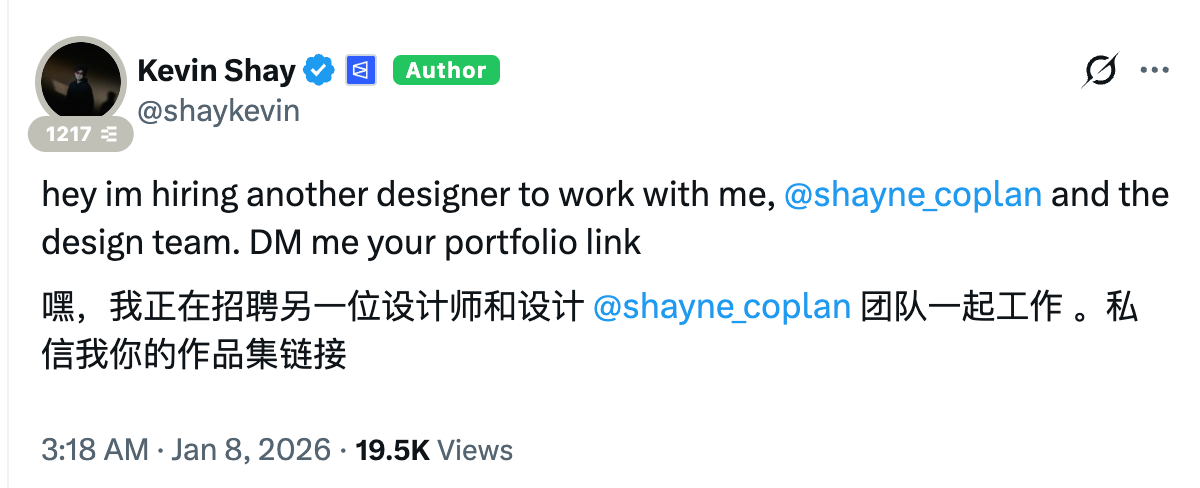
In January of this year, Polymarket's Head of Design, Kevin Shay, posted a tweet stating that he was recruiting designers. Apart from distinguishing itself from Kalshi's green and white UI, Polymarket's blue and white UI remains an important design language and iconic symbol. Its previously opened pop-up grocery store in New York also used corresponding blue and white elements in its design. In the crucial battle for brand突围, design is still a top priority for Polymarket's development.

Additionally, according to the official recruitment page, there are currently 2 design-related positions still open.
Development Engineers Continuously Recruited: Emphasizing Both Talent Acquisition and External Recruitment

As the business cornerstone of platform development, developers are also a key driving force behind Polymarket's recent business expansion. The strategy adopted by Polymarket's talent recruitment team is to emphasize both talent acquisition and external recruitment.

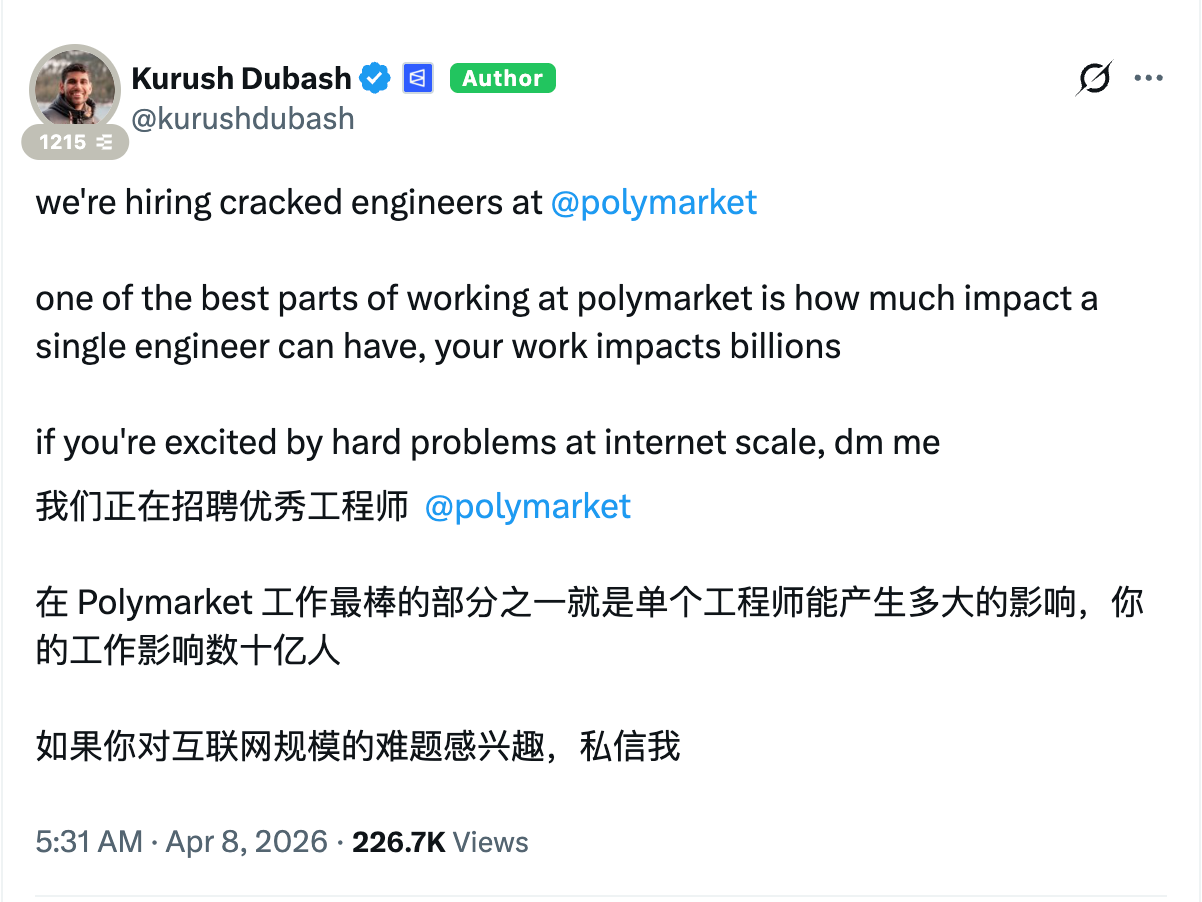
Kurush Dubash & Kunal Roy, Two Co-founders of Dome

In February, the prediction market API platform Dome was officially acquired by Polymarket. Subsequently, Dome's two co-founders, Kurush Dubash and Kunal Roy, also joined Polymarket. In April, they posted tweets recruiting top engineers, beginning to show a "person-to-person"火热 recruitment phenomenon.

It is worth mentioning that Polymarket also acquired the executive search firm Lunch in the same month; many of the executives and team members mentioned later were contacted and recruited by the leaders of this company; in March, Polymarket also acquired the DeFi infrastructure startup Brahma, and most of its team members have also been integrated into the Polymarket team.
Josh Stevens, Vice President of Engineering

On March 24th, former Aave engineer and senior vice president Josh announced that he had joined Polymarket. And just half a month later, he was already posting again on his personal account to recruit engineers. It seems that the developer gap at the rapidly developing Polymarket is much larger than outsiders might imagine.
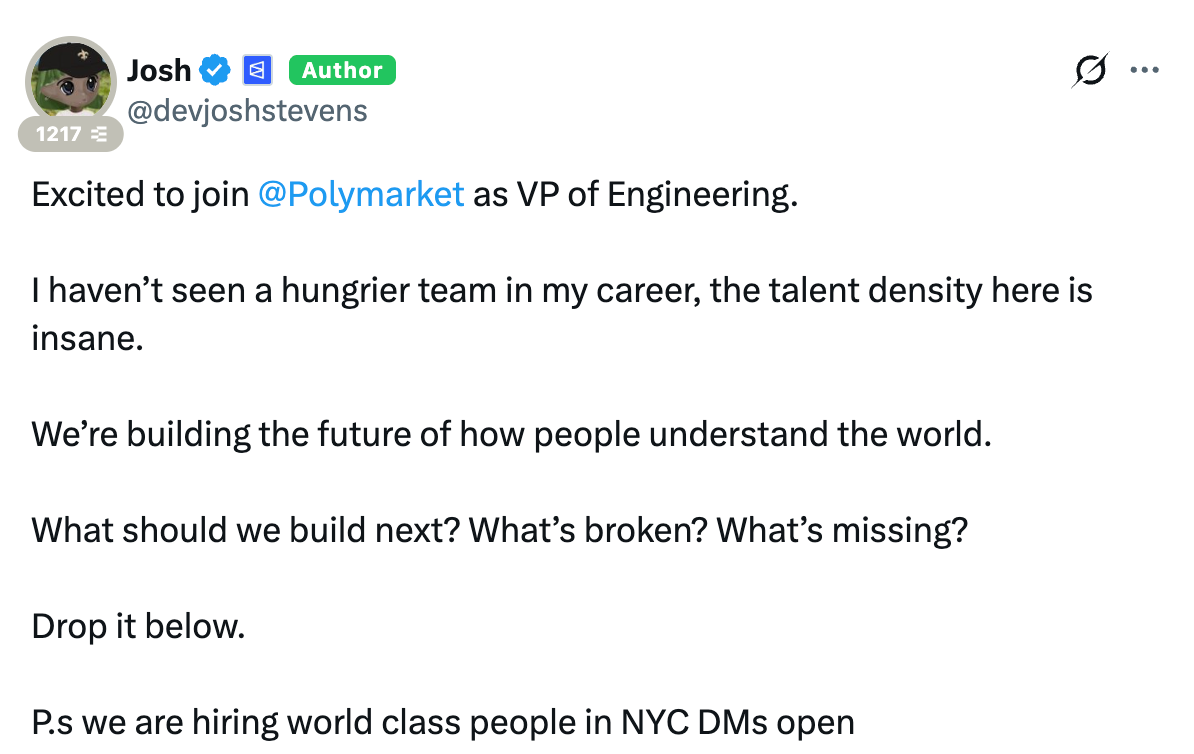
Joining announcement tweet in March
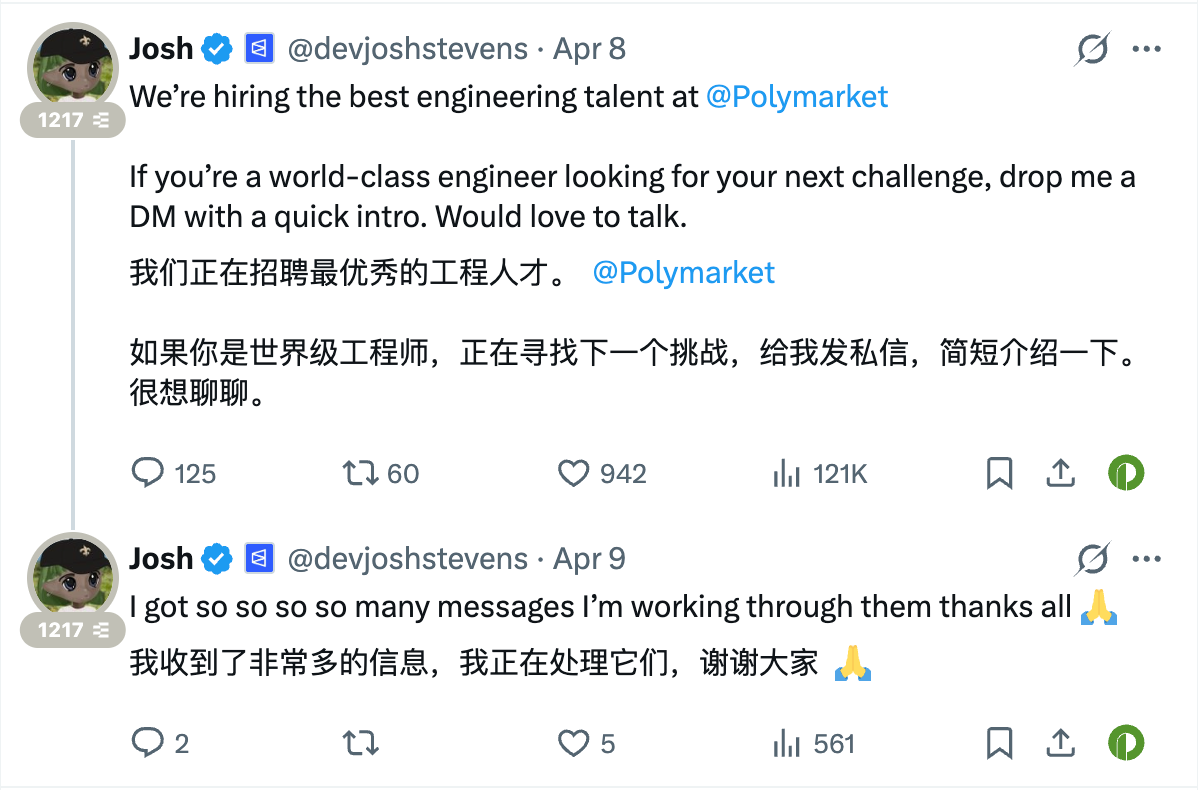
Posting recruitment information again in early April

Additionally, according to the official recruitment page information, the developer positions currently being recruited by Polymarket include Senior Backend Engineer (US Platform), C/C++ Senior Engineer (US Platform), Smart Contract Developer, Mobile AI Engineer, and Senior Platform Infrastructure Engineer. Interested friends can try applying.

Compliance, Legal, and Sports Betting Talent: Personnel Reserves for Polymarket's US Platform

Last November, by acquiring the US-compliant trading platform QCX, Polymarket finally managed to return to the US market. Facing the increasingly stringent regulatory environment in the US market and the regulatory contradictions between federal agencies and state/local courts, Polymarket has had to once again strengthen its talent reserves in legal and compliance aspects.

Matthew Lischin, Legal Counsel for Polymarket US Platform

In February 2026, after ending his 13-year tenure at RBC Capital Markets (the investment banking division of Royal Bank of Canada), Matthew Lischin finally joined Polymarket as the Head of North America Global Markets Legal Team. Public information shows that he will focus on the legal compliance of complex financial products such as equity derivatives and margin loans.

It is worth mentioning that when he posted on LinkedIn announcing his departure from RBC, Polymarket's Chief Legal Officer, Neal Kumar, left a comment to communicate. Perhaps due to this opportunity, Lischin later posted确认 joining the Polymarket US platform as Legal Counsel,直言: "The wish has finally come true!"

Ari Borod, Former Fanatics Executive Becomes President of Sports Business Development

In February 2026, after ending his 4-year tenure as Chief Commercial Officer (CBO) and other positions at the well-known sports betting platform Fanatics, Ari Borod subsequently plunged into Polymarket, the prediction market霸主 and rising star in sports betting.

Unexpectedly, due to his sensitive career experience, it also triggered a non-compete lawsuit from his former employer Fanatics. Although the lawsuit was eventually settled out of court, it must be said that in the process of the prediction market's growth, friction with traditional industries like sports betting may not only exist at the regulatory level but also at the talent争夺 level.

Public information shows that Ari Borod led the strategic transformation of Fanatics from fan merchandise to sports betting business. Earlier, he served as Chief Commercial Officer and Chief Operating Officer at The Action Network and worked at FanDuel for six years, rising from Assistant General Counsel to Vice President of Sports at Fanatics.

However, in the non-compete lawsuit filed by Fanatics in a Florida court, court documents revealed another shocking thing - Fanatics founder Michael Rubin and Fanatics Betting and Gaming CEO Matt King personally hold shares in Kalshi. It just goes to show that real business warfare is everywhere. Furthermore, even more laughably, Fanatics had previously been involved in a non-compete lawsuit for hiring Mike Hermalyn, former Senior Vice President of Growth at DraftKings. It seems因果循环,报应不爽 (karma is a cycle, retribution is not pleasant).

Institutional Liquidity Awaits Introduction: Former Coinbase Institutional Product Lead

On April 2nd, former Coinbase Head of Institutional & Retail Products, Brooke Rizzetto, officially announced joining Polymarket, stating that she would later be responsible for "institutional liquidity sales." After working at Coinbase for over 4 years, Brooke Rizzetto began seeking new ways of information pricing and liquidity introduction from the prediction market赛道.

In addition to the above personnel, other team members recently joining Polymarket include former "MrBeast (YouTube's top influencer Beast Mr.)" viral marketing lead Josh Tucker, and Citadel hedge fund veteran of 8 years Mukilan Ashok,主要负责 marketing, exchange platform upgrades and other business.

Furthermore, Polymarket's Head of People Recruitment, Matthew Kendall Clark, recently pointed out in a post that they are currently recruiting Personnel Recruitment Staff and Polymarket Head of Markets. This "talent arms race" among prediction market platforms is clearly still in the land-grabbing stage, far from over.

For more information about Polymarket's recruitment, please check its official recruitment page.

Пов'язані питання

QWhat is the valuation of Kalshi after its latest funding round in March, as mentioned in the article?

AKalshi was valued at $22 billion after its latest funding round in March.

QWhich two key strategies is Polymarket using to recruit developers for its platform expansion?

APolymarket is using talent acquisition and external recruitment as its key strategies to recruit developers.

QWho was hired as the President of Sports Business Development at Polymarket, and what controversy was associated with this hire?

AAri Borod was hired as the President of Sports Business Development, and his hiring led to a non-compete lawsuit from his former employer, Fanatics, which was eventually settled out of court.

QWhat specific role will Brooke Rizzetto, formerly of Coinbase, take on at Polymarket?

ABrooke Rizzetto will be responsible for institutional liquidity sales at Polymarket.

QWhich two companies did Polymarket acquire to support its talent recruitment and platform development efforts?

APolymarket acquired Dome, a prediction market API platform, and Brahma, a DeFi infrastructure startup, to support its talent recruitment and platform development.

Пов'язані матеріали

Q-Day Countdown: Will Quantum Computing End Cryptocurrencies?

Quantum Computing's Threat to Cryptocurrency: A Countdown to Q-Day Quantum computing, specifically Shor's algorithm, poses a fundamental threat to the public-key cryptography (e.g., ECDSA, RSA) that secures blockchain networks like Bitcoin and Ethereum. This critical juncture, known as Q-Day, is estimated to occur potentially within the next 5-15 years. The core vulnerability stems from the public and immutable nature of blockchains. Assets in addresses where the public key is already exposed on-chain (e.g., spent outputs) are at direct risk, as a sufficiently powerful quantum computer could derive the private key. This threatens the very trust model of cryptocurrencies. The response lies in Post-Quantum Cryptography (PQC)—algorithms like lattice-based ML-DSA and hash-based SLH-DSA, which are resistant to quantum attacks. NIST has standardized key PQC algorithms (FIPS 203, 204, 205), providing a migration path. However, the primary challenge is not technical but socio-economic and involves complex governance: * **Bitcoin's** path is constrained by its conservative ethos. Migrating requires a soft-fork to new address types, facing hurdles like significantly larger signature sizes and, most critically, the divisive governance question of how to handle at-risk legacy UTXOs without violating core principles. * **Ethereum** is pursuing a "cryptographic agility" strategy, with a multi-layered roadmap. It leverages account abstraction for user accounts and is developing compressed hash-based signatures (e.g., leanXMSS) for its consensus layer, aiming for a full-stack upgrade over time. In conclusion, quantum computing does not spell an instant end for cryptocurrency but initiates a critical countdown. The industry has a limited "engineering comfort window" to orchestrate a coordinated, ecosystem-wide migration to PQC. The ultimate bottlenecks are the immense coordination efforts and governance decisions required for this foundational transition.

marsbit24 хв тому

Q-Day Countdown: Will Quantum Computing End Cryptocurrencies?

marsbit24 хв тому

Trump, the President Who Knows Best How to 'Trade Stocks'

Former US President Donald Trump reported a record-breaking $2.2 billion in personal income for 2025, the highest annual income ever disclosed by a sitting president. This figure, from a 927-page government ethics filing, represented a 3.5-fold increase from his $600 million income in 2024 and boosted his net worth to $6.5 billion. The primary drivers were cryptocurrency (64% of income, approximately $1.4 billion) and real estate (26%, approximately $575 million). His crypto earnings stemmed largely from the launch of his personal meme coin, $TRUMP, generating over $600 million in licensing fees, and substantial profits from the WLFI token and its parent company. Despite a sluggish property market, his Mar-a-Lago resort and associated golf clubs saw revenue surges of 50% and 27%, respectively, attributed to their use as venues for presidential events. Trump's financial disclosure also revealed an unprecedented level of stock market activity, with over 22,000 trades executed in 2025, averaging 87 trades per market day. Media analyses noted several instances where significant trading coincided with major policy announcements, such as proposed tariffs, raising questions about potential conflicts of interest. While the White House stated these trades were handled by a family-managed trust fund and not Trump directly, critics highlighted this as a departure from the blind trusts traditionally used by presidents post-Watergate. The report has intensified debate over the commercialization of the presidency. Supporters view it as a success story of a businessman-president, while critics argue it demonstrates an unprecedented conversion of public influence into private wealth, with policy decisions potentially linked to personal financial gains. The controversy centers on whether Trump's earnings represent innovative entrepreneurship or a fundamental conflict of interest, sparking renewed calls for stricter ethics reforms in US governance.

marsbit33 хв тому

Trump, the President Who Knows Best How to 'Trade Stocks'

marsbit33 хв тому

Countdown to Q-Day: Will Quantum Computing End Cryptocurrencies?

The article explores the existential threat quantum computing poses to cryptocurrencies and the urgent need for "post-quantum" migration. It outlines that quantum computers, through Shor's algorithm, could break the elliptic-curve cryptography (ECC) underlying blockchain security, potentially allowing private keys to be derived from public keys. The core challenge is not a lack of post-quantum cryptography (PQC) standards—like NIST's ML-KEM and ML-DSA—but the immense complexity of upgrading entire ecosystems before "Q-Day" (when quantum computers become capable of such attacks, estimated around 2035-2045). Key points include: * **Bitcoin's** risk is concentrated in legacy UTXOs with exposed public keys (e.g., early P2PK outputs). Migration faces massive hurdles: PQC signatures are much larger, increasing transaction size and cost, and the governance dilemma of handling un-migrated assets threatens its "code is law" ethos. * **Ethereum's** strategy focuses on "cryptographic agility," using Account Abstraction for user accounts and developing compressed hash-based signatures (like leanXMSS with SNARK aggregation) for consensus. Its migration is a complex, full-stack overhaul of execution, consensus, and data layers. * The "security debt" is enormous. The comfortable engineering window for a coordinated, ecosystem-wide upgrade is only 5-8 years. High-value infrastructure (exchanges, bridges) may face pressure before mainnet protocols. In conclusion, quantum computing is not an instant "doomsday" event but a forcing function for systemic change. Bitcoin's ultimate test is social consensus and property rights governance, while Ethereum's is technical complexity. Failure to migrate in time could lead to a fundamental re-pricing of crypto assets.

链捕手37 хв тому

Countdown to Q-Day: Will Quantum Computing End Cryptocurrencies?

链捕手37 хв тому

Losing $55 Million to Sell Bitcoin, MicroStrategy's Faith Reaches Its Interest Payment Day

On July 6th, Michael Saylor's MicroStrategy announced the sale of 3,588 BTC for approximately $216 million, incurring a realized loss of around $55.45 million compared to its average cost basis. This move, contradicting Saylor's long-standing "never sell" Bitcoin philosophy, was executed to pay dividends on its digital credit securities. The article traces this shift from a small "desensitization test" sale of 32 BTC in late May to the board's authorization on June 30th to sell up to $1.25 billion in Bitcoin for corporate purposes like dividends and buybacks. Analysis reveals that MicroStrategy's previous growth "flywheel"—using stock premiums to fund more Bitcoin purchases—has stalled. With its stock trading near a critical threshold (1.22x its Bitcoin NAV), issuing new shares would dilute value. Simultaneously, its financing channels (preferred stock, common stock ATM, convertible notes) are constrained while facing rigid annual dividend/interest obligations of roughly $1.76 billion. Consequently, selling Bitcoin became the calculated "optimal solution" under its own financial model. This transforms MicroStrategy from crypto's most prominent steady buyer into a predictable seller, creating a potential overhead of ~2,400 BTC in monthly selling pressure if obligations are fully covered by sales. This shift challenges the valuation models of the entire Digital Asset Treasury (DAT) sector that emulated MicroStrategy. The company's path forward now hinges on Bitcoin's price recovery, which would allow its preferred stock to trade at par and reopen its financing flywheel, creating a cyclical dependency between the firm's financial model and the asset it holds.

链捕手1 год тому

Losing $55 Million to Sell Bitcoin, MicroStrategy's Faith Reaches Its Interest Payment Day

链捕手1 год тому

Торгівля

Спот
活动图片