# Пов'язані статті щодо CLARITY Act

Центр новин HTX надає останні статті та поглиблений аналіз на тему "CLARITY Act", що охоплює ринкові тренди, оновлення проєктів, технологічні розробки та регуляторну політику в криптоіндустрії.

Data of 54,000 wallet users leaked, Clarity odds just 10%: Hodler’s Digest, Aug. 16

Galaxy Digital has slashed the odds of the CLARITY Act passing in 2026 from 75% to just 10%, citing limited Senate session days. If it fails, the SEC and CFTC plan to issue their own crypto rules, though an SEC meeting was abruptly cancelled. High-profile meetings at the White House are planned to discuss the bill. Amid growing hack fears, crypto companies are urging AI labs to grant developers early access to advanced AI models for cybersecurity, following a $116M Coldcard wallet theft. Data breaches at Trezor and SafePal have exposed over 54,000 users' personal information. The CFTC is clashing with states over regulating prediction markets like Kalshi, ordering it to ignore a New York restraining order to maintain a national market, while a Washington state judge ruled against it. The Ethereum Foundation is revising its post-quantum plan, moving away from the Poseidon hash function, and scoping its next major upgrade, Hegotá, for next year. Tether received its first full clean audit opinion from KPMG, showing reserves exceeding liabilities by $6.814 billion. Marketwise, major cryptos saw weekly declines. Predictions include a possible Bitcoin bottom in October, while analysts dispute the feasibility of BTC reaching $1M by 2030. Glassnode notes Bitcoin is in its longest capitulation phase since FTX's collapse. Three men were charged for an alleged Bitcoin kidnapping plot in Missouri.

cointelegraph6 год тому

Data of 54,000 wallet users leaked, Clarity odds just 10%: Hodler’s Digest, Aug. 16

cointelegraph6 год тому

Roman Storm Accuses Google and OpenAI in Connection with U.S. Department of Justice Ruling on Cryptocurrency Case

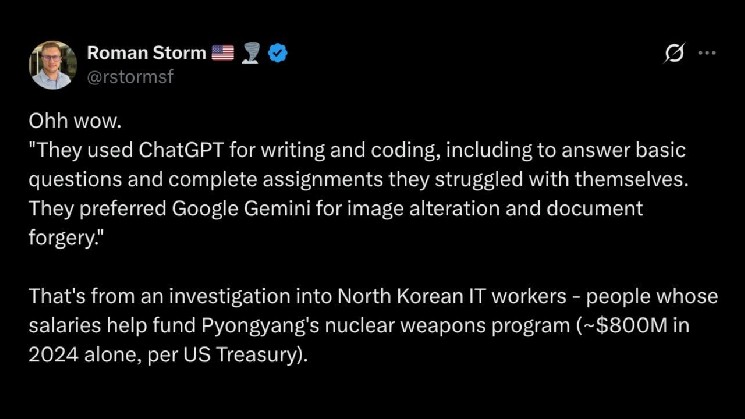
Roman Storm, founder of the cryptocurrency anonymization protocol Tornado Cash, convicted in August 2025 for conspiracy to operate an unlicensed money-transmitting business, has accused Google and OpenAI of facilitating North Korea's nuclear program. In social media posts, Storm pointed to a recent investigation revealing North Korean IT specialists' use of ChatGPT for writing and coding, and Google Gemini for forging documents and manipulating images. He argued that, under the same legal logic the U.S. Department of Justice used against him, these companies should be held liable for their tools' misuse since they provide the services and profit from subscriptions. Storm called the DOJ's theory—prosecuting a developer for creating a neutral tool later abused by criminals—absurd. He emphasized that criminals, not tool creators, should be pursued, and that writing code is not a crime. The Tornado Cash verdict sets a negative U.S. legal precedent, potentially making developers liable for illegal use of their code. Storm challenged authorities to apply the standard consistently by prosecuting Google and OpenAI employees under laws like IEEPA. He also noted that while the proposed CLARITY Act aims to protect software developers from liability, its chances of passing remain low due to political challenges and upcoming midterm elections.

cryptonews.ru9 год тому

Roman Storm Accuses Google and OpenAI in Connection with U.S. Department of Justice Ruling on Cryptocurrency Case

cryptonews.ru9 год тому

Congress Blocks CLARITY Act, SEC Decides to Act on Its Own: Crypto Regulation is Bypassing the Legislative Stalemate

Following a legislative impasse in the U.S. Senate over the CLARITY Act, the Securities and Exchange Commission (SEC) is moving forward independently with plans for a tailored regulatory framework for crypto assets. On August 11, the SEC announced a vote for August 14 on whether to formally propose "Regulation Crypto," a set of rules for investment contracts involving crypto assets. This marks the first formal crypto rulemaking initiative under Chairman Paul Atkins. The proposal, expected to be approved by the Republican-majority commission, would then enter a 60-90 day public comment period, with a final rule unlikely before 2027. This SEC action comes as the CLARITY Act, which passed the House and a Senate committee, remains stalled in the full Senate. A procedural vote was delayed until September 15 due to unresolved disagreements on anti-money laundering provisions, stablecoin regulation, and government ethics rules. Analysts give the bill a high probability of failure, citing insufficient bipartisan support. Regulation Crypto, based on a framework outlined by Atkins in March, is expected to propose three key exemptions: a startup exemption for limited fundraising, a financing exemption with simplified disclosures, and a crucial "investment contract safe harbor." This safe harbor could allow tokens to exit SEC jurisdiction if a project becomes sufficiently decentralized, addressing a long-standing industry concern over perpetual securities status. Two parallel tracks for crypto regulation are now advancing in Washington: the comprehensive but stalled legislative path of the CLARITY Act, and the administrative rulemaking of the SEC. While the SEC's rules would have more limited scope than a full law, they offer a potential regulatory baseline if Congress fails to act. The simultaneous progress signals a shift in Washington from debating whether to regulate crypto to actively determining how to do so.

marsbit08/12 01:26

Congress Blocks CLARITY Act, SEC Decides to Act on Its Own: Crypto Regulation is Bypassing the Legislative Stalemate

marsbit08/12 01:26

活动图片