# Пов'язані статті щодо AI Bubble

Центр новин HTX надає останні статті та поглиблений аналіз на тему "AI Bubble", що охоплює ринкові тренди, оновлення проєктів, технологічні розробки та регуляторну політику в криптоіндустрії.

Opinion: AI Bubble Bursts, Bitcoin and Other Risky Assets Are the First to Be Impacted

BIS Warns AI Investment Boom Could Trigger Market Stress, Impacting Bitcoin First The Bank for International Settlements (BIS) warns that a potential bursting of the "AI bubble" could tighten liquidity and severely impact risk assets like Bitcoin in the near term. Major tech firms are projected to spend over $1 trillion on AI infrastructure in 2025-2026. The BIS cautions that if returns fail to meet expectations, a sudden withdrawal of financing could turn this investment boom into a prolonged bust, creating ripple effects across financial markets. While AI holds long-term economic promise, the current scale and speed of investment, coupled with intense competition and physical bottlenecks (e.g., semiconductors, power grids), mirror historical bubbles. The report highlights that the AI funding web—spanning corporate debt, private credit, and complex vendor agreements—makes systemic risks harder to see. A disappointment in AI adoption could transmit stress through this chain, widening credit spreads and pressuring weaker borrowers. For Bitcoin, the initial reaction to such a market shock would likely be defensive. As liquidity tightens, investors typically sell liquid assets first, and Bitcoin often trades in line with other risk assets during portfolio de-risking. Recent correlations, like Bitcoin's drop following a sharp decline in South Korea's stock market, support this view. However, the longer-term outcome for Bitcoin depends on the policy response. If an AI-driven credit crunch forces central banks to inject liquidity and ease policy eventually, it could reignite Bitcoin's narrative as a hedge against monetary debasement. Yet, traders betting on this outcome may first have to endure significant market volatility and potential price declines.

marsbit06/30 04:38

Opinion: AI Bubble Bursts, Bitcoin and Other Risky Assets Are the First to Be Impacted

marsbit06/30 04:38

'Bear' Doomsday Prophecy: AI 'Reaching Its Peak', U.S. Stocks to Top Out Fastest in Q3, Down 30-50%

"A Short Seller's Dire Prediction: AI Boom Fading, US Stocks to Peak by Q3 with 30-50% Decline" Prominent macro investors Jeffrey Gundlach and Felix Zulauf warn that the AI-driven market rally is nearing its end, forecasting a major US stock market correction of 30-50%, potentially beginning as early as Q3. Their analysis points to alarming parallels with historical market tops, citing extreme concentration in the top AI-related stocks within the S&P 500. Zulauf's bearish thesis hinges on unsustainable capital expenditure trends among major cloud companies, negative free cash flow emergence, and soaring semiconductor prices. Gundlach highlights dangerous parallels to the 1999 tech bubble peak. A key divergence from conventional wisdom is Gundlach's view that long-term Treasury yields will not fall meaningfully even during a recession, due to America's structurally out-of-control fiscal deficits and soaring interest costs. He warns this could force the government into yield curve control or even a sovereign debt restructuring. Both investors express severe concerns about the opaque private credit market, drawing parallels to the pre-2008 financial crisis environment. They allege widespread rating inflation, misrepresented credit quality, liquidity illusions, and fraudulent asset valuations within this sector. The analysis links the AI boom and private credit crisis through financing costs. They argue that as AI companies' cash flows weaken and they seek funding, a high and sticky long-term interest rate environment will severely stress lower-rated corporate borrowers, exposing cracks in credit markets. Finally, they predict a regime shift where the US dollar weakens and US equities underperform global markets, marking the end of their long dominance. The stage is set for a significant market reversal.

marsbit06/23 09:08

'Bear' Doomsday Prophecy: AI 'Reaching Its Peak', U.S. Stocks to Top Out Fastest in Q3, Down 30-50%

marsbit06/23 09:08

If the AI Bubble Is Already Bursting, Who Will Truly Remain?

**Summary: If the AI Bubble is Bursting, What Will Remain?** The debate around an AI bubble is intensifying, with figures like Ray Dalio warning of high valuations while Jensen Huang sees immense opportunity. This echoes the dot-com bubble, which saw massive wealth destruction but ultimately left behind critical infrastructure like undersea cables and broadband, enabling future giants like Amazon and Netflix. Similarly, today's AI boom involves trillions invested in data centers, power, cooling, and GPUs, while application-layer revenue remains comparatively modest. This investment-disparity signals a bubble. However, the core technological progress is real and accelerating. AI inference costs have plummeted by over 99.7% since 2023, making intelligence increasingly cheap and accessible. This cost collapse is unlocking vast new demand. Instead of reducing spending, enterprises are tripling their AI cloud expenditure. Cheap "tokens" enable AI to move beyond simple chatbots into complex workflows—automating code writing, legal document review, financial analysis, and scientific research. This follows "Jevons's paradox": improved efficiency leads to greater total consumption. The market is now undergoing a necessary purification, weeding out "API-wrapper" startups with no real moat. The deeper evolution involves a shift from capital expenditure (CapEx) on infrastructure to operational expenditure (OpEx) on value-creation in applications. While hardware vendors currently profit most, long-term value will migrate to AI-native firms solving vertical industry problems. Ultimately, a market correction will cleanse speculative excess but will not reverse the AI+ trend. The massive physical and algorithmic infrastructure being built will endure, becoming a cheap, utility-like foundation. Just as the internet became indispensable to all industries post-2000, AI is poised to empower and redefine every sector, moving society irreversibly toward an intelligence-augmented era. The bubble may burst, but the underlying productive momentum is solid.

链捕手06/15 04:35

If the AI Bubble Is Already Bursting, Who Will Truly Remain?

链捕手06/15 04:35

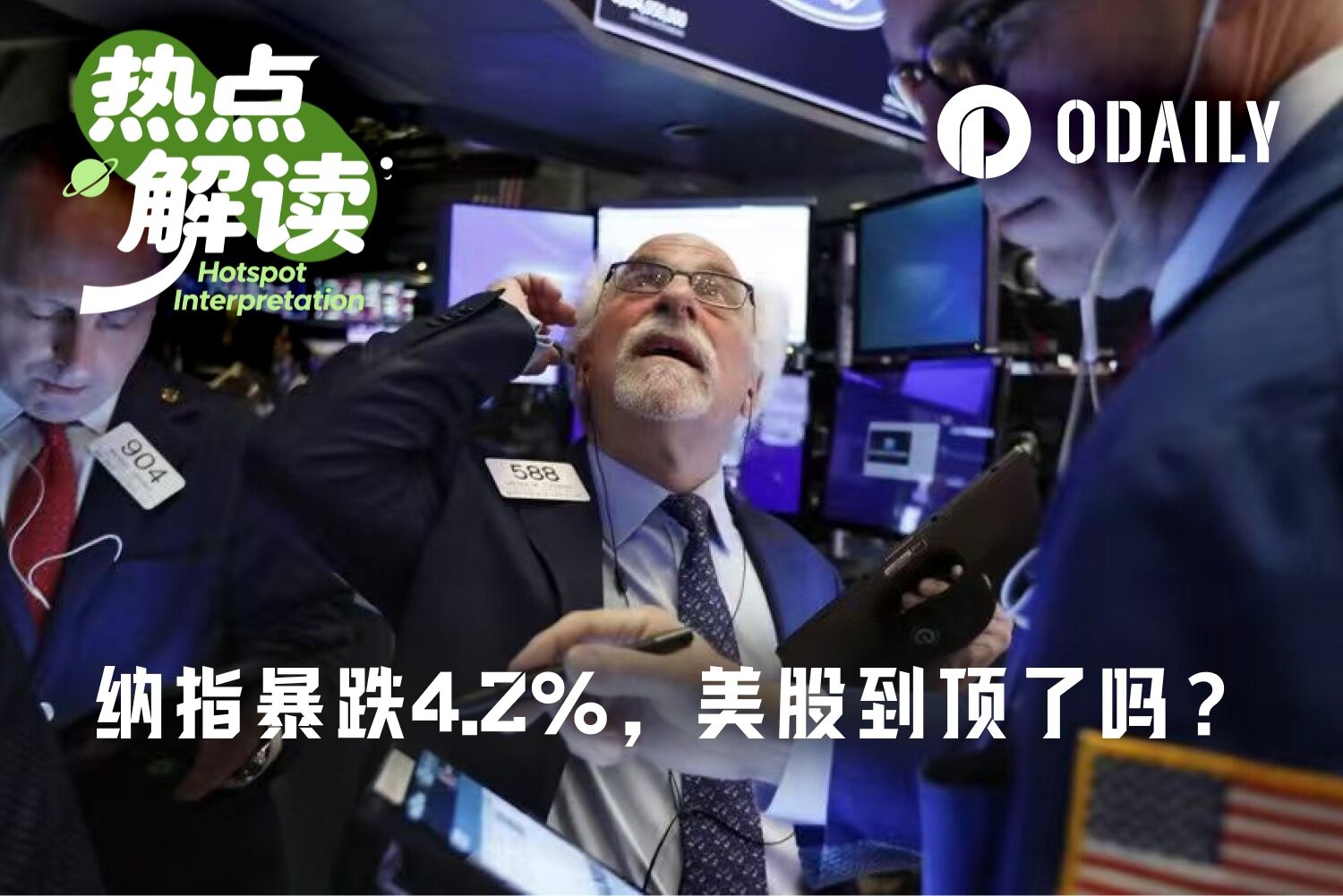
Nasdaq Plunges 4.2% in a Single Day, Did 'Black Friday' Pop the U.S. Stock Bubble?

The Nasdaq Composite plummeted 4.18% on June 5, its biggest single-day drop since April 2025, triggering widespread debate over whether the U.S. stock market has peaked. The sell-off was sparked by a stronger-than-expected U.S. non-farm payrolls report, which fueled fears of economic overheating and pushed back market expectations for Federal Reserve rate cuts, leading to a sharp rise in Treasury yields. The AI sector, the primary driver of the recent bull market, suffered severe losses, with the Philadelphia Semiconductor Index crashing over 10%. Stocks like Nvidia, Broadcom, and Micron led the decline. Concerns are mounting about the sustainability of AI capital expenditures and high valuations, with signs of order cuts for next-generation chips emerging. Analyses point to several warning signs: historically high market valuations (e.g., elevated Shiller CAPE ratio, Buffett Indicator), extreme bullish sentiment indicators, and significant insider selling. The sell-off also caused a key technical breakdown, with the S&P 500 breaking below its short-term moving average and testing its 200-day moving average. Wall Street is divided on the outlook. Bears warn this could be the start of a bubble deflation or a "stagflation" scenario, while bulls view it as a healthy, overdue correction within a bull market driven by solid corporate earnings growth. A more moderate view suggests the easy liquidity-driven rally is over, and markets are entering a phase of fundamental stock-picking with potential for consolidation. The immediate future hinges on key upcoming events: the May CPI report and the mid-June FOMC meeting. Their outcomes will be critical in determining whether this is a temporary pullback or the beginning of a more significant trend reversal. The consensus is that the era of one-directional market gains may be ending, requiring increased investor caution.

Odaily星球日报06/08 10:36

Nasdaq Plunges 4.2% in a Single Day, Did 'Black Friday' Pop the U.S. Stock Bubble?

Odaily星球日报06/08 10:36

Will the US AI Bull Market Crash?

Will the U.S. AI bull market collapse? SoftBank has invested $34.6 billion in OpenAI, with Masayoshi Son selling stakes in Nvidia, Deutsche Telekom, Alibaba, and T-Mobile to fund it. He plans to invest another $30 billion this year, raising his stake to 13%, even taking on debt. This frenzy is driven by OpenAI's valuation surging to $852 billion in February, generating over $45 billion in paper gains for SoftBank. Similarly, Anthropic is reportedly negotiating funding at a $900 billion valuation, up from $61.5 billion a year ago. The article draws a parallel to the dot-com bubble, comparing OpenAI and Anthropic to Yahoo. Back then, Yahoo's portal model seemed unassailable, but it was disrupted by more targeted services. Today, the core assumption is that all AI applications must rely on foundational models like OpenAI and Anthropic, making them permanent "toll booths" of the AI era. However, as AI becomes a ubiquitous utility, this "model-as-gateway" advantage may erode. Financially, to justify trillion-dollar valuations with high P/E ratios (30-40x), these companies would need annual net profits of $25-30 billion, implying revenues of $50-80 billion. Current metrics like Annual Recurring Revenue (ARR)—$25 billion for OpenAI and $30 billion for Anthropic—are based on monthly subscription extrapolations and include promotional, less-sticky API usage. Aggressive price cuts on tokens to capture market share further squeeze margins. A critical risk is that the entire AI industry's profitability depends on downstream applications generating substantial revenue. Currently, besides some coding and content assistance, no "killer app" has emerged to create massive new markets. If enterprises pause AI spending due to performance plateaus, economic downturns, or poor ROI, the foundation for these valuations could crumble. Two potential outcomes are outlined: 1) A Yahoo-style crash where valuations collapse, companies downsize, and AI becomes a low-margin utility business. 2) A successful reinvention where companies find sustainable monetization, perhaps by replacing SaaS or achieving AGI. However, the market's impatience could trigger a downturn before such a breakthrough. The article concludes that while AI will undoubtedly transform society as a fundamental infrastructure, the current speculative frenzy mirrors past bubbles. A correction wouldn't mean the end of AI but could remove financial hype, leading to more grounded integration into industries. The rapid rise warrants caution, as a collapse in trillion-dollar valuations could cause significant economic damage, surpassing the fallout from the dot-com bust.

marsbit05/29 09:11
Will the US AI Bull Market Crash?

marsbit05/29 09:11

The Real AI Bubble, You Can't Buy It

The article argues that the real "bubble" in the current AI boom is largely invisible and inaccessible to the average investor. Unlike the 2000 dot-com bubble, where overvalued companies were publicly traded, the most significant value surges and financial risks are occurring in private markets. Core AI companies like OpenAI, Anthropic, xAI, and Databricks have seen valuations skyrocket (e.g., OpenAI's from $157B to $852B in 18 months), but these transactions happen through private secondary sales, not public stock exchanges. These opaque markets create an "anxiety exposure," leading public investors to chase indirect proxies like memory chip or utility stocks. The author highlights how AI wealth extraction has been radically front-loaded. Employees and founders can cash out years before a potential IPO through structured secondary sales, "founder-led secondary" deals, and collateralized loans against private equity. Major tech firms also use "acqui-hires" or technology licensing deals (like Google/Character.AI, Microsoft/Inflection AI) to secure talent and tech without full acquisitions, allowing early exits outside of regulatory scrutiny. Furthermore, the AI infrastructure build-out is compared to the 2008 real estate bubble. Massive data center projects are financed through complex, off-balance-sheet structures involving private credit, joint ventures, and asset-backed securities using GPUs as collateral (e.g., CoreWeave's deals). This creates a "shadow borrowing" system where the stability of future AI demand underpins trillions in debt, posing systemic risks if expectations falter. The recent collapse of SaaS company Pluralsight, financed by major private credit firms, is cited as a warning. The conclusion is that the most dangerous part of the AI bubble isn't in plain sight on public markets; by the time the average investor sees it, the critical wealth transfers have already occurred in private, unregulated spaces.

marsbit05/14 07:10

The Real AI Bubble, You Can't Buy It

marsbit05/14 07:10

活动图片