Ripple Gains UK Regulatory Approval Ahead Of FCA’s New Crypto Licensing Regime

bitcoinistОпубліковано о 2026-01-10Востаннє оновлено о 2026-01-10

Анотація

Ripple has secured a regulatory approval from the UK’s Financial Conduct Authority (FCA) through its subsidiary Ripple Markets UK Ltd. The company obtained an Electronic Money Institution (EMI) license under the Money Laundering Regulations (MLR), allowing it to provide payment services and issue electronic money. However, the approval comes with restrictions: Ripple cannot operate crypto-fiat automated exchange machines, offer services to retail clients, or issue e-money to consumers without prior written consent from the FCA. This approval aligns with the UK’s broader effort to integrate crypto into its financial framework. The FCA will introduce a new crypto licensing regime under the Financial Services and Markets Act starting September 2026. Ripple and other crypto firms must reapply for authorization under the new rules by October 2027 to continue regulated activities.

In a significant development, Ripple has expanded its footprint in regulated markets after gaining regulatory approval from the UK’s financial authorities to provide payment services.

Ripple Obtains FCA Approval

On Friday, Ripple secured a major regulatory victory in the UK by officially obtaining its registration approval with the Financial Conduct Authority (FCA) through its subsidiary Ripple Markets UK Ltd.

According to the FCA’s official records, the company obtained an Electronic Money Institution (EMI) license under the country’s Money Laundering Regulations (MLR). Therefore, it will be able to conduct certain crypto-related activities in the UK.

The EMI registration will allow Ripple to provide payment services and issue electronic money, according to the FCA website. However, it will remain subject to key restrictions without the financial authority’s approval.

First, “Ripple Markets UK Ltd will not, without the prior written consent of the Authority, provide the following services: 1. The firm will not operate a machine which utilises any automated processes to exchange cryptoassets for money or money for cryptoassets 2. Offer or commence any services to retail clients,” the records read.

In addition, the company cannot appoint any agents or distributors, and “will not issue electronic money, or provide payment services, to a consumer, micro-enterprise or charity.”

Ripple’s regulatory approval comes amid the authorities’ efforts to develop a comprehensive financial services regulation that integrates crypto assets into the existing framework, positioning the UK as a global crypto hub.

As reported by Bitcoinist, the UK Treasury is set to extend existing laws to cover crypto firms, moving exchanges, wallet providers, and other crypto service companies from the current anti-money-laundering registration to the regulatory regime of banks and brokers.

FCA To Start New Registration Regime In September

Ahead of the new rules’ implementation, set to take effect in October 2027, the FCA recently unveiled a timeline for crypto firms to comply with the new registration regime, which could affect Ripple’s recent victory.

On January 8, the financial regulator published a notice informing that it expects to open the application period for crypto firms requesting authorization in September 2026.

Notably, firms seeking to undertake any of the new crypto asset regulated activities will need new approvals to undertake those activities authorized by the FCA under the Financial Services and Markets Act 2000 (FSMA).

Therefore, crypto companies operating in the UK must secure approval or a variation of the existing permission. The FCA emphasized that “firms that are registered with us under the MLRs should note that there will be no automatic conversion and that they will need to secure authorisation by us under FSMA prior to the commencement of the new regime.”

Based on this, Ripple’s UK subsidiary will need to reapply in September to continue conducting regulated crypto activities under the new regime. Firms that apply during the established window are expected to receive a decision before the rules take effect. Nonetheless, companies that have not received approval by October 2027 will be allowed to continue operating until a decision is made.

Meanwhile, companies that miss the application period or are not authorized before the new rules are enacted will enter a “transitional provision.” This will allow them to continue fulfilling existing contracts, but they won’t be able to conduct new regulated crypto activities in the UK until they are authorized.
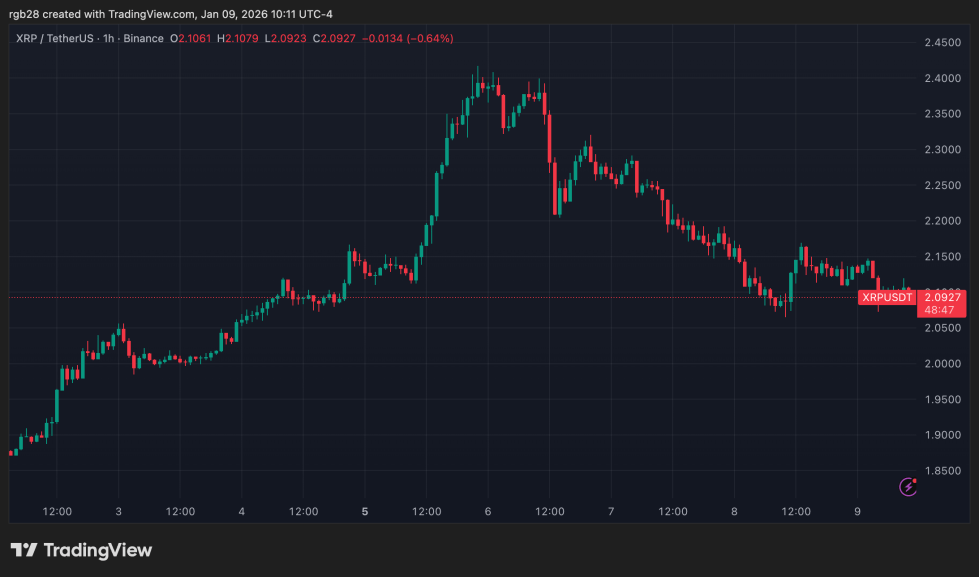
XRP trades at $2.09 in the one-week chart. Source: XRPUSDT on TradingView


Пов'язані питання

QWhat type of regulatory approval did Ripple obtain from the UK's Financial Conduct Authority (FCA)?

ARipple obtained an Electronic Money Institution (EMI) license under the UK's Money Laundering Regulations (MLR) through its subsidiary Ripple Markets UK Ltd.

QWhat are the key restrictions placed on Ripple Markets UK Ltd despite the FCA approval?

AThe company cannot operate automated crypto-to-fiat exchange machines, offer services to retail clients, appoint agents or distributors, or issue electronic money or provide payment services to consumers, micro-enterprises, or charities without prior written consent from the FCA.

QWhen will the FCA open the application period for crypto firms seeking authorization under the new regime?

AThe FCA expects to open the application period for crypto firms requesting authorization in September 2026.

QWhat must Ripple's UK subsidiary do to continue conducting regulated crypto activities under the new regime starting October 2027?

ARipple's UK subsidiary will need to reapply for authorization under the Financial Services and Markets Act 2000 (FSMA) in September 2026, as there is no automatic conversion from the current MLR registration.

QWhat happens to crypto companies that are not authorized by the FCA before the new rules take effect in October 2027?

ACompanies not authorized by October 2027 will enter a 'transitional provision' allowing them to fulfill existing contracts but not conduct new regulated crypto activities until they receive authorization.

Пов'язані матеріали

The Era Has Arrived Where Human Writers Must Prove They Are Not Machines

The article describes an era where AI-generated content is flooding the market, forcing human authors to prove they are not machines. It begins with the example of dozens of AI-written, error-ridden biographies of Henry Kissinger appearing on Amazon within hours of his death, a pattern repeated for other deceased celebrities and even living experts who find fraudulent books under their names. This spam content has exploded, with monthly new book releases on platforms like Amazon reaching 300,000 by late 2025. The issue spans genres, from suspiciously high proportions of AI-written teen romance and self-help books to dangerous, AI-generated foraging guides containing lethal advice. The platforms' automated review systems, designed to catch plagiarism and banned words, are ill-equipped to detect AI-generated text that avoids these pitfalls while being nonsensical or fraudulent. The problem has infiltrated traditional publishing. A major publisher, Hachette, had to recall a bestselling horror novel after AI detection tools suggested 78% of its content was machine-generated. An acclaimed European philosophy book was later revealed to be entirely written by AI under a fake author persona. In response, authors are fighting back. At the 2026 London Book Fair, 10,000 writers published a blank book titled "Don't Steal This Book" containing only their signatures—using emptiness as a protest weapon in an age of AI overproduction. Initiatives like the "Human Author Certification" program have emerged, ironically placing the burden on humans to prove their work is not machine-made. The article warns of a vicious cycle: AI-generated low-quality books pollute the data used to train future AI models, leading to "model collapse" and an ever-worsening flood of digital waste, eroding trust in publishing and devaluing human creativity.

marsbit15 хв тому

The Era Has Arrived Where Human Writers Must Prove They Are Not Machines

marsbit15 хв тому

The King of Blind Date Attire in Korea: How SK Hynix Made a Comeback Against Samsung?

In South Korea's dating scene, SK Hynix employees are now highly sought after, a status shift fueled by the company's astronomical profits and employee bonuses, projected to reach up to 6.1 million RMB per person by 2027. This marks a dramatic reversal for the long-time second-place player in memory semiconductors, which has now surpassed its rival Samsung in annual operating profit. The turnaround story began in 2008 when a struggling Hynix, emerging from bankruptcy restructuring, took a risky bet by agreeing to develop High Bandwidth Memory (HBM) with AMD. At the time, HBM had no clear market beyond high-end graphics cards and was a costly, complex technology. Major players like Samsung, pursuing its own HMC technology, declined. For Hynix, with only memory as its core business, it was a gamble born of necessity. The pivotal moment came in 2012 when SK Group Chairman Chey Tae-won acquired Hynix. Defying industry downturns, he invested heavily in R&D and fabrication, sustaining the HBM project through over a decade of commercial uncertainty and internal challenges. A key break occurred around 2016-2017 when Samsung faced production issues supplying HBM2 for Google's TPU, allowing SK Hynix to gain a crucial foothold in the data center market. The AI explosion post-ChatGPT in 2022 was the catalyst, turning HBM into a critical bottleneck for AI accelerators like NVIDIA's GPUs. By 2025, SK Hynix captured 62% of the global HBM market, leaving Samsung at 17%. For the first time, its annual operating profit exceeded Samsung's. Analysts point to the "innovator's dilemma" to explain Samsung's miss: its vast, successful business portfolio made it risk-averse, preventing an all-in bet on the initially niche HBM technology. In contrast, SK Hynix, as a challenger with its back against the wall, had no choice but to commit fully. The story highlights how Korea's chaebol system allows for ultra-long-term bets beyond quarterly pressures. However, SK Hynix's lead isn't guaranteed. Samsung is aggressively catching up on HBM4, and challenges like customer concentration (heavy reliance on NVIDIA) and technical hurdles in advanced packaging remain. The narrative underscores a market truth: the greatest alpha often comes from betting on uncertain, long-term directions others dismiss, much like HBM in 2008.

marsbit55 хв тому

The King of Blind Date Attire in Korea: How SK Hynix Made a Comeback Against Samsung?

marsbit55 хв тому

Торгівля

Спот
Ф'ючерси
活动图片




