Ripple Chiseled a Crack in the Wall, But Swift Tore Down the Entire Wall

深潮Опубліковано о 2025-12-23Востаннє оновлено о 2025-12-23

Анотація

At the Sibos 2025 conference, Swift announced a major evolution of its financial infrastructure by integrating a blockchain-based shared ledger to support tokenized assets and enable secure, real-time, and interoperable global transactions. The new system, built on Consensys' Ethereum Layer 2 network Linea, uses zk-EVM rollup technology to reduce costs and settlement times while meeting banking security standards. Over 30 major banks, including JPMorgan and Citibank, are participating in the pilot. The article reflects on Ripple’s long-standing effort to challenge traditional cross-border payments using XRP and RippleNet, which has seen adoption in retail and corporate remittances despite earlier regulatory challenges. However, Swift’s move represents a broader and more systemic shift. Unlike Ripple’s XRP-dependent model, Swift’s ledger is asset-agnostic, supporting CBDCs, stablecoins, and fiat currencies, and leverages its existing network of over 11,000 institutions. This transition marks a convergence of traditional and decentralized finance, enabling 24/7 settlement, reducing reliance on pre-funded accounts, and potentially freeing up trillions in trapped capital. By adopting a neutral, interoperable, and highly scalable blockchain framework, Swift is positioned to redefine global value transfer—moving from a legacy telegraphic model to a digitally-native, mathematically-verified system.

Author: Sanqing, Foresight News

During the Sibos 2025 conference in Frankfurt, Swift's Chief Business Officer Thierry Chilosi and Standard Chartered Bank's Global Head of Transaction Banking, Michael Spiegel, discussed a major transformation in global finance. As tokenization moves from pilot programs to reality, Swift officially announced the addition of a blockchain-based shared ledger to its infrastructure, aiming to achieve trusted and interoperable digital finance on a global scale. This ledger will serve as a secure, real-time transaction record between financial institutions, using smart contracts to validate transaction sequences and execute agreed-upon rules. It is designed to complement existing systems and seamlessly bridge traditional finance with tokenized assets.
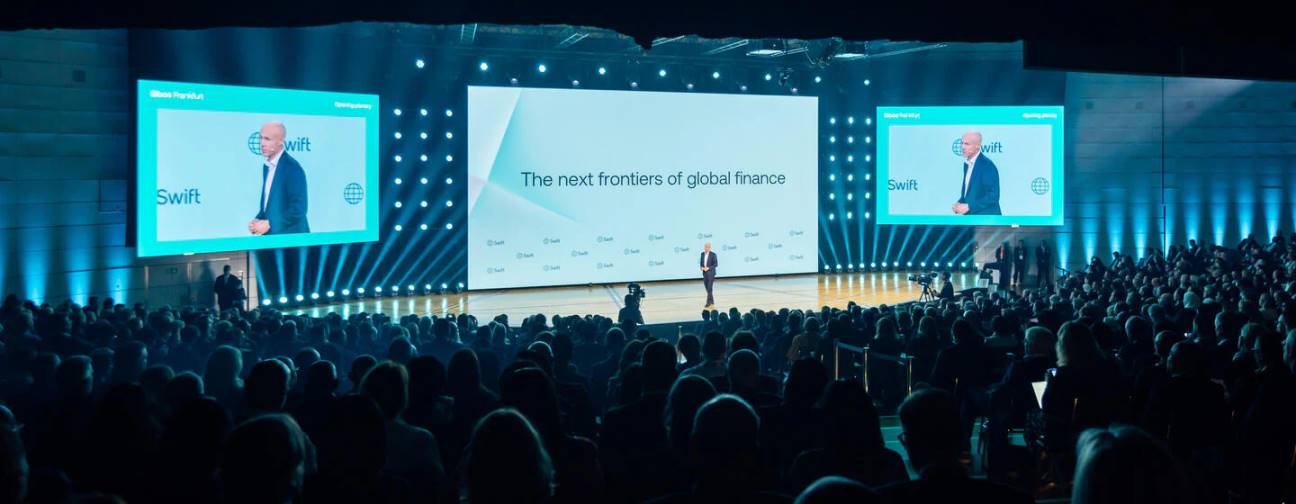
Image Source: Swift Official Website

Although Swift did not explicitly state the technical platform when initially announcing this major development to the banking industry, Consensys CEO Joe Lubin revealed at the Token2049 conference in Singapore that Swift is leveraging the Ethereum Layer 2 network Linea to build its new payment settlement platform. By adopting Linea's zk-EVM rollup technology, Swift can significantly reduce costs and latency while meeting the financial industry's stringent requirements for 24/7 real-time settlement and security. Currently, over 30 top financial institutions, including JPMorgan Chase, Bank of America, and Citibank, are preparing to participate in the pilot of this new blockchain-based payment rail built on Linea.

Ripple's In-Depth Efforts and Current Status

Before discussing Swift, we must revisit the pioneer that challenged the old system for over a decade: Ripple.

In 2012, Ripple emerged with the XRP Ledger (XRPL), with the core goal of replacing the inefficient Swift correspondent banking model. During this period, Ripple successfully built the global payment network RippleNet, connecting over 300 financial institutions. In fragmented markets like Southeast Asia, its On-Demand Liquidity (ODL) service demonstrated that XRP, as a bridge currency, could reduce cross-border settlement times from several days to just 3 to 5 seconds.

By 2020, affected by the U.S. SEC lawsuit, Ripple faced a blockade and stagnation in the U.S. market due to securities allegations. However, its global scale continued to expand. By 2022, its business had reached over 40 payment markets, with total payment volume doubling to approximately $30 billion.

In 2023, Ripple saw a turning point when a court ruled that XRP itself is not a security, marking a milestone victory for Ripple and the industry.

In August 2025, with the SEC completely abandoning its appeal, the five-year legal battle came to an end. The full clarification of its status led to the approval of an XRP spot ETF, marking its official entry into mainstream institutional asset allocation portfolios.

Today, Ripple is conducting cross-border payment and receipt businesses in multiple real-world scenarios, ranging from retail remittances (To C) to enterprise-level payments (To B).

In the retail sector, Japan's SBI Remit uses XRP to bridge real-time remittance channels to the Philippines, Vietnam, and Indonesia, significantly reducing the pre-funding costs for overseas workers. Santander Bank offers transparent real-time transfers to its customers through the One Pay FX app. Meanwhile, the Southeast Asian payment platform Tranglo has significantly improved the efficiency of peso and baht conversions with the support of Ripple ODL.

At the enterprise level, American Express and PNC Bank use RippleNet to optimize B2B trade settlements and international payment collection experiences.

Additionally, in national infrastructure, Ripple is collaborating with over 20 countries, including Palau, Montenegro, and Bhutan, to develop CBDC platforms, applying blockchain technology to the issuance and清算 systems of sovereign currencies.

Why Did Swift Choose Linea?

When giants in the industry布局 the Ethereum ecosystem, they have shown a high degree of consistency in their preference for Layer 2 technology: Coinbase's Base chain is built on OP Stack, while Robinhood announced earlier this year the launch of Robinhood Chain based on Arbitrum technology to support the tokenization and 24/7 trading of RWA.

This preference stems from L2's ability to leverage Ethereum's security while meeting high-performance demands through a modular architecture. Swift's choice of Linea over OP or Arbitrum lies in the core difference in underlying validation logic.

OP and Arbitrum use Optimistic Rollup, which operates on the logic of assuming transactions are valid by default and only verifying them if challenged. Asset withdrawals typically require a multi-day challenge period, which is a significant time cost for financial清算追求流动性.

Linea, on the other hand, uses zk-EVM, which provides instant validity proofs mathematically. For Swift and its partner banks, which need to process massive value settlements, zk-EVM not only offers faster finality but also ensures compliance verification while protecting transaction privacy.

Swift's choice of Linea embodies the first principle of capital operation: maximizing flow velocity.

Capital will flow like a fluid from low-velocity systems (requiring large amounts of idle准备金预存 in Nostro/Vostro accounts), high-friction systems (layers of correspondent bank fees), and slow-settlement systems (settlement taking days) of the traditional telegraphic instruction era to high-velocity, low-friction, fast-settlement blockchain digital systems.

Swift processes approximately $150 trillion in global payments annually. If it can achieve atomic-level reconciliation and 24/7 real-time settlement through Linea's technology stack, it means that trillions of dollars in准备金 currently积压 in the global financial system to hedge against清算 delays will be released and reinjected into the real economy.

As Consensys CEO Joe Lubin stated at the Token 2049 conference in Singapore, this is not merely a technological upgrade but the true convergence of TradFi and DeFi, marking the global value transfer protocol's official transition from the "Telegraphic Instruction Era" to the "Mathematical Verification Era."

The Significance of Swift Embracing Blockchain

As the global financial backbone network handling approximately $150 trillion in annual transaction volume, Swift's decision to build its ledger on Linea, an Ethereum Layer 2, signifies that blockchain technology will become the heart of mainstream finance.

Swift will eliminate fragmentation between different tokenized networks through unified technical standards, breaking down the long-standing barrier between TradFi and DeFi and implanting the efficiency genes of decentralized finance into the traditional清算 system.

Through a 24/7 operational real-time shared ledger, global financial institutions will no longer be limited by the cumbersome manual reconciliation and time-zone delays of the correspondent banking model. The massive amounts of idle capital currently积压 in correspondent bank accounts to hedge against清算 risk will be effectively released. This will enable the speed of capital flow to truly match the demands of the modern economy, ushering in a new era of global value transfer that is more transparent, lower cost, and更具互操作性.

Ripple struggled for a decade to build a new city based on the XRP Ledger outside the old system. However, the scale of financial institutions it currently connects appears势单力薄 compared to Swift's存量 network, which covers over 11,000 institutions across more than 200 countries.

The core threat from Swift lies in its "asset neutrality." Unlike Ripple's ODL model, which heavily relies on XRP as a bridge currency, Swift's blockchain ledger is designed to support multiple assets, including fiat currencies, stablecoins, and CBDCs.

Banks within the Swift system can achieve instant settlement by upgrading their existing rails without bearing the volatility risk of a single asset. This combination of "存量优势 (incumbent advantage) + technical compliance" is giving Ripple its most bone-chilling challenge since its inception.

Пов'язані питання

QWhat is the core technological difference between Swift's chosen Linea and other Layer 2 solutions like Optimistic Rollups?

AThe core difference lies in the underlying verification logic. Linea uses zk-EVM (Zero-Knowledge Ethereum Virtual Machine), which provides instant validity proofs for transactions. In contrast, Optimistic Rollups (like OP and Arbitrum) assume transactions are valid by default and only verify them if a challenge is issued, which introduces a multi-day withdrawal delay. For high-value financial settlements requiring speed and finality, zk-EVM's instant cryptographic verification is superior.

QHow did the resolution of Ripple's legal battle with the SEC in 2025 impact its business?

AThe resolution, with the SEC dropping its appeals in August 2025, provided full legal clarity for Ripple. This landmark victory led to the approval of an XRP spot ETF, marking its formal entry into the asset allocation lists of mainstream financial firms and solidifying its legitimacy in the market.

QWhat specific problem is Swift's new blockchain-based shared ledger designed to solve in global finance?

AIt is designed to solve the inefficiencies of the traditional correspondent banking model, including slow settlement times (taking days), high costs from intermediary fees, and the need for large amounts of pre-funded capital (Nostro/Vostro accounts) to hedge against settlement risk. The ledger enables secure, real-time, 24/7 settlement, releasing trapped capital and improving interoperability.

QWhy is Swift's approach considered a greater threat to Ripple than simply competing with its technology?

ASwift's threat stems from its 'asset neutrality' and immense existing network. Unlike Ripple's ODL model, which relies heavily on the XRP token as a bridge currency, Swift's ledger is designed to support multiple assets including fiat currencies, stablecoins, and CBDCs. This allows Swift's vast network of over 11,000 banks to upgrade for instant settlement without exposure to the volatility of a single asset, leveraging its massive existing infrastructure.

QName one retail and one corporate use case where Ripple's technology is currently being implemented.

ARetail: Japan's SBI Remit uses XRP to provide real-time remittance channels to the Philippines, Vietnam, and Indonesia. Corporate: American Express utilizes RippleNet to optimize its B2B trade settlement processes.

Пов'язані матеріали

The Era Has Arrived Where Human Writers Must Prove They Are Not Machines

The article describes an era where AI-generated content is flooding the market, forcing human authors to prove they are not machines. It begins with the example of dozens of AI-written, error-ridden biographies of Henry Kissinger appearing on Amazon within hours of his death, a pattern repeated for other deceased celebrities and even living experts who find fraudulent books under their names. This spam content has exploded, with monthly new book releases on platforms like Amazon reaching 300,000 by late 2025. The issue spans genres, from suspiciously high proportions of AI-written teen romance and self-help books to dangerous, AI-generated foraging guides containing lethal advice. The platforms' automated review systems, designed to catch plagiarism and banned words, are ill-equipped to detect AI-generated text that avoids these pitfalls while being nonsensical or fraudulent. The problem has infiltrated traditional publishing. A major publisher, Hachette, had to recall a bestselling horror novel after AI detection tools suggested 78% of its content was machine-generated. An acclaimed European philosophy book was later revealed to be entirely written by AI under a fake author persona. In response, authors are fighting back. At the 2026 London Book Fair, 10,000 writers published a blank book titled "Don't Steal This Book" containing only their signatures—using emptiness as a protest weapon in an age of AI overproduction. Initiatives like the "Human Author Certification" program have emerged, ironically placing the burden on humans to prove their work is not machine-made. The article warns of a vicious cycle: AI-generated low-quality books pollute the data used to train future AI models, leading to "model collapse" and an ever-worsening flood of digital waste, eroding trust in publishing and devaluing human creativity.

marsbit8 хв тому

The Era Has Arrived Where Human Writers Must Prove They Are Not Machines

marsbit8 хв тому

The King of Blind Date Attire in Korea: How SK Hynix Made a Comeback Against Samsung?

In South Korea's dating scene, SK Hynix employees are now highly sought after, a status shift fueled by the company's astronomical profits and employee bonuses, projected to reach up to 6.1 million RMB per person by 2027. This marks a dramatic reversal for the long-time second-place player in memory semiconductors, which has now surpassed its rival Samsung in annual operating profit. The turnaround story began in 2008 when a struggling Hynix, emerging from bankruptcy restructuring, took a risky bet by agreeing to develop High Bandwidth Memory (HBM) with AMD. At the time, HBM had no clear market beyond high-end graphics cards and was a costly, complex technology. Major players like Samsung, pursuing its own HMC technology, declined. For Hynix, with only memory as its core business, it was a gamble born of necessity. The pivotal moment came in 2012 when SK Group Chairman Chey Tae-won acquired Hynix. Defying industry downturns, he invested heavily in R&D and fabrication, sustaining the HBM project through over a decade of commercial uncertainty and internal challenges. A key break occurred around 2016-2017 when Samsung faced production issues supplying HBM2 for Google's TPU, allowing SK Hynix to gain a crucial foothold in the data center market. The AI explosion post-ChatGPT in 2022 was the catalyst, turning HBM into a critical bottleneck for AI accelerators like NVIDIA's GPUs. By 2025, SK Hynix captured 62% of the global HBM market, leaving Samsung at 17%. For the first time, its annual operating profit exceeded Samsung's. Analysts point to the "innovator's dilemma" to explain Samsung's miss: its vast, successful business portfolio made it risk-averse, preventing an all-in bet on the initially niche HBM technology. In contrast, SK Hynix, as a challenger with its back against the wall, had no choice but to commit fully. The story highlights how Korea's chaebol system allows for ultra-long-term bets beyond quarterly pressures. However, SK Hynix's lead isn't guaranteed. Samsung is aggressively catching up on HBM4, and challenges like customer concentration (heavy reliance on NVIDIA) and technical hurdles in advanced packaging remain. The narrative underscores a market truth: the greatest alpha often comes from betting on uncertain, long-term directions others dismiss, much like HBM in 2008.

marsbit48 хв тому

The King of Blind Date Attire in Korea: How SK Hynix Made a Comeback Against Samsung?

marsbit48 хв тому

Торгівля

Спот
Ф'ючерси

Популярні статті

Як купити CC

Ласкаво просимо до HTX.com! Ми зробили покупку CC(Canton) (CC) простою та зручною. Дотримуйтесь нашої покрокової інструкції, щоб розпочати свою криптовалютну подорож.Крок 1: Створіть обліковий запис на HTXВикористовуйте свою електронну пошту або номер телефону, щоб зареєструвати обліковий запис на HTX безплатно. Пройдіть безпроблемну реєстрацію й отримайте доступ до всіх функцій.ЗареєструватисьКрок 2: Перейдіть до розділу Купити крипту і виберіть спосіб оплатиКредитна/дебетова картка: використовуйте вашу картку Visa або Mastercard, щоб миттєво купити CC(Canton) (CC).Баланс: використовуйте кошти з балансу вашого рахунку HTX для безперешкодної торгівлі.Треті особи: ми додали популярні способи оплати, такі як Google Pay та Apple Pay, щоб підвищити зручність.P2P: Торгуйте безпосередньо з іншими користувачами на HTX.Позабіржова торгівля (OTC): ми пропонуємо індивідуальні послуги та конкурентні обмінні курси для трейдерів.Крок 3: Зберігайте свої CC(Canton) (CC)Після придбання CC(Canton) (CC) збережіть його у своєму обліковому записі на HTX. Крім того, ви можете відправити його в інше місце за допомогою блокчейн-переказу або використовувати його для торгівлі іншими криптовалютами.Крок 4: Торгівля CC(Canton) (CC)Легко торгуйте CC(Canton) (CC) на спотовому ринку HTX. Просто увійдіть до свого облікового запису, виберіть торгову пару, укладайте угоди та спостерігайте за ними в режимі реального часу. Ми пропонуємо зручний досвід як для початківців, так і для досвідчених трейдерів.

170 переглядів усьогоОпубліковано 2026.04.21Оновлено 2026.04.21

Як купити CC

Як купити BLEND

Ласкаво просимо до HTX.com! Ми зробили покупку Fluent (BLEND) простою та зручною. Дотримуйтесь нашої покрокової інструкції, щоб розпочати свою криптовалютну подорож.Крок 1: Створіть обліковий запис на HTXВикористовуйте свою електронну пошту або номер телефону, щоб зареєструвати обліковий запис на HTX безплатно. Пройдіть безпроблемну реєстрацію й отримайте доступ до всіх функцій.ЗареєструватисьКрок 2: Перейдіть до розділу Купити крипту і виберіть спосіб оплатиКредитна/дебетова картка: використовуйте вашу картку Visa або Mastercard, щоб миттєво купити Fluent (BLEND).Баланс: використовуйте кошти з балансу вашого рахунку HTX для безперешкодної торгівлі.Треті особи: ми додали популярні способи оплати, такі як Google Pay та Apple Pay, щоб підвищити зручність.P2P: Торгуйте безпосередньо з іншими користувачами на HTX.Позабіржова торгівля (OTC): ми пропонуємо індивідуальні послуги та конкурентні обмінні курси для трейдерів.Крок 3: Зберігайте свої Fluent (BLEND)Після придбання Fluent (BLEND) збережіть його у своєму обліковому записі на HTX. Крім того, ви можете відправити його в інше місце за допомогою блокчейн-переказу або використовувати його для торгівлі іншими криптовалютами.Крок 4: Торгівля Fluent (BLEND)Легко торгуйте Fluent (BLEND) на спотовому ринку HTX. Просто увійдіть до свого облікового запису, виберіть торгову пару, укладайте угоди та спостерігайте за ними в режимі реального часу. Ми пропонуємо зручний досвід як для початківців, так і для досвідчених трейдерів.

214 переглядів усьогоОпубліковано 2026.04.24Оновлено 2026.04.24

Як купити BLEND

Як купити ACN

Ласкаво просимо до HTX.com! Ми зробили покупку AITECH CLOUD NETWORK (ACN) простою та зручною. Дотримуйтесь нашої покрокової інструкції, щоб розпочати свою криптовалютну подорож.Крок 1: Створіть обліковий запис на HTXВикористовуйте свою електронну пошту або номер телефону, щоб зареєструвати обліковий запис на HTX безплатно. Пройдіть безпроблемну реєстрацію й отримайте доступ до всіх функцій.ЗареєструватисьКрок 2: Перейдіть до розділу Купити крипту і виберіть спосіб оплатиКредитна/дебетова картка: використовуйте вашу картку Visa або Mastercard, щоб миттєво купити AITECH CLOUD NETWORK (ACN).Баланс: використовуйте кошти з балансу вашого рахунку HTX для безперешкодної торгівлі.Треті особи: ми додали популярні способи оплати, такі як Google Pay та Apple Pay, щоб підвищити зручність.P2P: Торгуйте безпосередньо з іншими користувачами на HTX.Позабіржова торгівля (OTC): ми пропонуємо індивідуальні послуги та конкурентні обмінні курси для трейдерів.Крок 3: Зберігайте свої AITECH CLOUD NETWORK (ACN)Після придбання AITECH CLOUD NETWORK (ACN) збережіть його у своєму обліковому записі на HTX. Крім того, ви можете відправити його в інше місце за допомогою блокчейн-переказу або використовувати його для торгівлі іншими криптовалютами.Крок 4: Торгівля AITECH CLOUD NETWORK (ACN)Легко торгуйте AITECH CLOUD NETWORK (ACN) на спотовому ринку HTX. Просто увійдіть до свого облікового запису, виберіть торгову пару, укладайте угоди та спостерігайте за ними в режимі реального часу. Ми пропонуємо зручний досвід як для початківців, так і для досвідчених трейдерів.

53 переглядів усьогоОпубліковано 2026.04.28Оновлено 2026.04.28

Як купити ACN

Обговорення

Ласкаво просимо до спільноти HTX. Тут ви можете бути в курсі останніх подій розвитку платформи та отримати доступ до професійної ринкової інформації. Нижче представлені думки користувачів щодо ціни A (A).

活动图片