Cardano Price Forecast: 800% Upside or Another Step Down – Which Analyst Is Right About ADA?

cryptonews.ruОпубліковано о 2026-07-29Востаннє оновлено о 2026-07-29

Анотація

Cardano (ADA) is trading at $0.1643 on July 29th, rebounding from a fair value gap (FVG) around $0.1450-$0.1515 after a 6.27% drop. Key resistance levels are the 20-day EMA at $0.1654 and the 50-day EMA at $0.1737. Support levels include $0.1563 and $0.1513. Analyst Cheeky Crypto argues current prices are a generational buying opportunity, citing whale accumulation during June's market drop and Cardano's fundamentals like zero fees for failed transactions. He sees an 800% upside potential to previous highs. Conversely, analyst LuckSide Crypto attributes recent price weakness to geopolitical tensions (Iran rejecting a ceasefire) and a US Senate delay of the CLARITY Act, which is stalling crypto ETF approvals, including Grayscale's spot ADA ETF. On-chain data shows Cardano's stablecoin supply has tripled to over $55 million in a year. A new partnership with Reef Data for payment streams was also announced. The price forecast outlines two scenarios: 1) Bullish: ADA holds the FVG, reclaims key EMAs, and benefits from positive regulatory momentum. 2) Bearish: The FVG rebound fails due to heightened geopolitical risk and prolonged regulatory delays, pushing ADA towards lower support levels around $0.1563-$0.1513.

Cardano is trading at $0.1643 on July 29, having filled a fair value gap after Iran refused ceasefire talks and the Senate postponed the CLARITY Act for another week, with one analyst calling current prices a generational entry and another pointing directly to the legislative clock running out.

$ADA Bounces from FVG, but Triangle Already Broke Down
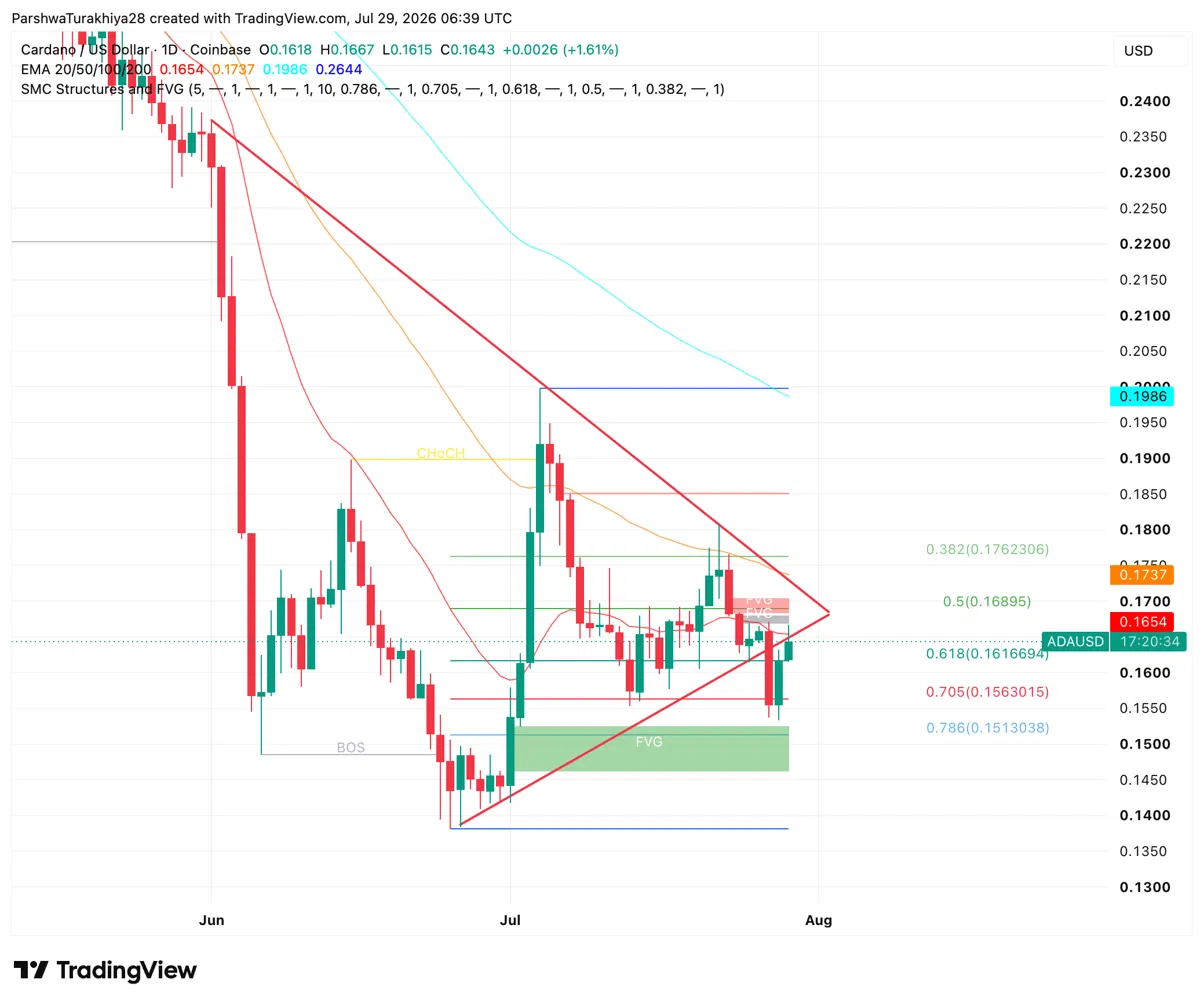
$ADA 1D Price Action (Source: TradingView)

The daily chart shows $ADA bouncing from the fair value gap roughly between $0.1450 and $0.1515 following yesterday's 6.27% drop, which broke through a triangular structure that had been compressing since mid-July. The FVG providing today's bounce sits just above the June lows around $0.1386.

The 20-day EMA at $0.1654 is the immediate ceiling above the current price, followed by the 50-day level at $0.1737. Below price, the SMC 0.705 level at $0.1563 and 0.786 at $0.1513 define the next support levels should the FVG bounce fail to hold.

What Are the Key Support and Resistance Levels for $ADA Today?

Resistance

  1. $0.1654 — 20-day EMA, immediate ceiling
  2. $0.1737 — 50-day EMA
  3. $0.1762 — 0.382 SMC Fibonacci Level
  4. $0.1986 — 100-day EMA level and CHoCH from the July recovery

Support

  1. $0.1617 — 0.618 SMC Fibonacci, current bounce zone
  2. $0.1563 — 0.705 level, next support below
  3. $0.1513 — 0.786 level and upper bound of FVG
  4. $0.1450 — Lower bound of FVG and last floor before June lows

Cheeky Crypto: Selling $ADA Here Could Cost You 800%

Analyst Cheeky Crypto argued in a YouTube video that $ADA at current prices represents an opportunity most investors will miss because they focus on price action rather than blockchain fundamentals. He cited a Claude AI analysis noting that whale wallets accumulated during the 40% market drop in June rather than selling, describing it as behavior historically leading to the largest percentage recoveries in major altcoins after macroeconomic conditions shift. His 800% figure is based on the gap between the current price and Cardano's previous all-time high, viewing the current drawdown as an entry point, not an exit.

He also explained Cardano's zero-fee model for failed transactions, lack of downtime, and increased throughput from Leios as reasons why institutional infrastructure will eventually run through Cardano rather than competitors. In his view, Hoskinson's goal of breaking into the top 10 by the end of 2026 is achievable, but some of today's top 10 altcoins will drop out of the ranking. He acknowledged it's a tall order given the competition.

LuckSide: CLARITY Act Delay Just Blew Up the Week

Analyst LuckSide Crypto pointed directly to two catalysts behind yesterday's 6.27% $ADA drop. The first was Iran's refusal of active talks with the U.S., contradicting weekend reports of a possible ceasefire and triggering over $500 million in crypto market liquidations. The second, which caused the session's late-session selloff, was the Senate tabling the CLARITY Act to prioritize a Russia sanctions bill, pushing the vote to next week and leaving the bill just days ahead of the August 8 recess.

LuckSide noted that over $30 trillion in assets from BlackRock, Fidelity, Schwab, Goldman Sachs, and Franklin Templeton now back the bill, making the political delay even more frustrating for the industry. He noted that Grayscale's spot $ADA ETF application remains stuck awaiting legislative clarity, and that any further signals of delay in the coming days would likely lead to lower prices again. In the immediate term, he is focused on the July 29 FOMC meeting conclusion and whether the Fed holds rates steady as CPI and PPI data suggests.

Cardano Stablecoin Supply Tripled, New Partnership Announced

The supply of stablecoins on the Cardano blockchain has grown from $18 million to over $55 million in the past year, a threefold increase, driven largely by USDC integration, reaching a new all-time high. LuckSide Crypto characterized this figure not as a small number but as proof of active capital entering the Cardano ecosystem despite bearish market sentiment.

Separately, Cardano announced a partnership with Reef Data for co-op payment stream locking, reward distribution, and participant payouts on-chain. Individual co-op members can self-custody their verified data. LuckSide presented this as another step in building real-world infrastructure on the network.

$ADA Price Forecast: Upside and Downside Targets

  • Positive Case: FVG holds, FOMC confirms rate hold on July 29, momentum on the CLARITY Act returns in the final days before August 8, and $ADA reclaims the 20-day EMA at $0.1654 moving towards the 50-day at $0.1737 as Cheeky Crypto's whale accumulation thesis begins translating into price recovery.
  • Negative Case: FVG bounce fails, Iran tensions escalate again, CLARITY Act momentum stalls past the August recess, and $ADA falls towards the SMC 0.705 level at $0.1563 and 0.786 at $0.1513 as the legislative overhang heightens risk-off sentiment through the week's end.
end-content

Трендові криптовалюти

Пов'язані питання

QAccording to the article, what are the two main catalysts mentioned by analyst LuckSide that caused ADA's 6.27% drop?

AThe two main catalysts are 1) Iran's refusal to engage in active ceasefire talks with the US, and 2) The US Senate postponing the CLARITY Act vote for another week, prioritizing a Russian sanctions bill instead.

QWhat is the bullish case for ADA's price as outlined in the article?

AThe bullish case requires the Fair Value Gap (FVG) to hold, the FOMC confirming a rate hold on July 29th, momentum for the CLARITY Act returning before the August 8th recess, and ADA reclaiming key moving averages (the 20-day EMA at $0.1654 and 50-day EMA at $0.1737).

QWhat key fundamental reasons does Cheeky Crypto give for being bullish on Cardano (ADA)?

ACheeky Crypto cites Cardano's fundamental strengths, including its zero-fee model for failed transactions, zero network downtime, and increased throughput from Leios, as reasons why institutional infrastructure will ultimately flow through Cardano.

QWhat recent on-chain development for Cardano does the article highlight as a sign of growing ecosystem activity?

AThe article highlights that the supply of stablecoins on the Cardano blockchain has tripled, growing from $18 million to over $55 million in the past year, primarily driven by the integration of USDCX.

QWhat are the immediate support and resistance levels for ADA based on the technical analysis in the article?

AImmediate resistance is the 20-day EMA at $0.1654, followed by the 50-day EMA at $0.1737. Immediate support is at the 0.618 SMC Fibonacci level at $0.1617, with the next support at the 0.705 SMC level at $0.1563.

Пов'язані матеріали

Qualcomm Chip Price Hike Deals a Blow to Android Phones

Qualcomm has officially announced a new round of price increases for its entire chip portfolio, effective September 1. The hikes, reaching up to 18% for the flagship Snapdragon 8 Elite Gen 6 Pro, follow similar moves by MediaTek, intensifying cost pressures on the already strained smartphone industry. CEO Cristiano Amon confirmed the plan, citing the need to offset rising industry-wide costs and restore declining profit margins. Qualcomm's Q3 FY2026 results showed a 25% drop in net profit, with mobile revenue plunging 20% year-over-year, hitting its lowest level since 2021. The surge in AI computing demand has led memory manufacturers to prioritize HBM production, creating a shortage in general-purpose DRAM and NAND Flash chips. Their prices soared by 93%-98% and 55%-60% respectively in Q1 2026, causing the memory cost share in smartphones to jump from 10%-15% to over 30%. Coupled with the soaring cost of advanced nodes like TSMC's 2nm and packaging, overall chip costs have reached historic highs. These upstream pressures are forcing downstream smartphone brands like Xiaomi, OPPO, and vivo to cut orders for mid-to-low-end models by up to 20% and use cost-saving measures like older chipsets. Reportedly, the Snapdragon 8E5 will be repurposed as a "long-lasting" chip for sub-brand phones in H2 2026. Amid this cost crisis, the Android market remains sluggish. Q2 2026 smartphone shipments in China fell 4.3% year-over-year, marking five consecutive quarters of decline. Major Android brands saw market share drop, while Huawei and Apple, with their in-house chip advantages, gained share. Qualcomm is diversifying into automotive and IoT sectors to reduce reliance on smartphones, but these new segments cannot yet fill the mobile revenue gap. Industry observers warn that the full impact of component cost hikes will hit in the second half of 2026, likely leading to higher-than-expected price increases for Android flagships and a further contraction in the Chinese smartphone market.

marsbit10 хв тому

Qualcomm Chip Price Hike Deals a Blow to Android Phones

marsbit10 хв тому

Breaking: GPT-5.6 Prices Slashed Effective Today

OpenAI has announced significant price cuts for its GPT-5.6 model API, effective immediately. The entry-level **GPT-5.6 Luna** sees the most drastic reduction, with input prices dropping 80% to $0.20 per million tokens and output prices falling to $1.20 per million tokens. The mid-tier **GPT-5.6 Terra** is reduced by 20%, now costing $2.00 (input) and $12.00 (output) per million tokens. The flagship **GPT-5.6 Sol** maintains its original price but introduces a new **Fast mode**, offering speeds up to 2.5 times faster for double the cost. The company attributes these price reductions to efficiency gains achieved through **GPT-5.6 Sol's own involvement in optimizing its production systems**. The model assisted in rewriting GPU kernels and improving speculative decoding, leading to a 20% reduction in end-to-end service costs and over 15% improvement in token generation efficiency. OpenAI emphasizes this process remained human-led. A key focus of the降价 is to lower the barrier for running **AI agent workflows**. By making the capable, tool-calling Luna model significantly cheaper, OpenAI aims to enable more frequent use in cost-sensitive, high-volume tasks like code review and monitoring. This creates a potential feedback loop: model-assisted efficiency gains lead to lower costs, which enables broader agent deployment, which in turn drives further optimization. The new pricing and features will also apply to Codex and ChatGPT Work subscriptions. The changes intensify competition in the large language model market, with OpenAI directly challenging rivals like Anthropic to respond.

marsbit39 хв тому

Breaking: GPT-5.6 Prices Slashed Effective Today

marsbit39 хв тому

South Koreans' 'Gambling Nature' is Actually Forced by Life

This article explores how systemic pressures in South Korea, rather than inherent "gambling" tendencies, drive widespread speculative financial behavior. It begins by noting the high frequency of flights from South Korea to Macau, symbolizing the search for outlets beyond domestic restrictions. The core argument is that ordinary life goals—stable employment, home ownership, and financial security—have become increasingly tied to asset markets due to structural economic factors. South Korea's development model, historically reliant on corporate leverage (chaebols), has evolved into a society where household debt and personal leverage are normalized as pathways to social mobility. Key mechanisms discussed include: * **Housing Policy:** Government measures to improve affordability, like extending mortgage terms to 50 years and the unique *jeonse* (key money) rental system, embed high leverage into the housing market. * **Financial Products:** The recent approval and explosive popularity of single-stock 2x leveraged ETFs (e.g., on Samsung and SK Hynix), easily accessed via mobile apps, lowered barriers to high-risk trading. * **Social Pressure:** Media narratives around soaring corporate profits (e.g., SK Hynix) and employee bonuses create a fear of missing out, pushing individuals to use leverage to "catch up." The article concludes that this "leveraged life" is a product of institutional history and policy choices. When traditional paths to success feel constrained, and policy facilitates debt-based solutions for housing and investment, speculative behavior becomes a rational, if risky, strategy for many. The rapid cycle of regulatory approval for leveraged ETFs followed by a market crash and official apology in mid-2026 exemplifies the system's inherent contradictions. Ultimately, the "bet" is not just on assets, but on using future earnings to secure a place in the present society.

marsbit39 хв тому

South Koreans' 'Gambling Nature' is Actually Forced by Life

marsbit39 хв тому

Торгівля

Спот

Популярні статті

Як купити ADA

Ласкаво просимо до HTX.com! Ми зробили покупку Cardano (ADA) простою та зручною. Дотримуйтесь нашої покрокової інструкції, щоб розпочати свою криптовалютну подорож.Крок 1: Створіть обліковий запис на HTXВикористовуйте свою електронну пошту або номер телефону, щоб зареєструвати обліковий запис на HTX безплатно. Пройдіть безпроблемну реєстрацію й отримайте доступ до всіх функцій.ЗареєструватисьКрок 2: Перейдіть до розділу Купити крипту і виберіть спосіб оплатиКредитна/дебетова картка: використовуйте вашу картку Visa або Mastercard, щоб миттєво купити Cardano (ADA).Баланс: використовуйте кошти з балансу вашого рахунку HTX для безперешкодної торгівлі.Треті особи: ми додали популярні способи оплати, такі як Google Pay та Apple Pay, щоб підвищити зручність.P2P: Торгуйте безпосередньо з іншими користувачами на HTX.Позабіржова торгівля (OTC): ми пропонуємо індивідуальні послуги та конкурентні обмінні курси для трейдерів.Крок 3: Зберігайте свої Cardano (ADA)Після придбання Cardano (ADA) збережіть його у своєму обліковому записі на HTX. Крім того, ви можете відправити його в інше місце за допомогою блокчейн-переказу або використовувати його для торгівлі іншими криптовалютами.Крок 4: Торгівля Cardano (ADA)Легко торгуйте Cardano (ADA) на спотовому ринку HTX. Просто увійдіть до свого облікового запису, виберіть торгову пару, укладайте угоди та спостерігайте за ними в режимі реального часу. Ми пропонуємо зручний досвід як для початківців, так і для досвідчених трейдерів.

1.0k переглядів усьогоОпубліковано 2024.12.10Оновлено 2026.06.02

Як купити ADA

Обговорення

Ласкаво просимо до спільноти HTX. Тут ви можете бути в курсі останніх подій розвитку платформи та отримати доступ до професійної ринкової інформації. Нижче представлені думки користувачів щодо ціни ADA (ADA).

活动图片