In-Depth Report on Web3 Robots Sector: When Machines Become On-Chain Economic Agents

HTX LearnОпубліковано о 2026-04-09Востаннє оновлено о 2026-06-19

Анотація

In 2026, the deep integration of AI, robotics, and Web3 infrastructure is giving rise to an entirely new narrative—the Web3 Robots sector. This sector has moved beyond conceptual hype into a critical phase of real-world application deployment. This report systematically outlines the definition, boundaries, and developmental logic of the Web3 Robots sector, and conducts an in-depth analysis across three layers: the infrastructure layer (operating systems, data layer, network layer), the machine economy layer (tokenized platforms, positioning networks), and the application-deployment layer (DePIN investment)—of representative projects including OpenMind, PrismaX, peaq, Virtuals Protocol, Geodnet, and XMAQUINA. The analysis covers their technical architectures, funding backgrounds, market performance, and participation opportunities. The research reveals that the sector is forming a three-tiered, synergistic architecture: “data-layer training for intelligence - system-layer standardization - network-layer incentive-driven collaboration”. Machines are evolving from closed-off tools into autonomous economic agents with on-chain identities, payment capabilities, and collaborative networks. Although the sector remains in its early stage and primarily focuses on foundational capability building, the emergence of tangible yield cases (e.g., peaq’s robot farm delivering 18% APY) signals a definitive shift from theoretical concept to observable, participable, substantive development. Fo...

I. Sector Definition & Evolutionary Logic: From Automated Tools to On-Chain Economic Agents

Robotics technology is nothing new. Over the past decade, industrial robotic arms, warehouse robots, and drones have achieved large-scale deployment across manufacturing and logistics sectors. Yet these robots remain fundamentally closed-system tools—they execute pre-programmed instructions but lack identity recognition, autonomous decision-making, value exchange, or cross-platform collaboration capabilities. As large AI models endow machines with “thinking” ability and blockchain provides identity and settlement infrastructure, a new paradigm is emerging: machines are no longer mere hardware—they are autonomous economic agents capable of holding on-chain identities, executing transactions independently, and participating in real-world production.
This transformation is driven by technological maturity across three dimensions. First, breakthroughs in embodied AI: large language models and multimodal models have endowed robots with natural language understanding, environmental perception, and task planning capabilities. For example, OpenMind’s OM1 operating system unifies perception, memory, reasoning, and action into a single framework, evolving robots from “capable of movement” to “capable of understanding and thinking”. Second, the rise of decentralized physical infrastructure networks (DePIN): blockchain provides physical devices with decentralized identifiers (DIDs), trusted data recording, and automated settlement, enabling machines to participate in market transactions as economic agents. Third, the maturation of stablecoins and Layer-2 solutions: efficient micropayment infrastructure makes high-frequency, low-value settlements between machines feasible, laying the financial foundation for the Machine Economy.

Forbes’ 2026 forecast states that blockchain will become AI’s trust network—every significant agent action will be recorded on a lightweight ledger, enabling compliance, governance, and accountability. In essence, the Web3 Robots sector is constructing a new economic system wherein machines can prove themselves, trust others, create value, and participate in distribution. This system comprises three architectural layers: the base layer is the OS empowering machine intelligence (e.g., OpenMind OM1); the middle layer is the protocol layer providing identity and collaborative networks (e.g., OpenMind FABRIC, peaq); and the top layer consists of labor markets and tokenized platforms targeting specific applications (e.g., Konnex, Virtuals). Synergy among these three layers is reshaping robots from “tools” into “digital citizens”.

II. Infrastructure Layer: Co-Evolution of Operating Systems, Data, and Networks

Foundational infrastructure development for the Web3 Robots sector is advancing simultaneously across multiple dimensions, with OpenMind’s OS-layer strategy, PrismaX’s data-layer exploration, and peaq’s network-layer construction standing out as most representative. Together, these three projects form a complete infrastructure loop of “system–data–network”, providing the operational bedrock for upper-layer applications.

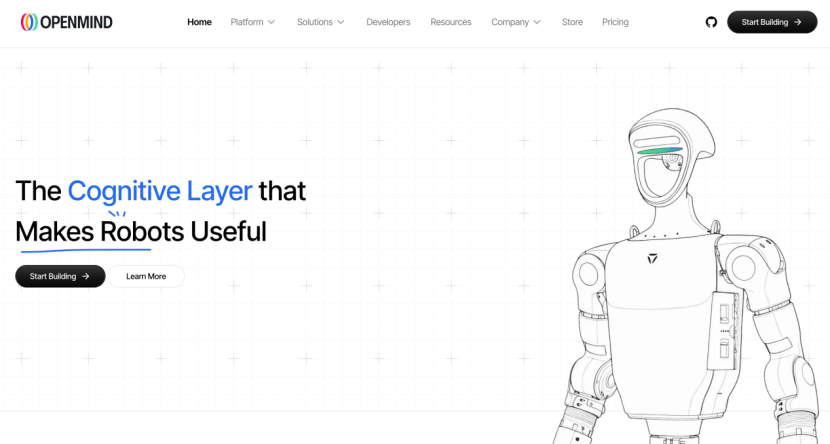
OpenMind is hailed as “Android for robotics”. Its core products include the open-source, AI-native robot operating system OM1 and the decentralized collaboration network FABRIC. OM1, licensed under MIT, has garnered over 2,500 stars on GitHub, attracted more than 500 global contributors, and welcomed over 7,500 independent developers. Unlike traditional robot operating systems (ROS), which focus solely on motion control and navigation, OM1 integrates four core modules—perception, memory, reasoning, and action—and supports advanced functions such as natural language interaction, environment mapping, and object recognition. OM1 has already been adapted for over ten leading hardware manufacturers including Unitree, Fourier Intelligence, UBTECH, and Deep Robotics, covering humanoid robots, quadrupeds, and robotic arms. The FABRIC protocol establishes a decentralized machine collaboration network, assigning each robot an on-chain identity (peaq ID) and supporting inter-machine skill sharing, task coordination, and USDC micropayments. In February 2026, FABRIC Protocol (ROBO) was launched on Binance Alpha and Binance Futures, achieving over $140 million in 24-hour trading volume, and was subsequently listed on OKX, Coinbase, Kraken, and other major exchanges. The project raised about $20 million in August 2025, led by Pantera Capital, with participation from Coinbase Ventures, DCG, and Sequoia China. Its latest valuation stands at approximately $200 million, while its Kaito Launchpad presale reached a $400 million FDV. Current participation avenues include Season 1 points programs, NFT minting on the FABRIC Identity Network, and GitHub code contributions, with strong expectations for upcoming airdrops.
PrismaX is dubbed the “gold mine” of physical-world training data. If algorithms are robots’ “brains”, then data is their “nourishment”. PrismaX targets the AI-robotics data layer, solving the industry’s most scarce resource—“physical-world interaction data”—Reinforcement Learning from Human Feedback (RLHF). Its platform allows users to remotely control real robotic arms via web interface and the system to record those operations, and sell the resulting datasets to robotics companies for AI training, rewarding users with points redeemable for future tokens. This “Play-to-Train” model creates a data flywheel: more users → more data → better models → more users. PrismaX recently closed an $11 million seed round led by top-tier VC a16z, with participation from Virtuals Protocol. Its ecosystem already hosts over 500 participants who’ve completed remote robotic arm operations, and it has deployed two fully functional robotic arm systems (“Tommy” and “Bill” from Unitech Walker). Users earn points via daily check-ins, whitepaper quizzes, or even paid training ($99), with market expectations pointing toward future airdrop distributions. Key risks include potential dilution of point value due to influxes of “airdrop-farming groups", and ongoing industry debate over whether remote-operation data can truly train commercially viable robots.

peaq is the Layer-1 network for the Machine Economy. peaq is a Layer-1 blockchain purpose-built for the Machine Economy, offering core functionalities including machine identity (peaq IDs), on-chain wallets, access control, and nanosecond-level time synchronization and supporting autonomous transactions among millions of robots and devices. Unlike many DePIN projects stuck at the conceptual stage, peaq has already validated a genuine commercial closed loop. Its Hong Kong-based Robo-farm deploys automated robots to grow hydroponic vegetables; users purchase NFTs representing farm equity, and vegetable sales revenue—converted into stablecoins—is distributed directly on-chain to NFT holders. Its first revenue distribution in late January 2026 yielded $3,820 USDT per claim, translating to an annualized return of approximately 18%. This “earn money by selling vegetables—not inflating tokens” model positions peaq as a flagship case of RWA (real-world asset) adoption. Partnerships include Bosch, Mastercard, and Airbus—spanning IoT sensor integration, payment gateway interoperability, and supply chain tracking. Its mainnet was launched in 2024; current circulating market cap stands at $34.25 million or so, with FDV at about $78 million. It hosts 50–60 live DePIN applications connecting over 2 million physical devices. Its native token $PEAQ serves primarily for gas fees and staking. The ongoing “Get Real” campaign offers a $210 million $PEAQ reward pool (valued at >$100 million), allowing users to earn XP/NP and claim tokens by completing real-world DePIN tasks.

The relationship among these three projects mirrors a complete production system: PrismaX supplies the “raw material” (data) for robot training; OpenMind’s OM1 serves as the “operating system” enabling intelligent robot operation; and peaq provides the “network and incentive layer” facilitating economic settlement. Their synergy forms the full infrastructure stack for decentralized embodied intelligence.

III. Financial Layer of the Machine Economy: Tokenized Platforms & Positioning Networks

Once the infrastructure layer resolves “how machines become intelligent” and “how machines collaborate”, the financial layer of the Machine Economy emerges. This layer addresses the core question: how do we price, trade, and circulate machine value? Virtuals Protocol and Geodnet offer distinct answers from complementary angles.

Virtuals Protocol is a tokenization platform for AI agents/robots, enabling community participation in agent issuance, staking, and governance. Its core mechanisms include the Pegasus/Unicorn ecosystem, the Agent Commerce Protocol (ACP) marketplace, and the Butler toolset. The ACP marketplace facilitates trustless commercial transactions among AI agents, supporting fully on-chain task posting, verification, and settlement. In March 2026, Virtuals co-developed the ERC-8183 standard (Agentic Commerce) with the Ethereum Foundation’s dAI team, introducing work primitives featuring on-chain escrow, evaluator certification, and modular hooks, enabling trustless agent-to-agent commerce. Data shows on-chain agent-generated revenue on Virtuals has surpassed $3 million (excluding fees), marking the emergence of verifiable, AI-agent-created economic output at scale. Its native token $VIRTUAL was launched at the end of 2023, currently commanding a $500 million or so market cap and being listed on major CEXs like Gate.io. Its weekly Epoch airdrop program remains active, allocating rewards based on veVIRTUAL staking and Butler usage: 2% to stakers, 3% to ecosystem participants. Early 2026 saw Virtuals partner with OpenMind’s FABRIC protoco, enabling robots to acquire economic identity via FABRIC, receive tasks from agents and settle them on-chain via ACP, achieving deep integration between the machine economy layer and infrastructure layer.

Geodnet is dubbed the centimeter-accurate navigation infrastructure for robots. Built on Solana, Geodnet is a decentralized high-precision positioning network delivering RTK (Real-Time Kinematic) centimeter-grade navigation services for robots, drones, and autonomous vehicles. Its network comprises globally distributed reference stations; node operators earn $GEOD tokens by deploying hardware, while users subscribe to access positioning data. Geodnet’s business model exhibits classic “real yield” traits: 80% of data revenue funds $GEOD buybacks and burns, creating a deflationary mechanism. At CES 2026 in January, Geodnet showcased its Geoswarm home-security drone, which autonomously launches from a compact rooftop docking station, patrols using GEODNET’s high-precision positioning data, and returns to dock without human intervention. Additionally, Geodnet launched consumer-facing RTK automotive hardware ($150) and an RTK survey receiver ($695), with the latter winning a CES Innovation Award. Geodnet has raised over $15 million total, including a round led by Multicoin Capital. Its token has migrated from Polygon to Solana and is now tradable on Coinbase. For investors, Geodnet’s buyback-and-burn mechanism and real hardware sales provide fundamental value support; notable ongoing incentives include node deployment rewards and staking yields.

From the financial-layer perspective, Virtuals Protocol solves the “liquidity” problem for AI agents, enabling agent capabilities to be tokenized, traded, and priced; Geodnet solves robots’ “spatial awareness” problem, enabling precise physical-world localization and navigation. Together, they expand the boundaries of the Machine Economy: the former allows machine value to flow within the digital world; the latter ensures machine activity in the physical world becomes more accurate and reliable.

IV. Application-Deployment Layer: From DePIN Investment to Real-World Assets

The infrastructure and financial layers constitute the “skeleton” and “blood” of the Web3 Robots sector, but what ultimately determines its vitality is whether the application-deployment layer can generate value in the real world. XMAQUINA and Robonomics explore this proposition from divergent angles.

XMAQUINA is a DAO-governed robot investment bank. XMAQUINA is a DePIN project that invests in and tokenizes real humanoid robot companies through DAO governance, allowing token holders to share in the companies’ earnings. Its core mechanisms include the “Robotics Bank” and the “Machine Economy Launchpad”. The DAO allocates capital to promising robotics startups (e.g., Apptronik, Figure AI) and manages them via specialized SubDAOs. In January 2026, XMAQUINA completed its final public auction, raising over $3.25 million from the community in less than 30 minutes, bringing its cumulative fundraising to $10 million. Its native token $DEUS was scheduled for TGE activation in January–February 2026, with 33% unlocked at launch and 67% released linearly. Current participation paths include holding $DEUS for governance voting and profit-sharing, monitoring DAO proposals and staking mechanisms, and preparing for upcoming Launchpad project listings. XMAQUINA’s model is essentially a “robotics-focused investment fund”, lowering the barrier for retail investors to participate in early-stage robotics company investments while decentralizing investment decisions via DAO governance.

Robonomics represents the earliest Web3 robot coordination platform. A pioneer in Web3 robotics since launching its testnet back in 2018, Robonomics provides cloud robotics services and smart-contract-based task assignment. Its core capabilities include IoT device integration, sensor data on-chain recording, and automated task execution. Its native token $XRT was launched in 2019 and trades on exchanges including Kraken, but maintains a relatively small market cap, making it an established project within the sector. Compared to newer entrants, Robonomics’ ecosystem is comparatively mature yet growth-stagnant, lacking recent large-scale airdrops or incentive campaigns, making it better suited for long-term observers focused on IoT-robotics integration.

Notably, innovative models are emerging across the application-deployment layer. peaq’s “Universal Basic Ownership Pilot” explores inclusive ownership of machine assets, while its tokenized machine deployment mechanism enables ordinary users to invest in and share profits from robot operations. Meanwhile, Virtuals’ ecosystem has given birth to agents like ArAIstotle ($FACY), achieving 382,000 queries, possessing 8,000 users, and generating $760,000 in tax revenue with ACP monthly growth surging 413x MoM, demonstrating the immense potential of the AI agent economy.

V. Challenges, Risks, and Future Outlook

Although the Web3 Robots sector holds vast promise, it remains in its infancy and faces multiple challenges and risks.

Technically, the sector still faces bottlenecks in hardware reliability and environmental adaptability. As OpenMind founder Jan Liphardt notes, reliability of critical components like dexterous hands remains a challenge: a five-fingered, 12-degree-of-freedom robotic hand failing after just 100 hours of operation would severely undermine its practical utility. Moreover, gaps between simulation tools and real environments as well as voice-interaction simulation requirements for social robots demand sustained engineering effort.

Valuation-wise, some projects face high-valuation/low-circulation risk. Take OpenMind for instance, its Kaito Launchpad presale is valued the project at $400 million FDV, doubling its prior round valuation ($200 million), potentially overextending secondary-market upside and exposing it to sell pressure from early VC unlocks. Investors must remain wary of projects where “narrative premiums” far exceed actual deployment progress.

Data-quality-wise, data-layer projects like PrismaX confront risks from “airdrop-farming groups" flooding in the system. If teams fail to effectively filter high-quality training data, points lose value, triggering sharp sell-offs during airdrops. Balancing user incentives with data integrity remains a universal challenge for all data-layer projects.

On the competition landscape, traditional robotics vendors favor closed systems (e.g., Tesla Optimus), akin to Apple’s iOS model. Whether open-source “Android-style” alternatives like OpenMind can survive amid tech giants hinges on their ability to attract sufficient mid-tier hardware vendors to build collective ecosystem momentum.

Looking ahead, the Web3 Robots sector will evolve along three primary trajectories: First, standardization. A2A (Agent-to-Agent) communication protocols are becoming the universal language for robots and agents. Just as HTTP unified the early internet, A2A will serve as the foundational communication layer for the autonomous world. Second, real yield. The peaq robot farm demonstrates that Web3 robotics projects can generate genuine cash flow independent of token inflation. More projects will explore “Device-as-a-Service” and “Robot-as-an-Asset” business models. Third, compliance and governance. As robots deepen economic participation, regulators will demand explainability and traceability for AI decisions. Blockchain’s immutable ledger will become critical infrastructure for meeting compliance requirements.

VI. Conclusion: Participation Strategy & Investment Logic

The Web3 Robots sector stands at a pivotal inflection point of transitioning from proof-of-concept to scalable application. For investors and ecosystem participants, the core strategic imperative today is to prioritize foundational capability building, track real-world deployment scale, and seize early participation opportunities.

On the ecosystem side, infrastructure-layer projects (OpenMind, peaq) offer higher certainty and moats, but valuations may already partially reflect expectations; data-layer projects (PrismaX) offer high optionality alongside data-quality risks; financial-layer (Virtuals) and application-layer (XMAQUINA) projects depend more heavily on ecosystem vitality and community engagement.

Reflecting on the mobile industry’s evolution from “copycat phone era” to the “Android/iOS duopoly”, the Web3 robotics sector may be experiencing a similar nascent phase. As OpenMind’s founder observes, there won’t be just one winner, rather, many strong players will emerge. For investors tracking this space, it is the optimal window now for observation, learning, and selective participation. The future of machines as on-chain economic agents is no longer science fiction, rather, it’s becoming reality.


Трендові криптовалюти

Пов'язані матеріали

Conversation with Investor Zheng Di: MicroStrategy's Coin Sale Experiment, AI Economy, and Opportunities in US Stocks

Frontier tech investor Zheng "Didier" Di discusses the recent Bitcoin price drop, the financial strategy shift at MicroStrategy, the AI-driven surge in U.S. stocks, and the evolving role of crypto exchanges. Didier posits that the recent BTC decline stems less from macro factors or ETF outflows, and more from market repricing due to MicroStrategy's new financial structure. Following a wave of preferred stock and debt issuance (STRC, STRZ, etc.), MicroStrategy must now manage cash flow to pay dividends, potentially leading to a market expectation of sustained, small-scale BTC sales to maintain its "per-share bitcoin neutral" principle. Didier views this as a financial "experiment" testing market capacity for such recurring sell pressure, which, while creating near-term structural headwinds, likely avoids a true "death spiral" absent major new external shocks. Shifting to AI, Didier argues that tokens are becoming the new form of labor, with AI models and compute (tokenized inputs) increasingly replacing human roles in execution and middle-management. This drives enterprise efficiency and higher margins, fueling the sustained rally in U.S. semiconductor, data center, and infrastructure stocks. He foresees an emerging "machine economy" where automated agents transact and collaborate on-chain. Regarding crypto exchanges offering U.S. equities, Didier sees this as a natural evolution. With few crypto-native assets generating lasting value, exchanges are pivoting towards real-world assets (RWAs) like stocks and bonds. This doesn't necessarily cannibalize crypto but reflects a maturing industry focusing on blockchain's core utilities: decentralized choice and efficient settlement. He notes that trading logic for crypto natives doesn't need to drastically change, as meme-driven and fundamentalist strategies find analogs in U.S. markets. The "1011 event" (likely referring to a major market crash) severely damaged crypto market liquidity, marking a probable end to the altcoin speculative cycle, with capital flowing towards the deeper liquidity of U.S. markets. For the macro outlook, Didier is cautious about near-term market pressure from potential mega-IPOs (e.g., SpaceX) and the U.S. midterm elections, which could bring more regulatory scrutiny. Long-term, he remains bullish on AI's productivity gains and its convergence with blockchain/Web3, predicting a shift from speculative frenzy to a more institutionalized, industrial phase for the crypto sector.

marsbit32 хв тому

Conversation with Investor Zheng Di: MicroStrategy's Coin Sale Experiment, AI Economy, and Opportunities in US Stocks

marsbit32 хв тому

Playnance’s $GCOIN Lists on KoinBX Amid Rapid Growth in India

Playnance's native token, $GCOIN, has been listed on the cryptocurrency exchange KoinBX as of June 18. This move aims to enhance accessibility for its rapidly growing community, particularly in India, where the blockchain-powered Web3 iGaming ecosystem has gained significant traction. Over 130 partners in Playnance's "Be the Boss" program have built communities engaging thousands of active players in the region. The "Be the Boss" model allows participants to create and manage their own gaming communities, earning rewards tied to community activity. CEO Pini Peter noted India's high engagement, with community leaders successfully building player networks. One partner, Dr. Nicolas, reported earning over $57,000 through the program in recent months, highlighting both the financial rewards and the opportunity to grow an engaged community. $GCOIN serves as the ecosystem's core utility token, incentivizing participation and aligning the interests of players and community leaders ("Bosses"). The listing on KoinBX is part of Playnance's strategy to expand globally, increasing the token's utility and accessibility by combining community ownership, gamified engagement, and blockchain-based incentives. Founded in 2020, Playnance is a Web3 iGaming infrastructure company focused on creating live, non-custodial, on-chain products to onboard mainstream users. It currently processes approximately one million transactions daily, aiming to simplify the user experience while maintaining full on-chain transparency.

TheNewsCrypto1 год тому

Playnance’s $GCOIN Lists on KoinBX Amid Rapid Growth in India

TheNewsCrypto1 год тому

STRC Hits Historic Low, Saylor's Perpetual Motion Machine Grinds to a Halt

STRC, the perpetual preferred stock issued by MicroStrategy to fund its Bitcoin purchases, hit a historic low of $85.32, a 17% discount to its $100 par value. Designed as a "digital credit engine" to trade stably near par and enable continuous share issuance for buying Bitcoin, its plunge signals a breakdown in this model. Three key factors drove the decline: 1. Bitcoin's price fell over 50% from its peak, trading around $63,000 amid hawkish Fed signals. 2. MicroStrategy's cash reserves were depleted after a $1.5 billion convertible note repayment, slashing the dividend coverage for STRC's 11.5% yield to ~7 months. The company then sold 32 BTC to cover dividends—Michael Saylor's first Bitcoin sale since 2022—damaging the "never sell" narrative. 3. A competing Bitcoin-backed preferred stock, Strive's SATA, offers a higher yield (~13%) and daily dividends, drawing investors away from STRC. The drop triggers a negative cycle: STRC below par halts ATM share issuances, cutting off a key funding source for Bitcoin buys and potentially forcing more BTC sales for dividends, further eroding confidence. While Saylor argues the model is mathematically sound—needing only 2.3% annual Bitcoin growth to sustain itself—the market is testing the resilience of the leveraged Bitcoin treasury strategy in a bear market. The STRC price now reflects rising skepticism about this financial machinery's durability during downturns.

marsbit1 год тому

STRC Hits Historic Low, Saylor's Perpetual Motion Machine Grinds to a Halt

marsbit1 год тому

A Guide to Grayscale’s ‘Bottom Fishing’: Using Cash Flow to Assess Cryptocurrency Value

**Title:** Grayscale's Guide to Bottom-Fishing: Valuing Cryptoassets Using Cash Flows **Summary:** This report by Grayscale Research presents a fundamental valuation framework for cryptocurrency assets, moving beyond pure speculation to analyze those with underlying cash flows. It distinguishes between "commodity-like" assets (e.g., Bitcoin) and "cash-flow" assets, primarily within DeFi. Using the leading decentralized lending protocol Aave as a case study, the analysis applies traditional financial methodologies like Discounted Cash Flow (DCF) and Price-to-Earnings (P/E) multiples. Key findings indicate that AAVE tokens are currently undervalued. Despite recent challenges, the protocol's strong revenue growth, ~50% net profit margin, and diversified treasury support a fundamental valuation range of $80-$100 per token (compared to a ~$75 market price at the time of writing). In a base-case scenario driven by stablecoin adoption and regulatory clarity, the fair value could rise to around $175 within a year. The report emphasizes that protocol success does not automatically translate to token value. It critically examines the "value capture" mechanisms—such as buybacks, burns, and staking rewards—that channel protocol profits to token holders. Furthermore, it addresses the legal and governance complexities of Decentralized Autonomous Organizations (DAOs), noting their difference from traditional corporate equity but highlighting how robust, transparent governance can align protocol economics with holder interests. The conclusion is that the crypto market is maturing, with capital increasingly flowing towards projects with demonstrable fundamentals, real adoption, and disciplined capital allocation, creating opportunities for value-based investors.

marsbit2 год тому

A Guide to Grayscale’s ‘Bottom Fishing’: Using Cash Flow to Assess Cryptocurrency Value

marsbit2 год тому

Торгівля

Спот
Ф'ючерси

Популярні статті

Що таке ETH 2.0

ETH 2.0: Нова ера для Ethereum Вступ ETH 2.0, широко відомий як Ethereum 2.0, є величезним оновленням для блокчейну Ethereum. Ця трансформація не є лише косметичною зміною; вона має на меті фундаментально покращити масштабованість, безпеку та сталий розвиток мережі. З переходом від енергомісткого механізму консенсусу Proof of Work (PoW) до більш ефективного Proof of Stake (PoS), ETH 2.0 обіцяє трансформаційний підхід до екосистеми блокчейнів. Що таке ETH 2.0? ETH 2.0 — це збірка особливих, взаємопов’язаних оновлень, спрямованих на оптимізацію можливостей та продуктивності Ethereum. Це перетворення розроблене для вирішення критичних викликів, з якими стикалося існуюче механізм Ethereum, зокрема щодо швидкості транзакцій та заторів у мережі. Мета ETH 2.0 Основні цілі ETH 2.0 зосереджені на покращенні трьох ключових аспектів: Масштабованість: Мета — значно підвищити кількість транзакцій, які мережа може обробити за секунду; ETH 2.0 прагне вийти за межі поточного обмеження приблизно в 15 транзакцій на секунду, потенційно досягнувши тисяч. Безпека: Підвищені заходи безпеки є невід’ємною частиною ETH 2.0, зокрема через покращену стійкість до кібератак і збереження децентралізованої етики Ethereum. Сталий розвиток: Новий механізм PoS розроблений не тільки для підвищення ефективності, але й для різкого зменшення споживання енергії, що узгоджує операційну структуру Ethereum з екологічними міркуваннями. Хто є творцем ETH 2.0? Створення ETH 2.0 можна віднести до Ethereum Foundation. Ця неприбуткова організація, яка відіграє важливу роль у підтримці розвитку Ethereum, очолюється відомим співавтором Віталіком Бутеріним. Його бачення більш масштабованого та стійкого Ethereum стало рушійною силою цього оновлення, залучаючи внески зі всього світу від розробників і ентузіастів, які прагнуть покращити протокол. Хто є інвесторами ETH 2.0? Хоча подробиці про інвесторів ETH 2.0 не були оприлюднені, відомо, що Ethereum Foundation отримує підтримку від різних організацій та осіб у сфері блокчейну та технологій. Ці партнери включають венчурні капітальні компанії, технологічні компанії та філантропічні організації, які мають спільний інтерес у підтримці розвитку децентралізованих технологій та інфраструктури блокчейну. Як працює ETH 2.0? ETH 2.0 відзначається введенням низки ключових функцій, які відрізняють його від попередника. Proof of Stake (PoS) Перехід до механізму консенсусу PoS є одним із знакових змін ETH 2.0. На відміну від PoW, який покладається на енергомісткий видобуток для перевірки транзакцій, PoS дозволяє користувачам підтверджувати транзакції та створювати нові блоки відповідно до кількості ETH, яку вони ставлять у мережі. Це призводить до підвищення енергоефективності, зменшуючи споживання приблизно на 99,95%, завдяки чому Ethereum 2.0 стає значно більш екологічною альтернативою. Шардові ланцюги Шардові ланцюги є ще одним ключовим нововведенням ETH 2.0. Ці менші ланцюги працюють паралельно з основним ланцюгом Ethereum, що дозволяє обробляти кілька транзакцій одночасно. Це підходи покращує загальну ємність мережі, усуваючи проблеми масштабованості, які переслідували Ethereum. Beacon Chain У центрі ETH 2.0 знаходиться Beacon Chain, яка координує мережу і управляє протоколом PoS. Вона виконує роль організатора: контролює валідаторів, забезпечує з’єднання шард з мережею і моніторить загальний стан екосистеми блокчейнів. Хронологія ETH 2.0 Шлях ETH 2.0 характеризується кількома ключовими етапами, які відображають еволюцію цього значного оновлення: Грудень 2020: Запуск Beacon Chain ознаменував введення PoS, проклавши шлях до міграції на ETH 2.0. Вересень 2022: Завершення "Злиття" є знаковим моментом, коли мережа Ethereum успішно перейшла з PoW на PoS, відкриваючи нову еру для Ethereum. 2023: Очікуване розгортання шардових ланцюгів має на меті подальше покращення масштабованості мережі Ethereum, закріплюючи ETH 2.0 як надійну платформу для децентралізованих додатків і послуг. Ключові особливості та переваги Покращена масштабованість Однією з найзначніших переваг ETH 2.0 є його покращена масштабованість. Поєднання PoS та шардових ланцюгів дозволяє мережі розширити свою ємність, що дозволяє їй обробляти набагато більший обсяг транзакцій в порівнянні з класичною системою. Енергоефективність Запровадження PoS є величезним кроком до енергоефективності в технології блокчейн. Значно зменшуючи споживання енергії, ETH 2.0 не тільки знижує операційні витрати, але також ближче узгоджується з глобальними цілями сталого розвитку. Підвищена безпека Оновлені механізми ETH 2.0 сприяють підвищенню безпеки по всій мережі. Впровадження PoS, поряд з інноваційними контрольними заходами, встановленими через шардові ланцюги та Beacon Chain, забезпечує вищий рівень захисту від потенційних загроз. Зниження витрат для користувачів З покращенням масштабованості вплив на витрати на транзакції також стане очевидним. Збільшена ємність і зменшені затори, як очікується, призведуть до зниження зборів для користувачів, що зробить Ethereum більш доступним для повсякденних транзакцій. Висновок ETH 2.0 є значною еволюцією в екосистемі блокчейну Ethereum. Оскільки він вирішує важливі питання, такі як масштабованість, споживання енергії, ефективність транзакцій і загальна безпека, важливість цього оновлення не можна недооцінювати. Перехід до Proof of Stake, введення шардових ланцюгів і фундаментальна робота Beacon Chain свідчать про майбутнє, в якому Ethereum може задовольнити зростаючі вимоги децентралізованого ринку. В індустрії, що рухається вперед завдяки інноваціям та прогресу, ETH 2.0 є підтвердженням можливостей технології блокчейн у прокладенні шляху до більш сталого та ефективного цифрового економіки.

173 переглядів усьогоОпубліковано 2024.04.04Оновлено 2024.12.03

Що таке ETH 2.0

Що таке ETH 3.0

ETH3.0 та $eth 3.0: Глибоке дослідження майбутнього Ethereum Вступ У швидко змінюваному світі криптовалют та технології блокчейн, ETH3.0, часто позначуваний як $eth 3.0, став темою значного інтересу та спекуляцій. Цей термін охоплює два основні концепти, які потребують уточнення: Ethereum 3.0: Це потенційне майбутнє оновлення, яке має на меті покращення можливостей існуючого блокчейну Ethereum, зокрема, фокусуючись на поліпшенні масштабованості та продуктивності. ETH3.0 Мем Токен: Цей окремий криптовалютний проект прагне використовувати блокчейн Ethereum для створення екосистеми, орієнтованої на меми, сприяючи залученню до криптовалютної громади. Розуміння цих аспектів ETH3.0 є важливим не лише для криптоентузіастів, але й для тих, хто спостерігає за широкими технологічними тенденціями у цифровому просторі. Що таке ETH3.0? Ethereum 3.0 Ethereum 3.0 пропонується як оновлення вже існуючої мережі Ethereum, яка стала основою багатьох децентралізованих додатків (dApps) та смарт-контрактів з моменту свого виникнення. Передбачувані удосконалення зосереджені в основному на масштабованості — інтегруючи передові технології, такі як шардінг та нульові знання (zk-докази). Ці технологічні нововведення націлені на забезпечення безпрецедентної кількості транзакцій на секунду (TPS), потенційно досягаючи мільйонів, тим самим вирішуючи одну з найзначніших обмежень, з якими стикається сучасна технологія блокчейн. Покращення є не лише технічним, а й стратегічним; воно спрямоване на підготовку мережі Ethereum до широкого прийняття та корисності в майбутньому, позначеному збільшеним попитом на децентралізовані рішення. ETH3.0 Мем Токен На відміну від Ethereum 3.0, ETH3.0 Мем Токен пропонує легшу та грайливішу домену, поєднуючи культуру інтернет-мемів із динамікою криптовалют. Цей проект дозволяє користувачам купувати, продавати та обмінювати меми на блокчейні Ethereum, надаючи платформу, яка сприяє залученню громади через креативність та спільні інтереси. ETH3.0 Мем Токен має на меті продемонструвати, як технологія блокчейн може перетинатися з цифровою культурою, створюючи випадки використання, які є водночас розважальними та фінансово життєздатними. Хто є творцем ETH3.0? Ethereum 3.0 Ініціатива щодо Ethereum 3.0 переважно підтримується консорціумом розробників та дослідників у межах громади Ethereum, зокрема, до складу якого входить Джастін Дрейк. Відомий своїми думками та внеском у розвиток Ethereum, Дрейк є помітною особистістю в обговореннях щодо переходу Ethereum на новий рівень консенсусу, який називається «Beam Chain». Цей колабораційний підхід до розробки свідчить про те, що Ethereum 3.0 не є продуктом єдиного творця, а скоріше втіленням колективної винахідливості, спрямованої на просування технології блокчейн. ETH3.0 Мем Токен Деталі про творця ETH3.0 Мем Токена наразі не відстежуються. Природа мем-токенів часто призводить до більш децентралізованої та громартової структури, що може пояснити відсутність специфічної атрибуції. Це узгоджується з етикою ширшої крипто-спільноти, де інновації часто виникають з колективних, а не індивідуальних зусиль. Хто є інвесторами ETH3.0? Ethereum 3.0 Підтримка Ethereum 3.0 переважно надходить від Фонду Ethereum поряд з ентузіастичною спільнотою розробників та інвесторів. Це базове співробітництво надає значний градус легітимності та підвищує ймовірність успішної реалізації, оскільки воно використовує довіру та авторитет, накопичені за роки роботи мережі. У швидко змінюваному кліматі криптовалют підтримка громади займає важливу роль у розвитку та прийнятті, позиціонуючи Ethereum 3.0 як серйозного конкурента для майбутніх блокчейн-інновацій. ETH3.0 Мем Токен Хоча наразі доступні джерела не надають явної інформації щодо інвестиційних фондів або організацій, що підтримують ETH3.0 Мем Токен, це свідчить про типову модель фінансування для мем-токенів, яка часто спирається на підтримку знизу та залучення громади. Інвестори в такі проекти зазвичай складаються з осіб, які мотивовані потенціалом інновацій, що керуються спільнотою, та духом співпраці, притаманним крипто-спільноті. Як працює ETH3.0? Ethereum 3.0 Відмінні риси Ethereum 3.0 полягають у його запропонованій реалізації технології шардінгу та zk-proof. Шардінг — це метод розподілу блокчейну на менші, керовані частини чи «шарди», які можуть обробляти транзакції одночасно, а не послідовно. Це децентралізоване оброблення допомагає запобігти заторам та забезпечити оперативність мережі навіть під великим навантаженням. Технологія нульових доказів (zk-proof) надає ще один рівень складності, дозволяючи валідацію транзакцій без розкриття підпорядкованих даних. Цей аспект не лише підвищує конфіденційність, а й збільшує загальну ефективність мережі. Також обговорюється включення нульової Ефірної віртуальної машини (zkEVM) в це оновлення, що ще більше підвищить можливості та корисність мережі. ETH3.0 Мем Токен ETH3.0 Мем Токен виділяється завдяки використанню популярності культури мемів. Він створює ринок, на якому користувачі можуть брати участь у торгівлі мемами не лише для розваги, але й для потенційного економічного вигоди. Інтегруючи функції, такі як стейкінг, забезпечення ліквідності та механізми управління, проект сприяє створенню середовища, яке заохочує взаємодію та участь громади. Пропонуючи унікальне поєднання розваг та економічних можливостей, ETH3.0 Мем Токен прагне залучити різну аудиторію, яка охоплює від криптоентузіастів до casual-консумерів мемів. Хронологія ETH3.0 Ethereum 3.0 11 листопада 2024: Джастін Дрейк натякає на майбутнє оновлення ETH 3.0, яке зосереджене на поліпшеннях масштабованості. Це оголошення означає початок формальних обговорень щодо майбутньої архітектури Ethereum. 12 листопада 2024: Очікується, що запропоновану пропозицію для Ethereum 3.0 буде представлено на Devcon у Бангкоку, що готує ґрунт для більш широкого зворотного зв'язку від громади та потенційних наступних кроків у розвитку. ETH3.0 Мем Токен 21 березня 2024: ETH3.0 Мем Токен офіційно потрапляє у список на CoinMarketCap, що означає його дебют у публічному крипто-просторі та підвищує видимість для його меморієнтованої екосистеми. Ключові моменти На завершення, Ethereum 3.0 представляє значну еволюцію в межах мережі Ethereum, зосереджуючись на подоланні обмежень щодо масштабованості та продуктивності через передові технології. Його запропоновані оновлення відображають проактивний підхід до майбутніх вимог і корисності. Натомість ETH3.0 Мем Токен втілює суть культури, керованої громадою, у сфері криптовалют, використовуючи культуру мемів для створення привабливих платформ, які заохочують творчість і участь користувачів. Розуміння окремих цілей і функцій ETH3.0 та $eth 3.0 є надзвичайно важливим для кожного, хто цікавиться поточними подіями в крипто-просторі. З обома ініціативами, які прокладають унікальні шляхи, вони разом підкреслюють динамічну та багатогранну природу інновацій у блокчейн-технологіях.

162 переглядів усьогоОпубліковано 2024.04.04Оновлено 2024.12.03

Що таке ETH 3.0

Як купити ETH

Ласкаво просимо до HTX.com! Ми зробили покупку Ethereum (ETH) простою та зручною. Дотримуйтесь нашої покрокової інструкції, щоб розпочати свою криптовалютну подорож.Крок 1: Створіть обліковий запис на HTXВикористовуйте свою електронну пошту або номер телефону, щоб зареєструвати обліковий запис на HTX безплатно. Пройдіть безпроблемну реєстрацію й отримайте доступ до всіх функцій.ЗареєструватисьКрок 2: Перейдіть до розділу Купити крипту і виберіть спосіб оплатиКредитна/дебетова картка: використовуйте вашу картку Visa або Mastercard, щоб миттєво купити Ethereum (ETH).Баланс: використовуйте кошти з балансу вашого рахунку HTX для безперешкодної торгівлі.Треті особи: ми додали популярні способи оплати, такі як Google Pay та Apple Pay, щоб підвищити зручність.P2P: Торгуйте безпосередньо з іншими користувачами на HTX.Позабіржова торгівля (OTC): ми пропонуємо індивідуальні послуги та конкурентні обмінні курси для трейдерів.Крок 3: Зберігайте свої Ethereum (ETH)Після придбання Ethereum (ETH) збережіть його у своєму обліковому записі на HTX. Крім того, ви можете відправити його в інше місце за допомогою блокчейн-переказу або використовувати його для торгівлі іншими криптовалютами.Крок 4: Торгівля Ethereum (ETH)Легко торгуйте Ethereum (ETH) на спотовому ринку HTX. Просто увійдіть до свого облікового запису, виберіть торгову пару, укладайте угоди та спостерігайте за ними в режимі реального часу. Ми пропонуємо зручний досвід як для початківців, так і для досвідчених трейдерів.

3.2k переглядів усьогоОпубліковано 2024.12.10Оновлено 2026.06.02

Як купити ETH

Обговорення

Ласкаво просимо до спільноти HTX. Тут ви можете бути в курсі останніх подій розвитку платформи та отримати доступ до професійної ринкової інформації. Нижче представлені думки користувачів щодо ціни ETH (ETH).

活动图片