# Subscription İlgili Makaleler

HTX Haber Merkezi, kripto endüstrisindeki piyasa trendleri, proje güncellemeleri, teknoloji gelişmeleri ve düzenleyici politikaları kapsayan "Subscription" hakkında en son makaleleri ve derinlemesine analizleri sunmaktadır.

When 500 Million People Abandon ChatGPT

ChatGPT's Global AI Assistant Market Share Drops Below 50% Three and a half years after its groundbreaking launch, ChatGPT faces a pivotal moment. While it remains the largest AI assistant globally, its market share has fallen below 50% for the first time, reaching 46.4% as of May, according to Sensor Tower's 2026 AI landscape report. Google's Gemini (27.7%) and Anthropic's Claude (10.3%) are now its main competitors, with Grok, Perplexity, and others also gaining ground. The market has evolved from awe and initial adoption into a phase of product comparison, ecosystem integration, and commercialization. User behavior has matured significantly. Loyalty is low; users readily switch between assistants for specific tasks. Gemini benefits from deep integration within Google's ecosystem (Search, Gmail, Android), while Claude has carved a niche among productivity-focused users with strong retention, nearly matching ChatGPT's. User choice is now influenced by a complex mix of capability, ecosystem, price, use case, and even brand trust. Commercialization is accelerating. AI app downloads continue but growth is slowing, while user spending is rising. Over $4.2 billion was spent in-app during H1 2026. Claude leads in premium subscription conversion rates (13%). OpenAI is expanding its revenue streams, testing ads shown to 17% of ChatGPT users daily by May. This shift highlights the immense financial pressure of model training and inference costs. Despite revenue growth, OpenAI's cash burn is intense, reaching $3.7 billion in Q1 2026. The company projects this could rise to $25-57 billion in the coming years, underscoring the industry-wide challenge of scaling profitably. The symbolism is clear: ChatGPT no longer defines the AI assistant market alone. The era of a single dominant product is over. Gemini, Claude, and specialized tools are collectively shaping user habits and business models. As AI assistants move from novelty to utility—judged on accuracy, efficiency, and value—they are becoming embedded in everyday digital life. ChatGPT may have lost its majority, but AI as a whole is winning, entering a mature, competitive, and diverse new phase.

marsbit2 saat önce
When 500 Million People Abandon ChatGPT

marsbit2 saat önce

ChatGPT Loses Half Its Market: From Monopoly to Shared Market in Three and a Half Years

In a landmark shift three and a half years after its debut, ChatGPT's global market share in the AI assistant market has fallen below 50% for the first time, dropping to 46.4% as of May 2026. This signals the end of its initial dominance, with the market now diversifying among competitors like Gemini (27.7%) and Claude (10.3%). The report from Sensor Tower indicates the AI assistant landscape has matured from a phase of awe and experimentation into one of product comparison, ecosystem integration, and monetization. Users are increasingly pragmatic, readily switching between assistants based on specific use cases, brand trust, and value propositions. The industry is moving past the "free lunch" era, with users demonstrating a willingness to pay for premium features, driving significant in-app expenditure. Major players are adopting varied monetization strategies: Claude boasts a high subscription conversion rate, while ChatGPT is increasingly testing ads and shopping integrations to complement its subscription revenue. However, this growth comes with immense costs, as exemplified by OpenAI's soaring cash burn for model training and infrastructure. While ChatGPT remains the largest single player, its declining share symbolizes a broader normalization of AI. The technology is no longer a novelty but an integral, scrutinized part of daily digital life, judged on practical utility, price, and seamless integration. The battle has shifted from proving AI's potential to competing in a crowded field where no single product holds a permanent monopoly.

marsbit06/18 05:51

ChatGPT Loses Half Its Market: From Monopoly to Shared Market in Three and a Half Years

marsbit06/18 05:51

How Much of the Subscription Fee You Pay to Claude Can Optical Module Companies Get?

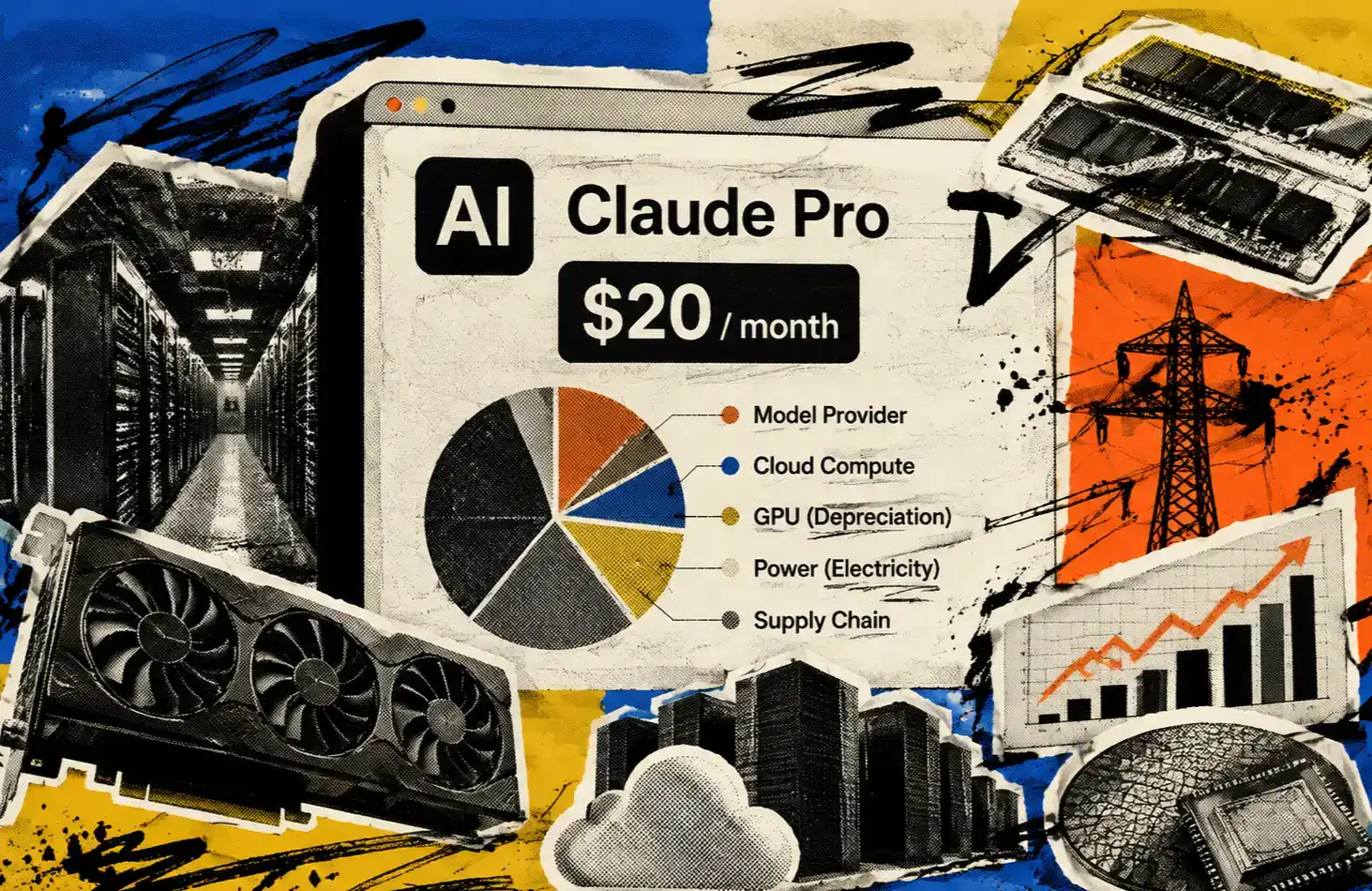
How much of your $20 Claude Pro subscription actually goes to AI model companies like Anthropic? A viral breakdown image highlights the fundamental valuation challenge for AI applications versus traditional SaaS. Unlike SaaS with high software margins, AI subscriptions face variable "inference costs": every user query consumes GPU time, power, and cloud resources. This creates a tension between fixed subscription fees and usage-driven expenses. While the specific dollar splits are illustrative, the core question is whether AI revenue can achieve SaaS-like margins as usage scales. Currently, infrastructure providers (cloud platforms, GPU makers like Nvidia, HBM suppliers, power/data centers) capture more certain revenue from growing AI usage. Their financials reflect pricing power and faster earnings validation. The bullish case hinges on efficiency improvements: model optimization, caching, smaller models, and custom chips could lower per-token costs over time. The key debate is whether cost declines can outpace increases in user workload complexity and volume. Ultimately, for AI companies to command high SaaS-like valuations, they must demonstrate not just user growth but also improving gross margins after accounting for inference costs. Investors will scrutinize not just subscriber numbers, but usage patterns, enterprise pricing tiers, and real efficiency gains.

marsbit06/17 03:43

How Much of the Subscription Fee You Pay to Claude Can Optical Module Companies Get?

marsbit06/17 03:43

Why 'AI Service Subscription' Is Destined to Die Out?

"Why 'AI Service Subscription Models' Are Doomed to Disappear" The article argues that the flat-rate subscription model for AI services is fundamentally unsustainable. It points to recent industry shifts, such as Anthropic limiting access to its flagship Claude Fable 5 model for subscribers after just 14 days, and GitHub and OpenAI moving towards credit-based or usage-based billing. The core problem is that subscription models rely on a capped human consumption limit—like watching videos or listening to music—which keeps costs predictable. However, the rise of autonomous AI agents shatters this premise. Agents can consume 5 to 30 times more computing resources (tokens) than a human chatting, and they operate continuously without user presence. This removes the natural usage cap, making fixed-price plans financially unviable as heavy users incur massive costs. Attempts to patch the model with higher tiers or usage caps have failed, often leading to "adverse selection" where only the heaviest users subscribe. The industry's solution is to hollow out subscriptions, replacing "unlimited" access with prepaid credits charged per token, akin to a utility meter. While chat-based subscriptions may linger, the real value and revenue are shifting to pay-as-you-go models. The current period represents a final, heavily subsidized phase for users. The conclusion is that the soul of subscription—a fixed price for worry-free use—is dying, soon to be replaced by pure usage-based pricing where everyone pays for their own "electricity meter."

marsbit06/15 03:23

Why 'AI Service Subscription' Is Destined to Die Out?

marsbit06/15 03:23

The Free Era of the Internet Has Come to an End

The free era of the internet is ending. On May 27th, Meta officially announced a global paid subscription rollout, including Instagram Plus ($3.99/month), Facebook Plus ($3.99/month), and WhatsApp Plus ($2.99/month). This follows a major company shift towards AI, marked by recent layoffs and a massive $125-145 billion investment in AI infrastructure. The move aims to create a predictable revenue stream for investors, moving beyond reliance on fluctuating ad income. Unlike the earlier European "pay for no ads" model, these new tiers focus on offering enhanced features—like anonymous Story viewing on Instagram or privacy tools on WhatsApp—to provide "a bit more control." However, a Forrester survey indicates 70% of users are reluctant to pay, questioning the value. The core of Meta's strategy lies in its upcoming AI subscriptions, priced at $7.99 and $19.99, offering advanced reasoning and higher usage limits, mirroring the freemium models of OpenAI and Anthropic. With Meta's billions of users, even a small conversion rate could generate significant revenue. Analysts are optimistic, with some projecting WhatsApp alone could bring in $40 billion annually by 2030. This shift reflects a broader industry trend where the old bargain of "free services for user data" is under pressure from rising privacy regulations and the immense costs of AI development. The success of Meta's subscriptions hinges on whether users find enough value in these premium features to open their wallets, signaling a fundamental change in how the internet is funded.

marsbit05/29 02:15

The Free Era of the Internet Has Come to an End

marsbit05/29 02:15

Introducing a 'Paid Subscription' in the Chinese Market, What's Doubao Thinking?

Chinese AI assistant "Doubao" (from ByteDance) has announced it will launch a paid subscription service alongside its free version, with plans priced at 68, 200, and 500 yuan per month. This move follows its achievement of over 345 million monthly active users and 1.8 billion daily interactions. The paid tiers aim to serve professional users with advanced features for complex tasks like PPT generation and data analysis, while basic functions remain free. The timing is strategic: user growth from free services is plateauing, and the market is now more receptive to paying for high-value AI tools. ByteDance leverages its technical edge in model efficiency and cost control to support this shift. However, significant challenges remain. The Chinese market is characterized by low long-term subscription loyalty, with users often paying only for immediate needs. Doubao's premium features face competition from free alternatives offered by rivals. Furthermore, the core business model of AI subscriptions struggles with scalability—more paying users mean higher compute costs, potentially creating a cycle where revenue fails to cover expenses. Intense price competition from rivals could also force difficult choices between maintaining premium pricing or engaging in a race to the bottom. In summary, while Doubao's massive user base ensures short-term subscription uptake, its long-term success depends on creating uniquely valuable, "sticky" services within ByteDance's ecosystem and solving the fundamental industry dilemmas of low renewal rates and unsustainable cost structures. The outcome will serve as a critical test case for the viability of premium C-end AI subscriptions in China.

marsbit05/14 02:50

Introducing a 'Paid Subscription' in the Chinese Market, What's Doubao Thinking?

marsbit05/14 02:50

活动图片