ChatGPT Loses Half Its Market: From Monopoly to Shared Market in Three and a Half Years

marsbit2026-06-18 tarihinde yayınlandı2026-06-18 tarihinde güncellendi

Özet

In a landmark shift three and a half years after its debut, ChatGPT's global market share in the AI assistant market has fallen below 50% for the first time, dropping to 46.4% as of May 2026. This signals the end of its initial dominance, with the market now diversifying among competitors like Gemini (27.7%) and Claude (10.3%). The report from Sensor Tower indicates the AI assistant landscape has matured from a phase of awe and experimentation into one of product comparison, ecosystem integration, and monetization. Users are increasingly pragmatic, readily switching between assistants based on specific use cases, brand trust, and value propositions. The industry is moving past the "free lunch" era, with users demonstrating a willingness to pay for premium features, driving significant in-app expenditure. Major players are adopting varied monetization strategies: Claude boasts a high subscription conversion rate, while ChatGPT is increasingly testing ads and shopping integrations to complement its subscription revenue. However, this growth comes with immense costs, as exemplified by OpenAI's soaring cash burn for model training and infrastructure. While ChatGPT remains the largest single player, its declining share symbolizes a broader normalization of AI. The technology is no longer a novelty but an integral, scrutinized part of daily digital life, judged on practical utility, price, and seamless integration. The battle has shifted from proving AI's potential to competing i...

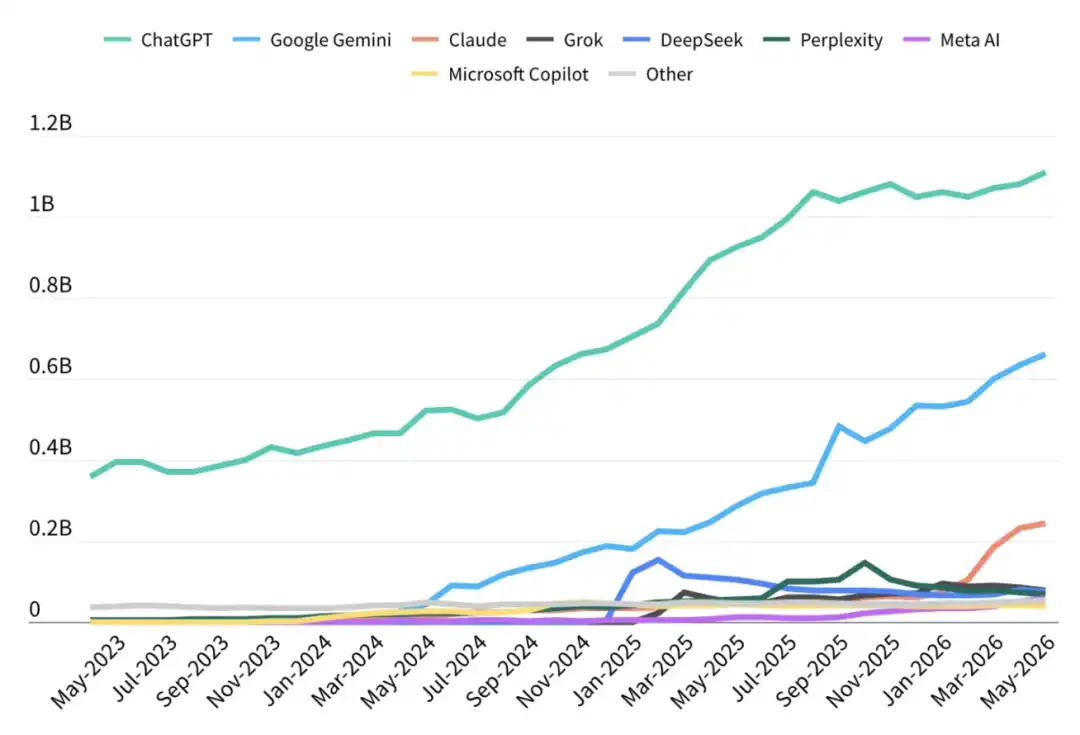
It has been three and a half years since ChatGPT made its debut. At that time, many people realized for the first time that a dialog box could become the next-generation internet gateway. Today, it has long been the fastest application in human history to reach 1 billion monthly active users. Yet, at the same time, it has reached a symbolic turning point:

ChatGPT's global market share has fallen below 50% for the first time.

According to data analytics firm Sensor Tower's "State of AI 2026 Report," as of the end of May this year, ChatGPT's share of the global AI assistant market dropped to 46.4%. Before January this year, that figure was still above 50%. ChatGPT remains the world's largest AI assistant. But leading no longer equals monopolizing.

The AI assistant boom ignited by OpenAI has moved from awe, trial, and admiration into the stages of product comparison, ecosystem integration, paid conversion, and commercial realization.

Loyalty Is a False Proposition, Users Are All 'Heartbreakers'

In 2023, having a ChatGPT account still carried a certain identity of being an AI pioneer.

By 2026, AI assistants have increasingly become internet infrastructure, much like search, email, and office suites. The most noteworthy change in the Sensor Tower report is not just that ChatGPT still ranks first.

More importantly, users are becoming more willing to migrate. As long as another assistant is more convenient in a specific scenario, users will immediately allocate time to another product.

The main competitors pulling ChatGPT's share below 50% are Gemini and Claude.

As of the end of May, Gemini's global share reached 27.7%, and Claude reached 10.3%. Products like Grok, Perplexity, DeepSeek, and Meta AI each still hold less than 5%, but they are also constantly squeezing the remaining market.
Gemini's growth is easy to understand. It's backed by Google's complete ecosystem. Search, Gmail, Docs, Calendar, and Android are all natural entry points. When AI is embedded into tools users rely on daily, many average users have no need to specifically open another webpage to summon ChatGPT.

Especially after the release of Gemini 3.0, Google also achieved its first truly significant victory, officially securing a seat at the AI table and entering the mainstream user's view.

Claude's path is more like a victory for a productivity tool.

It lacks a distribution system like Google's, but has built a strong reputation in scenarios like writing, coding, long-text processing, and complex task collaboration. Sensor Tower states that Claude is approaching ChatGPT's user retention levels. For power users, AI assistants have shed their toy-like attributes and are genuinely beginning to impact work efficiency.
A more subtle change is that when users evaluate AI products, they no longer look solely at model capability. As AI assistants gradually take on more personalized interaction characteristics, users are also starting to discuss work, emotions, judgments, and decisions with them. Brand trust, value orientation, and institutional relationships can all become part of the user's choice.

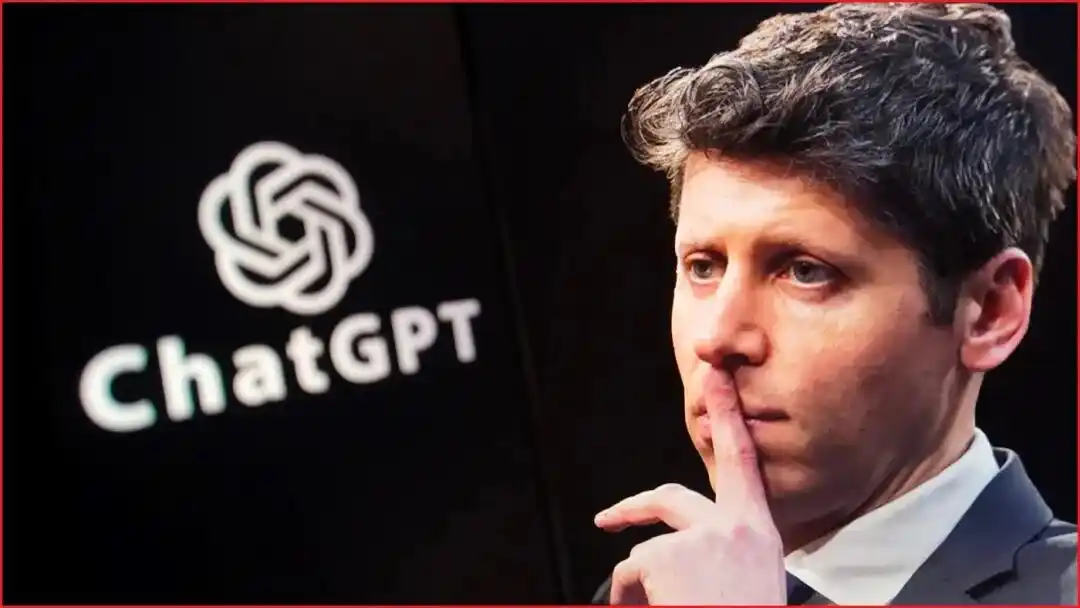
A hint of public controversy can trigger a massive wave of uninstalls. OpenAI CEO Sam Altman has likely gained a deep understanding of this over the past year.

AI companies once believed that as long as the model was stronger, users would stay. The reality in 2026 is far more complex. Capability, ecosystem, price, use case, and brand trust are now collectively determining whether an assistant will be used consistently.

The Free Lunch Is Over, AI Apps Start Talking Money

Beyond market share, another set of data from the Sensor Tower report better illustrates the stage change in the industry: AI applications are still growing, but the growth logic has changed.

Sensor Tower estimates that in the first half of 2026, global AI app downloads will approach 2.3 billion, with in-app spending exceeding $4.2 billion. In comparison, AI app in-app spending was $1.83 billion in the first half of 2025.

Users are still downloading AI apps and are also willing to pay for AI.

However, the growth rates for both downloads and spending have slowed. Meanwhile, the industry has moved from a period of rapid expansion into a more realistic phase of competition.

Vendors can no longer just talk about user growth; they must also prove they can turn traffic into revenue. Regional differences are also emerging. Asia remains the market with the highest AI app downloads, but in Q1 2026, downloads declined for the first time by 3.3%, mainly affected by markets like India.
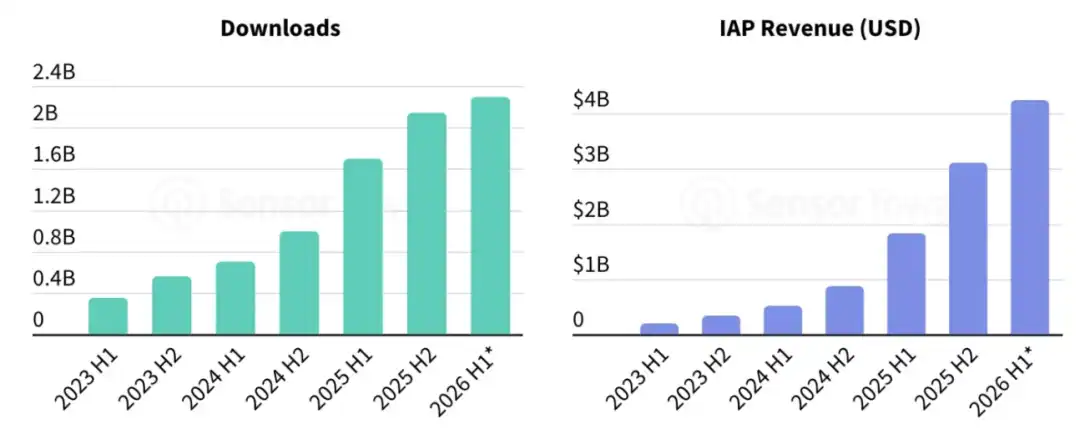
In contrast, North America and Europe are stronger in terms of in-app consumption. For AI companies, what truly determines the business model is often the ability to pay; install base only solves part of the problem. The trend in the US market is more pronounced. Users are starting to use AI assistants for productivity tasks and are more willing to pay for premium features.

Claude performs notably well here. Sensor Tower states that Anthropic has 13% of its users subscribing to a paid plan, a conversion rate ranking among the highest in the industry. This 13% subscription conversion rate explains why Claude can continue to expand its presence amidst competition from giants.

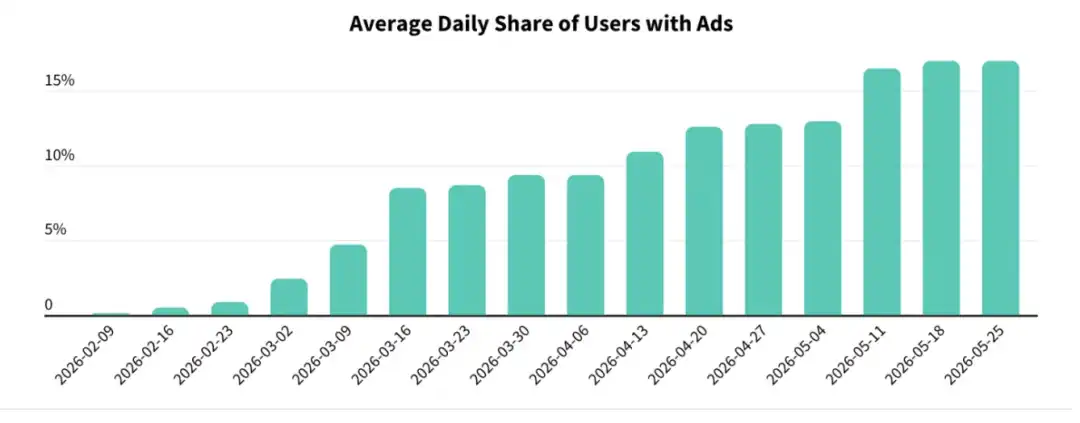
As long as AI can help users save time, complete code, organize documents, and handle complex tasks, monthly subscription fees ranging from twenty to even two hundred dollars are actually within an acceptable range. ChatGPT's commercialization path is more diverse and also more controversial. Sensor Tower states that OpenAI began testing ads in ChatGPT starting in February this year, gradually expanding the scale of ad displays and the proportion of users covered.

By May, an average of 17% of users were seeing ads daily. Software and shopping are currently the largest advertiser categories, followed by media & entertainment, and food & beverage.
From subscriptions to ads, ChatGPT is moving towards a more typical internet business model. Early users were familiar with a clean dialog box, an entry point imbued with the imagination of Artificial General Intelligence (AGI).

Unfortunately, even the smartest AI on this planet ultimately cannot escape the fate of becoming a shopping guide.

For OpenAI, ads and shopping have become necessary experiments to advance. Now, this entry point is also starting to carry ads, shopping guides, recommendations, and transaction conversions.

Model inference, training, and computing power expenses are extremely costly; relying solely on subscription revenue can hardly cover long-term investments. Advertising and shopping are becoming the next pieces of the puzzle for ChatGPT's commercialization.

As AI begins to penetrate core scenarios like shopping, office work, and search, the imagination of AI becoming a unified super-gateway is also encountering increasingly realistic platform boundaries. Sensor Tower estimates that in the first half of 2026, global AI app usage time will grow from 17.2 billion hours in the same period last year to approximately 36 billion hours.

Among them, the top three AI assistants account for 89% of the total usage time of AI assistant apps.

New players still have opportunities, but these opportunities exist more in fragmented scenarios, such as AI companions, AI content generation, and vertical industry tools. The main battlefield for general assistants is already mostly occupied by ChatGPT, Gemini, and Claude.

Stepping Down from the Altar, AI Goes Mainstream

ChatGPT's share decline occurs at a somewhat paradoxical time: OpenAI's revenue is still growing rapidly, its user base is still expanding, and its capital reserves far exceed those of most startups. According to a report by The Information, based on documents OpenAI disclosed to shareholders, OpenAI consumed $3.7 billion in cash in the first quarter, more than half of its $5.7 billion revenue.

Both cash burn and revenue tripled compared to the same period last year.

This is also a common challenge facing the current AI industry. Users and revenue continue to grow, yet massive capital investment is required to sustain model training, inference services, and infrastructure construction.
Furthermore, OpenAI expects cash burn could reach $25 billion in 2026, further rising to $57 billion in 2027. Even though OpenAI has confidentially submitted its IPO filing documents, the listing time may still be adjusted based on market conditions.

In other words, as one of the world's strongest AI brands, OpenAI still needs to answer a question: when models become increasingly expensive, competition grows fiercer, and users become more prone to migrate, how high can ChatGPT's business model's profit margin ultimately be.

Nevertheless, even as ChatGPT's share falls below 50%, it remains the world's largest AI assistant and is still the name most frequently mentioned when discussing AI. But this milestone is symbolic. The AI assistant market has moved beyond the era defined by a single product. In the past, ChatGPT was responsible for convincing the public that AI could change the internet.

Now, Gemini, Claude, Grok, DeepSeek, and various vertical AI assistants are collectively dividing up user time, usage scenarios, and commercial revenue.
User demands are also subtly changing.

By now, you likely no longer find satisfaction in just having AI write a poem or tell a silly joke. Instead, you start demanding it write code with fewer errors, process documents more accurately, collaborate in office work more conveniently, and offer more reasonable subscription prices, etc.

When a technology no longer elicits repeated amazement but instead begins to be criticized, compared, and replaced, it has truly started to enter mainstream life.

ChatGPT has lost half of its market dominance, but AI has truly begun to win over the world.

It's just that in this new world, there are no eternal kings, only us, forever ready to migrate for better tools.


Trend Kriptolar

İlgili Sorular

QAccording to the article, what is the current global market share of ChatGPT and what has caused its decline?

AAccording to the article, as of May, ChatGPT's global market share has dropped to 46.4%. The decline is attributed to increased competition from other AI assistants like Gemini (27.7%) and Claude (10.3%). Users are now more willing to migrate to other products if they offer a better fit for specific scenarios, and factors like ecosystem integration, productivity features, brand trust, and price are becoming key decision points.

QWhat does the article suggest about user loyalty in the AI assistant market?

AThe article suggests that user loyalty is a 'false proposition' and that users are fickle ('渣男'). Users are willing to switch between AI assistants based on which product performs better in specific use cases, such as writing, coding, or integration with existing tools like Google's ecosystem.

QHow is the business model for AI applications evolving, according to the Sensor Tower report cited in the article?

AThe business model is shifting from focusing solely on user growth to monetization. The 'free lunch' is ending. Methods include subscription fees (e.g., Claude's 13% paid user conversion rate) and advertising (e.g., ChatGPT testing ads shown to 17% of daily users by May). The report notes that while downloads are still growing, the pace has slowed, and the ability to convert traffic into revenue is now critical.

QWhat financial challenge does OpenAI face despite its growth, as mentioned in the article?

ADespite rapid revenue growth, OpenAI faces the significant financial challenge of massive cash burn to sustain model training, inference services, and infrastructure. The article states that in Q1, OpenAI burned $3.7 billion in cash, over half of its $5.7 billion revenue. It is projected that cash burn could reach $25 billion in 2026 and $57 billion in 2027, raising questions about the long-term profitability of its business model.

QWhat does the symbolic decline of ChatGPT's market share below 50% represent for the AI industry?

AThe symbolic decline represents the end of a single product defining the AI assistant market. The industry has moved past the initial phase of awe and experimentation into a stage of practical comparison, ecosystem competition, and commercial diversification. While ChatGPT popularized AI, the market is now being shared by multiple players like Gemini, Claude, and others, indicating that AI technology is maturing and becoming integrated into everyday life.

İlgili Okumalar

My Coding Betting Dashboard is Profiting, but Polymarket is Truly Not a Good Place for 'Arbitrage'

The author built a custom monitoring dashboard for Polymarket, a prediction market platform, and tested it with $1,600, achieving over 30% returns. However, the core argument is that Polymarket is not a good venue for traditional arbitrage. The dashboard has two main sections: a "Portfolio Dashboard" for tracking active positions with key metrics like total capital, P&L, and a risk-control module using a tier system (T1, T2, T3), and an "Opportunity Watchlist" for monitoring markets. The article details a critical structural trap in binary markets: a bet with a high perceived probability of success still carries a 100% loss risk if wrong. The author's T1/T2/T3 system is designed to manage this by limiting position sizes based on conviction and time horizon, emphasizing that high confidence should not equal high concentration. A key insight is the danger of "pseudo-diversification"—betting on different markets driven by the same underlying variable. The author concludes that Polymarket offers few true low-risk, arbitrage opportunities. It is instead a high-risk environment where wins can create a false sense of mastery, leading to large losses. The platform is better viewed as a training ground for honing judgment through disciplined, framework-driven betting rather than a reliable income source. The tools help transform intuition into structured, rule-based decisions to mitigate the risk of catastrophic errors.

marsbit2 saat önce

My Coding Betting Dashboard is Profiting, but Polymarket is Truly Not a Good Place for 'Arbitrage'

marsbit2 saat önce

WeChat AI Card Hands-On Guide: Has the AI Shopping Era Arrived?

**"WeChat AI Card" Practical Test Guide: Has the Era of AI Shopping Arrived?** WeChat has officially launched the "AI Exclusive Card," a feature integrated into its Workbuddy AI assistant. This card is designed to handle payments for AI-initiated purchases. Our hands-on test reveals it's not yet a tool for fully autonomous AI shopping, but rather a controlled payment layer for AI agents. The AI Card functions as an isolated sub-wallet within WeChat Pay. Users must bind the card and transfer funds into it from their main wallet. Crucially, every transaction requires explicit user confirmation via smartphone scan; AI cannot spend autonomously. Currently accessible through the Workbuddy agent, the card targets specific digital consumption scenarios: purchasing paid content (reports, data), calling paid APIs/tools, and subscribing to services. Its design prioritizes security and control by separating funds and mandating approval for each payment. We tested a real-world scenario: ordering bubble tea via Workbuddy using a "Meituan Life Assistant" skill. The process encountered multiple hurdles: high "skill" usage costs (exceeding daily free credits), and most importantly, while a payment was successfully initiated, the AI purchased an incorrect product (a mismatched group-buy coupon instead of the desired drink). This highlights the current limitation: the **AI Card only solves the payment step**. The broader challenge lies in the **AI agent's execution chain**—accurately understanding intent, navigating third-party platforms, selecting the right product, and ensuring proper fulfillment. The payment succeeded, but the purchase failed to meet the user's need. In conclusion, the WeChat AI Exclusive Card is a cautious, early-step experiment in AI commerce. It provides a secure, user-controlled payment method for agent interactions but is not yet capable of reliable, end-to-end complex purchases. For now, it's best used for low-value, low-risk digital services with careful user verification at each step. The vision of AI handling complete shopping tasks remains a work in progress.

marsbit4 saat önce

WeChat AI Card Hands-On Guide: Has the AI Shopping Era Arrived?

marsbit4 saat önce

Deconstructing Notion's Growth: From a Note-taking Tool to 100 Million Users—How Notion Built a Triple Growth Flywheel Through Product, Templates, and Community

Notion's growth from a niche note-taking tool to a platform with 100 million users is powered by three interconnected flywheels: Product-Led Growth (PLG), a Template Economy, and Community-Driven Growth. First, Notion's PLG strategy relies on a highly flexible, "plastic" product that users can adapt to countless personal and team workflows. Its freemium model lowers the barrier to entry, while features like page sharing and collaboration drive organic, usage-based viral growth as users naturally invite others. Second, the Template Economy solves the "blank page" problem. Templates, created by both Notion and its community, transform abstract product capabilities into concrete, copyable solutions for specific scenarios (e.g., project management, content calendars). This dramatically lowers activation costs for new users and fuels SEO-driven discovery. Third, a vibrant Community acts as a distributed growth engine. Users and official Ambassadors create tutorials, share use cases, and host local events. This community not only educates users but also fosters a sense of identity around pursuing "better ways of working," strengthening loyalty and enabling global, low-cost expansion. Together, these flywheels create a self-reinforcing ecosystem: a great product attracts users who create templates and community content, which in turn attracts more users and deepens engagement. This system allowed Notion to scale from individuals to teams and enterprises through a bottom-up adoption path. Looking ahead, AI integration promises to accelerate these flywheels further by making templates smarter and the platform a potential AI-native work operating system. Ultimately, Notion's defensible advantage is not just its features, but this deeply entrenched network of user assets, creators, and community trust.

marsbit4 saat önce

Deconstructing Notion's Growth: From a Note-taking Tool to 100 Million Users—How Notion Built a Triple Growth Flywheel Through Product, Templates, and Community

marsbit4 saat önce

$10 Billion, Qualcomm to Acquire Chip Legend Jim Keller's Company

Global mobile chip giant Qualcomm is in advanced talks to acquire AI chip startup Tenstorrent in a deal valued between $8-10 billion, according to media reports. This potential acquisition would be one of the largest in the AI chip sector in recent years. Tenstorrent, led by legendary chip architect Jim Keller, has gained prominence for its RISC-V architecture and AI accelerator designs. The move highlights Qualcomm's strategic push to diversify beyond its core smartphone chip business. As the smartphone market matures, Qualcomm is aggressively targeting growth in automotive, data center, and cloud AI. Acquiring Tenstorrent would allow Qualcomm to rapidly enter the high-end AI computing market, bypassing lengthy in-house development cycles. Tenstorrent's cost-effective system architecture, which avoids expensive HBM memory and relies on standard Ethernet for clustering, offers a potential alternative to Nvidia's costly solutions. Furthermore, Tenstorrent's high-performance RISC-V CPU technology and its focus on the automotive and edge computing segments align with Qualcomm's strategic goals, including its "Snapdragon Digital Chassis" platform. Despite the strategic rationale, the high valuation has sparked some investor caution. The successful integration of Tenstorrent's open-source culture and independent team into Qualcomm's organization, along with the commercialization of its technology, remains a key challenge.

marsbit5 saat önce

$10 Billion, Qualcomm to Acquire Chip Legend Jim Keller's Company

marsbit5 saat önce

İşlemler

Spot
Futures

Popüler Makaleler

DOGE M Nedir

Doge Matrix ($doge m): Topluluk Destekli Kripto Paranın Yeni Türü Giriş Kripto para dünyası sürekli evrilen bir manzaraya sahipken, yeni projeler sürekli olarak ortaya çıkmakta ve her biri yatırımcıların ve meraklıların ilgisini çekmeyi hedeflemektedir. Bu alandaki en son katılımcılardan biri, $doge m sembolü ile temsil edilen Doge Matrix'tir. Bu proje, Dogecoin etrafındaki popüler meme kültürüne dayanan kökleri sayesinde dikkat çekmiş ve web3 alanında kendine bir yer edinmiştir. Bu makale, Doge Matrix'in genel bir analizini sunmayı amaçlamakta; genel bakış, yaratıcı, yatırımcılar, işlevsellik, zaman çizelgesi ve dikkat çekici yönleri kapsayacaktır. Doge Matrix ($doge m) Nedir? Doge Matrix, görünüşte Dogecoin'in geniş çekiciliği üzerine inşa edilen, topluluk destekli bir kripto para projesidir. Dogecoin, Shiba Inu maskotu ve meme kökenleri ile bilinen bir dijital para birimidir. Doge Matrix'in genel hedefleri geniş bir şekilde tanımlanmamış olsa da, topluluk katılımı ve desteğini kullanma taahhüdü ile karakterize edilmektedir. Geleneksel kripto paralardan farklı olarak, genellikle altyapı teknolojileri aracılığıyla fayda veya içsel değer vurgulayan Doge Matrix, kripto paraların kültürel fenomenini benimseyen bir alanda kendini konumlandırmaktadır; özellikle meme tabanlı varlıkların ethos'u ile özdeşleşenlere hitap etmektedir. Dogeoin topluluğunun güçlü yönlerinden yararlanan Doge Matrix, daha geniş bir ekosistemin parçası olarak faaliyet göstermekte ve kripto para ve dijital alanla ilgilenen kullanıcıların katılımını ve etkileşimini davet etmektedir. Doge Matrix'in ($doge m) Yaratıcısı Kimdir? Doge Matrix'in yaratıcısının kimliği bilinmemektedir. Bu şeffaflık eksikliği, bazı projelerin kurucularının kimliklerini açıklamadan başlatıldığı kripto para alanında yaygın bir durumdur. Kurucu ekip hakkında bilgi eksikliği, potansiyel yatırımcılar arasında projenin hesap verebilirliği ve yönü hakkında sorular doğurabilir. Doge Matrix'in ($doge m) Yatırımcıları Kimlerdir? Şu anda, Doge Matrix'i destekleyen yatırımcılar veya yatırım fonları hakkında kamuya açık bir bilgi bulunmamaktadır. Proje, esasen topluluk desteğine dayanmakta ve kurumsal yatırım yerine bu desteği kullanmaktadır. Bu model, girişimin topluluk destekli doğası ile uyumlu olup, projenin yönünün katılımcılar tarafından şekillendirildiği bir ortam yaratmaktadır. Doge Matrix ($doge m) Nasıl Çalışır? Doge Matrix'in operasyonel mekanizmaları ile ilgili ayrıntılar biraz belirsizdir ve bu durum, meme coin alanındaki projelerin genel bir eğilimini yansıtmaktadır; burada yenilikçi işlevsellikler her zaman net bir şekilde ifade edilmemektedir. Bununla birlikte, Doge Matrix'in mevcut kripto para ekosisteminden yararlanmayı ve kullanıcı katılımını teşvik etmeyi amaçladığı görünmektedir; ayrıca Dogecoin ile ilişkilendirilen tanıdık kültürel referansları kullanmaktadır. Potansiyel olarak benzersiz özellikleri, teknolojik ilerlemelerden ziyade topluluk etkileşimlerinden kaynaklanmakta ve token sahipleri arasında paylaşılan deneyimleri ve işbirliğini vurgulamaktadır. Kesin yenilikler açıkça belirtilmemiş olsa da, proje, topluluk üyelerinin katılabileceği, fikir paylaşabileceği ve projenin potansiyelini ileriye taşıyabileceği bir alan yaratmaktadır. Doge Matrix'in ($doge m) Zaman Çizelgesi Projenin zaman çizelgesine bakmak, şimdiye kadar tanımlayıcı olayları ortaya koymaktadır: 25 Kasım 2024: Doge Matrix, erken tarihindeki önemli bir dönüm noktası olarak tüm zamanların en yüksek değerine ulaştı. 1 Ocak 2025: Aksine, Doge Matrix tüm zamanların en düşük değerine ulaştı ve bu durum, kripto paralarla sıkça ilişkilendirilen dalgalanmayı göstermektedir; özellikle bir projenin yaşam döngüsünün erken aşamalarında. Devam Ediyor: Proje, topluluğu tarafından aktif bir şekilde işlem görmeye ve desteklenmeye devam etmekte, ancak belirli gelecekteki dönüm noktaları veya hedefler henüz açıklanmamıştır. Doge Matrix ($doge m) Hakkında Ana Noktalar Topluluk Odaklılık Doge Matrix'in merkezinde topluluk katılımına olan taahhüt bulunmaktadır. Proje, üyeleri arasında işbirliği ve ortak hedefler üzerine inşa edilmiştir ve kolektif çabanın önemini vurgulamaktadır. Genellikle tanımlı bir liderlik yapısına sahip merkezi projelerin aksine, Doge Matrix şu anda her topluluk üyesinin sesinin önemli olduğu daha akışkan bir yönetişim yaklaşımını sergilemektedir. Dalgalanma Kripto para piyasası, dalgalanması ile ünlüdür ve Doge Matrix de bu durumdan muaf değildir. Fiyat geçmişi, yüksek ve düşük değerler arasında önemli dalgalanmaları yansıtmaktadır; bu durum birçok yeni kripto para için tipik olmakla birlikte, yeni token'lara yapılan yatırımlarla ilişkili riskleri vurgulamaktadır. Ayrıntılı Bilgi Eksikliği Doge Matrix hakkında en çarpıcı özelliklerden biri, teknolojik altyapısı ve operasyonel mekanizmaları ile ilgili ayrıntılı bilginin kıtlığıdır. Bu belirsizlik, potansiyel yatırımcıların projeye katılmadan önce kapsamlı bir araştırma yapmalarını gerektirmektedir. Sonuç Özetle, Doge Matrix ($doge m), topluluk katılımı ve kültürel anlamda önem taşıyan projelerin yeni bir dalgasını temsil etmektedir. Belirli ayrıntılardan yoksun olsa da—örneğin, net bir liderlik, tanımlı hedefler ve ayrıntılı işlevsellik—proje, meme kültürünün yerleşik çekiciliğinden yararlanarak kripto topluluğunda ilgi uyandırmayı başarmıştır. Kripto para alanındaki herhangi bir yatırımda olduğu gibi, doğasında var olan riskleri anlamak ve kapsamlı bir araştırma yapmak, potansiyel katılımcılar için esastır. Doge Matrix, kripto endüstrisinin dinamik, bazen öngörülemez doğasının bir hatırlatıcısı olarak durmakta; sürekli evrim ve topluluk destekli girişimlere olan heyecan ile işaretlenmektedir.

384 Toplam GörüntülenmeYayınlanma 2025.02.03Güncellenme 2025.02.03

DOGE M Nedir

$M Nedir

Mantis'i Anlamak ($M): Zincirler Arası İşlemde Yeni Bir Dönem Web3 ve kripto para dünyasının sürekli gelişen manzarasında, yeni projeler kullanıcı deneyimini artırmayı ve merkeziyetsiz finans ekosistemindeki işlevsel olanakları genişletmeyi amaçlayan yenilikçi çözümler sunmaya çalışıyor. Dikkat çeken projelerden biri, zincirler arası etkileşim ve niyet tabanlı uzlaşma ilkeleri üzerine kurulu öncü bir protokol olan Mantis ($M). Bu makale, Mantis'in temel işlevselliği, yaratıcıları, yatırım destekleri, yenilikçi özellikleri ve kritik dönüm noktaları dahil olmak üzere temel yönlerini inceliyor. Mantis ($M) Nedir? Mantis, çok alanlı niyet uzlaşma protokolü olarak tanımlanır ve kullanıcıların çeşitli blockchain platformları arasında karmaşık finansal işlemleri sorunsuz bir şekilde gerçekleştirmelerini sağlar. Protokol, üç ana katman üzerinden çalışır: Niyet İfadesi: Kullanıcılar, DISE LLM adlı gelişmiş bir AI dil modeli aracılığıyla doğal dil kullanarak işlem hedeflerini ifade edebilirler. Örneğin, bir kullanıcı belirli bir kayma toleransı ile Ethereum (ETH) ile Solana (SOL) takası yapmak istediğini ifade edebilir. İcra: Bu katman, kullanıcı niyetlerini yerine getirmek için rekabet eden bir çözücü ağı kullanır. İşlemler, kullanıcı taleplerinin en iyi şekilde karşılanmasını sağlayan İsteklerin Tesadüfü (CoWs) ve Emir Akışı İhaleleri (OFAs) gibi mekanizmalarla gerçekleştirilir. Uzlaşma: Mantis, Inter-Blockchain Communication (IBC) protokolünü kullanarak atomik zincirler arası işlemleri mümkün kılar ve kullanıcıların Ethereum, Solana ve Cosmos dahil olmak üzere çeşitli desteklenen zincirler arasında işlem yapmalarını sağlar. Mantis, tüm süreç boyunca işlemlerin bütünlüğünü korumak için kriptografik kanıtlar kullanarak yerel getiri üretimi sunmak üzere tasarlanmıştır. Yaratıcılar ve Geliştirme Ekibi Mantis, blockchain etkileşim çözümlerine vurgu yapan araştırma odaklı bir kuruluş olan Composable Foundation tarafından tasarlanmıştır. Bu vakıf, Mantis'in mimarisi ve işlevselliğini bilgilendiren kapsamlı araştırma ve geliştirme çabalarına katkıda bulunan Harvard Üniversitesi ve Lizbon Üniversitesi gibi saygın akademik kurumlarla işbirliği yapmaktadır. Composable Foundation'ın blockchain alanında yeniliği teşvik etme konusundaki kararlılığı, Mantis'i çoklu blockchain ağları arasında artan etkileşim talebine yönelik sağlam bir çözüm olarak konumlandırmaktadır. Yatırımcılar ve Destek Bireysel yatırımcılarla ilgili belirli detaylar kamuya açıklanmamış olsa da, Mantis çeşitli kuruluşlardan önemli destek almaktadır: IBC destekli zincirlerden ekosistem hibeleri, protokolün büyümesini ve merkeziyetsiz finans ekosistemleri içindeki entegrasyonunu destekler. Altyapı sağlayıcılarıyla stratejik ortaklıklar, Mantis'in ağ yeteneklerini ve dağıtım stratejilerini geliştirmektedir. Composable Foundation'ın hazinesi aracılığıyla finansman, sürekli gelişim ve operasyonel maliyetler için sürdürülebilir finansal destek sağlamaktadır. Bu işbirlikçi çabalar, paydaşlar arasında zincirler arası işlevselliği artırmanın önemine ve Mantis'in altyapısal yeniliklerinin potansiyel faydasına dair bir uzlaşmayı yansıtmaktadır. Ana Yenilikler Mantis, işlevselliğini ve faydasını artıran birkaç öncü yenilikle kendini farklı kılar: Zincir Bağımsız Niyetler: Kullanıcılar, herhangi bir desteklenen zincirden işlem başlatabilirken, başka bir zincirde uzlaşma yapabilirler. Bu esneklik, kullanıcıları güçlendirir ve farklı platformlar arasında etkileşimi artırır. AI Destekli Arayüz: DISE LLM entegrasyonu, kullanıcıların doğal dil kullanarak karmaşık DeFi işlemleri gerçekleştirmelerini sağlar, böylece etkileşimleri basitleştirir ve blockchain teknolojisini daha geniş bir kitleye erişilebilir hale getirir. Zincirler Arası MEV Yakalama: Mantis, çözücüler arasında rekabet yoluyla maksimum çıkarılabilir değer (MEV) için iç bir pazar oluşturur. Bu yenilikçi yaklaşım, karmaşık işlemlerde daha büyük verimlilik ve değer çıkarımı sağlar. Modüler Uzlaşma Katmanı: Protokol, sıfır bilgi kanıtları ve iyimser rolluplar gibi çeşitli doğrulama yöntemlerini destekleyerek, ortaya çıkan blockchain teknolojilerine uyum sağlayabilen çok yönlü bir çerçeve sunar. Tarihsel Zaman Çizelgesi Mantis'in gelişimi, yolculuğunu ve büyümesini belirleyen birkaç kritik dönüm noktası ile işaretlenmiştir: | Yıl | Dönüm Noktası | |———–|————————————————————————–| | 2022 | Composable Foundation'ın araştırma bölümünde ilk konsept geliştirilmesi. | | Q3 2024 | Solana ve Ethereum arasında köprüleme yetenekleri ile testnet'in başlatılması. | | Q1 2025 | Ana ağ lansmanı ile birlikte beklenen Token Üretim Etkinliği (TGE). | | Q2 2025 | DISE LLM entegrasyonu ve zincirler arası yeteneklerin genişletilmesi bekleniyor. | | 2025 H2 | Daha fazla IBC güncellemeleri ile 15'ten fazla zincir için planlanan destek. | Bu zaman çizelgesi, Mantis'in evrimini, kavramsal tartışmalardan aktif uygulamaya ve gelecekteki büyüme aşamalarına kadar özetlemektedir. Ekosistem Büyüme Stratejisi Mantis'in ekosistem büyüme stratejisi, kullanıcı katılımını ve geliştirici etkileşimini teşvik etmeyi amaçlayan birkaç girişim içermektedir: Kredi Sistemi: Kullanıcılar, likidite sağlayarak ve referans programlarına katılarak protokol kredileri kazanabilirler. Bu krediler, gelecekte teşvikler için kullanılabilir, böylece güçlü bir kullanıcı topluluğu oluşturur. Modüler Yazılım Geliştirme Kiti (SDK): Bu araç seti, geliştiricilerin Mantis'in altyapısını kullanarak niyet odaklı modellere dayalı uygulamalar oluşturmasını sağlar ve böylece ekosistem içinde yeniliği teşvik eder. Yönetim Modeli: Protokol olgunlaştıkça, $M token sahipleri protokol yönetiminde söz sahibi olacak, önerilen güncellemeler ve değişiklikler üzerinde oy kullanabilecek, böylece topluluk katılımını ve merkeziyetsizliği artıracaktır. Mantis, zincirler arası mimaride önemli bir ilerlemeyi temsil etmektedir. Gelişmiş AI algoritmalarını sağlam bir uzlaşma çerçevesi ile sorunsuz bir şekilde entegre ederek, Mantis çoklu zincir ekosistemlerindeki parçalanma sorunlarını ele almayı hedeflemektedir. Yenilikçi yaklaşımı, geliştirilmiş kullanıcı deneyimlerini önceliklendirirken, merkeziyetsizlik ve güvenlik ilkelerine bağlı kalmakta ve blockchain teknolojilerinin gelecekteki etkileşimi için yeni bir standart belirlemektedir. Mantis, büyüme ve uygulama yolculuğuna devam ederken, Web3 ve merkeziyetsiz finans alanındaki rekabetçi manzarada dikkatle izlenmesi gereken bir proje olma vaadini taşımaktadır. Sınırları aşma ve kullanıcı katılımını artırma konusundaki odaklanmasıyla, Mantis kripto para alanındaki gelecekteki gelişmelerin ayrılmaz bir parçası olmaya hazırlanıyor.

39 Toplam GörüntülenmeYayınlanma 2025.03.18Güncellenme 2025.03.18

$M Nedir

M Nasıl Satın Alınır

HTX.com’a hoş geldiniz! MemeCore (M) satın alma işlemlerini basit ve kullanışlı bir hâle getirdik. Adım adım açıkladığımız rehberimizi takip ederek kripto yolculuğunuza başlayın. 1. Adım: HTX Hesabınızı OluşturunHTX'te ücretsiz bir hesap açmak için e-posta adresinizi veya telefon numaranızı kullanın. Sorunsuzca kaydolun ve tüm özelliklerin kilidini açın. Hesabımı Aç2. Adım: Kripto Satın Al Bölümüne Gidin ve Ödeme Yönteminizi SeçinKredi/Banka Kartı: Visa veya Mastercard'ınızı kullanarak anında MemeCore (M) satın alın.Bakiye: Sorunsuz bir şekilde işlem yapmak için HTX hesap bakiyenizdeki fonları kullanın.Üçüncü Taraflar: Kullanımı kolaylaştırmak için Google Pay ve Apple Pay gibi popüler ödeme yöntemlerini ekledik.P2P: HTX'teki diğer kullanıcılarla doğrudan işlem yapın.Borsa Dışı (OTC): Yatırımcılar için kişiye özel hizmetler ve rekabetçi döviz kurları sunuyoruz.3. Adım: MemeCore (M) Varlıklarınızı SaklayınMemeCore (M) satın aldıktan sonra HTX hesabınızda saklayın. Alternatif olarak, blok zinciri transferi yoluyla başka bir yere gönderebilir veya diğer kripto para birimlerini takas etmek için kullanabilirsiniz.4. Adım: MemeCore (M) Varlıklarınızla İşlem YapınHTX'in spot piyasasında MemeCore (M) ile kolayca işlemler yapın.Hesabınıza erişin, işlem çiftinizi seçin, işlemlerinizi gerçekleştirin ve gerçek zamanlı olarak izleyin. Hem yeni başlayanlar hem de deneyimli yatırımcılar için kullanıcı dostu bir deneyim sunuyoruz.

470 Toplam GörüntülenmeYayınlanma 2025.07.02Güncellenme 2026.06.02

M Nasıl Satın Alınır

Tartışmalar

HTX Topluluğuna hoş geldiniz. Burada, en son platform gelişmeleri hakkında bilgi sahibi olabilir ve profesyonel piyasa görüşlerine erişebilirsiniz. Kullanıcıların M (M) fiyatı hakkındaki görüşleri aşağıda sunulmaktadır.

活动图片













