# Rubin İlgili Makaleler

HTX Haber Merkezi, kripto endüstrisindeki piyasa trendleri, proje güncellemeleri, teknoloji gelişmeleri ve düzenleyici politikaları kapsayan "Rubin" hakkında en son makaleleri ve derinlemesine analizleri sunmaktadır.

55TB to 28TB? The Rumor and Panic Behind Rubin's Memory Being Halved

Title: 55TB to 28TB? The Rumor and Panic Behind the Potential Halving of Rubin's Memory. On June 4th, a report from SemiAnalysis suggested NVIDIA's next-gen Vera Rubin NVL72 AI rack may ship with roughly 28TB of SOCAMM DRAM per rack instead of the anticipated 55TB, primarily using 96GB modules. This sparked a market panic, causing Micron's stock to drop over 10% on fears of halved memory demand. However, the article argues this panic is misguided for several key reasons. First, SOCAMM modules are socketed and upgradeable, not soldered. Lower initial configuration doesn't mean permanent demand loss. Second, the primary driver is a severe 2026 LPDDR5X supply shortage, not diminished need. NVIDIA is likely prioritizing rack shipments with available components. Third, with fixed total LPDDR5X supply, using less per rack could allow NVIDIA to ship *more* racks, not necessarily reducing overall memory orders. Micron's sharp drop was also attributed to a broader semiconductor sell-off triggered by Broadcom's earnings, with the SemiAnalysis report providing a convenient narrative for profit-taking after Micron's massive rally. In summary: the report on lower default configurations is likely accurate, but interpreting it as a demand collapse is wrong. The real risk for Micron lies in its reportedly minimal HBM4 share for Rubin, not in potentially flexible SOCAMM demand. The sell-off appears more like a correction amplified by coinciding negative catalysts.

marsbit06/05 01:15

55TB to 28TB? The Rumor and Panic Behind Rubin's Memory Being Halved

marsbit06/05 01:15

Jensen Huang Announces 8 New Products in 1.5 Hours, NVIDIA Fully Bets on AI Inference and Physical AI

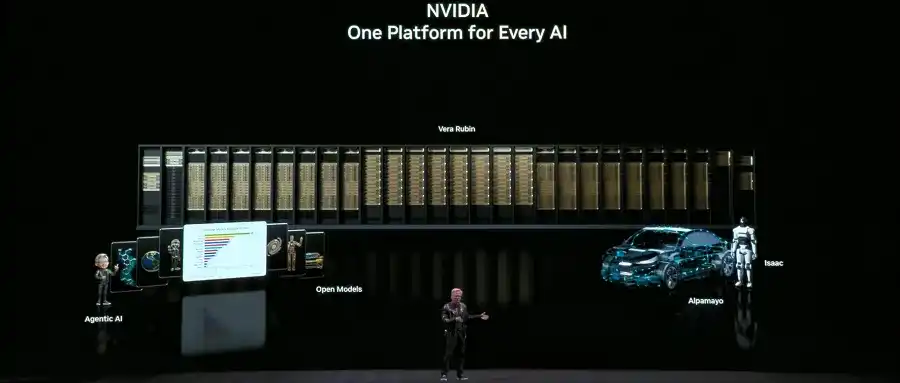
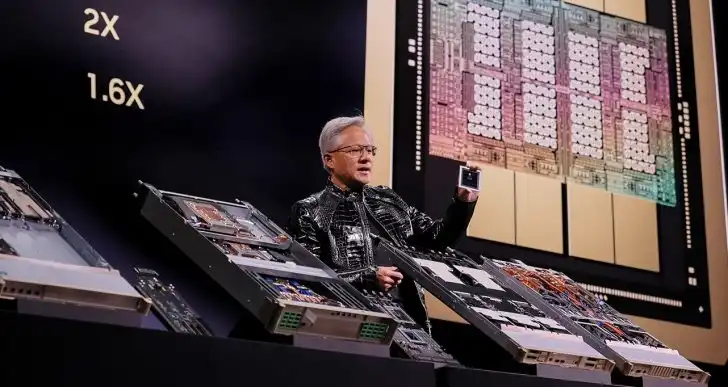
NVIDIA CEO Jensen Huang unveiled eight major announcements during his CES 2026 keynote, focusing on advancing AI inference and physical AI technologies. The centerpiece was the NVIDIA Vera Rubin POD AI supercomputer, which integrates six custom chips—Vera CPU, Rubin GPU, NVLink 6 Switch, ConnectX-9 SuperNIC, BlueField-4 DPU, and Spectrum-X CPO—designed for协同 performance. The Rubin GPU offers 5x higher inference and 3.5x higher training performance than Blackwell, with support for HBM4 memory. The Vera Rubin NVL72 system delivers 3.6 EFLOPS in NVFP4 inference performance in a single rack, with enhanced memory bandwidth. NVIDIA also introduced the Spectrum-X Ethernet CPO for improved power efficiency, a推理上下文内存存储平台 to optimize KV cache storage and reduce recomputation, and the DGX SuperPOD based on Rubin architecture, cutting token costs for large MoE models to 1/10. On the software side, NVIDIA expanded its open-source offerings, including new models and datasets, and emphasized the rise of physical AI. The company open-sourced the Alpha-Mayo model for autonomous driving, enabling reasoning-based decision-making, and announced production-ready NVIDIA DRIVE platforms for Mercedes-Benz. Partnerships with Siemens and robotics firms like Boston Dynamics were highlighted, underscoring NVIDIA’s full-stack approach to AI infrastructure and real-world AI applications.

marsbit01/06 04:36
Jensen Huang Announces 8 New Products in 1.5 Hours, NVIDIA Fully Bets on AI Inference and Physical AI

marsbit01/06 04:36

活动图片