Original | Odaily Planet Daily (@OdailyChina)
Author | Azuma (@azuma_eth)

On July 30th, Eastern Time, US online broker Robinhood (HOOD) officially announced its Q2 2026 financial results.
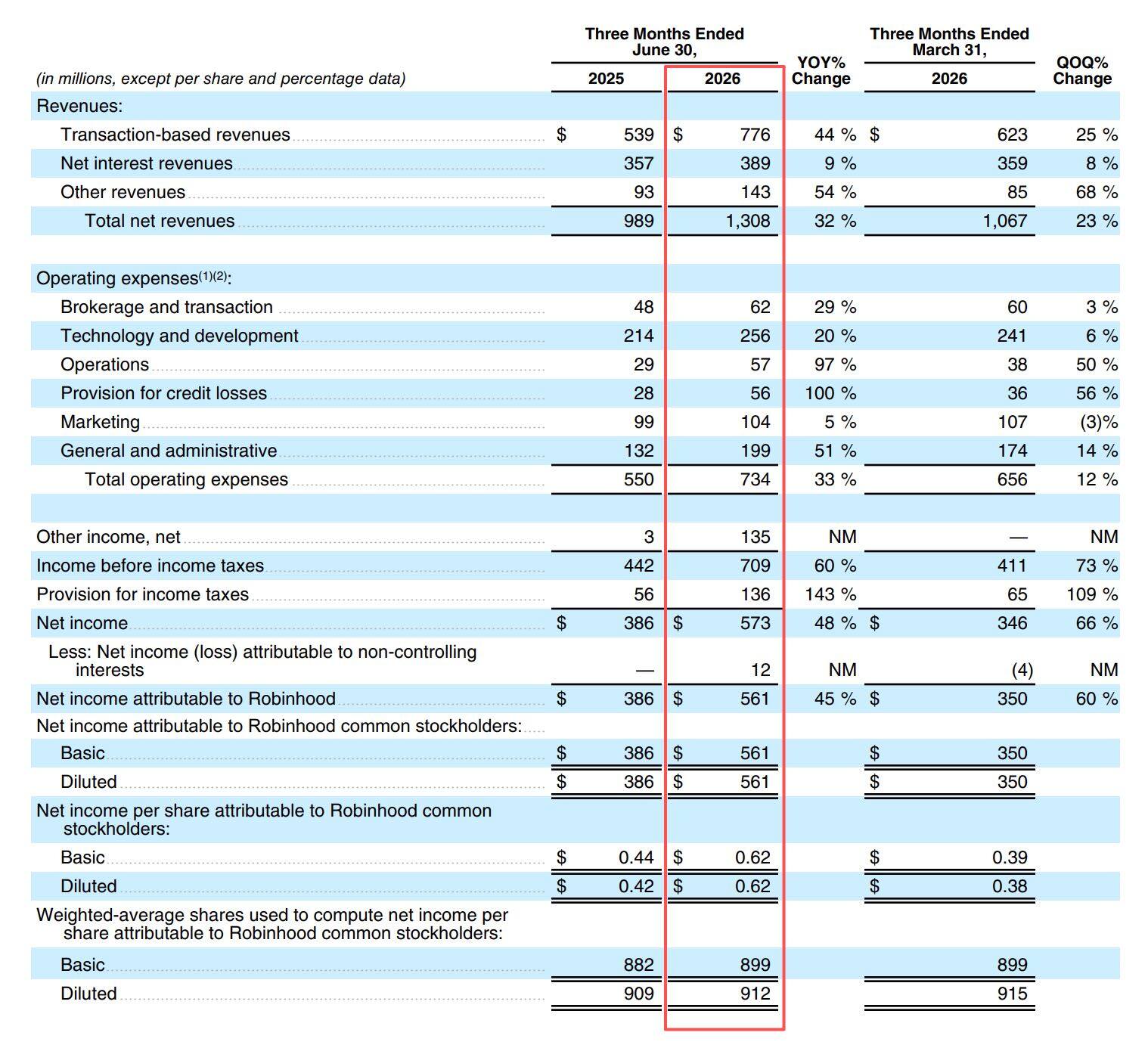
The report shows, Robinhood achieved Q2 net revenue of $1.308 billion, a 32% year-over-year increase, hitting a record high; Net income attributable to common stockholders reached $561 million, a 45% year-over-year increase; Diluted earnings per share (EPS) were $0.62, exceeding market expectations of $0.42.
Robinhood's growth this quarter was driven by trading business, user assets, and subscription services. Specifically:
- Transaction-based revenue reached $776 million, up 44% YoY, with event contract revenue hitting $156 million, an increase of over 10 times; Options revenue reached $342 million, up 29% YoY; Equities revenue reached $129 million, up 95% YoY.
- Net interest revenue reached $389 million, up 9% YoY; Other revenue reached $143 million, up 54% YoY, reflecting that Robinhood is expanding revenue streams through new services like the Trump Account and Gold subscriptions, gradually reducing reliance on a single transaction business.
- User scale and deposited funds also continued to grow. Funded accounts reached 28.4 million, up 7% YoY; Robinhood Gold subscribers reached 4.8 million, up 39% YoY, a record high; Total assets under custody reached $369 billion, up 32% YoY; Net deposits for the quarter reached $21.7 billion, up 28% YoY.
Compared to the past model relying on commission-free trading and young retail investors for growth, the current Robinhood is attempting to transform from a "retail trading platform" into a one-stop financial ecosystem covering trading, wealth management, digital assets, and on-chain finance.
Explosive Growth in Trading Business, Prediction Markets Become a Major Growth Point
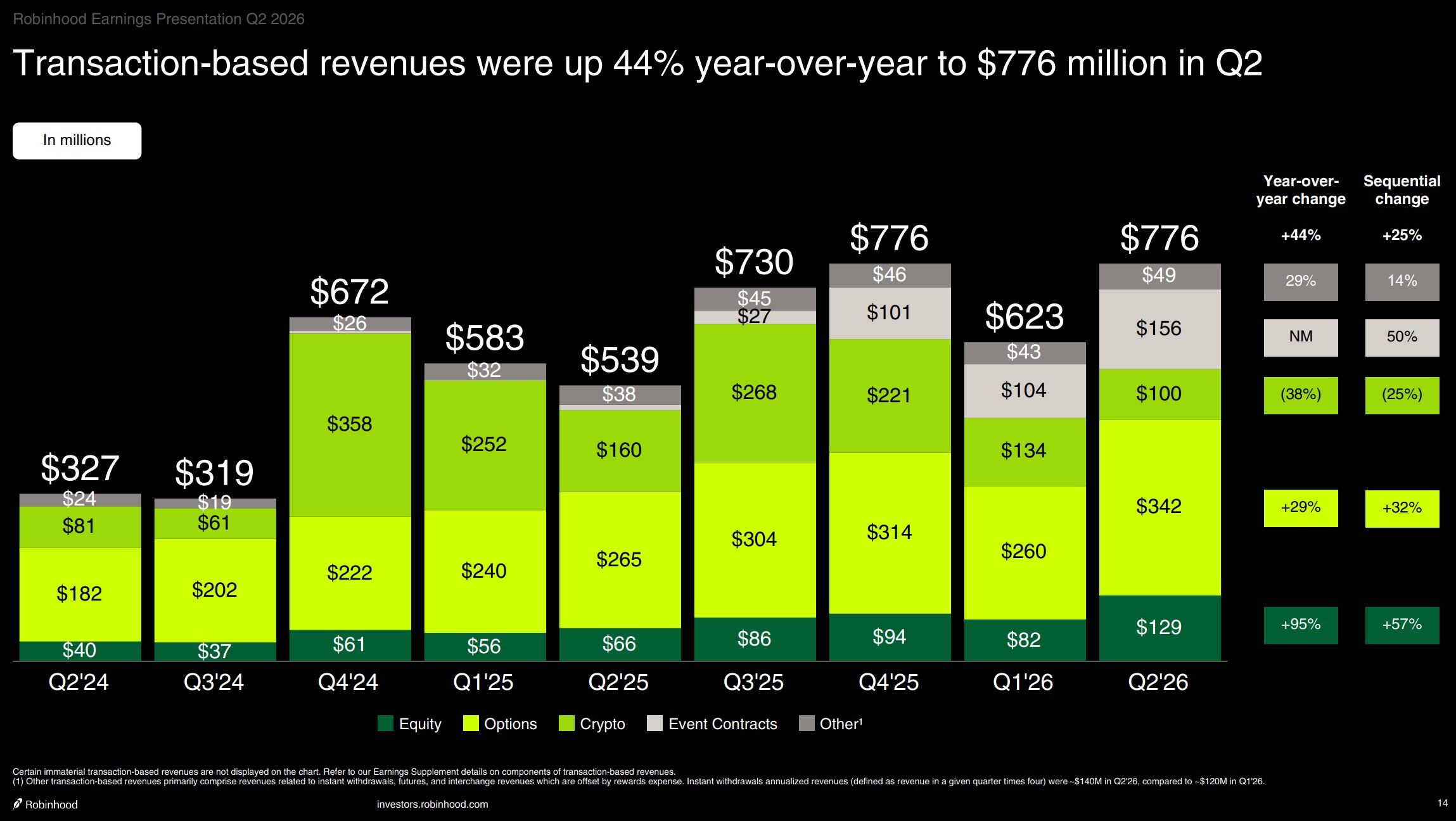
The most eye-catching performance for Robinhood this quarter came from the explosion of its trading business. Data shows, Q2 trading revenue for Robinhood reached $776 million, a 44% YoY increase, becoming the main driver of overall revenue growth.
Specifically, the revenue data and growth status of various trading services are as follows:
- Equities trading revenue reached $129 million, up 95% YoY;
- Options trading revenue reached $342 million, up 29% YoY;
- Event contract (i.e., prediction market) revenue reached $156 million, an increase of over 10 times YoY;
- Cryptocurrency trading revenue was approximately $100 million, down 38% YoY, the only declining category among mainstream trading services......
Benefiting from the favorable environment of the US stock market rally in Q2, the overall trading activity on the Robinhood platform also hit a new high. Q2 equities notional trading volume reached $956 billion, up 85% YoY; Options contract volume reached 774 million, up 50% YoY.
A key point worth noting in the earnings report is that prediction markets have now become a new direction Robinhood is heavily betting on, and also the biggest growth point this quarter's performance — for details, see "The First Prediction Market Concept Stock Has Emerged!".
This year, the popularity of prediction markets has continued to rise, experiencing a major surge during the World Cup cycle, while Robinhood has also accelerated its layout during the same period. In Q2, Robinhood launched its own prediction market platform, Rothera — a CFTC-licensed prediction market exchange and clearing house jointly established by Robinhood and Susquehanna International Group.
During the World Cup cycle, Robinhood redirected some orders originally destined for Kalshi to be executed on Rothera. Artemis data shows this move helped Rothera capture nearly 15% of the market share for World Cup-related event contracts.
Compared to traditional stock trading, prediction markets have stronger event-driven attributes and better suit the demand of young users for instant information and interactive trading. For Robinhood, this not only means new revenue sources but also signifies the company's attempt to broaden user trading scenarios.
Growth in User Asset Deposits, Robinhood Seeks a Second Growth Curve
If the trading business is the main driver of Robinhood's current performance growth, then deeper financial services centered on user assets are the key to further capturing long-term value.
In the past, Robinhood relied more on transaction fees and user activity for growth. However, as the platform scales, the company is attempting to increase user asset deposits and expand revenue sources through subscriptions, wealth management, credit cards, and other businesses.
- As of the end of Q2, Robinhood's funded accounts reached 28.4 million, up 7% YoY; total assets under custody reached $369 billion, up 32% YoY; net deposits for the quarter reached $21.7 billion, with net deposits over the past 12 months reaching $75.7 billion.
- At the same time, Robinhood Gold (paid subscription membership) continues to grow rapidly. Q2 Gold subscribers reached 4.8 million, up 39% YoY, a record high.
- Additionally, new products launched around high-value users are also starting to scale. The Robinhood Credit Card business has achieved over $100 million in annualized revenue, with Gold Card users surpassing 1 million; Robinhood Strategies has attracted over 300,000 users, with assets under management approaching $2 billion.
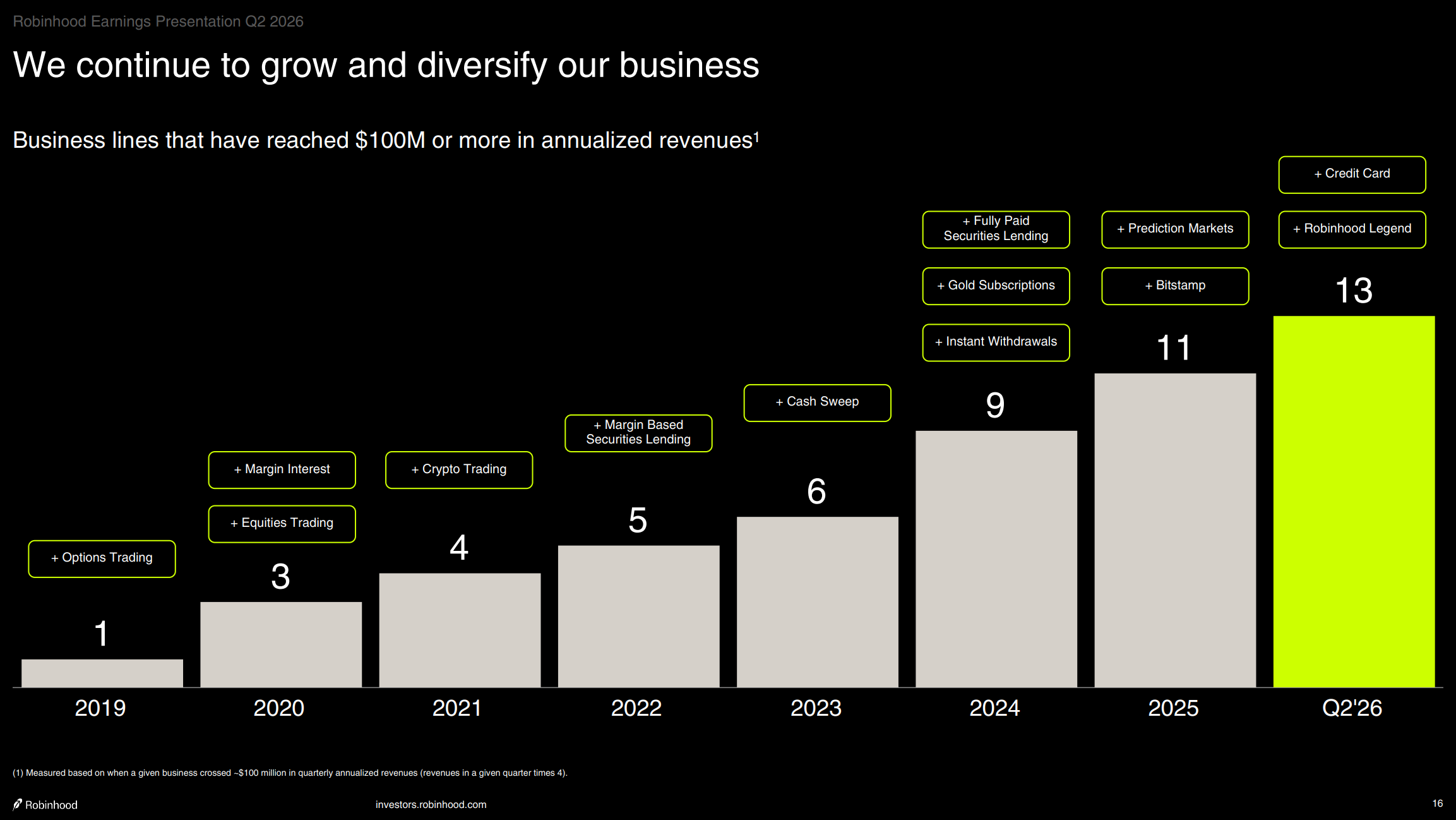
In the earnings presentation, Robinhood revealed that 13 business lines have now surpassed $100 million in annualized revenue, including equities trading, options trading, crypto trading, Gold subscriptions, prediction markets, credit cards, etc.
This means Robinhood is transitioning from a platform dependent on trading cycles to a comprehensive ecosystem covering trading, asset management, payments, and financial services.
AI and Blockchain: Robinhood Bets on Next-Generation Financial Infrastructure
Beyond traditional trading and wealth management businesses, Robinhood is also extending its reach into the fields of AI and blockchain, attempting to position itself early for the next generation of financial infrastructure.
In May this year, Robinhood announced the launch of the Agentic Trading feature, allowing users to trade stocks, options, and crypto assets through AI agents. As of the end of Q2, nearly 100,000 users had opened Agentic Trading accounts, with related asset holdings exceeding $100 million.
Different from merely providing trading tools, Robinhood aims to embed AI capabilities directly into the investment process, enhancing user engagement frequency through automated analysis and trading assistance. Currently, Agentic Trading is still in its early stages, but its growth rate indicates that AI is becoming an important direction for Robinhood to expand its product boundaries.
Simultaneously, Robinhood is also accelerating its blockchain push. In Q2, Robinhood launched the Robinhood Chain public mainnet, positioned as an Ethereum Layer 2 network for Real World Assets (RWA). Driven by the recent Meme coin rally, Robinhood Chain has now become one of the most active underlying ecosystems in the current Web3 market.
Next Stop: "Super Financial App"
Overall, the biggest change reflected in Robinhood's Q2 report is not just that revenue and profits continue to hit new highs, but that the company's growth logic is changing.
In the past, Robinhood attracted young investors with low-barrier trading and grew rapidly through stocks, options, and crypto trading. Now, the company is constantly expanding the boundaries of user demand through businesses like Gold subscriptions, credit cards, prediction markets, AI trading, and blockchain. In terms of long-term strategy, Robinhood is attempting to evolve from a simple "trading platform" into a "Super Financial App" covering investment, wealth management, digital assets, and more financial service scenarios.
The core of this goal is not merely to add more products, but to build a more complete financial ecosystem around the user lifecycle: users can complete trading, asset management, cash management, and even participate in future on-chain finance all on the same platform.
Of course, this path is still full of challenges. On one hand, new businesses are still in their early stages, and whether they can sustainably contribute to scaled revenue needs time to verify. On the other hand, the regulatory environment in areas like prediction markets, crypto assets, and on-chain finance could also affect Robinhood's future expansion pace.
But at least from the Q2 report, Robinhood is no longer content with being just an online broker serving retail traders; it is advancing towards becoming the next-generation financial gateway.