Welcome to the New Crypto World: Only This Time, The Place Where You Lose Money Is Called the Stock Market

marsbit2026-07-30 tarihinde yayınlandı2026-07-30 tarihinde güncellendi

Özet

Welcome to the New Crypto World: Only This Time, the Place to Lose Money is Called the Stock Market. The article depicts a future (2026) where global stock markets, particularly tech stocks, are exhibiting behaviors and risks reminiscent of the cryptocurrency world. The narrative centers on a sharp crash in South Korea's KOSPI index and leading stocks like SK Hynix, highlighting widespread retail losses, leverage-induced liquidations, and extreme volatility. It argues that a significant shift in market dynamics is underway: pricing is increasingly driven by narratives (like the AI boom) over fundamental valuation, amplified by high leverage and the rapid, emotion-fueled consensus formed on social media. Former crypto traders, seeking new opportunities, brought their high-risk strategies—chasing narratives, using leverage—into equity markets, focusing on sectors like AI and semiconductors. Ironically, data suggests some major tech stocks have recently shown greater volatility and faster crashes than Bitcoin, which is becoming relatively more stable and "stock-like" through institutional adoption. The piece details how leveraged ETFs in Korea, particularly those tied to single stocks, created a vicious cycle of forced selling that exacerbated the market plunge. It concludes that while stocks retain underlying fundamentals, the *trading* of them has undergone a "de-rationalization": markets now prioritize themes, social media sentiment, and leveraged bets over traditional ana...

Author: Dou Wanle

July 13, 2026, Seoul.

South Korea's benchmark KOSPI index plummeted 8.95% in a single day, triggering its 7th circuit breaker of the year. SK Hynix, the 'national destiny stock' in the eyes of Koreans, plunged 15.37%, a decline not seen in nearly two decades. Samsung Electronics also fell over 10%.

Margin calls were issued for over 1.2 million leveraged accounts. Brokerage systems automatically liquidated between 320,000 and 460,000 accounts. More heartbreaking is that 62% of those liquidated were young people aged 20 to 30. Some lost their down payment for a wedding apartment, others were trading on margin...

A young man in his 20s in Busan, who lost money following a recommendation from a stock YouTuber, went and stabbed the influencer.

In the past, these phrases would most likely have been used to describe scenes after a crypto market crash. Today, they are recurring in the South Korean, American, and Japanese markets as the tech stock tide recedes.

Sharp rallies and sell-offs are just the surface. What's truly changed is the method of valuation—narrative outweighs fundamentals, leverage amplifies emotions, and social media drives consensus to extremes with unprecedented speed.

Global stock markets, especially tech stocks, are becoming increasingly like the crypto world.

Returning to the Family Home

"Welcome back to the family home."

After the crash, crypto traders who had switched to stocks shared numerous loss stories online. Comments like the one above were ubiquitous.
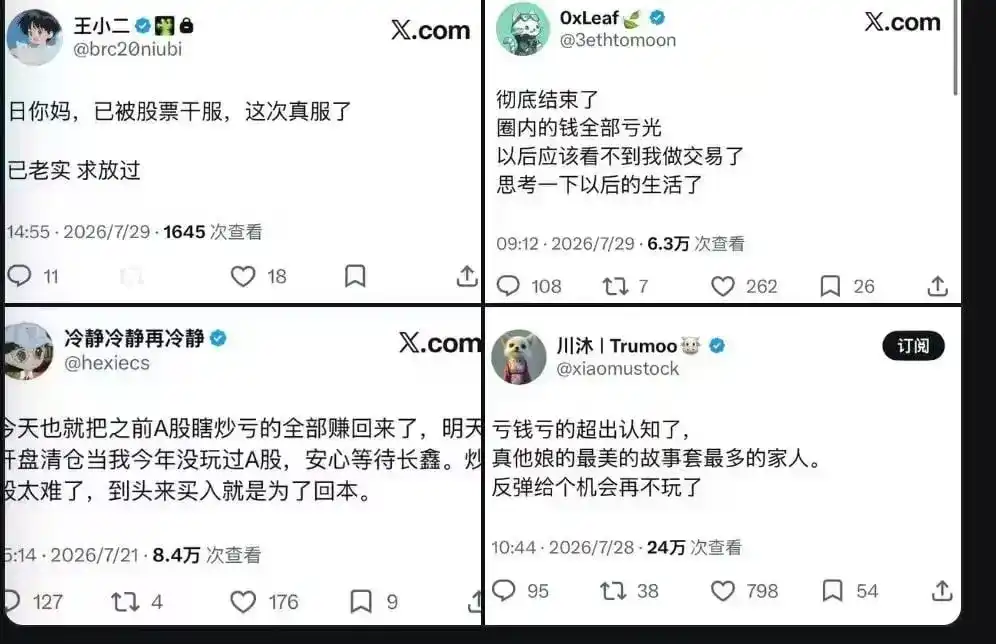
The so-called "family home" refers to the cryptocurrency world. From the second half of 2025 to early 2026, a major drama of "leaving the family home" unfolded in the crypto space.

A number of KOLs and veteran players who had been in the cryptocurrency market for years began to lose faith. Bitcoin was range-bound with tepid trading volume, meme coins kept getting shaved. Many felt "this circle is boring" and started turning their attention to US stocks.

This choice seemed very reasonable.

Stocks have revenue, profits, financial reports, and SEC oversight. Compared to crypto projects lacking cash flow and priced purely on consensus, US stocks at least appeared to be more mature and safer assets.

The crypto traders didn't just take their liquidity; they brought their trading methods along too.

In the crypto market, they were accustomed to chasing new narratives, hunting for high-volatility targets, using leverage, and swiftly switching positions based on social media sentiment. Upon entering the stock market, this approach barely changed—only the trading objects shifted from tokens to AI, memory chips, and leveraged ETFs, repeatedly achieving significant gains.

Memory stocks soon became the new collective consensus.

The logic was not complicated: AI servers require more high-bandwidth memory (HBM), leading to supply shortages and rising memory prices. Micron, Samsung Electronics, and SK Hynix naturally became the most direct 'shovel sellers.' The phrase "you can never have enough memory" became deeply ingrained.
Numerous crypto KOLs reinvented themselves, starting to talk about US stocks, memory cycles, and AI capital expenditure. Products like the 2x leveraged SK Hynix ETF were also regarded as more 'efficient' betting tools than regular stocks.

Until the market reversed in July.

Bitcoin Becomes the "Low Volatility Asset"

How long does it take to fall from the peak?

Bitcoin took 268 days to halve its value, and silver took 169 days for a similar magnitude of retracement.

In contrast, SanDisk took only 36 days to fall about 55%, and SK Hynix took only 34 days to drop about 53%.

While both experienced a 'halving,' Bitcoin took nearly nine months, while memory stocks took just over one month.
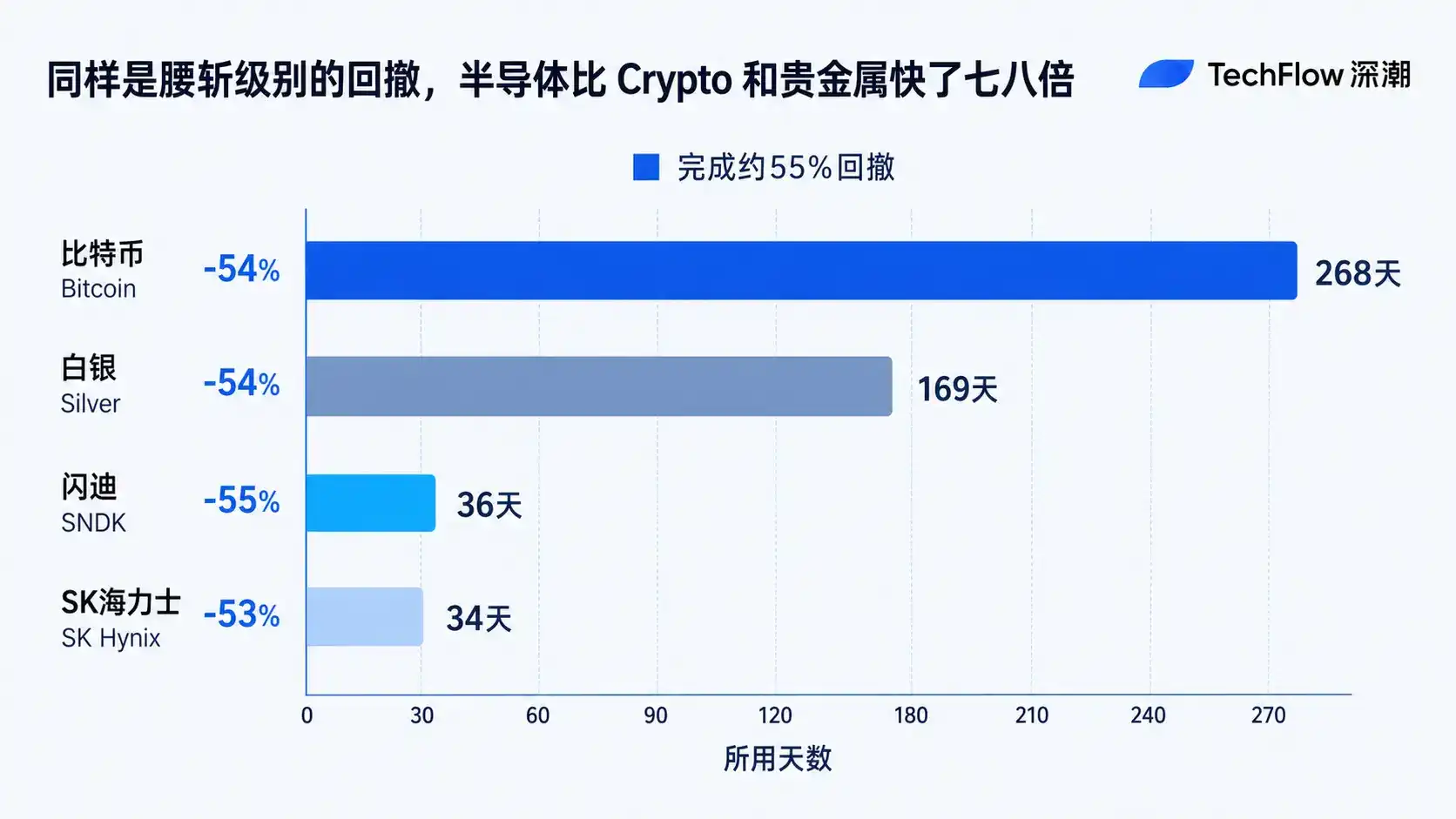
This is the ironic twist of this round of market movements. In the past, investors worried Bitcoin could surge or crash within days, while stocks adjusted slowly based on earnings and valuations. Now, some tech stocks are completing an entire bubble burst in a shorter time frame than cryptocurrencies.

It's very counter-intuitive. Compared to some tech stocks, Bitcoin is becoming relatively stable.

According to Schwab statistics, Bitcoin's historical volatility in 2025 was about 42%, with a maximum drawdown of around 32%. During the same period, Tesla's volatility was about 63% with a max drawdown of 48%, and Nvidia's volatility was about 50% with a max drawdown of 37%.

Bitcoin remains a high-risk asset, but the volatility of some major tech stocks is even greater.

Bitwise even predicted in its 2026 outlook that Bitcoin's overall volatility might continue to be lower than Nvidia's.

So the current situation is quite absurd: Bitcoin is becoming more like tech stocks, while tech stocks are becoming more like Bitcoin.

When Narrative Becomes the Valuation Anchor

There's an old saying in crypto: trading crypto is trading narratives.

In 2026, global tech stocks are turning this saying into reality.

AI is certainly not vaporware. Nvidia, Microsoft, Google, and large cloud computing companies have real revenue and are investing real capital to build data centers.

But there's a long road between "AI will indeed create value" and "any company touching AI is worth buying at any price."

At the height of the frenzy, the market simply skipped that road.

AI servers, optical modules, memory chips, data centers, power equipment, even nuclear energy companies—as long as they could be placed within the AI industrial chain, their stock prices could surge. Businesses were still in the planning stage, orders not yet secured, but the market would price them based on the best possible outcome years in advance.

The story in South Korea was "AI semiconductors are tied to national destiny." As KOSPI kept hitting new highs, more and more families began opening stock accounts for their underage children, gifting popular stocks like Samsung Electronics and SK Hynix as long-term presents.

A similar concentration occurred in the A-share market. In the first half of 2026, the TMT sector's market cap reached 41.78 trillion yuan, accounting for about 31.45% of the total A-share market value. On some trading days, turnover in the tech sector approached half of the entire market's.

The US market has long been priced around a handful of large tech companies. As index gains relied increasingly on just a few firms, and as funds, options, and retail investors flooded into the same stocks, seemingly diversified portfolios were essentially betting on the same AI story.

This is reminiscent of the old crypto world. Dogecoin's surge in 2021 wasn't due to a technological breakthrough, but because Elon Musk tweeted. The surge in tech stocks in 2026 wasn't because all companies experienced explosive earnings growth, but because ChatGPT convinced everyone that "AI will rewrite everything."

That narratives could dominate the market so rapidly is also inseparable from changes in dissemination methods.

In the past, stock information primarily came from financial reports, research notes, and institutional roadshows. Today, more and more people's investment decisions come from YouTube, X, short videos, and paid communities.

Complex company research is compressed into a few sentences: Time will prove compute and optical modules, AI compute will always be insufficient...

Social media algorithms don't reward caution either. Overnight riches are always the traffic magnet: someone doubled their money overnight with options, an office worker achieved financial freedom by heavily investing in memory stocks, someone used leveraged ETFs to earn years' worth of salary in a few months.

Charts are the best advertisement. A large number of housewives and middle-aged women began investing their private savings, and some even sold properties to buy stocks, reminiscent of students dropping out of school to all-in on Web3 a few years ago...

The Leverage Carnival

The scariest thing in crypto isn't volatility; it's the lethal combination of leverage and volatility. In 2026, global stock markets are perfectly replicating it.

On May 27, 2026, the Korea Exchange approved the listing of 16 single-stock leveraged ETFs with 2x leverage, tracking stocks like Samsung Electronics and SK Hynix.

Retail investors went wild. From approval to mid-July, Korean retail investors accumulated a net purchase of 14 trillion won (approx. 64 billion RMB) worth of single-stock leveraged ETFs. During the same period, foreign investors bought only about 2 trillion won.

These ETFs had several fatal design flaws.

These products rebalance their positions daily. The more severe the volatility, the more significant the decay in net asset value. Assume a stock falls 10%, then rises 11.1%—it returns to its original price. The corresponding 2x leveraged product would first fall 20%, then rise 22.2%, ultimately still losing about 2.2%.

The problem is even worse during rapid declines.

To maintain target leverage, the products need to passively reduce risk exposure after a decline. Selling further depresses the underlying price, triggering more position reductions, stop-losses, and margin pressure.

Goldman Sachs later pointed out that the "rapid deleveraging" of these products was the main cause of abnormal intraday volatility in KOSPI, with 62% of institutional net selling stemming from ETF-related liquidations.

Two months later, South Korean regulators urgently halted all new listings of single-stock leveraged ETFs. The minimum margin requirement was drastically raised from 10 million won to 30 million won, and only cash was recognized.

But it was too late. 2.3 trillion won in forced liquidation amounts, and the wealth of hundreds of thousands of families vanished into thin air.

Even the US stock market, the deepest in the world, is experiencing the backlash of leverage.

JPMorgan analysts recently noted that US stocks still have "deleveraging room," needing three months to return to pre-April levels.

The ratio of memory chip stock leveraged ETF assets to underlying market cap is three times the average for all stock ETFs. Even for broad leveraged stock index ETFs, the ratio is high relative to its own history.

A Regression

"Stock markets becoming like crypto" doesn't mean stocks have become completely identical to cryptocurrencies.

Stocks still have companies, assets, revenue, and cash flow behind them. They also have financial disclosures, audits, and regulation. Even when market sentiment fades, a truly profitable company still possesses a calculable value.

What's truly changed is at the trading layer.

In the past, people bought a company's future profits. Now, more and more people are trading the heat of a theme.

The crypto-fication of stock markets is essentially a revolution of de-rationalization.

Traditional stock markets look at P/E, cash flow; crypto-fied markets look at narratives, imagination. Traditional stock markets consider 20% volatility high; crypto-fied markets see individual stocks fluctuating 10-15% daily as the norm.

Traditional markets use leverage via margin trading; crypto-fied markets use ETFs, derivatives, quantitative strategies. Traditional market info comes from research reports, financial statements; crypto-fied market info comes from Twitter, YouTubers, online communities. Traditional markets have institutions rationally pricing; crypto-fied markets have institutions becoming retail-like, quant funds chasing momentum...

What's even more laughable is, now Bitcoin is striving to become like a stock, gaining mainstream financial acceptance through ETFs, institutionalization, and declining volatility.

This is an absurd point of intersection.

Those who transitioned from crypto to stocks ultimately found they hadn't left the "family home." It's the same repeating mechanism: grand narratives, crowded positions, easily accessible leverage, and everyone believing they can exit before everyone else.

The words written by a Korean retail investor on a trading forum are worth everyone remembering: I want to go back to the days before I traded stocks, and get my money back.

But the market never issues refunds.

Trend Kriptolar

İlgili Sorular

QAccording to the article, why are global stock markets, especially tech stocks, becoming more like the cryptocurrency market?

AThe article argues that stock markets, particularly tech stocks, are becoming more like the cryptocurrency market due to several converging factors. Firstly, pricing is increasingly driven by narrative and hype (like AI) rather than traditional valuation metrics like earnings. Secondly, the widespread use of leverage, especially through products like single-stock leveraged ETFs, magnifies volatility and emotions, similar to crypto trading. Finally, social media and online influencers rapidly form and spread consensus, pushing market sentiment to extremes and encouraging herd behavior among retail investors.

QWhat role did single-stock leveraged ETFs play in the South Korean market crash described in the article?

AIn South Korea, the approval of single-stock 2x leveraged ETFs (tracking stocks like Samsung and SK Hynix) in May 2026 played a catastrophic role. A massive influx of retail money into these products created concentrated, highly leveraged positions. Their daily rebalancing mechanism caused significant 'volatility decay' during swings. Most critically, during the sharp July decline, these ETFs were forced to automatically sell underlying stocks to maintain their target leverage. This created a vicious cycle of forced selling, further driving down stock prices, triggering more margin calls, and leading to a market crash. High estimated that 62% of institutional net selling during the crash was related to ETF liquidations.

QWhat paradoxical comparison does the article make between Bitcoin and certain technology stocks in 2026?

AThe article presents a paradoxical and counterintuitive comparison: while Bitcoin is notorious for its volatility, data from 2025 showed that its historical volatility (~42%) and maximum drawdown (~32%) were actually lower than those of major tech stocks like Tesla (~63% volatility, ~48% drawdown) and Nvidia (~50% volatility, ~37% drawdown). Furthermore, it took stocks like SK Hynix only about 34 days to fall roughly 53% from their peak, whereas a similar 'halving' for Bitcoin historically took about 268 days. Thus, compared to some hyper-volatile tech stocks, Bitcoin was ironically becoming a relatively 'low-volatility asset'.

QHow does the article characterize the change in information sources and decision-making for stock investors?

AThe article characterizes a fundamental shift in how stock investment information is sourced and decisions are made. Traditionally, investors relied on financial reports, analyst research, and institutional roadshows. Now, decisions are increasingly influenced by content from social media platforms like YouTube, X (Twitter), short video apps, and paid online communities. Complex company analysis is reduced to simple, viral slogans or narratives (e.g., 'AI compute will always be scarce'). Social media algorithms favor sensational, get-rich-quick stories over cautious analysis, accelerating the spread of consensus and FOMO (fear of missing out) among retail investors.

QWhat is the core irony or 'crossroads' highlighted at the end of the article regarding Bitcoin and stocks?

AThe article highlights a profound irony at the current crossroads of finance. On one hand, Bitcoin and the crypto market, originally the 'wild west' of finance, are striving to become more like traditional stocks—seeking legitimacy through ETFs, institutional adoption, and reduced volatility to gain mainstream acceptance. On the other hand, segments of the traditional stock market, especially tech stocks, are regressing to behave more like the speculative, narrative-driven, high-leverage crypto market of the past. The 'crypto natives' who moved to stocks found they never left their '原生家庭' (native home)—the same mechanisms of hype, leverage, and the greater fool theory were now dominant in equities.

İlgili Okumalar

Coinbase Vice President: The Wars Over Cryptocurrency Regulation Are Over

Coinbase's new Vice President, Ryan VanGrak, declared that regulatory wars in the cryptocurrency sector are over. Since taking office on July 9, 2026, he has shifted the company's approach from litigation and sanctions to focusing on growth and innovation. The industry can now concentrate on development rather than fighting for its right to exist. He highlighted that the Digital Asset Market Clarity Act (CLARITY Act), which aims to establish a clear federal regulatory framework dividing oversight between the SEC and CFTC, has gained significant momentum. This framework is intended to provide proper supervision, investor protection, and maintain U.S. leadership in digital assets. VanGrak's appointment marks a strategic shift from a "wartime" to a "peacetime" advisor, replacing former Chief Legal Officer Paul Grewal, who oversaw major litigation, including a dismissed 2023 SEC lawsuit. With his background at Citadel Securities and the SEC, VanGrak brings deep regulatory and institutional finance expertise as Coinbase expands beyond a simple exchange into a broader financial services provider, offering stocks, futures, prediction markets, and AI tools. For investors, bipartisan support for crypto legislation like the CLARITY Act represents a major shift from the enforcement-focused environment of 2023-2024. Lawmakers are now focused on *how* to regulate crypto, not *if* it should exist. However, risks remain, as the bill's passage is not yet guaranteed.

cryptonews.ru19 dk önce

Coinbase Vice President: The Wars Over Cryptocurrency Regulation Are Over

cryptonews.ru19 dk önce

Deep Dive into FWA: An Intriguing Experiment Turning NFTs into "On-Chain Gachapon"

A Deep Dive into FWA: The “On-Chain Gacha” Experiment for NFTs Fake World Assets (FWA), created by TokenWorks, introduces an innovative “NFT gacha machine” fully operating on-chain. Users can deposit eligible NFTs paired with ETH (called Backing) to create a Position, acting as a prize pool. Others can then pay a uniform Acquisition Price for a chance to win a random NFT from the pool. The core mechanism features a reverse probability system: Positions with lower Backing have a higher chance of being selected, serving as common prizes, while high-Backing Positions are rare “jackpots.” The acquisition price is calculated based on the harmonic mean of all Backings, keeping entry costs low. When a Position is won, the purchaser must choose: keep the NFT or accept the Standing Bid (85% of the Backing, claimable in ETH or $FWA tokens), returning the NFT to the original depositor. The protocol involves two main roles. Depositors provide liquidity (NFT + ETH), earning a share of fees from each draw, distributed equally per active Position, plus potential $FWA rewards. Purchasers pay to spin the gacha, receiving $FWA rewards for participation. A special “Crown” reward goes to the Position with the highest Backing. The $FWA token has a fixed supply and is initially obtainable only through protocol participation (depositing or purchasing), with external buying disabled early on to reduce sell pressure. Its value is supported by a built-in buy pressure: when purchasers opt for the $FWA settlement on a Standing Bid, the protocol uses the backing ETH to buy $FWA from the market. Revenue for the protocol comes from a 1% fee on each draw, a 1% settlement fee when an NFT is kept, and the 15% discount from Standing Bid settlements (currently allocated to the protocol). The design cleverly blends Uniswap-style liquidity provision, gacha mechanics, and tokenomics to create a novel, self-regulating marketplace for NFT liquidity and engagement.

marsbit33 dk önce

Deep Dive into FWA: An Intriguing Experiment Turning NFTs into "On-Chain Gachapon"

marsbit33 dk önce

10,000 Scientists Get 1 Year of Free Access: OpenAI Brings the Scientific Research Pipeline into ChatGPT

OpenAI has launched the "ChatGPT for Academic Researchers" program, offering free one-year access to its flagship models for 100,000 university researchers globally, with 10,000 spots available this summer. Selected institutions include prestigious centers like ENS Paris and the IAS at Princeton. The initiative provides an integrated research workspace within ChatGPT, bundling tools like ChatGPT, ChatGPT Work, and Codex, along with expanded Deep Research capabilities, higher usage limits, and specialized tools for life sciences. The suite connects to platforms like Zotero and GitHub, aiming to streamline the entire research workflow from literature review and coding to data analysis and manuscript drafting. OpenAI notes that about 1.3 million people already use ChatGPT weekly for advanced science and math. The program targets building long-term user dependency by embedding these tools into daily research habits. However, access comes with limitations: it does not include API credits or model weights, and eligibility is restricted to verified academic researchers from supported countries. This approach contrasts with Anthropic's "AI for Science" program, which offers API credits but not an integrated workspace. Both companies emphasize preventing misuse by withholding model weights, a point of contention for AI researchers seeking transparency. The core strategy remains clear: provide a powerful, integrated environment to foster user reliance ahead of the post-free period.

marsbit38 dk önce

10,000 Scientists Get 1 Year of Free Access: OpenAI Brings the Scientific Research Pipeline into ChatGPT

marsbit38 dk önce

What's Going On with Gigadevice? Major Shareholder Cashes Out 44 Billion, Then Announces 20 Billion Buyback

Gigadevice Innovation, a leading Chinese memory chip company, has executed a controversial financial maneuver. The company's controlling shareholder and chairman, Zhu Yiming, sold approximately 44 billion RMB worth of his shares between early May and mid-June 2026, capitalizing on a soaring stock price that peaked at 846.66 RMB on June 29th. Following a subsequent stock crash—plummeting to around 350 RMB in 22 trading days and erasing over 330 billion RMB in market value—Zhu announced a combined "market rescue" plan on July 29th. This plan includes his personal commitment to buy back at least 1 billion RMB in shares and a company proposal to repurchase 1 to 2 billion RMB worth of stock. This sequence of high-selling followed by a low-buying plan has confused and unsettled many of the company's 240,000 retail investors. The stock's dramatic decline was attributed to several factors: the successful IPO of its sister company, Changxin Technologies, which ended Gigadevice's status as a primary investment proxy for the domestic memory sector; a Morgan Stanley report warning of a potential peak in the memory chip cycle; and a severe loss of market confidence triggered by the chairman's massive sell-off. While the sell-off was procedurally compliant, its timing has been criticized. The company's fundamentals appear strong, with preliminary H1 2026 results showing revenue up 177% year-on-year to 11.5 billion RMB and net profit skyrocketing 1099% to 6.9 billion RMB, driven by a boom in memory chips and MCU demand. However, a significant portion (2.05 billion RMB) of this profit came from non-recurring gains like securities investment, and the memory industry is notoriously cyclical. Analysts highlight the company's role in the domestic substitution of niche DRAM and NOR Flash memory, with some maintaining bullish price targets. Yet, the recent events underscore key risks: its fabless model creates dependency on foundries like Changxin, and the chairman's actions have raised serious questions about management's alignment with minority shareholders. The promised buybacks cannot commence until December 13th due to a mandatory six-month cooling-off period following an insider sale, leaving the stock vulnerable in the interim.

marsbit38 dk önce

What's Going On with Gigadevice? Major Shareholder Cashes Out 44 Billion, Then Announces 20 Billion Buyback

marsbit38 dk önce

İşlemler

Spot

Popüler Makaleler

$S$ Nedir

SPERO'yu Anlamak: Kapsamlı Bir Genel Bakış SPERO'ya Giriş İnovasyonun manzarası gelişmeye devam ederken, web3 teknolojilerinin ve kripto para projelerinin ortaya çıkışı dijital geleceği şekillendirmede önemli bir rol oynamaktadır. Bu dinamik alanda dikkat çeken projelerden biri SPERO, $$s$$ olarak adlandırılmaktadır. Bu makale, SPERO hakkında ayrıntılı bilgi toplamak ve sunmak amacıyla, meraklılar ve yatırımcıların web3 ve kripto alanlarındaki temellerini, hedeflerini ve yeniliklerini anlamalarına yardımcı olmayı amaçlamaktadır. SPERO,$$s$$ Nedir? SPERO,$$s$$, kripto alanında merkeziyetsizlik ve blok zinciri teknolojisi ilkelerini kullanarak etkileşimi, faydayı ve finansal kapsayıcılığı teşvik eden bir ekosistem yaratmayı amaçlayan benzersiz bir projedir. Proje, kullanıcıların yenilikçi finansal çözümler ve hizmetler sunarak eşler arası etkileşimleri yeni yollarla kolaylaştırmayı hedeflemektedir. SPERO,$$s$$'nin temel amacı, bireyleri güçlendirmek ve kripto para alanındaki kullanıcı deneyimini artıran araçlar ve platformlar sağlamaktır. Bu, daha esnek işlem yöntemlerini mümkün kılmayı, topluluk odaklı girişimleri teşvik etmeyi ve merkeziyetsiz uygulamalar (dApp'ler) aracılığıyla finansal fırsatlar yaratmayı içermektedir. SPERO,$$s$$'nin temel vizyonu kapsayıcılık etrafında dönmekte olup, geleneksel finansal sistemlerdeki boşlukları kapatmayı ve blok zinciri teknolojisinin faydalarından yararlanmayı hedeflemektedir. SPERO,$$s$$'nin Yaratıcısı Kimdir? SPERO,$$s$$'nin yaratıcısının kimliği bir miktar belirsizdir, çünkü kurucusu(ları) hakkında ayrıntılı arka plan bilgisi sağlayan sınırlı kamuya açık kaynaklar bulunmaktadır. Bu şeffaflık eksikliği, projenin merkeziyetsizlik taahhüdünden kaynaklanabilir—birçok web3 projesinin paylaştığı bir etik anlayışı, bireysel tanınmanın yerine kolektif katkıları önceliklendirmektedir. Topluluk ve onun kolektif hedefleri etrafında tartışmaları merkezileştirerek, SPERO,$$s$$, belirli bireyleri öne çıkarmadan güçlendirme özünü taşımaktadır. Bu nedenle, SPERO'nun etik anlayışını ve misyonunu anlamak, tek bir yaratıcının kimliğini belirlemekten daha önemlidir. SPERO,$$s$$'nin Yatırımcıları Kimlerdir? SPERO,$$s$$, kripto sektöründe yeniliği teşvik etmeye adanmış girişim sermayedarlarından melek yatırımcılara kadar çeşitli yatırımcılar tarafından desteklenmektedir. Bu yatırımcıların odak noktası genellikle SPERO'nun misyonuyla uyumlu olup, toplumsal teknolojik ilerlemeyi, finansal kapsayıcılığı ve merkeziyetsiz yönetimi vaat eden projeleri önceliklendirmektedir. Bu yatırımcı temelleri, yalnızca yenilikçi ürünler sunan projelere değil, aynı zamanda blok zinciri topluluğuna ve ekosistemlerine olumlu katkılarda bulunan projelere de ilgi duymaktadır. Bu yatırımcıların desteği, SPERO,$$s$$'yi hızla gelişen kripto projeleri alanında dikkate değer bir rakip haline getirmektedir. SPERO,$$s$$ Nasıl Çalışır? SPERO,$$s$$, onu geleneksel kripto para projelerinden ayıran çok yönlü bir çerçeve kullanmaktadır. İşte benzersizliğini ve yeniliğini vurgulayan bazı temel özellikler: Merkeziyetsiz Yönetim: SPERO,$$s$$, kullanıcıların projenin geleceğiyle ilgili karar alma süreçlerine aktif olarak katılmalarını sağlayan merkeziyetsiz yönetim modellerini entegre etmektedir. Bu yaklaşım, topluluk üyeleri arasında sahiplik ve hesap verebilirlik duygusunu teşvik etmektedir. Token Kullanımı: SPERO,$$s$$, ekosistem içinde çeşitli işlevler sunmak üzere tasarlanmış kendi kripto para token'ını kullanmaktadır. Bu token'lar, işlemleri, ödülleri ve platformda sunulan hizmetlerin kolaylaştırılmasını sağlayarak genel etkileşimi ve faydayı artırmaktadır. Katmanlı Mimari: SPERO,$$s$$'nin teknik mimarisi, modülerlik ve ölçeklenebilirliği destekleyerek projenin evrimi sırasında ek özelliklerin ve uygulamaların sorunsuz bir şekilde entegrasyonuna olanak tanımaktadır. Bu uyum sağlama yeteneği, sürekli değişen kripto manzarasında geçerliliği sürdürmek için hayati öneme sahiptir. Topluluk Katılımı: Proje, işbirliği ve geri bildirim teşvik eden mekanizmalar kullanarak topluluk odaklı girişimlere vurgu yapmaktadır. Güçlü bir topluluk oluşturarak, SPERO,$$s$$, kullanıcı ihtiyaçlarını daha iyi karşılayabilir ve piyasa trendlerine uyum sağlayabilir. Kapsayıcılığa Odaklanma: Düşük işlem ücretleri ve kullanıcı dostu arayüzler sunarak, SPERO,$$s$$, daha önce kripto alanında yer almamış bireyler de dahil olmak üzere çeşitli bir kullanıcı tabanını çekmeyi hedeflemektedir. Bu kapsayıcılık taahhüdü, erişilebilirlik yoluyla güçlendirme misyonuyla uyumludur. SPERO,$$s$$ Zaman Çizelgesi Bir projenin tarihini anlamak, gelişim yolculuğu ve kilometre taşları hakkında kritik bilgiler sağlar. Aşağıda, SPERO,$$s$$'nin evriminde önemli olayları haritalayan önerilen bir zaman çizelgesi bulunmaktadır: Kavram Geliştirme ve Fikir Aşaması: SPERO,$$s$$'nin temelini oluşturan ilk fikirler, blok zinciri endüstrisindeki merkeziyetsizlik ve topluluk odaklılık ilkeleriyle yakından uyumlu olarak geliştirildi. Proje Beyaz Kağıdının Yayınlanması: Kavramsal aşamayı takiben, SPERO,$$s$$'nin vizyonunu, hedeflerini ve teknolojik altyapısını ayrıntılı bir şekilde açıklayan kapsamlı bir beyaz kağıt yayımlandı ve topluluk ilgisini ve geri bildirimini toplamak amacıyla sunuldu. Topluluk Oluşturma ve Erken Katılımlar: Projenin hedefleri etrafında tartışmalar yürüterek destek toplamak ve erken benimseyenler ile potansiyel yatırımcılar için bir topluluk oluşturmak amacıyla aktif iletişim çabaları gerçekleştirildi. Token Üretim Etkinliği: SPERO,$$s$$, yerel token'larını erken destekçilere dağıtmak ve ekosistem içinde başlangıç likiditesini sağlamak amacıyla bir token üretim etkinliği (TGE) gerçekleştirdi. İlk dApp'in Yayınlanması: SPERO,$$s$$ ile ilişkili ilk merkeziyetsiz uygulama (dApp) faaliyete geçti ve kullanıcıların platformun temel işlevleriyle etkileşimde bulunmalarını sağladı. Sürekli Gelişim ve Ortaklıklar: Projenin tekliflerine sürekli güncellemeler ve iyileştirmeler yapılmakta olup, blok zinciri alanındaki diğer oyuncularla stratejik ortaklıklar, SPERO,$$s$$'yi rekabetçi ve gelişen bir oyuncu haline getirmiştir. Sonuç SPERO,$$s$$, web3 ve kripto paranın finansal sistemleri devrim niteliğinde dönüştürme ve bireyleri güçlendirme potansiyelinin bir kanıtıdır. Merkeziyetsiz yönetime, topluluk katılımına ve yenilikçi tasarlanmış işlevselliğe olan bağlılığıyla, daha kapsayıcı bir finansal manzaraya doğru bir yol açmaktadır. Hızla gelişen kripto alanındaki herhangi bir yatırımda olduğu gibi, potansiyel yatırımcılar ve kullanıcılar, SPERO,$$s$$ içindeki devam eden gelişmelerle ilgili olarak kapsamlı bir araştırma yapmaları ve düşünceli bir şekilde katılmaları teşvik edilmektedir. Proje, kripto endüstrisinin yenilikçi ruhunu sergileyerek, sayısız olasılığını keşfetmeye davet etmektedir. SPERO,$$s$$'nin yolculuğu hala devam ederken, temel ilkeleri, teknoloji, finans ve birbirimizle etkileşim biçimimizi etkileyebilir.

203 Toplam GörüntülenmeYayınlanma 2024.12.17Güncellenme 2024.12.17

$S$ Nedir

AGENT S Nedir

Agent S: Web3'te Otonom Etkileşimin Geleceği Giriş Web3 ve kripto para dünyasında sürekli gelişen manzarada, yenilikler bireylerin dijital platformlarla etkileşim biçimlerini sürekli olarak yeniden tanımlıyor. Bu tür öncü projelerden biri olan Agent S, açık ajans çerçevesi aracılığıyla insan-bilgisayar etkileşimini devrim niteliğinde değiştirmeyi vaat ediyor. Otonom etkileşimlerin yolunu açarak, Agent S karmaşık görevleri basitleştirmeyi ve yapay zeka (AI) alanında dönüştürücü uygulamalar sunmayı hedefliyor. Bu detaylı inceleme, projenin karmaşıklıklarına, benzersiz özelliklerine ve kripto para alanındaki etkilerine dalacaktır. Agent S Nedir? Agent S, bilgisayar görevlerinin otomasyonunda üç temel zorluğu ele almak üzere özel olarak tasarlanmış çığır açıcı bir açık ajans çerçevesidir: Alan Spesifik Bilgi Edinimi: Çerçeve, çeşitli dış bilgi kaynaklarından ve iç deneyimlerden akıllıca öğrenir. Bu çift yönlü yaklaşım, alan spesifik bilgi açısından zengin bir veri havuzu oluşturmasını sağlar ve görev yürütmedeki performansını artırır. Uzun Görev Ufukları Üzerinde Planlama: Agent S, karmaşık görevlerin verimli bir şekilde parçalanmasını ve yürütülmesini kolaylaştıran deneyim artırımlı hiyerarşik planlama kullanır. Bu özellik, çoklu alt görevleri etkili ve verimli bir şekilde yönetme yeteneğini önemli ölçüde artırır. Dinamik, Homojen Olmayan Arayüzlerle Başlama: Proje, ajanlar ve kullanıcılar arasındaki etkileşimi geliştiren yenilikçi bir çözüm olan Ajan-Bilgisayar Arayüzü'ni (ACI) tanıtmaktadır. Çok Modlu Büyük Dil Modellerini (MLLM'ler) kullanarak, Agent S çeşitli grafik kullanıcı arayüzlerini sorunsuz bir şekilde gezinebilir ve manipüle edebilir. Bu öncü özellikler aracılığıyla, Agent S, makinelerle insan etkileşimini otomatikleştirmede karşılaşılan karmaşıklıkları ele alan sağlam bir çerçeve sunarak, AI ve ötesinde birçok uygulama için zemin hazırlıyor. Agent S'nin Yaratıcısı Kimdir? Agent S'nin kavramı temelde yenilikçi olsa da, yaratıcısı hakkında spesifik bilgiler belirsizliğini koruyor. Yaratıcı şu anda bilinmiyor, bu da projenin yeni aşamasını veya kurucu üyeleri gizli tutma stratejik tercihini vurguluyor. Anonimlikten bağımsız olarak, odak çerçevenin yetenekleri ve potansiyeli üzerinde kalıyor. Agent S'nin Yatırımcıları Kimlerdir? Agent S, kriptografik ekosistemde oldukça yeni olduğundan, yatırımcıları ve finansal destekçileri hakkında ayrıntılı bilgiler açıkça belgelenmemiştir. Projeyi destekleyen yatırım temelleri veya organizasyonları hakkında kamuya açık bilgilerdeki eksiklik, finansman yapısı ve gelişim yol haritası hakkında sorular doğuruyor. Destekleyicilerin anlaşılması, projenin sürdürülebilirliğini ve potansiyel pazar etkisini değerlendirmek için kritik öneme sahiptir. Agent S Nasıl Çalışır? Agent S'nin temelinde, çeşitli ortamlarda etkili bir şekilde çalışmasını sağlayan son teknoloji bir sistem yatmaktadır. İşleyiş modeli birkaç ana özellik etrafında inşa edilmiştir: İnsan Benzeri Bilgisayar Etkileşimi: Çerçeve, bilgisayarlarla etkileşimleri daha sezgisel hale getirmeyi amaçlayan gelişmiş AI planlaması sunar. Görev yürütmedeki insan davranışını taklit ederek, kullanıcı deneyimlerini yükseltmeyi vaat eder. Anlatı Belleği: Yüksek düzeyde deneyimlerden yararlanmak için kullanılan Agent S, görev geçmişlerini takip etmek amacıyla anlatı belleğini kullanarak karar verme süreçlerini geliştirir. Episodik Bellek: Bu özellik, kullanıcılara adım adım rehberlik sağlayarak, çerçevenin görevler gelişirken bağlamsal destek sunmasına olanak tanır. OpenACI Desteği: Yerel olarak çalışabilme yeteneği ile Agent S, kullanıcıların etkileşimleri ve iş akışları üzerinde kontrol sağlamasına olanak tanır ve Web3'ün merkeziyetsiz felsefesiyle uyumlu hale gelir. Dış API'lerle Kolay Entegrasyon: Çeşitli AI platformlarıyla uyumluluğu ve çok yönlülüğü, Agent S'nin mevcut teknolojik ekosistemlere sorunsuz bir şekilde entegre olmasını sağlar ve geliştiriciler ile organizasyonlar için cazip bir seçenek haline getirir. Bu işlevsellikler, Agent S'nin kripto alanındaki benzersiz konumuna katkıda bulunarak, karmaşık, çok aşamalı görevleri minimum insan müdahalesi ile otomatikleştirir. Proje geliştikçe, Web3'teki potansiyel uygulamaları dijital etkileşimlerin nasıl gelişeceğini yeniden tanımlayabilir. Agent S'nin Zaman Çizelgesi Agent S'nin gelişimi ve kilometre taşları, önemli olaylarını vurgulayan bir zaman çizelgesinde özetlenebilir: 27 Eylül 2024: Agent S'nin kavramı, “Bilgisayarları İnsan Gibi Kullanan Açık Bir Ajans Çerçevesi” başlıklı kapsamlı bir araştırma makalesi ile tanıtıldı ve projenin temelini sergiledi. 10 Ekim 2024: Araştırma makalesi arXiv'de kamuya açık olarak yayınlandı ve çerçevenin derinlemesine bir incelemesini ve OSWorld benchmark'ına dayalı performans değerlendirmesini sundu. 12 Ekim 2024: Agent S'nin yetenekleri ve özellikleri hakkında görsel bir içgörü sağlayan bir video sunumu yayımlandı ve potansiyel kullanıcılar ve yatırımcılarla daha fazla etkileşim sağlandı. Bu zaman çizelgesindeki işaretler, sadece Agent S'nin ilerlemesini değil, aynı zamanda şeffaflık ve topluluk katılımına olan bağlılığını da göstermektedir. Agent S Hakkında Ana Noktalar Agent S çerçevesi gelişmeye devam ederken, birkaç ana özellik öne çıkmakta ve yenilikçi doğasını ve potansiyelini vurgulamaktadır: Yenilikçi Çerçeve: İnsan etkileşimine benzer bir bilgisayar kullanımı sağlamak üzere tasarlanan Agent S, görev otomasyonuna yeni bir yaklaşım getiriyor. Otonom Etkileşim: GUI aracılığıyla bilgisayarlarla otonom olarak etkileşim kurabilme yeteneği, daha akıllı ve verimli hesaplama çözümlerine doğru bir sıçrama anlamına geliyor. Karmaşık Görev Otomasyonu: Sağlam metodolojisi ile karmaşık, çok aşamalı görevleri otomatikleştirerek süreçleri daha hızlı ve daha az hata payı ile gerçekleştirebilir. Sürekli İyileştirme: Öğrenme mekanizmaları, Agent S'nin geçmiş deneyimlerden öğrenmesini sağlar ve sürekli olarak performansını ve etkinliğini artırır. Çok Yönlülük: OSWorld ve WindowsAgentArena gibi farklı işletim ortamlarında uyumlu olması, geniş bir uygulama yelpazesine hizmet edebilmesini sağlar. Agent S, Web3 ve kripto alanında kendini konumlandırırken, etkileşim yeteneklerini artırma ve süreçleri otomatikleştirme potansiyeli, AI teknolojilerinde önemli bir ilerlemeyi temsil etmektedir. Yenilikçi çerçevesi aracılığıyla, Agent S dijital etkileşimlerin geleceğini örneklemekte ve çeşitli sektörlerde kullanıcılar için daha sorunsuz ve verimli bir deneyim vaat etmektedir. Sonuç Agent S, AI ve Web3'ün birleşiminde cesur bir sıçramayı temsil ediyor ve teknoloji ile etkileşim biçimimizi yeniden tanımlama kapasitesine sahip. Henüz erken aşamalarında olmasına rağmen, uygulama olanakları geniş ve çekici. Kritik zorlukları ele alan kapsamlı çerçevesi ile Agent S, otonom etkileşimleri dijital deneyimin ön plana çıkmasına taşımayı hedefliyor. Kripto para ve merkeziyetsizlik alanlarına daha derinlemesine girdikçe, Agent S gibi projelerin teknoloji ve insan-bilgisayar işbirliğinin geleceğini şekillendirmede önemli bir rol oynayacağı kesin.

674 Toplam GörüntülenmeYayınlanma 2025.01.14Güncellenme 2025.01.14

AGENT S Nedir

S Nasıl Satın Alınır

HTX.com’a hoş geldiniz! Sonic (S) satın alma işlemlerini basit ve kullanışlı bir hâle getirdik. Adım adım açıkladığımız rehberimizi takip ederek kripto yolculuğunuza başlayın. 1. Adım: HTX Hesabınızı OluşturunHTX'te ücretsiz bir hesap açmak için e-posta adresinizi veya telefon numaranızı kullanın. Sorunsuzca kaydolun ve tüm özelliklerin kilidini açın. Hesabımı Aç2. Adım: Kripto Satın Al Bölümüne Gidin ve Ödeme Yönteminizi SeçinKredi/Banka Kartı: Visa veya Mastercard'ınızı kullanarak anında Sonic (S) satın alın.Bakiye: Sorunsuz bir şekilde işlem yapmak için HTX hesap bakiyenizdeki fonları kullanın.Üçüncü Taraflar: Kullanımı kolaylaştırmak için Google Pay ve Apple Pay gibi popüler ödeme yöntemlerini ekledik.P2P: HTX'teki diğer kullanıcılarla doğrudan işlem yapın.Borsa Dışı (OTC): Yatırımcılar için kişiye özel hizmetler ve rekabetçi döviz kurları sunuyoruz.3. Adım: Sonic (S) Varlıklarınızı SaklayınSonic (S) satın aldıktan sonra HTX hesabınızda saklayın. Alternatif olarak, blok zinciri transferi yoluyla başka bir yere gönderebilir veya diğer kripto para birimlerini takas etmek için kullanabilirsiniz.4. Adım: Sonic (S) Varlıklarınızla İşlem YapınHTX'in spot piyasasında Sonic (S) ile kolayca işlemler yapın.Hesabınıza erişin, işlem çiftinizi seçin, işlemlerinizi gerçekleştirin ve gerçek zamanlı olarak izleyin. Hem yeni başlayanlar hem de deneyimli yatırımcılar için kullanıcı dostu bir deneyim sunuyoruz.

1.9k Toplam GörüntülenmeYayınlanma 2025.01.15Güncellenme 2026.06.02

S Nasıl Satın Alınır

Tartışmalar

HTX Topluluğuna hoş geldiniz. Burada, en son platform gelişmeleri hakkında bilgi sahibi olabilir ve profesyonel piyasa görüşlerine erişebilirsiniz. Kullanıcıların S (S) fiyatı hakkındaki görüşleri aşağıda sunulmaktadır.

活动图片