# Arm İlgili Makaleler

HTX Haber Merkezi, kripto endüstrisindeki piyasa trendleri, proje güncellemeleri, teknoloji gelişmeleri ve düzenleyici politikaları kapsayan "Arm" hakkında en son makaleleri ve derinlemesine analizleri sunmaktadır.

Qualcomm and Arm Fall Together: The Bill for Memory Price Hikes Finally Arrives at Mobile Chip Companies

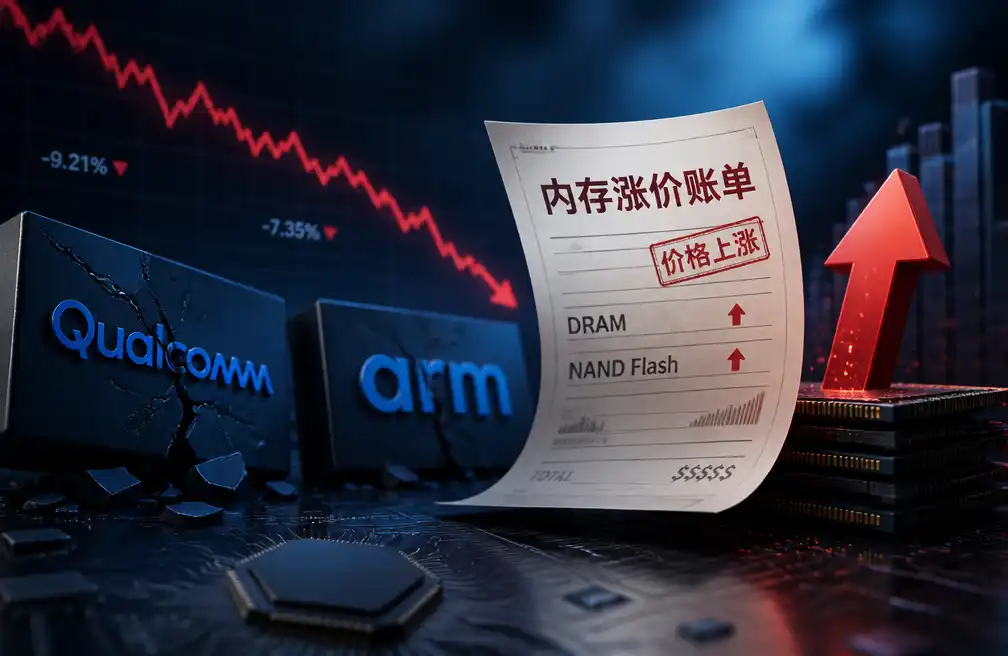
After posting Q2 FY2026 results, Qualcomm and Arm both saw their shares decline, reflecting the impact of memory price increases on the smartphone chip sector. Qualcomm's revenue of $9.95B slightly beat expectations, but EPS of $2.21 fell short. More concerning was its guidance for next quarter, with EPS projections below analyst estimates. The company directly attributed a >$1.50 per share annual EPS headwind to rising memory costs and supply constraints in Android phones, prompting planned price hikes. While automotive revenue grew 61% and is approaching one-third of phone revenue, the mobile segment declined 20%. Qualcomm also confirmed a significant reduction in its modem share for the upcoming iPhone and outlined a plan for data center revenue to replace all Apple-related income by FY2027. Arm's results surpassed expectations with revenue of $1.29B and EPS of $0.45, and its guidance was also strong. However, its stock fell. Key concerns included royalty revenue failing to set a new record and a downward revision to full-year royalty growth guidance from ~20% to the high-teens, citing weak smartphone demand and high memory prices. Despite robust growth in its data center business, Arm's premium valuation (over 100x forward P/E) means even beating expectations isn't enough to push the stock higher, as any sign of uncertainty is magnified. Ongoing global antitrust investigations add another risk factor. The situation highlights a broader shift. Memory price surges, which boosted Samsung's profits, are now pressuring chip designers. Meanwhile, the semiconductor sector saw significant corrections in July, with the hardest-hit stocks often being those with the biggest AI-driven gains year-to-date. Qualcomm, lacking such a premium, was an exception.

marsbit07/30 02:41

Qualcomm and Arm Fall Together: The Bill for Memory Price Hikes Finally Arrives at Mobile Chip Companies

marsbit07/30 02:41

Bernstein Report: Agentic AI Will Transform CPU from Supporting Role to Leading Role, Bullish on Hygon Information

Bernstein research report: Agentic AI will turn CPUs from supporting players to leading roles, bullish on Hygon Information. Analysts led by David Dai argue that AI is transitioning from the chatbot era to the agentic AI era. Unlike simple query-response models, agentic AI involves complex workflows including retrieval, planning, tool calling, and multi-step reasoning. This shift dramatically increases the demand for CPU compute to orchestrate these tasks, manage memory, and prevent expensive GPU idling. The report forecasts that the GPU-to-CPU ratio in inference clusters will reverse from 8:1 in 2025 to 1:1 by 2029. In agentic AI workloads, CPUs could account for 50% of the compute, on par with GPUs. Consequently, the server CPU Total Addressable Market (TAM) is projected to surge from $37 billion in 2025 to $223 billion by 2030, representing a 6x expansion. Arm is identified as a key beneficiary due to its superior performance-per-watt and a strategic shift from IP licensing to designing its own chips, targeting $15 billion in chip revenue by 2030. Bernstein raises Arm's price target to $500. For x86 vendors, the report is Overweight on AMD (target $600) and Hygon Information (target CNY 450), citing leadership and strong growth in the Chinese market respectively. Intel's target is raised to $100, reflecting upgraded earnings assumptions. The analysis acknowledges significant supply-side risks, questioning whether foundry and memory capacity can support such rapid CPU growth. The optimistic demand forecast also heavily relies on Nvidia's guidance for over $1 trillion in annual AI infrastructure spend by 2027.

marsbit06/17 09:46

Bernstein Report: Agentic AI Will Transform CPU from Supporting Role to Leading Role, Bullish on Hygon Information

marsbit06/17 09:46

ByteDance Adopts Arm CPUs, Jensen Huang: So Sad I Didn't Buy Arm

**Summary:** At Computex 2026, Arm CEO Rene Haas announced that ByteDance and Oracle have adopted Arm's self-designed Arm AGI data center CPU. The company expects significant revenue growth from this product, projecting $20 billion in demand for the 2027/2028 fiscal years. Haas noted that restricting AI-capable CPUs from the US to China is nearly impossible due to their widespread applications. Arm's stock has surged dramatically this year, notably rising 16% after NVIDIA's Arm-based Vera CPU and RTX Spark announcements. A highlight was the informal, humorous on-stage conversation between Haas and NVIDIA CEO Jensen Huang. Huang joked about NVIDIA's failed attempt to acquire Arm and playfully lamented selling his Arm shares. Both executives showed a clear sense of camaraderie and shared regret over the missed merger. Key technical topics were discussed: 1. **AI PC Design:** Huang explained NVIDIA's RTX Spark superchip (with a 20-core Arm CPU) is designed for future AI agents that will autonomously run and use tools on PCs, blending local and cloud processing. 2. **Agent vs. OS:** Huang emphasized the operating system remains crucial, as AI agents rely on its APIs and tools to function. 3. **Growth Constraints:** He identified the shift to "useful AI" that generates profitable tokens as a primary driver for immense, almost limitless, computational demand. Haas outlined Arm's strategy across PC and data centers. For PCs, Arm collaborates with partners like NVIDIA and MediaTek, offering its compute subsystem (CSS) for custom SoCs. In data centers, its Arm AGI CPU (built on TSMC's 3nm process) has gained major partners including OpenAI, Meta, and now ByteDance and Oracle. Arm presented a multi-year roadmap for its in-house CPU line. The article concludes that while GPUs dominated the AI training race, the explosion of AI agents is shifting significant focus to CPUs for inference, state management, and tool orchestration. The industry is trending towards vertical integration, with companies like cloud providers designing chips and chip/IP firms offering full solutions, all competing to deliver more efficient computing per watt.

marsbit06/04 04:51

ByteDance Adopts Arm CPUs, Jensen Huang: So Sad I Didn't Buy Arm

marsbit06/04 04:51

ARM's Stock Price Soars 30% Against the Trend, Is ARM, Now Making AI Chips, Winning Big?

ARM's stock surged over 15% on May 21, 2026, reaching a record high of $259, driven by its strategic pivot beyond its traditional IP licensing business. For over three decades, ARM has profited by licensing chip designs to companies like Apple and Qualcomm, earning mere cents per chip. However, with the mobile market maturing, growth stalled. In March 2026, ARM announced a historic shift: it would design and sell its own finished chips for the first time. Its "AGI CPU," built for AI data centers, targets the growing computational needs of AI Agents—tasks like workflow orchestration and data preprocessing where CPUs are crucial. This move positions ARM directly in the high-value server CPU market, competing with some of its own licensees. Analysts believe the rise of Agentic AI will dramatically increase demand for data center CPUs. Bernstein set a $300 price target, forecasting ARM's annual revenue could reach $26 billion by 2030 as the server CPU market expands. Major customers like Meta and OpenAI have already signed on for the AGI CPU, with committed demand reportedly doubling to over $2 billion within six weeks of launch. While this transformation offers massive upside, risks remain. ARM's valuation is extremely high (P/E ~300), pricing in future success. The company must also navigate potential conflicts with existing partners and execute flawless chip manufacturing. Nevertheless, Wall Street is betting that ARM's move from a "tax collector" to an AI infrastructure provider could redefine its growth trajectory for the AI era.

marsbit05/22 04:08
ARM's Stock Price Soars 30% Against the Trend, Is ARM, Now Making AI Chips, Winning Big?

marsbit05/22 04:08

Arm Steps Into Chip Manufacturing Itself | Rewire Morning News

Arm, after 35 years of only licensing its architecture, has begun manufacturing its own data center CPU, the 136-core Neoverse V3, with Meta as its first major client. This strategic shift aims to capture a larger market share and achieve significant revenue growth. In a separate legal battle, Anthropic is challenging the Pentagon's decision to ban federal agencies from using its AI, a move the presiding judge called "disturbing." Conversely, Palantir's military AI platform received a massive $13.4 billion funding commitment from the Pentagon, highlighting a stark divergence in the U.S. government's approach to AI militarization. Four tech billionaires presented conflicting visions on AI's impact. Perplexity's CEO and Palantir's CEO suggested AI-induced job loss is beneficial, while an OpenAI investor predicted 80% of jobs could be replaced by 2030. In contrast, BlackRock's CEO warned the greater threat is AI exacerbating wealth concentration. Circle's stock plummeted 18% due to proposed legislation threatening its business model, while Tether announced its first full audit by a Big Four firm, signaling a push for legitimacy amidst tightening regulations. OpenAI shut down its Sora video app, leading Disney to withdraw a $1 billion investment. An investor filing also revealed OpenAI now lists its major shareholder, Microsoft, as a top risk factor, indicating a strategic cleanup ahead of a potential IPO. Other notable news includes SK Hynix's record $8 billion order for EUV machines from ASML, Huawei's launch of a new AI accelerator, and Broadcom's warning that TSMC's production capacity is a major bottleneck for AI chips.

marsbit03/25 04:31

Arm Steps Into Chip Manufacturing Itself | Rewire Morning News

marsbit03/25 04:31

活动图片