When AI Agents need more than just GPUs, ARM is welcoming its own era.
In September 2023, ARM went public on Nasdaq at $51 per share. SoftBank sold less than 10% of its stake, cashing out approximately $4.9 billion. It was the largest tech IPO of that year, but many secretly harbored a question—how could a company that doesn't manufacture chips but only sells design blueprints justify a $54.5 billion valuation?
In less than three years, ARM has provided an answer no one anticipated.
On May 21, 2026, ARM's stock price surged over 15% in a single day, hitting a record high of $259. From around $201 at the end of April, it climbed 27% in just three weeks. By the intraday session on May 22, the stock price briefly touched $285.
From the IPO price of $51 to now, it has more than quintupled in less than three years.
This isn't a simple earnings report rally or analyst hype. ARM is undergoing the most profound identity transformation in its 35-year history. Can it completely reinvent itself?
AGI CPU: For the First Time in 35 Years, ARM is Manufacturing Its Own Chips
To understand ARM's current rally, one must first grasp how it made money in the past.
ARM's business model is unique in the semiconductor industry. It doesn't produce any chips itself. Instead, it licenses the underlying chip designs to other companies—Apple, Qualcomm, MediaTek, Samsung, and even Nvidia. Clients pay an upfront licensing fee to get the design blueprints, and then pay ARM a royalty for every chip produced based on ARM's architecture.
According to ARM's disclosures at IPO, the average royalty per chip is about 5 cents.
With this model, ARM's architecture found its way into 99% of the world's smartphones. By the time of its IPO, cumulative shipments of chips based on ARM designs exceeded 160 billion. But the problem was clear—the global smartphone market had essentially stopped growing.
ARM's revenue for fiscal year 2023 was $2.68 billion, even showing a slight year-over-year decline. A company that dominated the mobile computing era saw its revenue stagnating. The 5-cents-per-chip royalty model, in an era of plateauing phone markets, was destined to deliver only linear growth.
To break through the ceiling, ARM had to find a new growth engine.
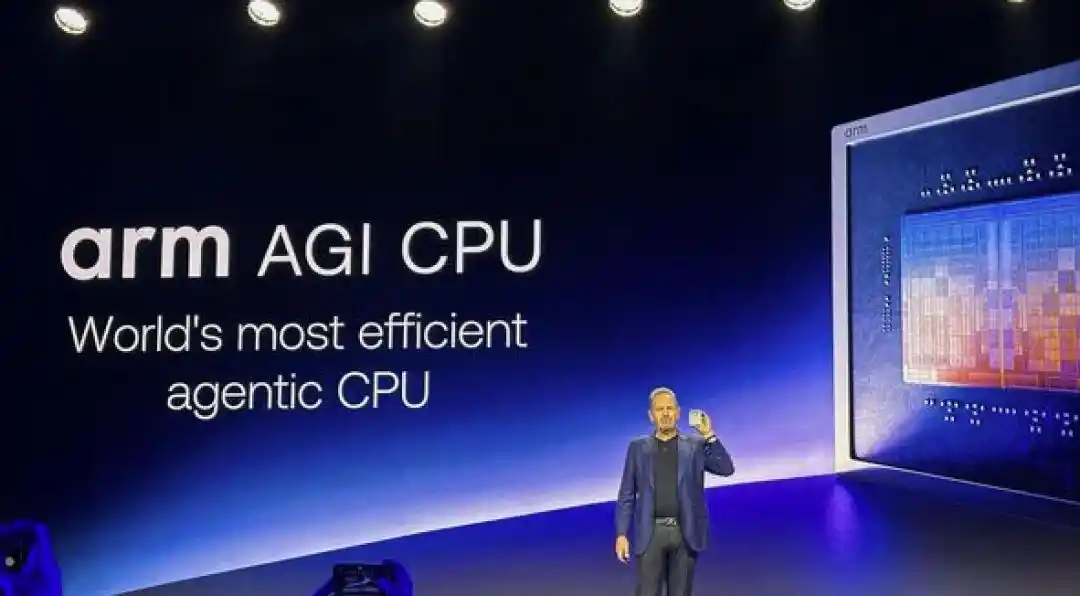
The AGI CPU launched by ARM|Image source: Livemint
On March 24, 2026, ARM held a launch event in San Francisco, announcing something the company had never done in its history—releasing and selling a finished chip of its own design.
This chip is named "AGI CPU," based on ARM's latest Neoverse V3 architecture, featuring up to 136 cores, manufactured using TSMC's 3nm process, with a TDP of 300 watts. It's not for training large models (that's the GPU's job), but specifically designed for "CPU-side" work in AI data centers—data preprocessing, model inference scheduling, network management, and most crucially, the orchestration of AI Agent workflows.
CEO Rene Haas said one sentence at the launch: "This is a pivotal turning point for the company."
This statement carries more weight than it appears on the surface. For 35 years, ARM adhered to one principle—we only sell designs, we don't compete with our customers. Apple uses ARM's architecture for its M-series chips, Qualcomm for Snapdragon, Nvidia for Grace. Everyone takes what they need, staying in their own lanes. Now, by stepping into chip manufacturing itself, ARM is essentially competing with its own customers for the same market.
But ARM's confidence stems from finding a new battlefield its customers haven't yet occupied.
The Underlying Logic of Data Centers is Being Rewritten
Over the past few years, everyone talked about GPUs. Nvidia's H100 and B200 are the hard currency of the AI era, with data center construction logic revolving around GPUs. CPUs? Just supporting actors, matched alongside GPUs at ratios like 1:4 to 1:8.
But Agentic AI is changing this equation.
Unlike traditional chatbots, AI Agents need to autonomously call tools, manage multi-step tasks, and coordinate multiple subsystems. These tasks are inherently serial and logic-intensive, precisely what CPUs excel at, not GPUs. When an Agent is busy calling APIs, waiting for external responses, or performing security checks, the expensive GPU next to it is essentially idling.
ARM's assessment is that, in the AI Agent era, the demand for CPU cores per gigawatt of data center power will surge from 30 million to 120 million—a fourfold increase. TrendForce research also points out that the CPU-to-GPU ratio in Agentic AI deployments will shift from the current 1:4 to 1:8, to 1:1 to 1:2.
Morgan Stanley further predicts that by 2030, Agentic AI could bring $32.5 to $60 billion in new demand to the data center CPU market, pushing the total server CPU market size beyond $100 billion.
Simply put, GPUs are the "engines" of the AI era, but the Agent era also needs a "dispatch center," and that's the CPU. This is precisely the position ARM's AGI CPU is targeting.
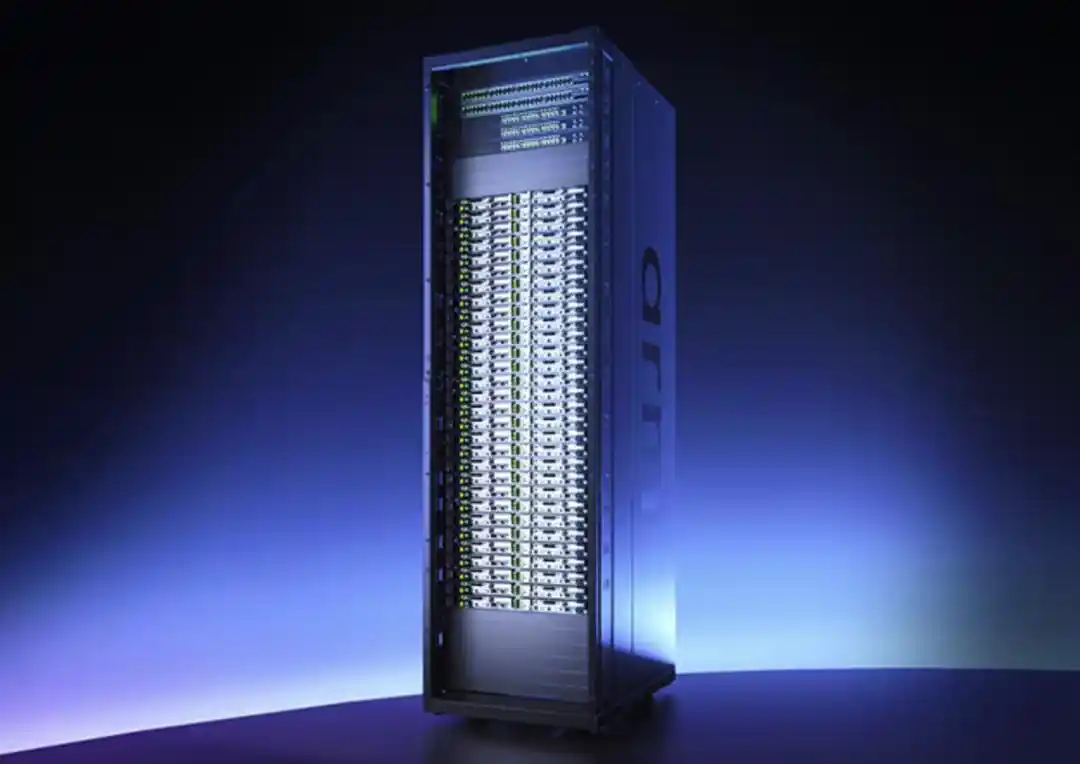
ARM's data center product lineup including the AGI CPU|Image source: ARM
ARM's AGI CPU is not a mere concept. Its initial customer list reads like the AI industry's "Hall of Fame"—Meta is a co-development partner and launch customer, with commercial contracts signed with OpenAI, Cerebras, Cloudflare, SAP, and SK Telecom. Server manufacturers like Lenovo, Supermicro, and Quanta have already begun offering integrated systems equipped with AGI CPUs.
Santosh Janardhan, Meta's Head of Infrastructure, stated that Meta co-developed this chip with ARM and will deploy it alongside Meta's in-house MTIA accelerators to optimize computational density in its "gigawatt-scale" AI data centers. Sachin Katti, Head of Industrial Computing at OpenAI, said the AGI CPU will become an integral part of OpenAI's infrastructure, responsible for the orchestration layer coordinating large-scale AI workloads.
What excites Wall Street even more is the speed of growth.
ARM revealed during its early-May earnings call that committed customer demand for the AGI CPU for FY2027-2028 already exceeds $2 billion—and this figure was only $1 billion six weeks ago when the product was just launched. Doubling in six weeks, this pace of demand acceleration is extremely rare in the hardware industry.
Meanwhile, ARM's traditional business is also accelerating. Q4 FY2026 revenue reached $1.49 billion, a 20% year-over-year increase, with licensing revenue soaring 29% to $819 million, setting a historical record for the best single-quarter performance.
ARM Repriced
The real catalyst for this rally was a heavyweight research report released by Bernstein analyst David Dai on May 19.
Dai initiated coverage on ARM with an Outperform rating, directly setting a $300 price target. His core logic was clear—AI is transitioning from chatbots to Agentic AI, which will drive structural growth in CPU demand, and ARM, with its power efficiency advantage, will be the biggest winner. He estimates that by 2030, the server CPU market will quadruple to $137 billion, with ARM's annual revenue surpassing $26 billion and earnings per share reaching $9.83.
Bernstein isn't alone. Jefferies raised its target price from $210 to $290, TD Cowen from $165 to $265, and Bank of America gave a $300 target. Citi also confirmed management's 2031 targets—$25 billion total revenue and $9 earnings per share.
This isn't optimism from a single firm; it's Wall Street collectively reframing ARM's valuation model. The market is no longer pricing ARM as a "chip IP licensing company" but starting to value it as an "AI infrastructure platform."
Interestingly, in the same month ARM launched its AGI CPU, Nvidia also announced it would sell its ARM-based Vera CPU as a standalone product. On May 19, Nvidia VP Ian Buck personally delivered the first Vera CPU systems to Anthropic, OpenAI, Oracle, and SpaceXAI. A GPU giant and an IP licensing giant simultaneously entering the CPU market in the same month—this in itself is the most powerful endorsement of the judgment that "Agentic AI is reshaping CPU demand."

Returning to ARM's business logic. In the past, selling blueprints earned 5 cents to $2 per chip in royalties. Now, manufacturing and selling its own chips means a data center CPU sells for thousands of dollars. It has jumped from the bottom to the mid-to-upper end of the value chain, boosting unit revenue by a factor of a thousand.
Of course, the risks are equally enormous. ARM's current P/E ratio is nearly 300, and its P/S ratio is close to 167. This valuation isn't pricing ARM of 2026, but ARM of 2030 or beyond. If the adoption pace of Agentic AI lags expectations, if execution missteps occur in the journey from IP design to mass chip production, if self-manufacturing chips alienate existing licensing customers and damage relationships—a problem in any single link could trigger a sharp correction.
Notably, ARM insiders have sold approximately $31.9 million worth of shares over the past three months. Management is signaling through action that they, too, find the current price not cheap.
But the market is clearly willing to buy into this story. Because what ARM is doing is transitioning from a "tax collector" to an "infrastructure supplier." If Agentic AI truly explodes as everyone expects, and CPU demand really quadruples, then today's ARM might just be getting started.
For the first time in 35 years, what ARM holds in its hand isn't just a blueprint, but an actual chip. Whether this chip can support a completely new ARM might not be revealed until after mass production ramps up post-2028.
But at least for now, Wall Street has already cast its vote of confidence in advance.
This article is from the WeChat public account "GeekPark" (ID: geekpark), author: Hualin Wuwang, editor: Jingyu