Crypto Community Reacts as U.S. Strategy Push AI While Leaving Digital Assets Undefined

bitcoinist2025-12-09 tarihinde yayınlandı2025-12-09 tarihinde güncellendi

Özet

The United States' new national security strategy, released by the Trump administration, has sparked debate in the crypto community by omitting any direct reference to digital assets or blockchain technology. The 33-page document instead prioritizes artificial intelligence, biotechnology, and quantum computing as core to the nation's technological ambitions. This silence on crypto contrasts with recent pro-crypto political statements and market momentum, creating policy uncertainty. While the strategy includes a vague reference to strengthening U.S. leadership in "digital finance," analysts see it as a broad gesture rather than concrete policy. The omission comes despite significant crypto-related actions this year, such as the GENIUS Act for stablecoins and the establishment of a national Bitcoin reserve. Following the release, Bitcoin's price briefly fell below $90,000, amid broader macroeconomic pressures. The industry is left navigating a familiar gap between political rhetoric and the lack of a comprehensive regulatory framework.

The United States’ new national security strategy has renewed debate across the crypto community after omitting any direct reference to digital assets or blockchain technology.

Released by the Trump administration, the document outlines the nation’s long-term security priorities and technological ambitions, yet its silence on crypto stands in contrast with both market momentum and recent political statements.

As global financial systems increasingly integrate digital assets, many observers see the absence as a signal of policy uncertainty at a time when regulatory clarity is becoming more important for industry growth.
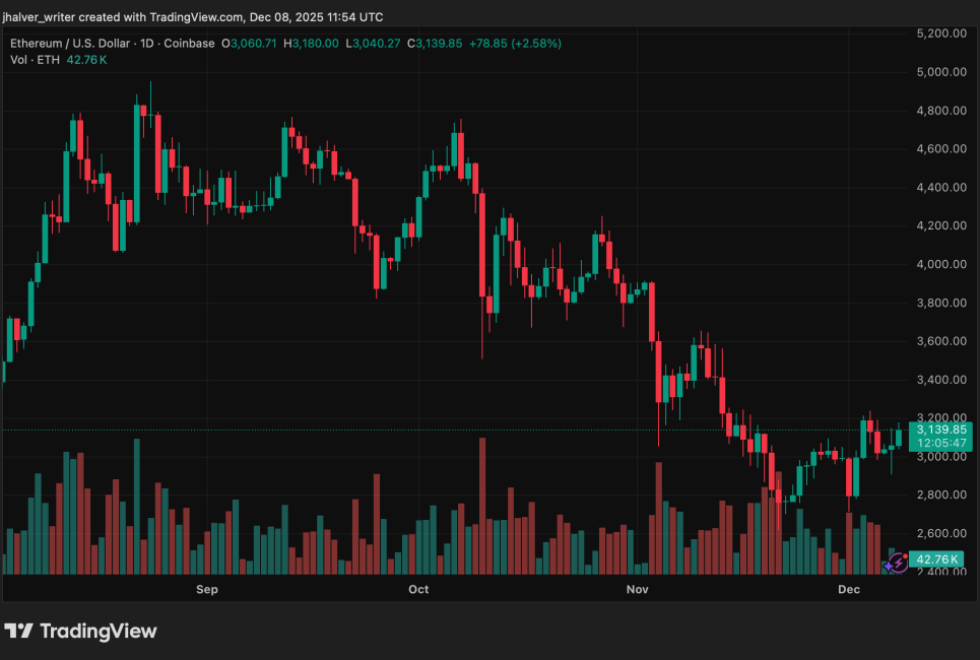
ETH's price records small profits on the daily chart. Source: ETHUSD on Tradingview

Why Has AI Taken the Spotlight

Across its 33 pages, the strategy places artificial intelligence, biotechnology, and quantum computing at the center of America’s next-generation competition.

The administration states that U.S. technology and standards must “drive the world forward,” underscoring a focus on advanced computing rather than decentralized finance. Digital assets, which had gained prominence through previous remarks from officials, receive no explicit mention.

This stands at odds with comments from President Trump in recent months. In a CBS 60 Minutes interview, he warned that China should not become the global leader in virtual assets and insisted that Bitcoin mining should remain within U.S. borders.

A Subtle Reference, but No Clear Policy

While crypto is not named in the strategy, the document does reference strengthening American “leadership in digital finance and innovation.”

Analysts view this as a broad gesture rather than a firm policy direction, but it leaves open the possibility that digital assets may still influence future regulatory or economic strategies.

This ambiguity comes despite a year of significant pro-crypto actions. Measures such as the GENIUS Act for stablecoin oversight, the formation of a crypto enforcement task force, reduced regulatory pressures on exchanges, and opposition to a central bank digital currency have all shaped expectations.

The establishment of a national Bitcoin reserve, funded through forfeited digital assets, further signals that crypto remains a strategic consideration even if not formally acknowledged in the latest blueprint.

Market Response and Broader Implications

Currently trading around $91,900, Bitcoin briefly fell below $90,000 following the release of the strategy, a move compounded by broader macroeconomic pressures and anticipation of a Federal Reserve rate decision.

The administration’s call for increased defense spending among NATO allies has also raised questions about inflation and monetary policy, factors that could influence investor appetite for digital assets.

For now, the omission leaves the industry navigating a familiar gap of strong political rhetoric, scattered policy initiatives, but no comprehensive framework. As the U.S. centers its priorities around AI and quantum computing, crypto’s position in national strategy remains undefined. Is this the end of the ‘Crypto Administration’?

Cover image from ChatGPT, ETHUSD chart from Tradingview

İlgili Okumalar

Five Core Forms of AI Agent in YC's Eyes

The article outlines five core architectural patterns for effective AI Agents, emerging from tools like Codex and Claude, that move beyond simple prompts towards reusable, process-based capabilities. 1. **Skills**: Reusable, parameterized workflows that function like method calls, allowing a single process (e.g., "/investigate") to handle various tasks based on input parameters. 2. **Thin Harness**: A lightweight execution framework (~200 lines) that manages the AI model's "hands and feet"—handling loops, file I/O, and context—without becoming bloated. 3. **Resolvers**: Routing tables that map tasks to specific Skills, preventing "context corruption" when managing dozens of Skills and ensuring outputs go to the correct locations. 4. **Latent vs. Deterministic Layer**: A critical separation where LLMs handle judgment, synthesis, and pattern recognition, while deterministic code handles tasks requiring precision, consistency, and low cost (like calculations). 5. **Memory**: A persistent, accumulating knowledge base (e.g., a markdown folder) with a "current trusted conclusion" section and an append-only timeline, enabling the system to learn and retain context over time. Together, these patterns create a "process power"—a durable competitive advantage. Unlike one-off prompt-based applications whose value quickly commoditizes, a well-designed AI Agent system encodes experience into reusable, parameterized workflows, offloads stable rules to code, and continuously learns through memory. This creates a structured, hard-to-replicate capability that can provide sustained value for individuals or businesses, such as an accountant automating client reviews while preserving privacy and accumulating expertise.

marsbit17 dk önce

Five Core Forms of AI Agent in YC's Eyes

marsbit17 dk önce

Tiger Research: On-Chain Risk Operators, The Market Cap Gap Between 147 Trillion and 70 Billion

This report by Tiger Research examines the evolution of risk management in decentralized finance (DeFi) lending. It highlights a power shift from protocol developers to specialized professional risk operators who manage on-chain capital. The era of protocols and community governance solely dictating DeFi lending is ending. A new professional asset management layer has emerged. While the sector is nascent, capital and distribution channels are rapidly consolidating around top risk operator teams, whose past performance is now a key criterion for institutional entry. The industry's development, accelerated by modular infrastructures like Morpho, has led to a clear division of labor mirroring traditional finance: distribution channels (e.g., exchanges), strategy/risk management (the risk operators), and product infrastructure/asset custody (smart contract protocols). This structure lowers the entry barrier for traditional institutions. Currently, the total value managed by risk operators is approximately $70 billion, dominated by a few leading teams like Steakhouse (RWA focus), Sentora (AI models), and Gauntlet (crisis management). Competition now centers on collateral standards, distribution access, and crisis response capabilities. The report outlines three primary entry paths for institutions: 1) **Distribution Model**: Leveraging external risk operators as backend service providers (common for exchanges). 2) **Asset Supply Model**: Onboarding real-world assets to DeFi as collateral. 3) **Independent Operator Model**: Building an in-house team to become a risk operator (e.g., Bitwise). The core opportunity lies in the strategy/risk management layer, where traditional financial institutions can leverage their existing expertise in due diligence and risk assessment without deep technical development. A vast opportunity gap exists: the global traditional asset management industry manages ~$147 trillion, while the entire DeFi sector is only ~$800 billion, with the risk operator niche at ~$70 billion. This disparity signifies immense growth potential. Once robust risk frameworks and clearer regulations are established, even a minor allocation from traditional markets could trigger exponential DeFi growth. Early movers who help build these foundational systems will gain significant rule-setting influence and first-mover advantages.

marsbit24 dk önce

Tiger Research: On-Chain Risk Operators, The Market Cap Gap Between 147 Trillion and 70 Billion

marsbit24 dk önce

Interview with Circle's Chief Economist: USDC's Entry into Hyperliquid Benefits Circle and HYPE, Stablecoins Are Becoming Marginal Buyers of U.S. Treasuries

In an interview with Circle's Chief Economist Gordon Liao, the conversation covers the strategic significance of USDC replacing USDH as the reference asset on the decentralized perpetual exchange Hyperliquid. This shift, facilitated by Coinbase as the reserve manager and Circle providing technical infrastructure, aims to capture net interest income for the platform, with 90% of reserve earnings directed back to Hyperliquid for HYPE token buybacks. Liao discusses how stablecoins like USDC, with their substantial on-chain settlement volumes (e.g., $21 trillion in Q1 2026), are emerging as marginal buyers of U.S. Treasuries, concentrating on short-term debt and effectively reducing the weighted duration of the market, which may provide underlying support for long-term rates. The dialogue also explores the evolving nature of stablecoins as both a medium of exchange and a vehicle for capital and collateral liquidity. Additionally, the panel touches on the CLARITY Act's legislative progress, noting compromises around "activity-based rewards" and remaining hurdles like ethics concerns. On AI, there's debate over value capture, with predictions that distribution and application layers, rather than foundational model companies like OpenAI, will accrue most value. Regarding the bond market, Liao attributes the rise in 30-year yields primarily to an increased term premium (around 80 bps) driven by supply-demand dynamics, including fiscal expansion and changing investor demand, rather than expectations of Fed rate hikes.

marsbit29 dk önce

Interview with Circle's Chief Economist: USDC's Entry into Hyperliquid Benefits Circle and HYPE, Stablecoins Are Becoming Marginal Buyers of U.S. Treasuries

marsbit29 dk önce

İşlemler

Spot
Futures

Popüler Makaleler

PUSH Nasıl Satın Alınır

HTX.com’a hoş geldiniz! Push Protocol (PUSH) satın alma işlemlerini basit ve kullanışlı bir hâle getirdik. Adım adım açıkladığımız rehberimizi takip ederek kripto yolculuğunuza başlayın. 1. Adım: HTX Hesabınızı OluşturunHTX'te ücretsiz bir hesap açmak için e-posta adresinizi veya telefon numaranızı kullanın. Sorunsuzca kaydolun ve tüm özelliklerin kilidini açın. Hesabımı Aç2. Adım: Kripto Satın Al Bölümüne Gidin ve Ödeme Yönteminizi SeçinKredi/Banka Kartı: Visa veya Mastercard'ınızı kullanarak anında Push Protocol (PUSH) satın alın.Bakiye: Sorunsuz bir şekilde işlem yapmak için HTX hesap bakiyenizdeki fonları kullanın.Üçüncü Taraflar: Kullanımı kolaylaştırmak için Google Pay ve Apple Pay gibi popüler ödeme yöntemlerini ekledik.P2P: HTX'teki diğer kullanıcılarla doğrudan işlem yapın.Borsa Dışı (OTC): Yatırımcılar için kişiye özel hizmetler ve rekabetçi döviz kurları sunuyoruz.3. Adım: Push Protocol (PUSH) Varlıklarınızı SaklayınPush Protocol (PUSH) satın aldıktan sonra HTX hesabınızda saklayın. Alternatif olarak, blok zinciri transferi yoluyla başka bir yere gönderebilir veya diğer kripto para birimlerini takas etmek için kullanabilirsiniz.4. Adım: Push Protocol (PUSH) Varlıklarınızla İşlem YapınHTX'in spot piyasasında Push Protocol (PUSH) ile kolayca işlemler yapın.Hesabınıza erişin, işlem çiftinizi seçin, işlemlerinizi gerçekleştirin ve gerçek zamanlı olarak izleyin. Hem yeni başlayanlar hem de deneyimli yatırımcılar için kullanıcı dostu bir deneyim sunuyoruz.

522 Toplam GörüntülenmeYayınlanma 2024.12.13Güncellenme 2025.03.21

PUSH Nasıl Satın Alınır

Tartışmalar

HTX Topluluğuna hoş geldiniz. Burada, en son platform gelişmeleri hakkında bilgi sahibi olabilir ve profesyonel piyasa görüşlerine erişebilirsiniz. Kullanıcıların PUSH (PUSH) fiyatı hakkındaki görüşleri aşağıda sunulmaktadır.

活动图片