Cardano Founder Hoskinson Launches Government And Policy Center

bitcoinist2025-10-16 tarihinde yayınlandı2025-10-16 tarihinde güncellendi

Özet

Charles Hoskinson, founder of Cardano, has launched the Hoskinson Government and Policy Center in Wyoming, positioning the new entity to...

Trusted Editorial content, reviewed by leading industry experts and seasoned editors. Ad Disclosure

Charles Hoskinson, founder of Cardano, has launched the Hoskinson Government and Policy Center in Wyoming, positioning the new entity to work on rural health care, agriculture, blockchain policy and “government transparency,” with plans to engage directly in the state’s 2026 election cycle in coordination with a Wyoming Integrity political action committee. The announcement was made on Oct. 15, 2025, via a sponsored post carried by Cowboy State Daily and by new social channels tied to the Center.

Cardano Founder Predicts ‘A Lot Of Fun Next Year’

The Center will concentrate its government-relations efforts inside Wyoming, a jurisdiction where Hoskinson has been steadily increasing his physical footprint. The announcement points to a medical clinic he financed in Gillette and a bison ranch in Platte County as examples of prior commitments, and lists near-term legislative priorities that include securing access to stem-cell therapies in the state.

In his statement, Hoskinson framed the initiative as a vehicle to “strengthen rural health care, modernize agriculture, and improve government transparency,” adding that “with smart legislation and the right technology, Wyoming can set the standard for how decentralized systems can deliver beneficial change in all walks of life.”
Leadership appointments were disclosed alongside the launch. Karen Wheeler, a career Wyoming official who served for decades in the Secretary of State’s office — including a brief stint as acting Secretary in 2018 and a 2015–2022 tenure as Deputy Secretary — will serve as Executive Director.

“I am truly honored to lead the Hoskinson Government and Policy Center as we work to advance thoughtful, forward-looking policy across healthcare, agriculture, and technology,” Wheeler said, describing the sectors as central to “Wyoming’s strength and growth.”

Kendrick Ladd, identified as a former US Army officer and federal regulatory investigator who now practices law in Wyoming, was named General Counsel and Head of Policy. “To benefit current and future Wyoming generations, the integration of emerging technology in government must spring from and strengthen Wyoming’s foundational principles of liberty, integrity, and government accountability,” Ladd said in the release.

The Center also named longtime Wyoming politics reporter Leo Wolfson as Wyoming Communications Director. Wolfson most recently covered the Legislature and state politics for Cowboy State Daily from 2022 through 2025. “I am beyond thrilled to be joining an organization like the Policy Center that’s focused on supporting Charles Hoskinson’s efforts to make Wyoming a strong and independent state for generations to come,” he said.

Beyond policy advocacy, the Center signaled electoral ambitions. It “plans on taking an active role in the 2026 elections in Wyoming” and will coordinate “throughout the election cycle” with the Wyoming Integrity PAC, an entity that Hoskinson previewed earlier this year as a vehicle to press for procurement transparency and ethics in state contracting.

Hoskinson amplified the launch on X. In a light-toned post, he wrote, “We are going to have a lot of fun next year :)” and reposted the Center’s announcement from its new @WyomingHGPC account.

The initiative builds on Hoskinson’s Wyoming-focused projects. The Gillette-based Hoskinson Health & Wellness Clinic as well as the Twin Pine/Hoskinson bison ranch near Wheatland are Hoskinson’s well-known projects besides Cardano. What remains less defined in the launch materials is the Center’s funding model, and any formal relationship, if any, with Cardano-affiliated entities such as Input Output Global.

For the crypto industry, the Wyoming emphasis is consistent with Hoskinson’s public critiques earlier this year of opaque procurement around the state’s stablecoin initiative, and his argument that clearer, more competitive processes could sustain Wyoming’s reputation as a crypto-friendly hub. “I’ve invested my time and resources here in Wyoming because I believe this state can lead the nation,” Hoskinson said.

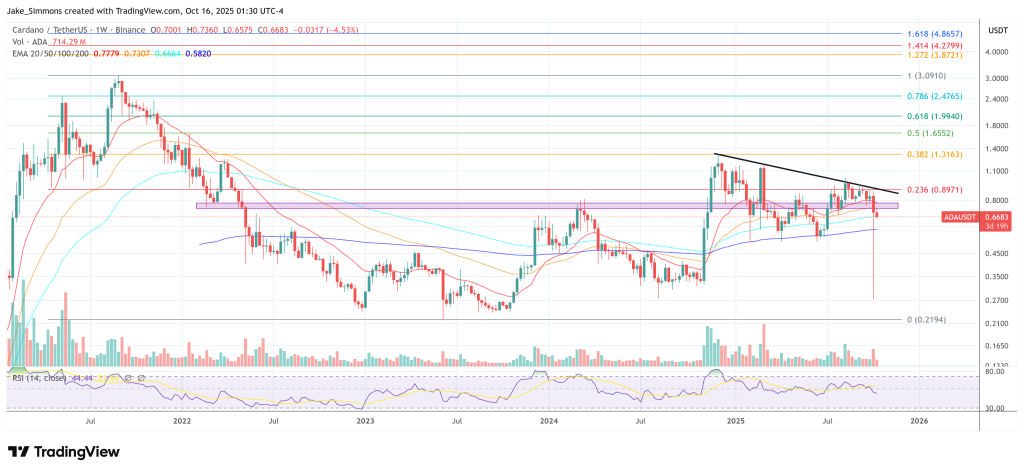
At press time, Cardano traded at $0.6683.
Cardano price
Cardano remains below key resistance, 1-day chart | Source: ADAUSDT on TradingView.com
Featured image from YouTube, chart from TradingView.com
Editorial Process for bitcoinist is centered on delivering thoroughly researched, accurate, and unbiased content. We uphold strict sourcing standards, and each page undergoes diligent review by our team of top technology experts and seasoned editors. This process ensures the integrity, relevance, and value of our content for our readers.

Jake Simmons has been a Bitcoin enthusiast since 2016. Ever since he heard about Bitcoin, he has been studying the topic every day and trying to share his knowledge with others. His goal is to contribute to Bitcoin's financial revolution, which will replace the fiat money system. Besides BTC and crypto, Jake studied Business Informatics at a university. After graduation in 2017, he has been working in the blockchain and crypto sector. You can follow Jake on Twitter at @realJakeSimmons.

İlgili Okumalar

A 10,000-Word Interpretation of the "Optical Interconnect" Industry Chain: The AI Infrastructure Bottleneck Obscured by GPU Glare

**Summary: The Rise of Optical Interconnect in AI Infrastructure** This analysis explores the critical, yet often overlooked, role of optical interconnects in large-scale AI data centers. While GPUs provide raw computational power, the efficiency of AI clusters depends heavily on high-speed data transfer between thousands of cooperating GPUs during both training and inference tasks. Copper-based electrical connections are hitting physical limits in bandwidth, distance, and power consumption. Fiber optics, using light signals, offer a superior solution with exponentially higher bandwidth and lower energy use over longer distances. This shift is driving rapid growth in the optical interconnect market. The core translation device is the pluggable optical transceiver (or module), which converts electrical signals from GPUs into optical signals for fiber transmission and vice versa. Its manufacturing involves two distinct semiconductor domains: indium phosphide (InP) for optical chips (lasers, modulators, detectors) and silicon for digital signal processing (DSP) chips. A transformative next-generation technology is Co-Packaged Optics (CPO). CPO moves the optical engine (a silicon photonic integrated circuit, or PIC) much closer to the GPU or switch inside the same chip package, drastically reducing power loss and latency. CPO necessitates an external laser source and relies on silicon photonics (using Silicon-on-Insulator/SOI wafers) for integration with silicon chips. The optical interconnect ecosystem is highly fragmented, unlike the concentrated GPU market. Key bottlenecks and players span the entire supply chain: InP substrates (e.g., AXT), epitaxial wafers (e.g., IQE), laser chips (e.g., Sivers, Lumentum, Coherent), silicon photonics foundries (e.g., Tower Semiconductor), SOI wafers (e.g., Soitec), DSP/switch chips (e.g., Broadcom, Marvell), and underlying fiber (e.g., Corning). The article posits that AI infrastructure competition is extending from "who has more GPUs" to "who can secure the scarce optical interconnect supply chain." CPO represents the largest potential growth variable, with projections suggesting it could become a market worth tens of billions of dollars by 2028. Investment opportunities vary from conservative (large, diversified players) to aggressive (small, high-beta companies focused on specific bottleneck technologies), but the sector carries significant volatility and execution risks.

marsbit21 dk önce

A 10,000-Word Interpretation of the "Optical Interconnect" Industry Chain: The AI Infrastructure Bottleneck Obscured by GPU Glare

marsbit21 dk önce

a16z: RWA Has Passed the Proof of Concept, but the Real Challenges Are Just Beginning

a16z highlights that the tokenized real-world asset (RWA) market, excluding stablecoins, has grown tenfold in under two years to roughly $340 billion. This surge is primarily driven by US Treasury bonds and gold, offering investors yield on idle stablecoins and providing institutions with more efficient settlement and collateral flows. However, the core insight is that most tokenized assets today are simply digital certificates for off-chain holdings—used for ownership and transfer but not deeply integrated into DeFi as composable financial building blocks. For instance, only about 5% of tokenized bonds ($8B) are actively used in DeFi protocols. Smaller categories like reinsurance tokens show much higher DeFi utilization (84%), indicating they were designed for on-chain composability from the start. The market remains concentrated, with US Treasuries and commodities comprising two-thirds of the total. Gold dominates the commodities segment. While Ethereum holds over half the market, activity is spreading across multiple chains like BNB Chain and Solana. Predictions for the market's future size vary widely (from $2 trillion to over $30 trillion by 2030/2034), reflecting different definitions of what constitutes tokenization. All agree on significant growth. The current market is minuscule compared to traditional finance (e.g., tokenized bonds are 0.01% of the global bond market). The key takeaway is that the initial "proof-of-concept" phase for moving familiar assets on-chain is proving successful. The next, harder challenge is moving more complex financial instruments onto blockchains and enabling true on-chain composability, where these assets become programmable components within a native digital financial system, rather than just digitized records.

marsbit58 dk önce

a16z: RWA Has Passed the Proof of Concept, but the Real Challenges Are Just Beginning

marsbit58 dk önce

The Wind of 'Proactive' AI Blows into Silicon Valley: Hark Secures $700 Million in Funding

Hark, an AI startup founded in late 2025, has raised $700 million in Series A funding at a $6 billion valuation. Led by Parkway Venture Capital with participation from NVIDIA, AMD Ventures, Intel Capital, Qualcomm Ventures, and Salesforce Ventures, the company aims to develop next-generation human-computer interfaces using a combination of proprietary foundational models and custom-built AI-native hardware. Founded by serial entrepreneur Brett Adcock, Hark envisions a system of multimodal devices equipped with agentic capabilities, end-to-end voice models, and personalized memory. This "active" AI approach seeks to move beyond passive chatbots, creating collaborative companions that anticipate needs and interact naturally within the real world. Adcock's experience with Figure, a humanoid robotics company, informs this hardware-focused venture. The article argues that while current AI is powerful, it remains confined to screens and traditional interfaces like chat. The next paradigm shift requires dedicated hardware that is always-on, possesses persistent memory, and enables intuitive interaction, potentially rivaling the impact of the iPhone. Hark is assembling a team with talent from Apple, Meta, Google, and Tesla to tackle this complex engineering challenge across models, hardware, and interaction design. Finally, the piece suggests Chinese startups may have an advantage in this "active" AI hardware space due to strong manufacturing ecosystems, a vast domestic market, and supportive government policies, framing the competition as one that requires integrated progress in models, operating systems, and devices.

marsbit1 saat önce

The Wind of 'Proactive' AI Blows into Silicon Valley: Hark Secures $700 Million in Funding

marsbit1 saat önce

İşlemler

Spot
Futures

Popüler Makaleler

ADA Nasıl Satın Alınır

HTX.com’a hoş geldiniz! Cardano (ADA) satın alma işlemlerini basit ve kullanışlı bir hâle getirdik. Adım adım açıkladığımız rehberimizi takip ederek kripto yolculuğunuza başlayın. 1. Adım: HTX Hesabınızı OluşturunHTX'te ücretsiz bir hesap açmak için e-posta adresinizi veya telefon numaranızı kullanın. Sorunsuzca kaydolun ve tüm özelliklerin kilidini açın. Hesabımı Aç2. Adım: Kripto Satın Al Bölümüne Gidin ve Ödeme Yönteminizi SeçinKredi/Banka Kartı: Visa veya Mastercard'ınızı kullanarak anında Cardano (ADA) satın alın.Bakiye: Sorunsuz bir şekilde işlem yapmak için HTX hesap bakiyenizdeki fonları kullanın.Üçüncü Taraflar: Kullanımı kolaylaştırmak için Google Pay ve Apple Pay gibi popüler ödeme yöntemlerini ekledik.P2P: HTX'teki diğer kullanıcılarla doğrudan işlem yapın.Borsa Dışı (OTC): Yatırımcılar için kişiye özel hizmetler ve rekabetçi döviz kurları sunuyoruz.3. Adım: Cardano (ADA) Varlıklarınızı SaklayınCardano (ADA) satın aldıktan sonra HTX hesabınızda saklayın. Alternatif olarak, blok zinciri transferi yoluyla başka bir yere gönderebilir veya diğer kripto para birimlerini takas etmek için kullanabilirsiniz.4. Adım: Cardano (ADA) Varlıklarınızla İşlem YapınHTX'in spot piyasasında Cardano (ADA) ile kolayca işlemler yapın.Hesabınıza erişin, işlem çiftinizi seçin, işlemlerinizi gerçekleştirin ve gerçek zamanlı olarak izleyin. Hem yeni başlayanlar hem de deneyimli yatırımcılar için kullanıcı dostu bir deneyim sunuyoruz.

1.3k Toplam GörüntülenmeYayınlanma 2024.12.10Güncellenme 2025.03.21

ADA Nasıl Satın Alınır

Tartışmalar

HTX Topluluğuna hoş geldiniz. Burada, en son platform gelişmeleri hakkında bilgi sahibi olabilir ve profesyonel piyasa görüşlerine erişebilirsiniz. Kullanıcıların ADA (ADA) fiyatı hakkındaki görüşleri aşağıda sunulmaktadır.

活动图片