Bernstein Interprets MRNA's 177% Surge: What's Fundamentals and What's Hype?

marsbit2026-08-21 tarihinde yayınlandı2026-08-21 tarihinde güncellendi

Özet

Bernstein's analysis of Moderna's 177% stock surge following positive Phase 3 results for its individualized neoantigen therapy (INT) in melanoma distinguishes fundamental drivers from market speculation. The clinical breakthrough is real: the INTerpath-001 trial met its primary and key secondary endpoints, providing crucial validation for mRNA technology in oncology beyond infectious diseases. However, Bernstein argues the magnitude of the stock move cannot be justified by this single trial's fundamentals alone. The surge was amplified by three key factors: 1) A re-rating of Moderna's mRNA platform potential for expansion into other cancers, 2) A massive short squeeze, given ~15% of shares were sold short pre-announcement, and 3) The compelling "cancer vaccine" narrative that fueled broader investor enthusiasm. While the melanoma success is significant, Bernstein cautions that replication in lung, kidney, and bladder cancers—which have different immunogenicity—is not guaranteed. Furthermore, INT's commercial model faces challenges: it's a personalized treatment, not a mass-market vaccine, implying higher production costs and potential margin pressures despite a projected multi-billion dollar peak sales opportunity. The report also notes sector rotation, with some funds moving from crowded AI/semiconductor trades into defensive healthcare stocks, adding further momentum. In conclusion, Bernstein maintains a "Market-Perform" rating and a $45 price target, far below the po...

On August 19, Moderna and Merck announced the Phase 3 topline results for the personalized neoantigen therapy intismeran autogene (referred to as INT) in combination with Keytruda for the treatment of high-risk melanoma.

INTerpath-001 enrolled a total of 1,137 patients with stage IIB to IV cutaneous melanoma who had completed surgical resection and had not previously received systemic treatment. At the first interim analysis, the trial simultaneously met its primary endpoint of Recurrence-Free Survival (RFS) and the key secondary endpoint of Distant Metastasis-Free Survival (DMFS). Overall Survival (OS) data is not yet mature, and the trial will continue.

The company has so far only confirmed that the results are statistically significant and clinically meaningful, without disclosing specific hazard ratios, confidence intervals, patient subgroups, and full safety data. In other words, the market has confirmed the trial's success but does not yet know exactly how strong the efficacy is.

Following the announcement, Moderna's stock closed up about 177% to $174.38, with its market capitalization increasing by approximately $45 billion in a single day; Merck's stock rose about 13% to $152.20, with its market cap increasing by about $50 billion. The market debate quickly shifted from "Will the trial succeed?" to "Can such a scale of gains be justified by fundamentals?"

Clinical Breakthrough is Real, But Insufficient to Explain the 177% Surge

Bernstein believes that INTerpath-001 meeting both the RFS and DMFS endpoints at the first interim analysis suggests the efficacy is likely quite robust.

Interim analyses typically need to cross a higher statistical threshold. Based on this, the report speculates that the Phase 3 trial's RFS hazard ratio could be in the range of 0.50 to 0.65, and the DMFS hazard ratio might be close to 0.40, roughly consistent with previous Phase 2 data.

A hazard ratio below 1 means the relative risk of recurrence, distant metastasis, or death events is lower in the combination therapy group compared to the Keytruda monotherapy group. For example, a hazard ratio of 0.50 roughly represents an approximate 50% reduction in the relative risk of the relevant event, but does not equate to half of the patients being cured.

The above ranges are merely Bernstein's speculation based on statistical thresholds and past data, not the Phase 3 results announced by the companies. Specific efficacy, safety, and overall survival trends still await complete data.

However, the significance of this trial extends beyond melanoma. It is Moderna's first pivotal trial success outside of respiratory vaccines and the first personalized neoantigen regimen proven to further improve Keytruda's efficacy in a Phase 3 study.

This provides critical clinical evidence for expanding mRNA from infectious disease vaccines to cancer treatment and marks the starting point for the market's revaluation of Moderna's platform value.

The Market is Trading on Platform Revaluation and Short Covering

Clinical results can explain a stock price increase but are insufficient to explain its magnitude.

Bernstein believes that even with optimistic success expectations for all of INT's later-stage projects, it is difficult to justify Moderna's approximately 177% single-day surge. This rally is primarily driven by the convergence of three forces:

Clinical success reduces the residual risk for the melanoma project;

Investors begin pricing in the platform potential of mRNA expansion to more cancer types;

High short interest triggers short covering, amplifying short-term buying pressure.

Prior to the results announcement, approximately 14% to 15% of Moderna's float was sold short. After the clinical results exceeded pessimistic expectations, short sellers were forced to buy to cover their positions, and previously underweight investors also started chasing the rally. Moderna's trading volume that day approached 200 million shares, roughly equivalent to half of the company's total outstanding shares.
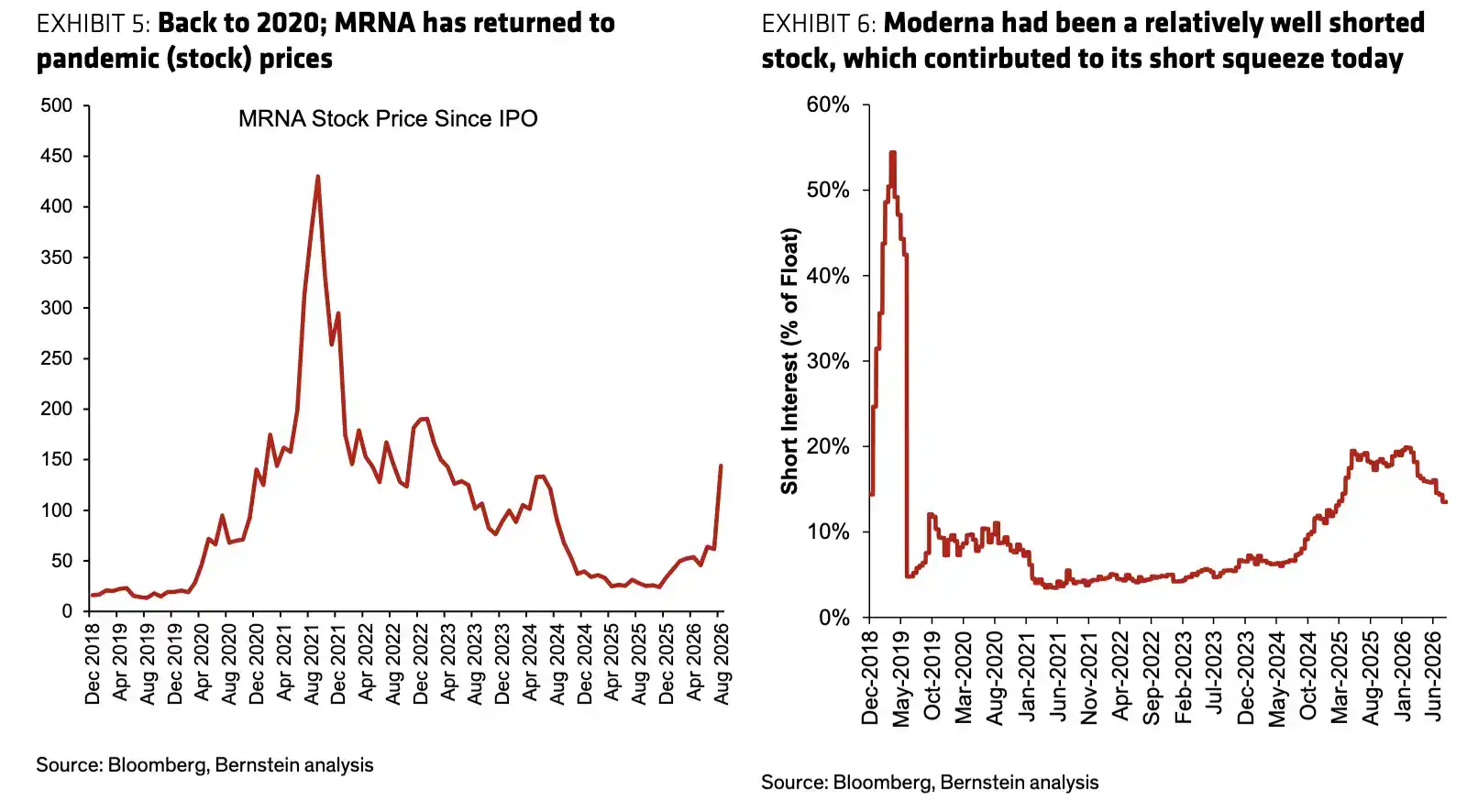
MRNA stock price chart (left) and short interest chart (right). MRNA's stock price surged on August 19, 2026, returning to pre-pandemic levels, while previously about 14-15% of its float was shorted, creating conditions for a short squeeze. Clinical data triggered the rise, but short covering further amplified the gains.

The news tag "cancer vaccine success" further amplified the spread effect. Compared to "personalized neoantigen therapy meets Phase 3 endpoints," this phrasing more easily leads the market to envision a large platform covering multiple cancer types.

Therefore, clinical data was the trigger for the rise, while platform narrative, short covering, and news effects amplified the gains. The amount of stock price increase does not mean the market has already confirmed that INT can generate equivalent levels of revenue and profit.

Melanoma is Just the Starting Point; Platform Replication Remains to Be Proven

Moderna and Merck currently have four Phase 3 studies and five Phase 2 studies around INT, covering melanoma, non-small cell lung cancer (NSCLC), renal cell carcinoma, and bladder cancer, and are beginning to enter unresectable or metastatic tumors.

Bernstein estimates that INTerpath-001 corresponds to a U.S. potential patient population of approximately 13,000 to 19,000 people, representing about 30% of the accessible patient population for the current Phase 3 and potential registration-enabling Phase 2 projects, and about 17% of all Phase 2 and Phase 3 projects.
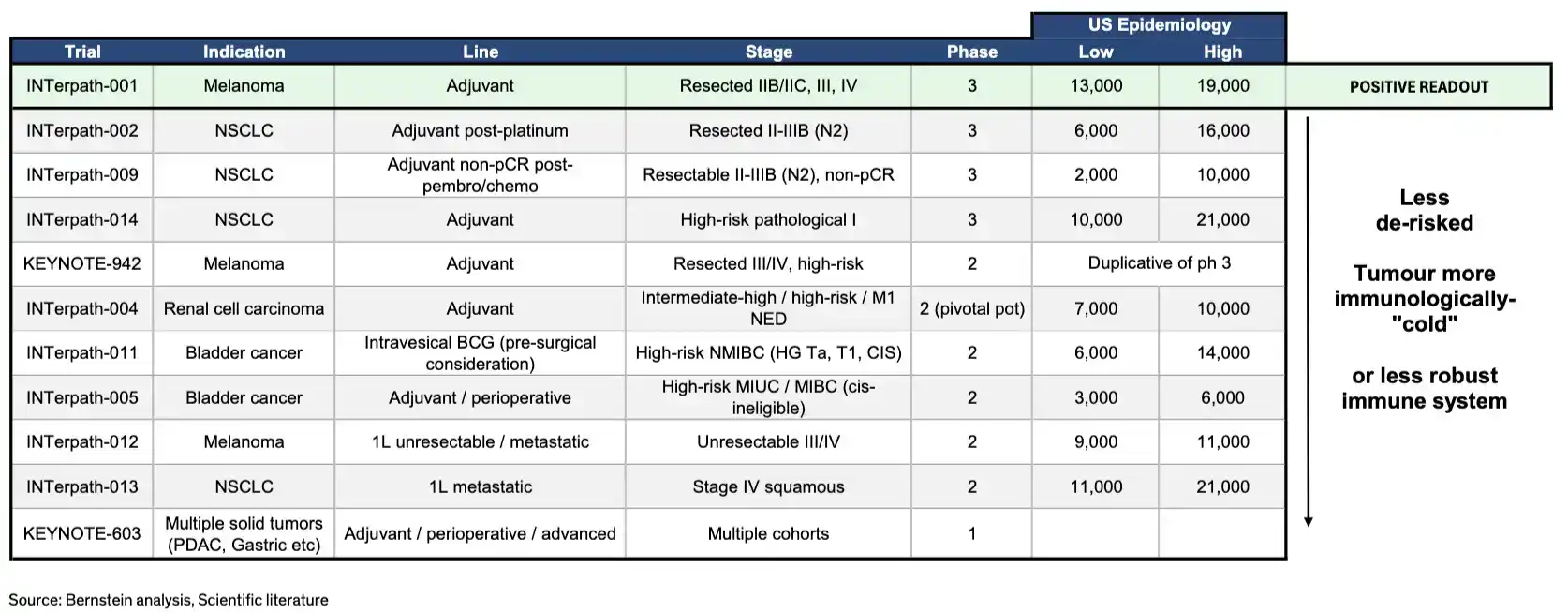
The U.S. accessible patient population for INTerpath-001 is approximately 13,000 to 19,000 people, representing only about 30% of the accessible patient total for current pivotal projects and about 17% of all Phase II and Phase III INT studies. Success in melanoma does not automatically guarantee the same results can be replicated in lung cancer, kidney cancer, and other cancer types.

If projects in lung cancer, kidney cancer, and bladder cancer can replicate the success in melanoma, INT's market potential will expand significantly. Bernstein currently gives an un-risk-adjusted sales forecast for early-stage melanoma and lung cancer of approximately $2.4 billion.

The report also uses Keytruda as an upside reference: its early-stage cancer indications generated about $7.9 billion in revenue in 2025, with an estimated $9.2 billion in 2028, and INT's future pricing could potentially be higher than Keytruda's.

But $2.4 billion is an un-risk-adjusted sales forecast, not profit, and certainly not realized performance. INT also has not yet covered several important Keytruda indications like triple-negative breast cancer, cervical cancer, and head and neck cancer.

More critically, melanoma typically has strong immunogenicity. Its success cannot be directly extrapolated to tumors with different immune microenvironments, such as lung cancer, kidney cancer, and bladder cancer.

INTerpath-001 proves the platform's *potential* for replication but does not prove replication *will* necessarily occur. The market has already started trading the endgame of success in other cancer types, but the relevant clinical data is still on the way.

Bernstein therefore maintains its "Market-Perform" rating and $45 price target for Moderna, far below the August 19 closing price of $174.38.

The "Cancer Vaccine" Label Blurs Commercial Realities

INT is not a preventive vaccine for healthy populations but a personalized treatment for cancer patients. At this stage, it is used as adjuvant therapy after patients have completed tumor resection, with the goal of reducing the risk of recurrence and distant metastasis caused by residual disease.

Tumor tissue and blood samples must be individually collected from each patient, followed by gene sequencing and algorithm analysis. The system selects up to 34 patient-specific neoantigens from the patient's tumor mutations, then produces the corresponding mRNA construct to induce a T-cell response against the tumor.
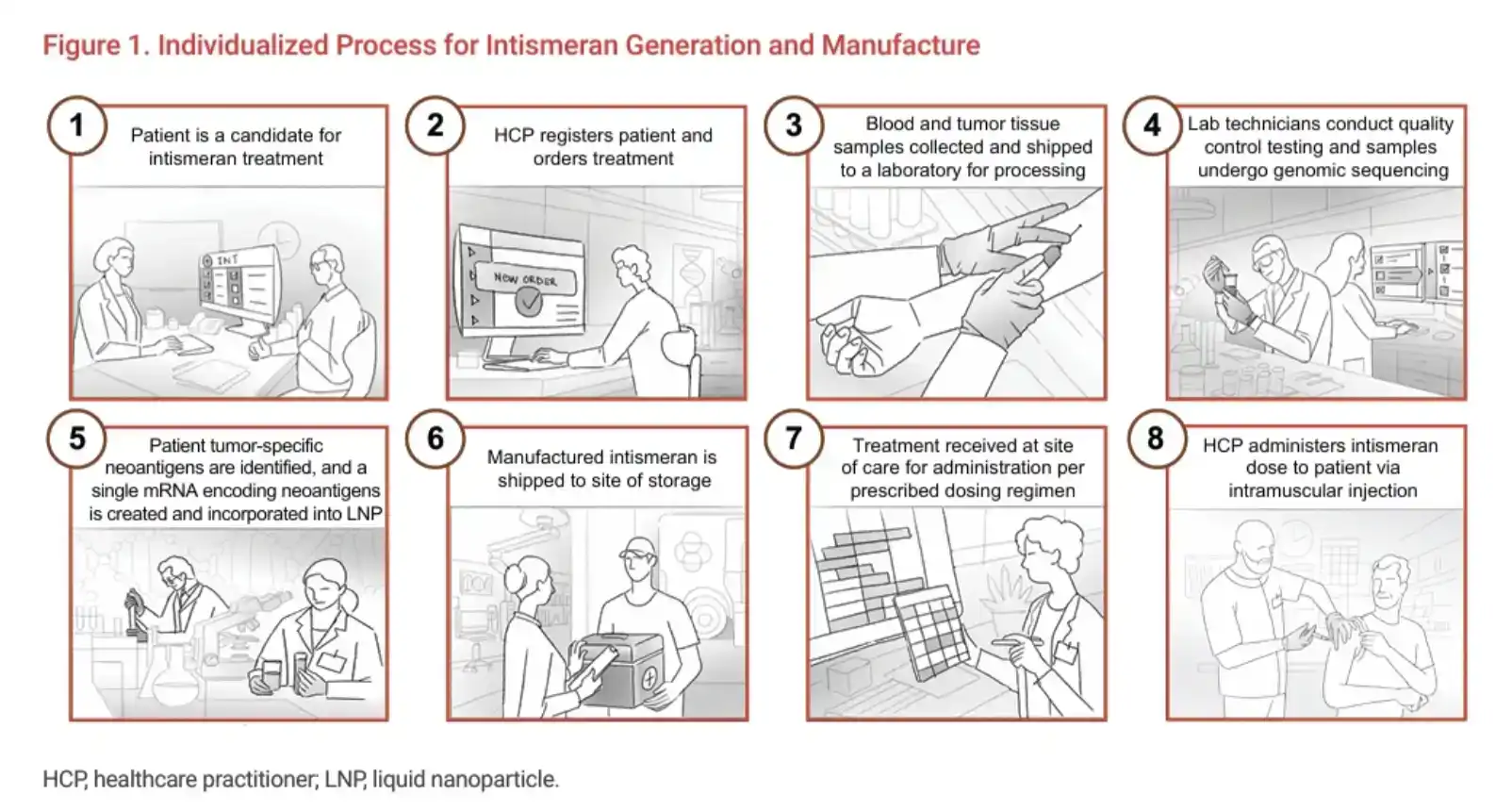
Therefore, while INT uses Moderna's mRNA platform, its business model is closer to that of a personalized oncology drug:

The target patient population is in the tens of thousands, not tens or hundreds of millions like traditional vaccines;

Each patient requires separate sequencing, design, and production;

Production costs are difficult to scale down rapidly like batch-produced vaccines;

Regulatory, pricing, and reimbursement will follow the oncology drug pathway.

"Cancer vaccine" is an easily communicable label, but it may amplify market imagination about patient scale while downplaying real-world constraints like personalized production costs and commercialization efficiency. The incremental impact of INT's success on traditional vaccine raw material suppliers is also relatively limited.

For Billions in Revenue, How Much Profit Ultimately Remains?

Compared to sales potential, Bernstein is more concerned about INT's profit margins.

Merck will be responsible for global commercialization. Moderna will participate in co-promotion in the U.S., while Merck will independently handle marketing and sales in markets outside the U.S. The two parties will share costs and profits per the agreement.

Bernstein uses the single melanoma indication as an example, assuming INT's peak sales reach $1.2 billion, with gross margins gradually improving from 35% at launch to 60%. After deducting approximately $250 million in SG&A expenses and profit sharing, the mature-stage contribution to Moderna's EPS would be about $0.60.

This is Bernstein's scenario calculation, not company guidance. It illustrates that even if INT becomes a billion-dollar product, personalized production costs and profit sharing will limit profit realization.

The market's current pricing, however, already implies multiple favorable conditions: success in other cancer types, smooth expansion of custom manufacturing, favorable pricing and reimbursement, and continuously improving gross margins. None of these conditions have yet been fully verified.

For Merck, INT's strategic value lies primarily in expanding Keytruda's usage. Most trials use an "INT + Keytruda" vs. "Keytruda monotherapy" design, so INT is first and foremost an add-on therapy, not a replacement for Keytruda.

If the combination regimen becomes the new standard of care, Bristol-Myers Squibb's Opdivo, Roche's Tecentriq, and AstraZeneca's Imfinzi could face market share pressure in some melanoma and NSCLC markets. However, the low initial gross margins and profit sharing could also weigh on INT's contribution to Merck's operating profit margin.

Therefore, Merck's approximately $50 billion market cap increase is similarly difficult to explain solely by the profits from the current melanoma project.

Pharma Sector Rally Also Influenced by AI Trading Rotation

Bernstein believes this rally is not entirely Moderna's individual stock story.

The report observes that the pharmaceutical and semiconductor sectors have recently shown a certain inverse trading characteristic. Against a backdrop of increasingly concentrated AI and semiconductor holdings, pharmaceuticals have started to be viewed by some investors as a relatively clean defensive option: demand is less affected by economic cycles, while potentially benefiting long-term from AI's application in drug discovery and clinical trials.
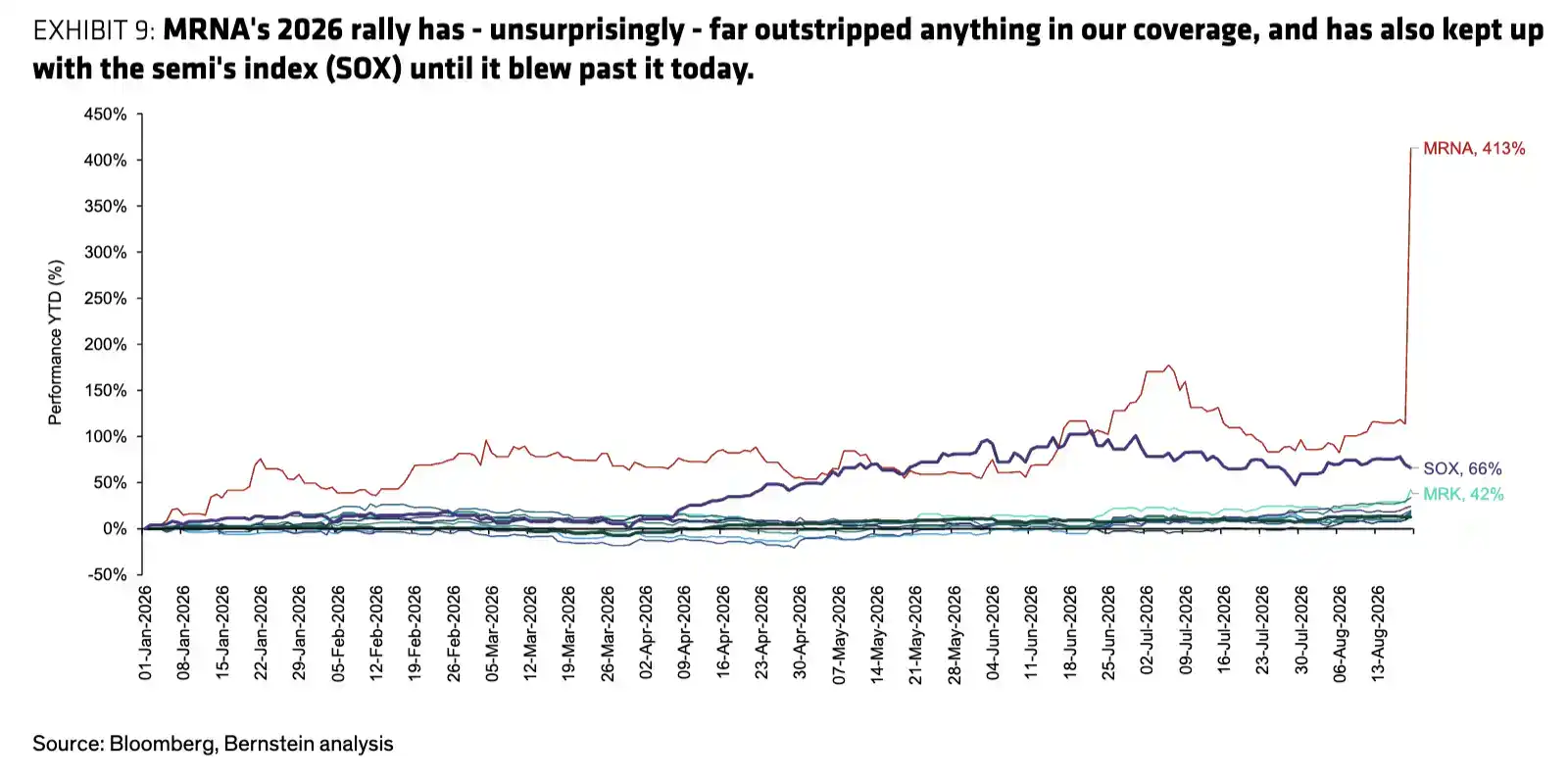
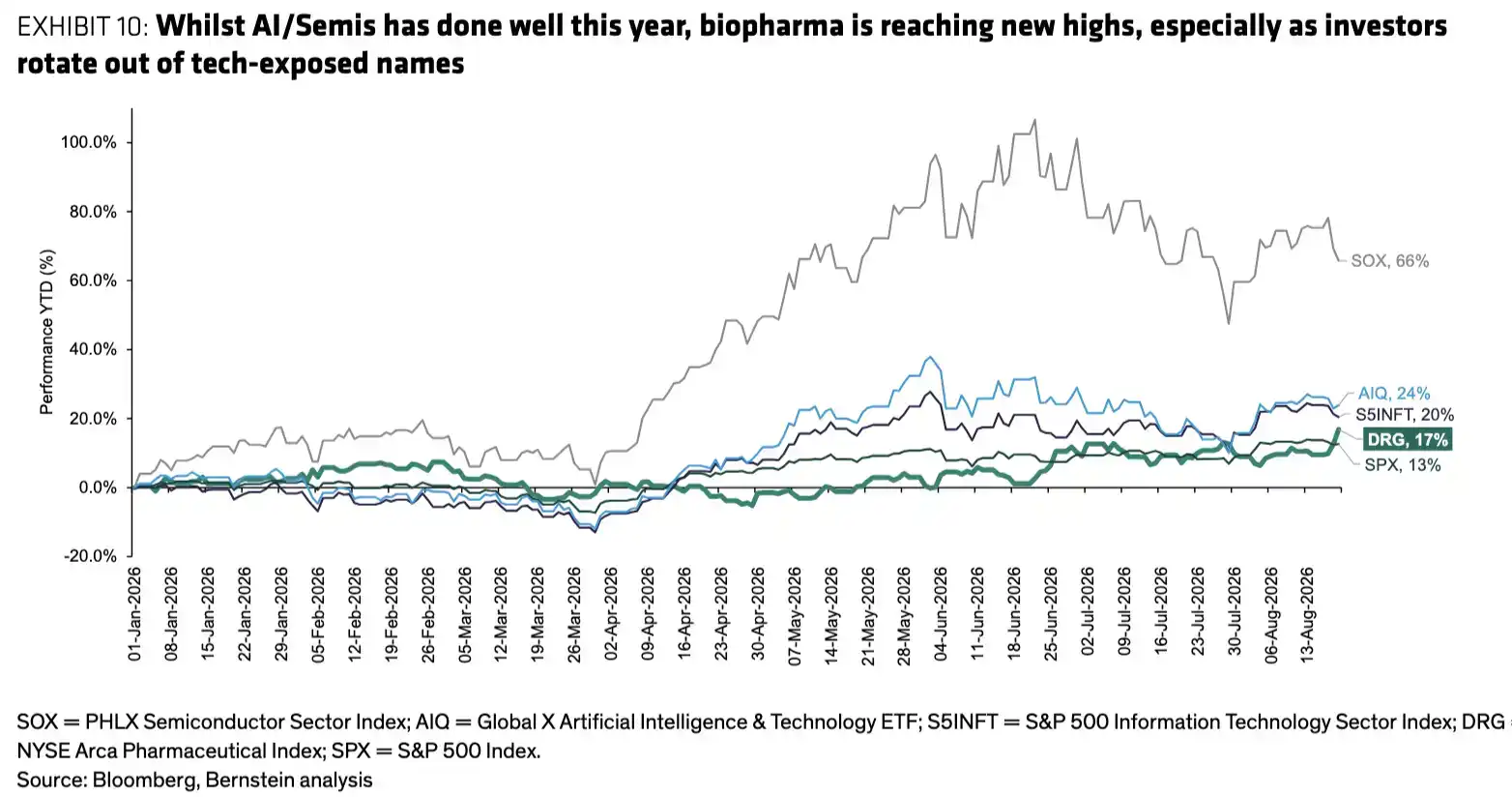
In 2026, the pharmaceutical sector (DRG) and the semiconductor index (SOX) show a clear inverse trading characteristic. When the AI theme experiences volatility and capital flows out of the tech sector, the pharmaceutical sector, as a defensive asset, sees capital inflows. Moderna's rise is not just an individual stock story but also a result of sector rotation.

This is merely Bernstein's interpretation of capital flows and does not imply a stable negative correlation between pharmaceuticals and semiconductors. However, when tech stock volatility rises, sector rotation can provide additional buying pressure for the pharma sector and amplify the market impact of INT's clinical results.

Thus, Moderna's rise contains three layers of trading: the foundation is the Phase 3 melanoma success, the middle layer is mRNA platform revaluation, and the outer layer consists of short covering and sector rotation. The further from the core, the greater the distance from quantifiable fundamentals.

From Clinical Breakthrough to Earnings Inflection Point: Three Validations Remain

INTerpath-001 has proven that mRNA personalized neoantigen therapy can succeed in a large Phase 3 trial. But to define it as Moderna's earnings inflection point, at least three more validations are needed:

First, complete Phase 3 data. The specific hazard ratios, safety profile, patient subgroups, and OS trends will determine INT's real advantage over Keytruda monotherapy.

Second, cross-cancer replication. Results from subsequent lung, kidney, and bladder cancer trials will determine whether melanoma is just a favorable indication or the starting point for a broader oncology platform.

Third, commercialization efficiency. Custom manufacturing cycles, capacity, pricing, reimbursement, and gross margins will determine whether sales can be converted into profits sufficient to support the valuation.

Bernstein does not deny the clinical value of INTerpath-001. Its real warning is: the market has rapidly jumped from a successful melanoma trial to endgame pricing based on a multi-cancer platform and long-term profit realization.

A clinical breakthrough has occurred, but an earnings inflection point is not yet confirmed. The current stock price is trading more on the imagination of platform success and short-term demand amplified by high short interest.


Trend Kriptolar

İlgili Sorular

QAccording to the article, what clinical trial results did Moderna and Merck announce that led to Moderna's stock surging by approximately 177%?

AModerna and Merck announced positive topline results from the Phase 3 INTerpath-001 trial. The trial evaluated the combination of intismeran autogene (INT), an individualized neoantigen therapy, with Keytruda (pembrolizumab) for the adjuvant treatment of high-risk melanoma (stage IIB to IV) after complete resection. At its first interim analysis, the trial met both its primary endpoint of Recurrence-Free Survival (RFS) and a key secondary endpoint of Distant Metastasis-Free Survival (DMFS), demonstrating statistical significance and clinical meaning.

QBesides the positive clinical data, what other three key factors does Bernstein cite as drivers of Moderna's extreme stock price increase?

ABernstein identifies three additional factors that amplified the stock price movement beyond the clinical results: 1) The clinical success triggered a market re-evaluation of Moderna's mRNA platform potential beyond infectious diseases into oncology. 2) A high short interest (14-15% of float) led to forced short covering, which intensified buying pressure. 3) The use of the compelling but potentially oversimplified 'cancer vaccine' news label enhanced market excitement and broad investor attention.

QWhat does Bernstein estimate as the potential US patient population for the INT therapy based solely on the successful melanoma trial (INTerpath-001), and what does this represent relative to the broader program?

ABernstein estimates that the US addressable patient population for the INT therapy based on the successful melanoma trial (INTerpath-001) is approximately 13,000 to 19,000 patients. This represents about 30% of the patient population in the late-stage (Phase 3 and potential registrational Phase 2) projects and only about 17% of the patient population across all ongoing Phase 2 and Phase 3 INT studies.

QAccording to Bernstein's analysis, what are the key commercial and logistical differences between INT and a traditional mass-market vaccine?

AINT operates more like a personalized cancer drug than a traditional vaccine. Key differences include: 1) Its target patient population is in the tens of thousands, not millions or billions. 2) Each treatment is customized for an individual patient based on sequencing their tumor and blood samples to identify up to 34 specific neoantigens. 3) Its production cannot achieve the same economies of scale as batch-produced vaccines, keeping manufacturing costs higher. 4) Its regulatory path, pricing, and reimbursement will follow the model for oncology drugs, not vaccines.

QWhat three future validations does Bernstein argue are necessary to confirm the clinical breakthrough as a true inflection point for Moderna's business?

ABernstein states that three key validations are still required: 1) The release of full Phase 3 data, including specific hazard ratios, safety profiles, patient subgroups, and overall survival trends, to define the true advantage over Keytruda monotherapy. 2) Successful replication of the results across other cancer types (e.g., non-small cell lung cancer, renal cell carcinoma, bladder cancer) to prove the platform's broad applicability. 3) Demonstration of commercial efficiency, encompassing the therapy's custom production cycle, capacity, pricing, reimbursement, and ultimately, its gross margins, to ensure sales can translate into profits that justify the valuation.

İlgili Okumalar

Uniswap Founder: When Stocks and Treasuries Are Fully On-Chain, How Will AMMs Restructure the Global Market?

Uniswap founder Hayden Adams argues that as traditional assets like stocks become tokenized, Automated Market Makers (AMMs) could fundamentally restructure global markets. The core insight is that AMMs are most efficient in "correlated pairs"—such as NVDA/SPY—where assets move together. In these pairs, passive liquidity providers (LPs) who are willing to hold the underlying assets face lower inventory risk and minimal hedging costs compared to traditional, delta-neutral market makers. This cost advantage allows AMMs to undercut professional firms. Tokenization enables assets to trade directly against each other on a shared settlement layer, rather than being siloed in dollar-based systems. Adams observes this pattern already emerging in DeFi, where assets naturally pair with correlated benchmarks (e.g., ETH for Ethereum assets). He believes this will extend to tokenized stocks, with liquidity concentrating in low-volatility correlated pairs, while a few high-volume "bridge pairs" (like SPY/USD) handle dollar conversions. The article highlights that early correlated markets for tokenized stocks already exist (e.g., on Robinhood's chain), and Uniswap v4 hooks like DualPool can further boost LP returns. Adams draws a parallel to the rise of passive index funds, suggesting passive AMM liquidity could similarly democratize market-making and capture significant market share from traditional finance. A response from crypto KOL Cody adds practical analysis, noting that while the correlated pair strategy reduces impermanent loss, current on-chain fees may not yet fully compensate for it. He shares his own LP strategy using valuation models, emphasizing that AMMs offer a novel, low-cost market-making avenue for those willing to hold inventory.

marsbit2 dk önce

Uniswap Founder: When Stocks and Treasuries Are Fully On-Chain, How Will AMMs Restructure the Global Market?

marsbit2 dk önce

Goldman Sachs Buys Volatility, Turns Bitcoin into a Yield Business

Goldman Sachs acquired NEOS Investments for up to $2.25 billion, gaining a suite of ETFs that generate income by selling options against crypto assets, particularly Bitcoin. This includes the BTCI fund, which sells call options against Bitcoin ETF holdings to capture high premiums from crypto’s volatility, offering investors stable cash flow—around 27% annualized in returns—while capping upside potential and fully exposing them to downside risk. The move highlights Wall Street’s broader push to package crypto-native yield—through staking, lending, and structured products—without taking directional bets on prices. Firms like Fidelity, JPMorgan, and Morgan Stanley now offer staking services or accept crypto as collateral for loans, collecting steady fees regardless of market direction. In contrast, native crypto firms like Bitwise remain vulnerable to market downturns, as their revenue depends entirely on assets under management. This reflects a strategic pivot: large institutions no longer need to “believe” in crypto to profit from it. They monetize volatility and investor activity through fee-based structures, leaving price risk to retail investors. As regulatory shifts like the proposed 401(k) rules unfold, yield-generating crypto products may gain even broader adoption in traditional portfolios, further cementing Wall Street’s role as a neutral intermediary capturing reliable revenue streams from the ecosystem.

marsbit6 dk önce

Goldman Sachs Buys Volatility, Turns Bitcoin into a Yield Business

marsbit6 dk önce

AI Launches a Fierce Assault on Cancer, Virtually Tests 4,000 Anti-Cancer Drugs, Google Gemma Downloads Exceed 1 Billion

Google's open-source Gemma AI model family has reached a new milestone, surpassing 10 billion cumulative downloads in two and a half years since its February 2024 launch. This growth has fueled a vast ecosystem, with over 100,000 developer-derived model variants powering diverse applications, from NASA satellites to over 100 million phones. A standout application involves cancer research. In collaboration with Google Research and Yale, a team developed a 27-billion-parameter model called Cell2Sentence-Scale 27B (C2S-Scale). This model innovatively converts complex single-cell sequencing data into a "sentence" of gene names ranked by activity, allowing it to analyze cellular behavior. It was used to conduct a "dual-context virtual screen" of over 4,000 drugs, aiming to find one that specifically boosts antigen presentation—a key process for immune system recognition—only in the presence of low interferon signals (a "cold tumor" context), not in neutral conditions. The model identified silmitasertib (CX-4945), a CK2 kinase inhibitor, as a top candidate. Subsequent live-cell experiments validated this AI-generated hypothesis, showing that the drug combined with low-dose interferon increased antigen presentation by about 50%, whereas neither element alone had a significant effect. This represents a novel, AI-proposed mechanistic pathway for potential cancer therapy. Beyond biomedicine, the Gemma ecosystem is expanding into unique domains. Models have been deployed in space on high-performance GPUs and are being used in projects like DolphinGemma to decipher dolphin communication patterns. The 10-billion-download milestone underscores a key trend: the disruptive potential of AI lies not just in raw model capability but in its widespread, silent integration into diverse hardware and real-world applications, as evidenced by the thriving "Gemmaverse" community.

marsbit7 dk önce

AI Launches a Fierce Assault on Cancer, Virtually Tests 4,000 Anti-Cancer Drugs, Google Gemma Downloads Exceed 1 Billion

marsbit7 dk önce

Shocking: OpenAI Fully Open-Sources Codex Harness

OpenAI has open-sourced the core framework of Codex, called "Harness," under an Apache-2.0 license. This move allows developers to deeply integrate AI agents into their own applications and workflows, moving beyond the limitations of generic chat interfaces. The Harness is the underlying execution system that manages an AI agent's complete lifecycle: understanding tasks, maintaining memory, using tools, handling failures, and requesting human approvals. OpenAI demonstrated that optimizations to the Harness alone can dramatically boost a model's performance, tripling scores on a benchmark while using significantly fewer tokens. The release includes three key components: a CLI tool (`codex exec`) for automated tasks, official SDKs (TypeScript/Python) for programmatic control, and the `app-server` for embedding agents directly into products. This enables features like persistent state, real-time event streaming, and human-in-the-loop controls. Early adopters showcase its versatility beyond coding. Examples include a tax preparation system that cut processing time by one-third, Cisco's platform for building apps with natural language, and a demo logistics dashboard where agents analyze data and propose actions within the existing interface. This paradigm shift grants developers full control over the user interface, context, tools, and security boundaries. AI becomes an invisible assistant within specialized software, rather than a separate chatbot. By open-sourcing the engine behind its powerful agents, OpenAI aims to spark a new wave of native, deeply integrated AI applications.

marsbit12 dk önce

Shocking: OpenAI Fully Open-Sources Codex Harness

marsbit12 dk önce

İşlemler

Spot

Popüler Makaleler

$S$ Nedir

SPERO'yu Anlamak: Kapsamlı Bir Genel Bakış SPERO'ya Giriş İnovasyonun manzarası gelişmeye devam ederken, web3 teknolojilerinin ve kripto para projelerinin ortaya çıkışı dijital geleceği şekillendirmede önemli bir rol oynamaktadır. Bu dinamik alanda dikkat çeken projelerden biri SPERO, $$s$$ olarak adlandırılmaktadır. Bu makale, SPERO hakkında ayrıntılı bilgi toplamak ve sunmak amacıyla, meraklılar ve yatırımcıların web3 ve kripto alanlarındaki temellerini, hedeflerini ve yeniliklerini anlamalarına yardımcı olmayı amaçlamaktadır. SPERO,$$s$$ Nedir? SPERO,$$s$$, kripto alanında merkeziyetsizlik ve blok zinciri teknolojisi ilkelerini kullanarak etkileşimi, faydayı ve finansal kapsayıcılığı teşvik eden bir ekosistem yaratmayı amaçlayan benzersiz bir projedir. Proje, kullanıcıların yenilikçi finansal çözümler ve hizmetler sunarak eşler arası etkileşimleri yeni yollarla kolaylaştırmayı hedeflemektedir. SPERO,$$s$$'nin temel amacı, bireyleri güçlendirmek ve kripto para alanındaki kullanıcı deneyimini artıran araçlar ve platformlar sağlamaktır. Bu, daha esnek işlem yöntemlerini mümkün kılmayı, topluluk odaklı girişimleri teşvik etmeyi ve merkeziyetsiz uygulamalar (dApp'ler) aracılığıyla finansal fırsatlar yaratmayı içermektedir. SPERO,$$s$$'nin temel vizyonu kapsayıcılık etrafında dönmekte olup, geleneksel finansal sistemlerdeki boşlukları kapatmayı ve blok zinciri teknolojisinin faydalarından yararlanmayı hedeflemektedir. SPERO,$$s$$'nin Yaratıcısı Kimdir? SPERO,$$s$$'nin yaratıcısının kimliği bir miktar belirsizdir, çünkü kurucusu(ları) hakkında ayrıntılı arka plan bilgisi sağlayan sınırlı kamuya açık kaynaklar bulunmaktadır. Bu şeffaflık eksikliği, projenin merkeziyetsizlik taahhüdünden kaynaklanabilir—birçok web3 projesinin paylaştığı bir etik anlayışı, bireysel tanınmanın yerine kolektif katkıları önceliklendirmektedir. Topluluk ve onun kolektif hedefleri etrafında tartışmaları merkezileştirerek, SPERO,$$s$$, belirli bireyleri öne çıkarmadan güçlendirme özünü taşımaktadır. Bu nedenle, SPERO'nun etik anlayışını ve misyonunu anlamak, tek bir yaratıcının kimliğini belirlemekten daha önemlidir. SPERO,$$s$$'nin Yatırımcıları Kimlerdir? SPERO,$$s$$, kripto sektöründe yeniliği teşvik etmeye adanmış girişim sermayedarlarından melek yatırımcılara kadar çeşitli yatırımcılar tarafından desteklenmektedir. Bu yatırımcıların odak noktası genellikle SPERO'nun misyonuyla uyumlu olup, toplumsal teknolojik ilerlemeyi, finansal kapsayıcılığı ve merkeziyetsiz yönetimi vaat eden projeleri önceliklendirmektedir. Bu yatırımcı temelleri, yalnızca yenilikçi ürünler sunan projelere değil, aynı zamanda blok zinciri topluluğuna ve ekosistemlerine olumlu katkılarda bulunan projelere de ilgi duymaktadır. Bu yatırımcıların desteği, SPERO,$$s$$'yi hızla gelişen kripto projeleri alanında dikkate değer bir rakip haline getirmektedir. SPERO,$$s$$ Nasıl Çalışır? SPERO,$$s$$, onu geleneksel kripto para projelerinden ayıran çok yönlü bir çerçeve kullanmaktadır. İşte benzersizliğini ve yeniliğini vurgulayan bazı temel özellikler: Merkeziyetsiz Yönetim: SPERO,$$s$$, kullanıcıların projenin geleceğiyle ilgili karar alma süreçlerine aktif olarak katılmalarını sağlayan merkeziyetsiz yönetim modellerini entegre etmektedir. Bu yaklaşım, topluluk üyeleri arasında sahiplik ve hesap verebilirlik duygusunu teşvik etmektedir. Token Kullanımı: SPERO,$$s$$, ekosistem içinde çeşitli işlevler sunmak üzere tasarlanmış kendi kripto para token'ını kullanmaktadır. Bu token'lar, işlemleri, ödülleri ve platformda sunulan hizmetlerin kolaylaştırılmasını sağlayarak genel etkileşimi ve faydayı artırmaktadır. Katmanlı Mimari: SPERO,$$s$$'nin teknik mimarisi, modülerlik ve ölçeklenebilirliği destekleyerek projenin evrimi sırasında ek özelliklerin ve uygulamaların sorunsuz bir şekilde entegrasyonuna olanak tanımaktadır. Bu uyum sağlama yeteneği, sürekli değişen kripto manzarasında geçerliliği sürdürmek için hayati öneme sahiptir. Topluluk Katılımı: Proje, işbirliği ve geri bildirim teşvik eden mekanizmalar kullanarak topluluk odaklı girişimlere vurgu yapmaktadır. Güçlü bir topluluk oluşturarak, SPERO,$$s$$, kullanıcı ihtiyaçlarını daha iyi karşılayabilir ve piyasa trendlerine uyum sağlayabilir. Kapsayıcılığa Odaklanma: Düşük işlem ücretleri ve kullanıcı dostu arayüzler sunarak, SPERO,$$s$$, daha önce kripto alanında yer almamış bireyler de dahil olmak üzere çeşitli bir kullanıcı tabanını çekmeyi hedeflemektedir. Bu kapsayıcılık taahhüdü, erişilebilirlik yoluyla güçlendirme misyonuyla uyumludur. SPERO,$$s$$ Zaman Çizelgesi Bir projenin tarihini anlamak, gelişim yolculuğu ve kilometre taşları hakkında kritik bilgiler sağlar. Aşağıda, SPERO,$$s$$'nin evriminde önemli olayları haritalayan önerilen bir zaman çizelgesi bulunmaktadır: Kavram Geliştirme ve Fikir Aşaması: SPERO,$$s$$'nin temelini oluşturan ilk fikirler, blok zinciri endüstrisindeki merkeziyetsizlik ve topluluk odaklılık ilkeleriyle yakından uyumlu olarak geliştirildi. Proje Beyaz Kağıdının Yayınlanması: Kavramsal aşamayı takiben, SPERO,$$s$$'nin vizyonunu, hedeflerini ve teknolojik altyapısını ayrıntılı bir şekilde açıklayan kapsamlı bir beyaz kağıt yayımlandı ve topluluk ilgisini ve geri bildirimini toplamak amacıyla sunuldu. Topluluk Oluşturma ve Erken Katılımlar: Projenin hedefleri etrafında tartışmalar yürüterek destek toplamak ve erken benimseyenler ile potansiyel yatırımcılar için bir topluluk oluşturmak amacıyla aktif iletişim çabaları gerçekleştirildi. Token Üretim Etkinliği: SPERO,$$s$$, yerel token'larını erken destekçilere dağıtmak ve ekosistem içinde başlangıç likiditesini sağlamak amacıyla bir token üretim etkinliği (TGE) gerçekleştirdi. İlk dApp'in Yayınlanması: SPERO,$$s$$ ile ilişkili ilk merkeziyetsiz uygulama (dApp) faaliyete geçti ve kullanıcıların platformun temel işlevleriyle etkileşimde bulunmalarını sağladı. Sürekli Gelişim ve Ortaklıklar: Projenin tekliflerine sürekli güncellemeler ve iyileştirmeler yapılmakta olup, blok zinciri alanındaki diğer oyuncularla stratejik ortaklıklar, SPERO,$$s$$'yi rekabetçi ve gelişen bir oyuncu haline getirmiştir. Sonuç SPERO,$$s$$, web3 ve kripto paranın finansal sistemleri devrim niteliğinde dönüştürme ve bireyleri güçlendirme potansiyelinin bir kanıtıdır. Merkeziyetsiz yönetime, topluluk katılımına ve yenilikçi tasarlanmış işlevselliğe olan bağlılığıyla, daha kapsayıcı bir finansal manzaraya doğru bir yol açmaktadır. Hızla gelişen kripto alanındaki herhangi bir yatırımda olduğu gibi, potansiyel yatırımcılar ve kullanıcılar, SPERO,$$s$$ içindeki devam eden gelişmelerle ilgili olarak kapsamlı bir araştırma yapmaları ve düşünceli bir şekilde katılmaları teşvik edilmektedir. Proje, kripto endüstrisinin yenilikçi ruhunu sergileyerek, sayısız olasılığını keşfetmeye davet etmektedir. SPERO,$$s$$'nin yolculuğu hala devam ederken, temel ilkeleri, teknoloji, finans ve birbirimizle etkileşim biçimimizi etkileyebilir.

413 Toplam GörüntülenmeYayınlanma 2024.12.17Güncellenme 2024.12.17

$S$ Nedir

AGENT S Nedir

Agent S: Web3'te Otonom Etkileşimin Geleceği Giriş Web3 ve kripto para dünyasında sürekli gelişen manzarada, yenilikler bireylerin dijital platformlarla etkileşim biçimlerini sürekli olarak yeniden tanımlıyor. Bu tür öncü projelerden biri olan Agent S, açık ajans çerçevesi aracılığıyla insan-bilgisayar etkileşimini devrim niteliğinde değiştirmeyi vaat ediyor. Otonom etkileşimlerin yolunu açarak, Agent S karmaşık görevleri basitleştirmeyi ve yapay zeka (AI) alanında dönüştürücü uygulamalar sunmayı hedefliyor. Bu detaylı inceleme, projenin karmaşıklıklarına, benzersiz özelliklerine ve kripto para alanındaki etkilerine dalacaktır. Agent S Nedir? Agent S, bilgisayar görevlerinin otomasyonunda üç temel zorluğu ele almak üzere özel olarak tasarlanmış çığır açıcı bir açık ajans çerçevesidir: Alan Spesifik Bilgi Edinimi: Çerçeve, çeşitli dış bilgi kaynaklarından ve iç deneyimlerden akıllıca öğrenir. Bu çift yönlü yaklaşım, alan spesifik bilgi açısından zengin bir veri havuzu oluşturmasını sağlar ve görev yürütmedeki performansını artırır. Uzun Görev Ufukları Üzerinde Planlama: Agent S, karmaşık görevlerin verimli bir şekilde parçalanmasını ve yürütülmesini kolaylaştıran deneyim artırımlı hiyerarşik planlama kullanır. Bu özellik, çoklu alt görevleri etkili ve verimli bir şekilde yönetme yeteneğini önemli ölçüde artırır. Dinamik, Homojen Olmayan Arayüzlerle Başlama: Proje, ajanlar ve kullanıcılar arasındaki etkileşimi geliştiren yenilikçi bir çözüm olan Ajan-Bilgisayar Arayüzü'ni (ACI) tanıtmaktadır. Çok Modlu Büyük Dil Modellerini (MLLM'ler) kullanarak, Agent S çeşitli grafik kullanıcı arayüzlerini sorunsuz bir şekilde gezinebilir ve manipüle edebilir. Bu öncü özellikler aracılığıyla, Agent S, makinelerle insan etkileşimini otomatikleştirmede karşılaşılan karmaşıklıkları ele alan sağlam bir çerçeve sunarak, AI ve ötesinde birçok uygulama için zemin hazırlıyor. Agent S'nin Yaratıcısı Kimdir? Agent S'nin kavramı temelde yenilikçi olsa da, yaratıcısı hakkında spesifik bilgiler belirsizliğini koruyor. Yaratıcı şu anda bilinmiyor, bu da projenin yeni aşamasını veya kurucu üyeleri gizli tutma stratejik tercihini vurguluyor. Anonimlikten bağımsız olarak, odak çerçevenin yetenekleri ve potansiyeli üzerinde kalıyor. Agent S'nin Yatırımcıları Kimlerdir? Agent S, kriptografik ekosistemde oldukça yeni olduğundan, yatırımcıları ve finansal destekçileri hakkında ayrıntılı bilgiler açıkça belgelenmemiştir. Projeyi destekleyen yatırım temelleri veya organizasyonları hakkında kamuya açık bilgilerdeki eksiklik, finansman yapısı ve gelişim yol haritası hakkında sorular doğuruyor. Destekleyicilerin anlaşılması, projenin sürdürülebilirliğini ve potansiyel pazar etkisini değerlendirmek için kritik öneme sahiptir. Agent S Nasıl Çalışır? Agent S'nin temelinde, çeşitli ortamlarda etkili bir şekilde çalışmasını sağlayan son teknoloji bir sistem yatmaktadır. İşleyiş modeli birkaç ana özellik etrafında inşa edilmiştir: İnsan Benzeri Bilgisayar Etkileşimi: Çerçeve, bilgisayarlarla etkileşimleri daha sezgisel hale getirmeyi amaçlayan gelişmiş AI planlaması sunar. Görev yürütmedeki insan davranışını taklit ederek, kullanıcı deneyimlerini yükseltmeyi vaat eder. Anlatı Belleği: Yüksek düzeyde deneyimlerden yararlanmak için kullanılan Agent S, görev geçmişlerini takip etmek amacıyla anlatı belleğini kullanarak karar verme süreçlerini geliştirir. Episodik Bellek: Bu özellik, kullanıcılara adım adım rehberlik sağlayarak, çerçevenin görevler gelişirken bağlamsal destek sunmasına olanak tanır. OpenACI Desteği: Yerel olarak çalışabilme yeteneği ile Agent S, kullanıcıların etkileşimleri ve iş akışları üzerinde kontrol sağlamasına olanak tanır ve Web3'ün merkeziyetsiz felsefesiyle uyumlu hale gelir. Dış API'lerle Kolay Entegrasyon: Çeşitli AI platformlarıyla uyumluluğu ve çok yönlülüğü, Agent S'nin mevcut teknolojik ekosistemlere sorunsuz bir şekilde entegre olmasını sağlar ve geliştiriciler ile organizasyonlar için cazip bir seçenek haline getirir. Bu işlevsellikler, Agent S'nin kripto alanındaki benzersiz konumuna katkıda bulunarak, karmaşık, çok aşamalı görevleri minimum insan müdahalesi ile otomatikleştirir. Proje geliştikçe, Web3'teki potansiyel uygulamaları dijital etkileşimlerin nasıl gelişeceğini yeniden tanımlayabilir. Agent S'nin Zaman Çizelgesi Agent S'nin gelişimi ve kilometre taşları, önemli olaylarını vurgulayan bir zaman çizelgesinde özetlenebilir: 27 Eylül 2024: Agent S'nin kavramı, “Bilgisayarları İnsan Gibi Kullanan Açık Bir Ajans Çerçevesi” başlıklı kapsamlı bir araştırma makalesi ile tanıtıldı ve projenin temelini sergiledi. 10 Ekim 2024: Araştırma makalesi arXiv'de kamuya açık olarak yayınlandı ve çerçevenin derinlemesine bir incelemesini ve OSWorld benchmark'ına dayalı performans değerlendirmesini sundu. 12 Ekim 2024: Agent S'nin yetenekleri ve özellikleri hakkında görsel bir içgörü sağlayan bir video sunumu yayımlandı ve potansiyel kullanıcılar ve yatırımcılarla daha fazla etkileşim sağlandı. Bu zaman çizelgesindeki işaretler, sadece Agent S'nin ilerlemesini değil, aynı zamanda şeffaflık ve topluluk katılımına olan bağlılığını da göstermektedir. Agent S Hakkında Ana Noktalar Agent S çerçevesi gelişmeye devam ederken, birkaç ana özellik öne çıkmakta ve yenilikçi doğasını ve potansiyelini vurgulamaktadır: Yenilikçi Çerçeve: İnsan etkileşimine benzer bir bilgisayar kullanımı sağlamak üzere tasarlanan Agent S, görev otomasyonuna yeni bir yaklaşım getiriyor. Otonom Etkileşim: GUI aracılığıyla bilgisayarlarla otonom olarak etkileşim kurabilme yeteneği, daha akıllı ve verimli hesaplama çözümlerine doğru bir sıçrama anlamına geliyor. Karmaşık Görev Otomasyonu: Sağlam metodolojisi ile karmaşık, çok aşamalı görevleri otomatikleştirerek süreçleri daha hızlı ve daha az hata payı ile gerçekleştirebilir. Sürekli İyileştirme: Öğrenme mekanizmaları, Agent S'nin geçmiş deneyimlerden öğrenmesini sağlar ve sürekli olarak performansını ve etkinliğini artırır. Çok Yönlülük: OSWorld ve WindowsAgentArena gibi farklı işletim ortamlarında uyumlu olması, geniş bir uygulama yelpazesine hizmet edebilmesini sağlar. Agent S, Web3 ve kripto alanında kendini konumlandırırken, etkileşim yeteneklerini artırma ve süreçleri otomatikleştirme potansiyeli, AI teknolojilerinde önemli bir ilerlemeyi temsil etmektedir. Yenilikçi çerçevesi aracılığıyla, Agent S dijital etkileşimlerin geleceğini örneklemekte ve çeşitli sektörlerde kullanıcılar için daha sorunsuz ve verimli bir deneyim vaat etmektedir. Sonuç Agent S, AI ve Web3'ün birleşiminde cesur bir sıçramayı temsil ediyor ve teknoloji ile etkileşim biçimimizi yeniden tanımlama kapasitesine sahip. Henüz erken aşamalarında olmasına rağmen, uygulama olanakları geniş ve çekici. Kritik zorlukları ele alan kapsamlı çerçevesi ile Agent S, otonom etkileşimleri dijital deneyimin ön plana çıkmasına taşımayı hedefliyor. Kripto para ve merkeziyetsizlik alanlarına daha derinlemesine girdikçe, Agent S gibi projelerin teknoloji ve insan-bilgisayar işbirliğinin geleceğini şekillendirmede önemli bir rol oynayacağı kesin.

867 Toplam GörüntülenmeYayınlanma 2025.01.14Güncellenme 2025.01.14

AGENT S Nedir

S Nasıl Satın Alınır

HTX.com’a hoş geldiniz! Sonic (S) satın alma işlemlerini basit ve kullanışlı bir hâle getirdik. Adım adım açıkladığımız rehberimizi takip ederek kripto yolculuğunuza başlayın. 1. Adım: HTX Hesabınızı OluşturunHTX'te ücretsiz bir hesap açmak için e-posta adresinizi veya telefon numaranızı kullanın. Sorunsuzca kaydolun ve tüm özelliklerin kilidini açın. Hesabımı Aç2. Adım: Kripto Satın Al Bölümüne Gidin ve Ödeme Yönteminizi SeçinKredi/Banka Kartı: Visa veya Mastercard'ınızı kullanarak anında Sonic (S) satın alın.Bakiye: Sorunsuz bir şekilde işlem yapmak için HTX hesap bakiyenizdeki fonları kullanın.Üçüncü Taraflar: Kullanımı kolaylaştırmak için Google Pay ve Apple Pay gibi popüler ödeme yöntemlerini ekledik.P2P: HTX'teki diğer kullanıcılarla doğrudan işlem yapın.Borsa Dışı (OTC): Yatırımcılar için kişiye özel hizmetler ve rekabetçi döviz kurları sunuyoruz.3. Adım: Sonic (S) Varlıklarınızı SaklayınSonic (S) satın aldıktan sonra HTX hesabınızda saklayın. Alternatif olarak, blok zinciri transferi yoluyla başka bir yere gönderebilir veya diğer kripto para birimlerini takas etmek için kullanabilirsiniz.4. Adım: Sonic (S) Varlıklarınızla İşlem YapınHTX'in spot piyasasında Sonic (S) ile kolayca işlemler yapın.Hesabınıza erişin, işlem çiftinizi seçin, işlemlerinizi gerçekleştirin ve gerçek zamanlı olarak izleyin. Hem yeni başlayanlar hem de deneyimli yatırımcılar için kullanıcı dostu bir deneyim sunuyoruz.

2.2k Toplam GörüntülenmeYayınlanma 2025.01.15Güncellenme 2026.06.02

S Nasıl Satın Alınır

Tartışmalar

HTX Topluluğuna hoş geldiniz. Burada, en son platform gelişmeleri hakkında bilgi sahibi olabilir ve profesyonel piyasa görüşlerine erişebilirsiniz. Kullanıcıların S (S) fiyatı hakkındaki görüşleri aşağıda sunulmaktadır.

活动图片