Morgan Stanley Research Report Analysis: Gold Hits Target Price of $4450 Earlier Than Expected, Central Bank Purchases Provide Bottom Support

marsbit2026-08-21 tarihinde yayınlandı2026-08-21 tarihinde güncellendi

Özet

Morgan Stanley's Commodity Update reports that gold has reached its Q4 2026 target of $4450/oz earlier than expected. The price surge, driven by declining Fed hike probabilities, reversed ETF outflows from May-June, with July-August seeing 70 tonnes of net inflows. Central bank buying provides strong support, with China purchasing 60 tonnes this year and Poland increasing holdings toward a 700-tonne target. Gold is decoupling from its traditional inverse relationship with the 10-year real yield, now pricing in fiscal concerns linked to rising yields rather than the yields themselves. While the Fed's path remains a dominant driver for ETF flows, new structural supports include sustained central bank purchases (345 tonnes in H1 2026), historically low COMEX short positions, and yield curve steepening driven by fiscal worries. Morgan Stanley sees a path for gold to surpass $5000/oz by 2027, with the combined scenario of a steady Fed, continued central bank buying, and deepening fiscal concern pricing supporting a higher price floor. Short-term volatility from inflation data and limited short-covering potential is expected but should not alter the overarching bullish trend.

Author: Rita

Gold has reached Morgan Stanley's fourth-quarter target price of $4450 per ounce, achieving this faster than anticipated.

On August 20, Morgan Stanley released a commodities quick take. From July to August, a decline in the probability of Fed rate hikes drove a net inflow of 70 tonnes into gold ETFs, reversing the net outflow of 93 tonnes seen from May to June.

Central banks are also taking action. The People's Bank of China purchased 60 tonnes of gold this year, the highest level since 2023; Poland increased its holdings by 82 tonnes, bringing its total reserves to 632 tonnes and approaching its target of 700 tonnes.

Morgan Stanley expects the gold price to surpass $5000 per ounce by 2027. The upward trajectory carries volatility risks.

Gold Price Movement Is Decoupling from the Real Interest Rate Framework

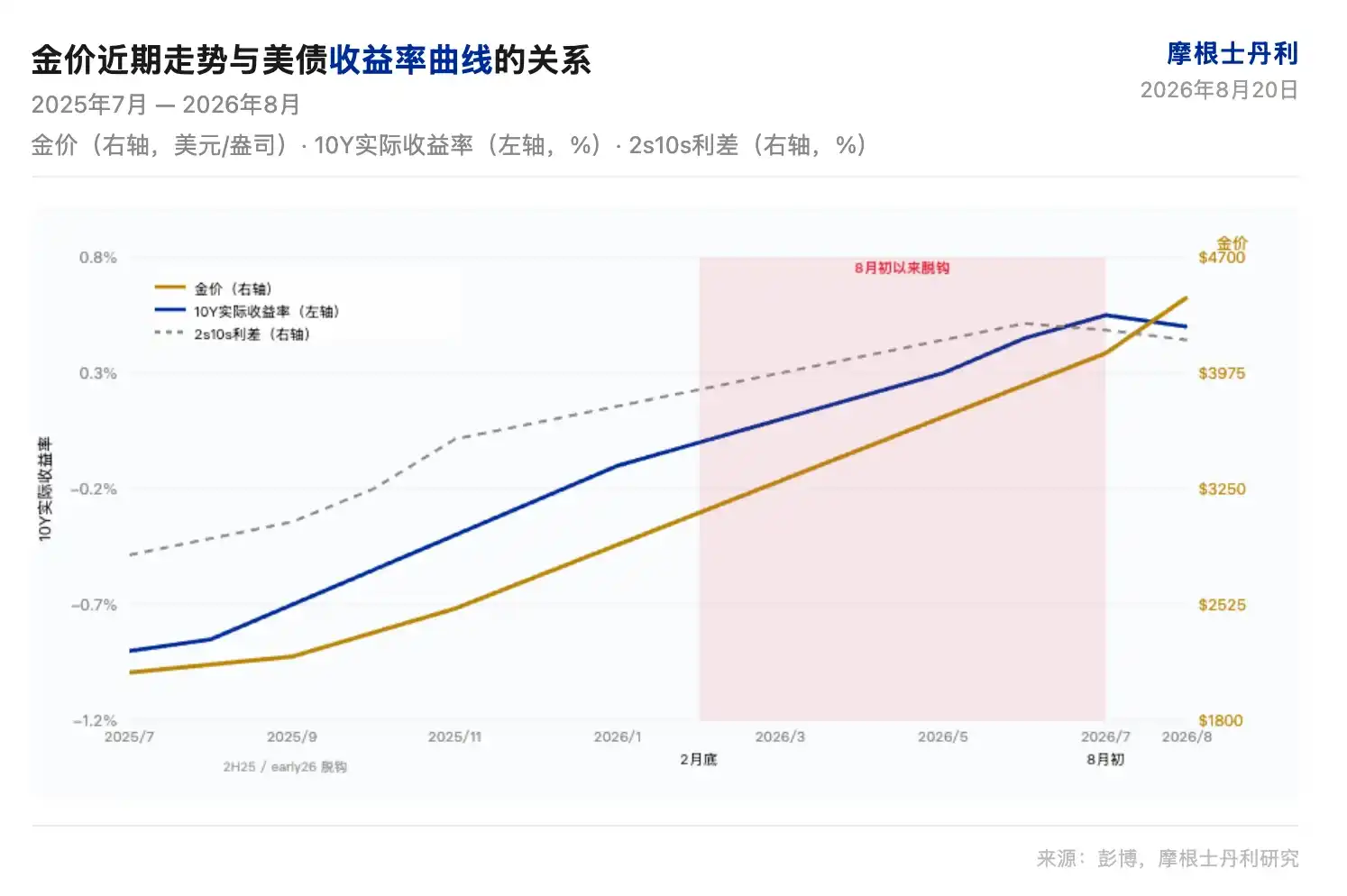
From late February to early August, gold maintained a stable negative correlation with the 10-year real interest rate. Since early August, the gold price has continued to rise even as long-term rates remained flat. A similar decoupling occurred in the latter half of 2025 and early 2026.

During that period, Fed rate cuts lowered short-term rates, while concerns over rising government debt, currency depreciation, and inflation expectations collectively supported long-term rates, leading to a steepening yield curve and simultaneous strength in gold prices. This time, the rise in long-term rates is driven more by oil prices and tech bond issuance, but market attention to government debt is also resurging.

Morgan Stanley judges that the gold price is now pricing in the fiscal concerns behind the rising yields, rather than the yields themselves.
The Fed Path Remains Dominant, While Structural Factors Are Emerging as New Support

The Federal Reserve's policy path dominates ETF fund flows. Upcoming US inflation data and communication signals from Fed officials will determine the direction of rate hike expectations. Morgan Stanley's US economists expect the Fed to hold rates steady throughout 2026, implying limited pressure from the interest rate side.

The drivers for gold are changing. Beyond the real interest rate framework, three structural factors provide new support: continued central bank purchases, with global central banks net buying 345 tonnes in H1 2026, consistent with Morgan Stanley's full-year forecast of 700 tonnes; COMEX (New York Commodity Exchange) gold futures short positions have fallen to their lowest level since April 2020, narrowing the room for short-term short-covering, but short-side pressure has been largely absorbed; and fiscal concerns underpinning the steepening yield curve are becoming an invisible catalyst for the gold price.

Path to $5000 Is Open, Short-Term Volatility Is Normal

US inflation data is the primary source of short-term volatility. If inflation exceeds expectations, markets may reprice the Fed's rate hike path, triggering a gold price correction. With COMEX short positions at historically low levels, the space for rapid price increases driven by short-covering is limited. Gold ETF inflows are more a reaction to reduced rate hike probabilities rather than expectations of rate cuts. This differs from the typical pattern during a rate-cutting cycle, creating uncertainty about the sustainability of these inflows.

Morgan Stanley's base case judgment: A combination of the Fed holding steady, continued central bank purchases, and deepening pricing of fiscal concerns will push the center of gravity for gold prices higher. Short-term volatility will not alter this direction.
Disclaimer

This article is a compilation and interpretation by Chaoxiang Research of a third-party brokerage research report (Morgan Stanley, August 20, 2026), combined with the organization of publicly available market information. The ratings, target prices, earnings forecasts, and related judgments cited in the text are the views of the analysts at that brokerage firm, representing only the stance of their affiliated institution. They do not represent the views of Chaoxiang Research and do not constitute any investment advice.

Markets carry risks, and investment decisions should be made independently. This article should not be used as a basis for trading any securities.


Trend Kriptolar

İlgili Sorular

QAccording to the Morgan Stanley report, what new structural factors are supporting the gold price beyond the traditional real interest rate framework?

ABeyond the traditional real interest rate framework, three new structural factors are providing support for the gold price: 1) Sustained central bank purchases (global central banks bought a net 345 tonnes in H1 2026, in line with MS's full-year forecast of 700 tonnes). 2) COMEX gold futures short positions have fallen to their lowest level since April 2020, meaning short-covering potential is limited as bearish forces are already digested. 3) Fiscal concerns underlying the steepening yield curve are becoming an invisible catalyst for gold prices.

QWhy did Morgan Stanley's Q4 2024 gold price target of $4450/oz get reached ahead of schedule?

AMorgan Stanley's Q4 2024 target of $4450 per ounce was reached ahead of schedule primarily due to a decline in Fed rate hike probabilities from July to August, which triggered net inflows of 70 tonnes into gold ETFs, reversing the 93 tonnes of net outflows seen from May to June. Additionally, continued central bank buying provided underlying support.

QWhat is Morgan Stanley's long-term price forecast for gold and what are the main drivers for reaching it?

AMorgan Stanley forecasts that the gold price could break through $5000 per ounce by 2027. The main drivers for reaching this level are the combination of: the Fed holding rates steady, continued central bank purchases, and a deepening market pricing of fiscal concerns. Their baseline view is that these three factors叠加 (overlap) will push the gold price center higher.

QWhat does Morgan Stanley identify as the primary source of short-term volatility for gold prices?

AMorgan Stanley identifies upcoming U.S. inflation data as the primary source of short-term volatility for gold prices. If inflation exceeds expectations, the market may reprice the Federal Reserve's interest rate path, potentially triggering a correction in gold prices.

QHow has the relationship between gold prices and the 10-year real interest rate changed recently, and what does Morgan Stanley believe is the reason?

AFrom late February to early August, gold maintained a stable negative correlation with the 10-year real interest rate. Starting in early August, gold prices continued to rise even as long-end rates held flat, showing a decoupling. Morgan Stanley judges that gold is now pricing the fiscal concerns behind the potential for rising yields, rather than the yield level itself.

İlgili Okumalar

Uniswap Founder: When Stocks and Treasuries Are Fully On-Chain, How Will AMMs Restructure the Global Market?

Uniswap founder Hayden Adams argues that as traditional assets like stocks become tokenized, Automated Market Makers (AMMs) could fundamentally restructure global markets. The core insight is that AMMs are most efficient in "correlated pairs"—such as NVDA/SPY—where assets move together. In these pairs, passive liquidity providers (LPs) who are willing to hold the underlying assets face lower inventory risk and minimal hedging costs compared to traditional, delta-neutral market makers. This cost advantage allows AMMs to undercut professional firms. Tokenization enables assets to trade directly against each other on a shared settlement layer, rather than being siloed in dollar-based systems. Adams observes this pattern already emerging in DeFi, where assets naturally pair with correlated benchmarks (e.g., ETH for Ethereum assets). He believes this will extend to tokenized stocks, with liquidity concentrating in low-volatility correlated pairs, while a few high-volume "bridge pairs" (like SPY/USD) handle dollar conversions. The article highlights that early correlated markets for tokenized stocks already exist (e.g., on Robinhood's chain), and Uniswap v4 hooks like DualPool can further boost LP returns. Adams draws a parallel to the rise of passive index funds, suggesting passive AMM liquidity could similarly democratize market-making and capture significant market share from traditional finance. A response from crypto KOL Cody adds practical analysis, noting that while the correlated pair strategy reduces impermanent loss, current on-chain fees may not yet fully compensate for it. He shares his own LP strategy using valuation models, emphasizing that AMMs offer a novel, low-cost market-making avenue for those willing to hold inventory.

marsbit2 dk önce

Uniswap Founder: When Stocks and Treasuries Are Fully On-Chain, How Will AMMs Restructure the Global Market?

marsbit2 dk önce

Goldman Sachs Buys Volatility, Turns Bitcoin into a Yield Business

Goldman Sachs acquired NEOS Investments for up to $2.25 billion, gaining a suite of ETFs that generate income by selling options against crypto assets, particularly Bitcoin. This includes the BTCI fund, which sells call options against Bitcoin ETF holdings to capture high premiums from crypto’s volatility, offering investors stable cash flow—around 27% annualized in returns—while capping upside potential and fully exposing them to downside risk. The move highlights Wall Street’s broader push to package crypto-native yield—through staking, lending, and structured products—without taking directional bets on prices. Firms like Fidelity, JPMorgan, and Morgan Stanley now offer staking services or accept crypto as collateral for loans, collecting steady fees regardless of market direction. In contrast, native crypto firms like Bitwise remain vulnerable to market downturns, as their revenue depends entirely on assets under management. This reflects a strategic pivot: large institutions no longer need to “believe” in crypto to profit from it. They monetize volatility and investor activity through fee-based structures, leaving price risk to retail investors. As regulatory shifts like the proposed 401(k) rules unfold, yield-generating crypto products may gain even broader adoption in traditional portfolios, further cementing Wall Street’s role as a neutral intermediary capturing reliable revenue streams from the ecosystem.

marsbit6 dk önce

Goldman Sachs Buys Volatility, Turns Bitcoin into a Yield Business

marsbit6 dk önce

AI Launches a Fierce Assault on Cancer, Virtually Tests 4,000 Anti-Cancer Drugs, Google Gemma Downloads Exceed 1 Billion

Google's open-source Gemma AI model family has reached a new milestone, surpassing 10 billion cumulative downloads in two and a half years since its February 2024 launch. This growth has fueled a vast ecosystem, with over 100,000 developer-derived model variants powering diverse applications, from NASA satellites to over 100 million phones. A standout application involves cancer research. In collaboration with Google Research and Yale, a team developed a 27-billion-parameter model called Cell2Sentence-Scale 27B (C2S-Scale). This model innovatively converts complex single-cell sequencing data into a "sentence" of gene names ranked by activity, allowing it to analyze cellular behavior. It was used to conduct a "dual-context virtual screen" of over 4,000 drugs, aiming to find one that specifically boosts antigen presentation—a key process for immune system recognition—only in the presence of low interferon signals (a "cold tumor" context), not in neutral conditions. The model identified silmitasertib (CX-4945), a CK2 kinase inhibitor, as a top candidate. Subsequent live-cell experiments validated this AI-generated hypothesis, showing that the drug combined with low-dose interferon increased antigen presentation by about 50%, whereas neither element alone had a significant effect. This represents a novel, AI-proposed mechanistic pathway for potential cancer therapy. Beyond biomedicine, the Gemma ecosystem is expanding into unique domains. Models have been deployed in space on high-performance GPUs and are being used in projects like DolphinGemma to decipher dolphin communication patterns. The 10-billion-download milestone underscores a key trend: the disruptive potential of AI lies not just in raw model capability but in its widespread, silent integration into diverse hardware and real-world applications, as evidenced by the thriving "Gemmaverse" community.

marsbit7 dk önce

AI Launches a Fierce Assault on Cancer, Virtually Tests 4,000 Anti-Cancer Drugs, Google Gemma Downloads Exceed 1 Billion

marsbit7 dk önce

Shocking: OpenAI Fully Open-Sources Codex Harness

OpenAI has open-sourced the core framework of Codex, called "Harness," under an Apache-2.0 license. This move allows developers to deeply integrate AI agents into their own applications and workflows, moving beyond the limitations of generic chat interfaces. The Harness is the underlying execution system that manages an AI agent's complete lifecycle: understanding tasks, maintaining memory, using tools, handling failures, and requesting human approvals. OpenAI demonstrated that optimizations to the Harness alone can dramatically boost a model's performance, tripling scores on a benchmark while using significantly fewer tokens. The release includes three key components: a CLI tool (`codex exec`) for automated tasks, official SDKs (TypeScript/Python) for programmatic control, and the `app-server` for embedding agents directly into products. This enables features like persistent state, real-time event streaming, and human-in-the-loop controls. Early adopters showcase its versatility beyond coding. Examples include a tax preparation system that cut processing time by one-third, Cisco's platform for building apps with natural language, and a demo logistics dashboard where agents analyze data and propose actions within the existing interface. This paradigm shift grants developers full control over the user interface, context, tools, and security boundaries. AI becomes an invisible assistant within specialized software, rather than a separate chatbot. By open-sourcing the engine behind its powerful agents, OpenAI aims to spark a new wave of native, deeply integrated AI applications.

marsbit12 dk önce

Shocking: OpenAI Fully Open-Sources Codex Harness

marsbit12 dk önce

Haiwei Huaxin's Official Seal Seized by Over a Hundred People, High-Stakes Corporate Battle's 'Nuclear Deterrence' in Action Again

On August 18th, Haowei Huaxin, a semiconductor firm specializing in gallium arsenide and gallium nitride wafers, reported that over a hundred individuals forcibly entered its offices and seized the company's official seals from a safe, including the corporate, contract, and party committee seals. The incident is the latest escalation in a protracted control dispute. Haowei Huaxin, established in 2010, was originally a joint venture. Control became contested after 2021 when Zhenwei Financial Holding injected capital, becoming the largest shareholder (34.01%), while former parent Haite High-Tech's stake was diluted to 33.79%. An agreed-upon governance structure collapsed, leading to mutual accusations. Haite claimed it was locked out of the subsidiary's premises, while also alleging improper management like livestock being kept on the chip fabrication site. After state-owned Qingdao Haiyue Holdings took over Zhenwei's stake in 2023, Haite accused it of illegally seizing control. Despite Haite winning several legal battles in 2024-2026, which affirmed its rights to nominate directors and the chairman, it failed to regain physical control or recover the seals. The stakes are high: market valuations for Haite's stake in Haowei Huaxin are estimated between 3.7 to 5 billion USD, yet it is only valued at about 83 million USD on Haite's books. Losing control effectively jeopardizes a significant portion of Haite's value. In response to the seal seizure, Haite framed it as a "shareholder rights protection" action agreed upon by five shareholders. This mirrors a pattern in Chinese corporate disputes where seizing physical seals becomes a tactic to paralyze the opponent's daily operations, seen in past conflicts at companies like Dangdang and Bitmain. However, such actions don't resolve underlying ownership issues; the opposing party can report the seals stolen, declare them void, and apply for new ones, albeit with significant delay. The incident underscores how fragile corporate governance can devolve into physical confrontations over symbols of authority, with control ultimately determined by law and shareholding, not possession of a seal.

marsbit57 dk önce

Haiwei Huaxin's Official Seal Seized by Over a Hundred People, High-Stakes Corporate Battle's 'Nuclear Deterrence' in Action Again

marsbit57 dk önce

İşlemler

Spot

Popüler Makaleler

$BANK Nedir

Bank AI: Bankacılıkta Devrimsel Bir Adım Giriş Teknolojideki hızlı ilerlemelerin damgasını vurduğu bir çağda, Bank AI, yapay zeka (AI) ve bankacılık hizmetleri kesişiminde yer almaktadır. Bu yenilikçi proje, finansal manzarayı yeniden tanımlamayı, operasyonel verimliliği, güvenlik önlemlerini ve müşteri deneyimlerini AI'nin gücüyle geliştirmeyi hedefliyor. Bank AI yolculuğuna çıkarken, projenin içeriğine, operasyonel dinamiklerine, tarihsel bağlamına ve önemli kilometre taşlarına dalacağız. Bank AI Nedir? Bank AI, yapay zekanın çeşitli bankacılık operasyonlarına entegrasyonunu hedefleyen dönüştürücü bir girişimi temsil etmektedir. Bu proje, süreçleri otomatikleştirmek, risk yönetimi protokollerini geliştirmek ve kişiselleştirilmiş hizmetler aracılığıyla müşteri etkileşimini artırmak için AI'nin yeteneklerinden yararlanmaktadır. Bank AI'nin temel hedefleri şunlardır: Bankacılık Fonksiyonlarının Otomasyonu: AI teknolojilerini kullanarak, Bank AI rutin görevleri otomatikleştirmeyi, insan kaynakları üzerindeki yükü azaltmayı ve verimliliği artırmayı amaçlamaktadır. Geliştirilmiş Risk Yönetimi: Proje, dolandırıcılık ve diğer tehditlere karşı güvenlik önlemlerini güçlendirerek riski tahmin edip tanımlamak için AI algoritmalarını kullanmaktadır. Bankacılık Hizmetlerinin Kişiselleştirilmesi: Bank AI, müşteri verilerini ve davranışlarını analiz ederek, özel finansal ürünler ve hizmetler sunmaya odaklanmaktadır. Müşteri Deneyimini İyileştirme: Chatbotlar ve sanal asistanlar gibi AI destekli çözümlerin uygulanması, kullanıcıların daha insana yakın etkileşimler yaşamasını sağlamayı hedeflemekte, bankalarla etkileşim biçimlerini devrim niteliğinde değiştirmektedir. Bu hedeflerle, Bank AI, bankacılığı daha verimli, güvenli ve kullanıcı odaklı hale getiren önemli bir oyuncu olarak kendini konumlandırmaktadır. Bank AI'nin Yaratıcısı Kimdir? Bank AI'nin yaratıcısı hakkında detaylar bilinmemektedir. Bu nedenle, mevcut bilgilerde belirli bir kişi veya organizasyon tanımlanmamıştır. Projenin başlangıcı etrafındaki anonimlik soruları gündeme getirse de, bunun iddialı vizyonu ve hedefleri üzerinde bir olumsuz etkisi yoktur. Bank AI'nin Yatırımcıları Kimlerdir? Proje yaratıcılarında olduğu gibi, Bank AI'nin yatırımcıları veya destekleyen organizasyonları hakkında da özel bilgiler açıklanmamıştır. Bu bilgiler olmadan, projenin ilerlemesini destekleyen finansal destek ve kurumsal destek hakkında bir çerçeve çizmek zordur. Yine de, böyle yenilikçi bir alanda gelişimi sürdürmek için sağlam bir yatırım temelinin önemi büyüktür. Bank AI Nasıl Çalışır? Bank AI, geleneksel bankacılık çerçevelerinden ayıran benzersiz faktörlere odaklanarak birden fazla yenilikçi alanda faaliyet göstermektedir. İşte temel operasyonel özellikler: Otomasyon: Makine öğrenimi algoritmalarını uygulayarak, Bank AI bankalar içindeki çeşitli manuel süreçleri otomatikleştirir. Bu, operasyonel maliyetleri azaltır ve insan çalışanların daha stratejik faaliyetlere yönelmelerini sağlar. Gelişmiş Risk Yönetimi: Risk yönetimi uygulamalarına AI entegrasyonu, bankaların dolandırıcılık gibi potansiyel tehditleri doğru bir şekilde tahmin etme araçlarıyla donatılmasını sağlar, böylece müşteri bilgileri ve varlıkları güvence altına alınır. Özelleştirilmiş Finansal Tavsiyeler: Müşteri etkileşimlerinden sürekli olarak öğrenerek, AI sistemleri kullanıcı ihtiyaçlarının daha iyi anlaşılmasını sağlar ve finansal kararlar hakkında özelleştirilmiş tavsiyeler sunar. Geliştirilmiş Müşteri Etkileşimleri: AI destekli chatbotlar ve sanal asistanlar kullanarak, Bank AI daha etkileşimli bir müşteri deneyimi sunar, kullanıcıların sorularını hızlı bir şekilde çözmelerine imkan tanır, bekleme sürelerini azaltır ve memnuniyet seviyelerini artırır. Bu operasyonel özellikler, Bank AI'yi bankacılık sektöründe bir öncü olarak konumlandırmakta ve hizmet sunumu ile operasyonel mükemmeliyet için yeni standartlar belirlemektedir. Bank AI Zaman Çizelgesi Bank AI'nin gidişatını anlamak için tarihsel bağlamına bir göz atmak gerekmektedir. Aşağıda önemli kilometre taşlarını ve gelişmeleri vurgulayan bir zaman çizelgesi bulunmaktadır: 2010'ların Başları: AI entegrasyonunun bankacılık hizmetlerine olan ilgisi arttı, bankacılık kurumları potansiyel faydalarını tanımaya başladılar. 2018: Bankaların temel müşteri hizmetleri ve geliştirilmiş güvenlik yönetimi için risk yönetim sistemlerinde chatbotlar gibi AI araçları kullanmaya başlamasıyla AI teknolojilerinin uygulanmasında belirgin bir artış yaşandı. 2023: AI'nin karmaşıklığı artmaya devam etti ve belge işleme ile gerçek zamanlı yatırım analizi gibi daha karmaşık görevler için üretken AI devreye alındı. Bu yıl, AI teknolojisi sayesinde bankaların sahip olduğu yeteneklerde önemli bir sıçrama yaşandı. 2024-Güncel Durum: Bu yıl itibarıyla, Bank AI yükselişte, devam eden araştırmalar ve geliştirmeler bankacılık operasyonlarındaki yetenekleri daha da artırmaya hazırlanıyor. AI uygulamalarının sürekli araştırılması, heyecan verici gelişmelere işaret etmektedir. Bank AI Hakkında Anahtar Noktalar Bankacılıkta AI Entegrasyonu: Bank AI, bankacılık süreçlerini kolaylaştırmak ve kullanıcı deneyimlerini geliştirmek için yapay zekanın benimsenmesine odaklanmaktadır. Otomasyon ve Risk Yönetimi Vurgusu: Proje, rutin görevlerin yükünü azaltmayı amaçlarken, tahmine dayalı analizlerle güvenlik çerçevelerini geliştirmeye büyük önem vermektedir. Kişiselleştirilmiş Bankacılık Çözümleri: Müşteri verilerinden yararlanarak, Bank AI bireysel kullanıcı ihtiyaçlarına yönelik özelleştirilmiş bankacılık hizmetleri sunar. Gelişime Bağlılık: Bank AI, teknolojinin sürekli evrimi ile uyumlu olmasını sağlamak ve güncel kalmak için sürekli araştırma ve geliştirme çabalarına bağlı kalmaktadır. Sonuç Özetle, Bank AI bankacılık endüstrisinde önemli bir adımı temsil etmekte, yapay zekayı kullanarak operasyonel paradigmaları yeniden şekillendirmekte, güvenliği artırmakta ve müşteri memnuniyetini teşvik etmektedir. Yaratıcı ve yatırımcılar hakkındaki bilgi eksikliklerine rağmen, Bank AI'nin net hedefleri ve işlevsel mekanizmaları, devam eden evrimi için güçlü bir temel sunmaktadır. AI teknolojisi gelişmeye ve bankacılık sektörüyle birleşmeye devam ettikçe, Bank AI finansal hizmetlerin geleceğini önemli ölçüde etkilemeye hazır durumda, bankacılıkla olan anlayışımızı ve etkileşim biçimlerimizi geliştirmektedir.

306 Toplam GörüntülenmeYayınlanma 2024.04.06Güncellenme 2024.12.03

$BANK Nedir

BANK Nasıl Satın Alınır

HTX.com’a hoş geldiniz! Lorenzo Protocol (BANK) satın alma işlemlerini basit ve kullanışlı bir hâle getirdik. Adım adım açıkladığımız rehberimizi takip ederek kripto yolculuğunuza başlayın. 1. Adım: HTX Hesabınızı OluşturunHTX'te ücretsiz bir hesap açmak için e-posta adresinizi veya telefon numaranızı kullanın. Sorunsuzca kaydolun ve tüm özelliklerin kilidini açın. Hesabımı Aç2. Adım: Kripto Satın Al Bölümüne Gidin ve Ödeme Yönteminizi SeçinKredi/Banka Kartı: Visa veya Mastercard'ınızı kullanarak anında Lorenzo Protocol (BANK) satın alın.Bakiye: Sorunsuz bir şekilde işlem yapmak için HTX hesap bakiyenizdeki fonları kullanın.Üçüncü Taraflar: Kullanımı kolaylaştırmak için Google Pay ve Apple Pay gibi popüler ödeme yöntemlerini ekledik.P2P: HTX'teki diğer kullanıcılarla doğrudan işlem yapın.Borsa Dışı (OTC): Yatırımcılar için kişiye özel hizmetler ve rekabetçi döviz kurları sunuyoruz.3. Adım: Lorenzo Protocol (BANK) Varlıklarınızı SaklayınLorenzo Protocol (BANK) satın aldıktan sonra HTX hesabınızda saklayın. Alternatif olarak, blok zinciri transferi yoluyla başka bir yere gönderebilir veya diğer kripto para birimlerini takas etmek için kullanabilirsiniz.4. Adım: Lorenzo Protocol (BANK) Varlıklarınızla İşlem YapınHTX'in spot piyasasında Lorenzo Protocol (BANK) ile kolayca işlemler yapın.Hesabınıza erişin, işlem çiftinizi seçin, işlemlerinizi gerçekleştirin ve gerçek zamanlı olarak izleyin. Hem yeni başlayanlar hem de deneyimli yatırımcılar için kullanıcı dostu bir deneyim sunuyoruz.

939 Toplam GörüntülenmeYayınlanma 2025.05.09Güncellenme 2026.06.02

BANK Nasıl Satın Alınır

Tartışmalar

HTX Topluluğuna hoş geldiniz. Burada, en son platform gelişmeleri hakkında bilgi sahibi olabilir ve profesyonel piyasa görüşlerine erişebilirsiniz. Kullanıcıların BANK (BANK) fiyatı hakkındaki görüşleri aşağıda sunulmaktadır.

活动图片