# Сопутствующие статьи по теме AI

Новостной центр HTX предлагает последние статьи и углубленный анализ по "AI", охватывающие рыночные тренды, новости проектов, развитие технологий и политику регулирования в криптоиндустрии.

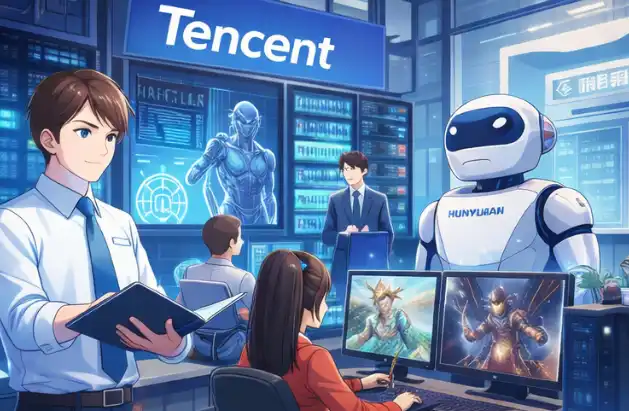
From Tencent and Circle: Looking at the Easy and Hard Questions of Investment

The article contrasts the investment prospects of Tencent and Circle in the AI era, framing the decision as a choice between "easy" and "hard" problems, inspired by Charlie Munger's philosophy. Tencent's stock has declined despite strong earnings, as the market shifted from fearing insufficient AI investment to worrying about excessive spending. The author argues this pessimism is overdone. WeChat's nascent AI agent, Yuanbao, is seen as a prototype for a future, more powerful system-native agent. Crucially, this agent would have system-level permissions to seamlessly interact with the massive Mini Program ecosystem (housing apps like Meituan, Didi, etc.), making it a practical, usable product for billions. The author believes the high-probability success of this inevitable development makes investing in Tencent an "easy" decision that the market is currently overlooking. Conversely, Circle's recent rise is fueled by the AI narrative, specifically the belief that AI agents will require blockchain-based stablecoins for settlement, with USDC as the leading compliant option. The author deconstructs this bullish thesis, identifying high uncertainties in its core assumptions: whether AI transactions will *necessarily* use stablecoins (vs. other protocols like Google's UCP), USDC's ability to maintain its lead against competitors like Tether or PayPal, and whether stablecoins even possess strong network effects in an agent-dominated world where cost and friction are paramount. The compounding uncertainty makes investing in Circle a "hard" problem, riskier than market sentiment suggests. In summary, the author posits that Tencent presents a clear, high-probability opportunity (easy), while Circle's future is built on a chain of speculative assumptions (hard).

marsbit3 ч. назад

From Tencent and Circle: Looking at the Easy and Hard Questions of Investment

marsbit3 ч. назад

Cursor's "Shelling" Kimi Controversy Reverses: From Infringement Allegations to Authorized Cooperation, China's Open-Source Models Once Again Become the Global AI Foundation

On March 20, AI programming tool Cursor (parent company Anysphere, valued at $29.3 billion) released its self-developed model Composer 2, claiming performance improvements through continued pre-training and reinforcement learning, without disclosing the base model source. Shortly after, a captured API request revealed the model ID as "kimi-k2p5-rl-0317-s515-fast," suggesting it was built on Kimi K2.5. Moonshot AI’s pre-training lead Du Yulun initially accused Cursor of violating Kimi’s modified MIT license, which requires commercial products exceeding certain revenue or user thresholds to credit Kimi model usage. The controversy gained traction with Elon Musk’s public comment. However, the situation reversed when Moonshot AI officially congratulated Cursor, clarifying that the usage was authorized through Fireworks AI’s commercial platform. Cursor’s co-founder Aman Sanger and VP Lee Robinson later explained that Kimi K2.5 was selected as the strongest base model after evaluation, and Composer 2 involved significant additional training by Cursor. They admitted failure to credit Kimi initially was a mistake. This incident highlights the growing influence of Chinese open-source models in the global AI ecosystem, as noted by Hugging Face’s CEO. It also serves as indirect validation for Moonshot AI, which is currently raising funds at a $18 billion valuation, suggesting its technology may be even more valuable than estimated.

marsbit13 ч. назад

Cursor's "Shelling" Kimi Controversy Reverses: From Infringement Allegations to Authorized Cooperation, China's Open-Source Models Once Again Become the Global AI Foundation

marsbit13 ч. назад

活动图片