
BIT Trading Moment: BTC Still Suppressed by Weekly 200 EMA, Rejection May Restart Decline; Storage and Semiconductors that Surged Last Night Begin Falling in Evening Trading

marsbitPublished on 2026-07-22Last updated on 2026-07-22

Abstract

**Crypto & Stock Market Wrap: Bitcoin Tests Resistance, Stocks Retreat After AI Surge** Bitcoin consolidates around $66,000, facing key resistance near $68,000—an area seen as a major psychological and technical hurdle where previous rallies have failed. Analysts note the cryptocurrency is caught between its 200-week moving average (~$63,333) and 200-week EMA (~$68,328). A clear break above $68k is needed to signal a stronger bullish trend, while a rejection could lead to a retest of $63k support. Market sentiment remains cautious, with low futures open interest pointing to a low-liquidity rebound rather than a full bull market. Bitcoin spot ETFs saw another $203 million inflow. US stock futures pointed lower after a strong Tuesday session led by a massive rebound in semiconductors and memory stocks. The rally was fueled by renewed optimism about AI-driven hardware demand, with Micron, SanDisk, and SK Hynix surging. However, those gains reversed in pre-market trading. Super Micro Computer (SMCI) soared over 20% after hours on strong guidance and a record backlog. Other standouts included Rocket Lab and nuclear energy plays Oklo and X-Energy. Rising oil prices (Brent above $91) and climbing Treasury yields (10-year near 4.64%), however, are reigniting inflation concerns and acting as a headwind for equities. In Asia, markets were mixed. South Korea's KOSPI pared early gains to close slightly higher as semiconductor stocks like SK Hynix gave back initial surges. Japan's Nikk...

This article is jointly produced by PANews and BIT U.S. Stocks. BIT U.S. Stocks offers 10,000+ U.S. main board stocks and ETFs, supports stablecoin deposits/withdrawals and traditional USD wire transfers, allowing you to enjoy full shareholder rights including dividends and voting.

Bitcoin Faces Resistance Wall at $68,000 but Hovers Above 200-Week Moving Average

The crypto market continues its rebound, with Bitcoin price stabilizing around $66,000, having briefly surpassed $66,900 during the session, marking a rebound of over 15% from the July low. CoinDesk points out that Bitcoin currently appears to be following chip stocks and broader macro risk appetite rather than trading solely on the "digital gold" narrative.

Current overhead resistance for Bitcoin is concentrated around $67,000, $67,300, $67,900, and $68,000. Bitfinex analysts believe that the $68,000 area is not only close to the average cost basis for investors over the past five months but also corresponds to the failure point of the mid-June rebound. A large amount of trapped capital may sell upon breakeven, so the initial test could trigger significant volatility.

Technically, traders are watching the BTC 200-week MA around $63,333 and the 200-week EMA around $68,328. Daan Crypto Trades notes that Bitcoin is currently sandwiched between the 200-week MA, the 200-week EMA, and the bull market support band. The price is in the middle of these key moving averages; a weekly close below $55,000 or above $70,000 is needed to confirm a major directional breakout. A break above $68,000 could open up further upside for Bitcoin; failure could lead to a retest of support near $63,000.

However, the market remains in a cautious recovery phase. Vetle Lunde, head of research at K33 Research, notes that CME Bitcoin futures open interest has fallen to its lowest level since 2023, and spot trading volume remains notably weak. The current price action resembles a "summer low-liquidity rebound" rather than the start of a full-fledged bull market.

Key Points for Today:

  • MBG will unlock approximately 27.15 million tokens worth about $3.3 million on July 22.

  • SOON (SOON) will unlock approximately 20.24 million tokens worth about $3.3 million on July 23.

  • Token Unlock · 08:00

  • aPriori (APR) will unlock approximately 31.88 million tokens worth about $6.8 million on July 23.

  • Upbit 24-Hour Trading Volume Ranking: BTC, XRP, ETH, ERA, ONDO

  • Bitcoin Spot ETF: +$203 million, marking 6 consecutive days of net inflows.

  • Ethereum Spot ETF: +$37.471 million, marking 3 consecutive days of net inflows.
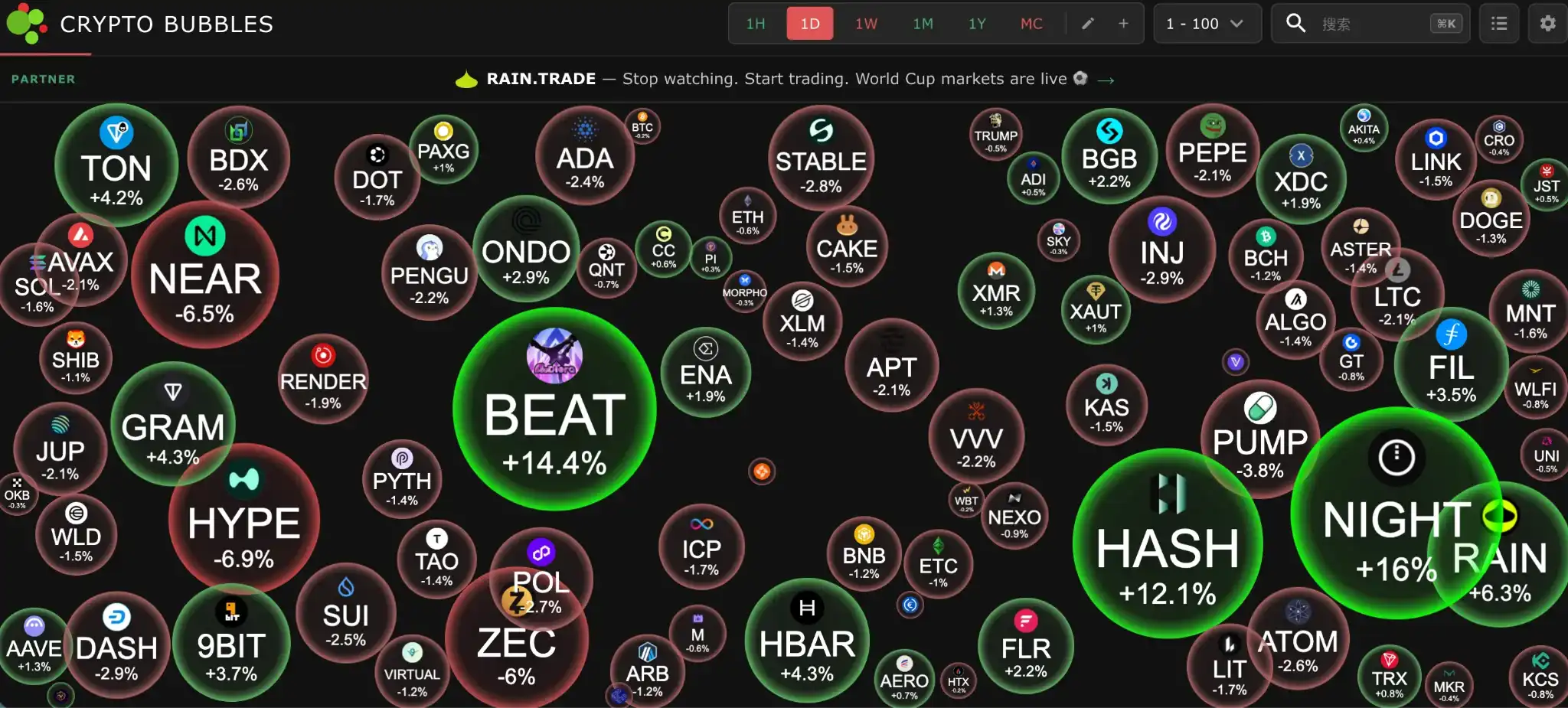
Top Gainers Among Top 100 Coins by Market Cap Today: NIGHT up 16%, BEAT up 14.4%, HASH up 12.1%, RAIN up 6.3%, GRAM up 4.3%.

U.S. Stock Index Futures Fall; Stocks That Surged Last Night Decline in Evening Trading
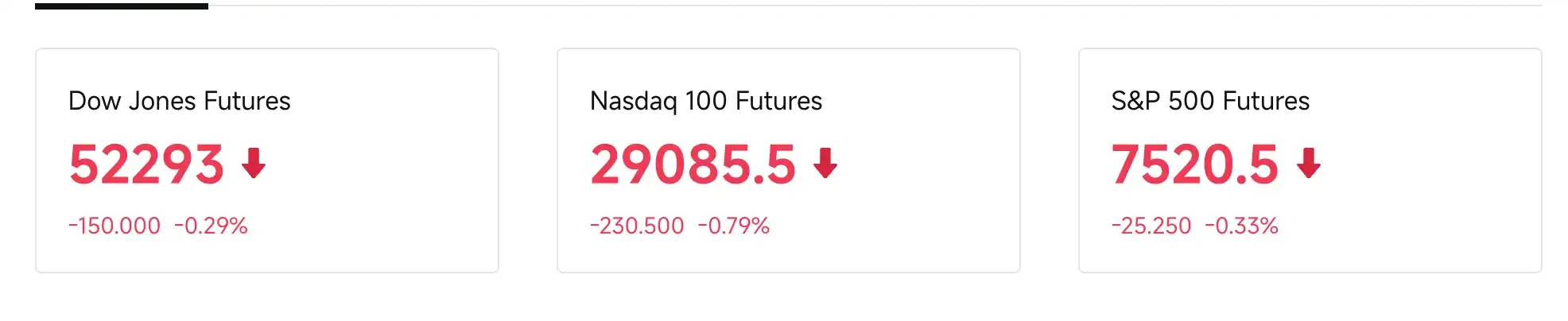
U.S. stock index futures are down across the board, with Nasdaq 100 futures falling 0.79%, Dow futures falling 0.29%, and S&P 500 futures falling 0.33%.
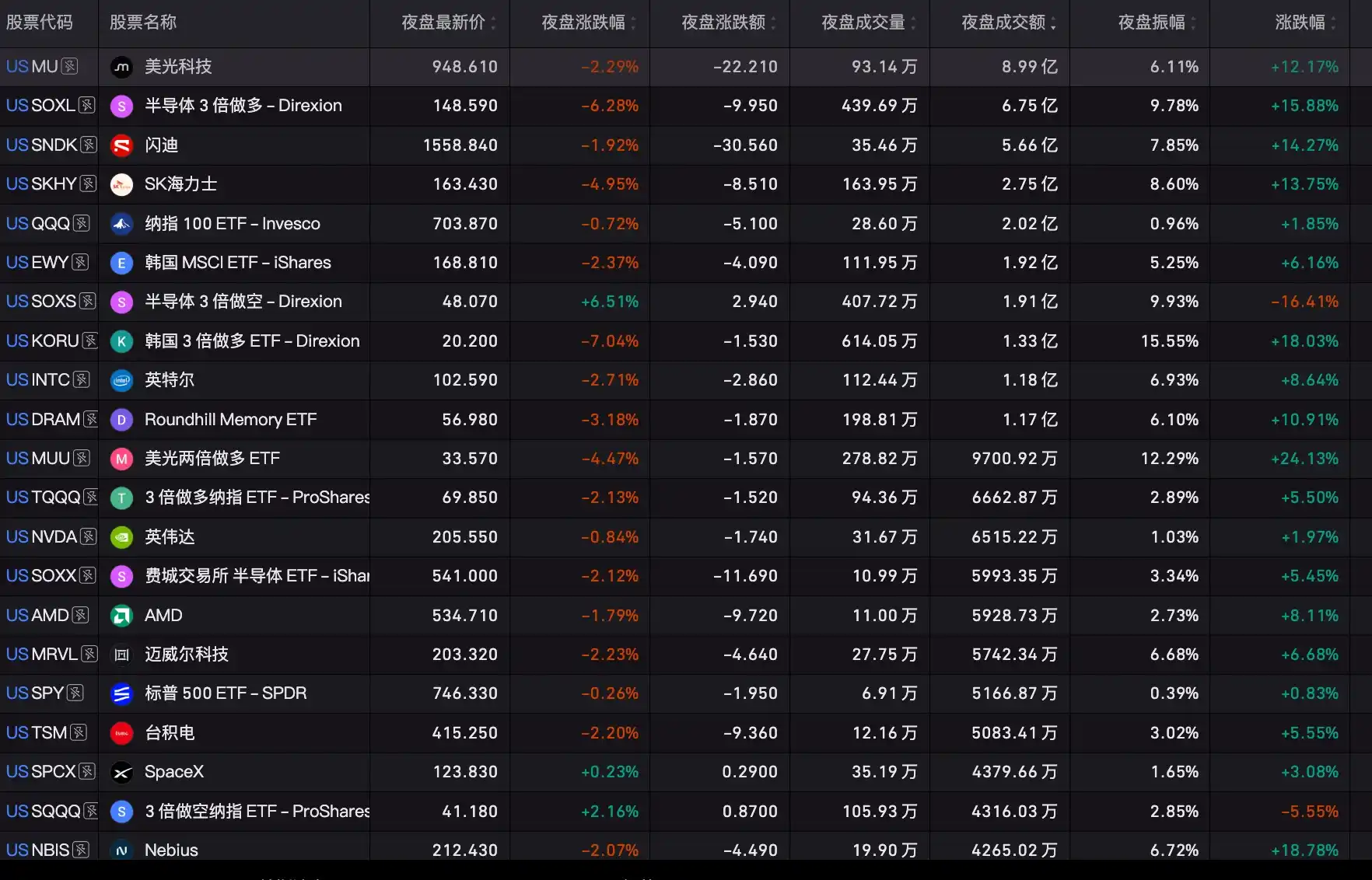
BIT evening trading data shows that in the U.S. night session, the semiconductor and storage sectors that surged last night began to decline. The Semiconductor ETF fell 2.22%, the 3x Long Semiconductor ETF fell 6.28%, and Intel fell 2.7%. Memory stocks that surged over 10% last night, Micron fell 2.29%, SanDisk fell 1.92%, SK Hynix fell 4.95%, and the DRAM Storage ETF fell 3.18%.

  • The standout in Tuesday's after-hours and evening U.S. trading was Super Micro Computer (SMCI), up over 20% after-hours and up 15.8% in evening trading. The company expects Q4 revenue near the low end of its $11.0-$12.5 billion guidance range but significantly raised its gross margin outlook to 15%-17%, well above the prior 8.2%-8.4% expectation. More crucially, the company said quarterly new orders exceeded $60 billion, with backlog hitting a record high, directly reinforcing the view that AI server demand remains strong.

  • Rocket Lab rose over 7% after-hours and is up 4% in evening trading, after securing a $266 million U.S. Air Force contract for suborbital rocket launch missions.

  • Oklo rose over 6.6% after-hours, X-Energy rose over 8.6% after-hours, and both are up over 3% in evening trading. Both companies formally joined the new nuclear reactor construction plan pushed by the Trump administration, as the market continues to trade "power after AI computing power" as the next layer of infrastructure.

  • SpaceX ended a 7-day losing streak, rising 3.08% last night and continuing to gain 0.23% in evening trading. The market awaits its first post-IPO earnings report on August 4th; simultaneously, ahead of a large unlock on August 6th, the battle between shorts and longs is intensifying. S3 Partners estimates that about 206 million SpaceX shares are currently shorted, representing roughly 32% of the float, with a nominal short position of about $25 billion.

U.S. Stocks Rallied Strongly Last Night, but Oil and Treasuries are Throwing Cold Water
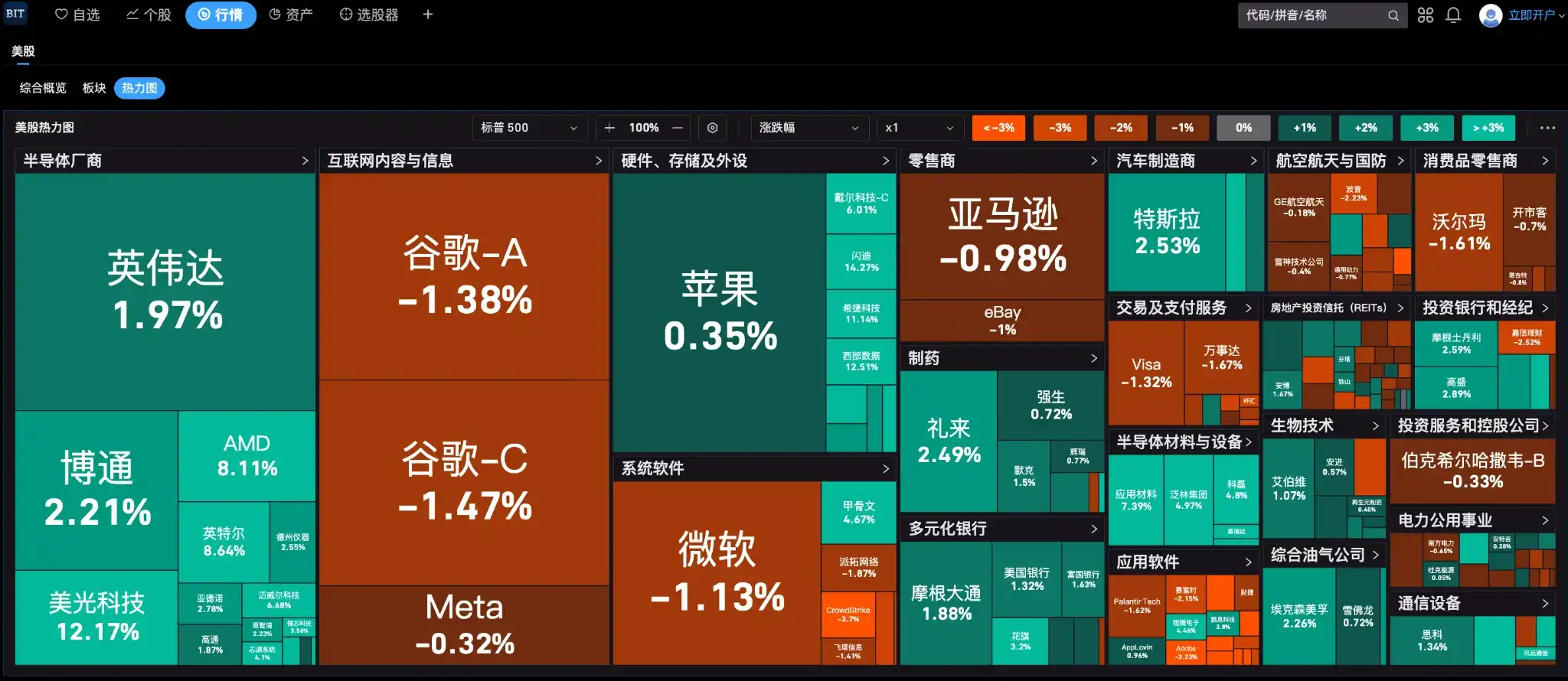
U.S. stock indices collectively closed higher on Tuesday, ending a three-day losing streak. The Philadelphia Semiconductor Index surged 5.21%, its best single-day performance in six weeks. The memory sector skyrocketed: Micron up 12.17%, SanDisk up 14.27%, Western Digital up 12.51%, Seagate up 11.14%, SK Hynix's U.S.-listed shares up 13.75%. The market regained belief that the proliferation of AI models will drive more demand for memory, computing power, and servers.

Bank of America believes that open-source models like Kimi K3 will not weaken hardware demand; instead, local deployment and private training will increase demand for HBM, DRAM, and NAND. UBS also noted that tech giants see AI as a "winner-takes-all" competition and will continue buying hardware even if short-term returns are low.

Nvidia rose 1.97% as the company disclosed its Vera Rubin platform entering volume production ramp-up, with Google Cloud, Microsoft Azure, Oracle Cloud, and CoreWeave beginning deployment. AMD rose 8.11% on pre-event positioning ahead of its AI event. Intel rose 8.64%, buoyed by the semiconductor sector rebound and its foundry business securing a Fortinet order.

Jun, a guest analyst for BIT U.S. Stocks business, previously pointed out that the near-term key for U.S. stocks lies in two lines: first, whether earnings reports validate profits, and second, whether positioning in AI infrastructure and semiconductors stabilizes. AI infrastructure stocks had previously been pressured by factors like Meta's compute leasing plans and SK Hynix's sharp decline, but this rebound suggests the market is reassessing AI hardware demand.

However, U.S. stocks are not without headwinds. Brent crude oil rose above $91, as U.S.-Iran conflict escalates continuously, with the U.S. conducting strikes on Iranian targets for the 11th consecutive night. Red Sea shipping is also threatened by Houthi attacks. Rising oil prices are reviving inflation concerns.

Treasuries are also throwing cold water on stocks. The 10-year Treasury yield rose to around 4.64%, breaking above the key 4.60% level; the 30-year TIPS yield rose to 2.95%, the highest since 2008. RBC rates strategist Izaac Brook stated that rising energy prices are the main driver for higher rates. Natixis chief U.S. economist Christopher Hodge believes the Fed should pay more attention to the energy price shock that has already occurred.
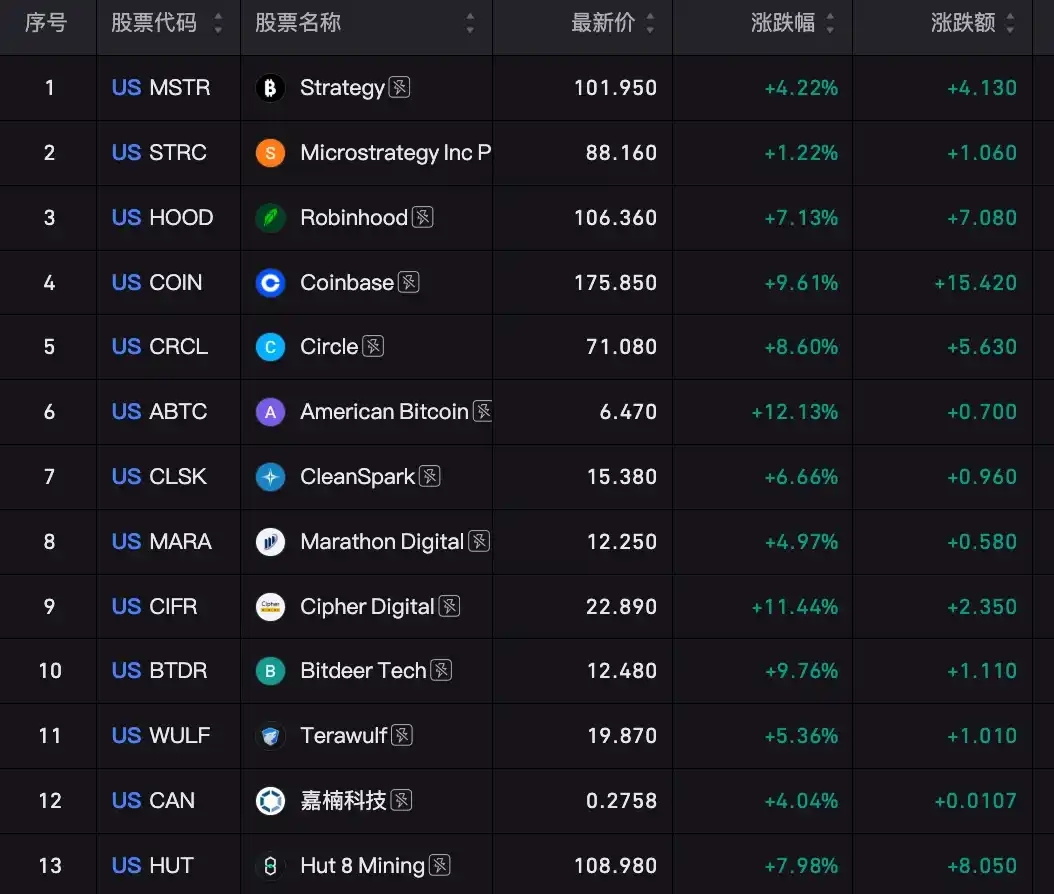
According to BIT U.S. Stocks data, crypto-related stocks performed strongly: Coinbase up ~9.6%, Robinhood up 7.11%, Strategy up 4.22%. The primary reason is progress on the U.S. "CLARITY Act," leading the market to believe crypto regulation is becoming clearer. Circle will report earnings on August 5th; the market will focus on USDC scale and reserve income. Miners also strengthened: American Bitcoin up 12.13%, Cipher Digital up 11.44%, Hut 8 up 7.98%, Bitdeer up 9.76%, driven by both the Bitcoin rebound and the AI compute transition narrative.

South Korean Semiconductors Recover, Japanese Yen Risk Heats Up

Asian markets generally followed the U.S. tech stock recovery but with unstable momentum. The AI hardware rebound boosted South Korean and Japanese tech supply chains, but the yen falling past 163, rising oil prices, and higher Treasury yields kept markets alert.

South Korea's KOSPI index initially rose over 6% in early trading but closed up 0.74%. The rise was mainly due to nearing completion of earlier leveraged ETF liquidations, with the market shifting from panic selling to recovery. JPMorgan strategist Mixo Das stated that South Korean leveraged ETF deleveraging may be about 75% complete.

South Korean semiconductor stocks gave up early gains. SK Hynix initially rose over 9% but closed down 0.32%; Samsung Electronics rose 0.57%. SK Hynix was rumored to be in talks to acquire Intel's Ohio campus for U.S. memory chip production, but subsequent unclear news caused stock volatility. The South Korean government also discussed exchange rate stability with major exporters like Samsung Electronics, SK Hynix, Hyundai Motor, and Kia, expecting improved semiconductor exports in H2 to support foreign exchange supply and demand.

In Japan, the Nikkei 225 index closed down 0.18%. Japan's June exports grew 19.3% year-over-year, imports grew 25.4%, resulting in a trade deficit of ¥406.9 billion. Yen depreciation benefits export companies' income conversion but also raises energy and import costs.

The biggest risk remains the exchange rate. The yen hit a new low since 1986. Former Bank of Japan policy board member Sayuri Shirai warned that if the Fed continues raising rates, USD/JPY could head toward 165. The market is beginning to worry about potential Japanese government intervention in the forex market. Any intervention could trigger global carry trade unwinding, impacting tech stocks and risk assets.

What to Watch Next:

July 22 (Wednesday) (Tech Super Day)

  • 21:00 Samsung Galaxy Global Unpacked Event: Market will watch for more on-device AI features in new devices.

  • July 22-23 AMD AI Event: Market looks to see if AMD can provide a clearer AI server roadmap and customer orders, determining if the AI hardware rebound can spread.

  • Google, Tesla, IBM, Texas Instruments, and ServiceNow report earnings after the close: Alphabet's earnings focus on Google Cloud, advertising, and AI capital expenditure. Strong cloud growth supports the AI hardware chain; high investment with weak returns could pressure tech stocks. Tesla's earnings focus on auto gross margin, energy storage, FSD, and Robotaxi.

July 23 (Thursday)

  • 20:15 ECB Interest Rate Decision and Lagarde Press Conference: Market expects no change, but comments on inflation and liquidity withdrawal will trigger euro and global bond market volatility.

  • 20:30 U.S. Initial Jobless Claims: Market expects ~214,000. Claims significantly below expectations suggest a tight labor market, making Fed easing harder; rising claims would strengthen the growth slowdown trade, benefiting Treasuries and pressuring banks and cyclical stocks.

  • Intel reports earnings after the close, the most critical transformation test post-semiconductor bear market. Same-day earnings: Nokia, Lockheed Martin, RTX, Blackstone, American Airlines, Newmont, Honeywell, SAP, Digital Realty, T-Mobile, among others.


Trending Cryptos

Related Questions

QAccording to the article, what is the key technical resistance level for Bitcoin's price around $68,000?

AThe article states that the resistance around $68,000 is significant because it is close to the average entry cost for investors over the past five months and corresponds to the failure point of the mid-June rebound. A large amount of trapped capital may sell upon breaking even, so the initial test of this level could cause sharp volatility. Technically, the 200-week EMA is also located near $68,328.

QWhat were the main reasons for the surge in semiconductor and memory stocks like Micron in the US market according to the analysts cited?

AAnalysts from Bank of America and UBS provided key reasons. Bank of America believes that open-source AI models like Kimi K3 will not weaken hardware demand. Instead, local deployment and private training will increase demand for HBM, DRAM, and NAND memory. UBS added that tech giants view AI as a 'winner-takes-all' competition, meaning they will continue buying hardware even if short-term returns are low.

QWhat major risk for the stock market is highlighted from the movements in crude oil and U.S. Treasury bonds?

ARising crude oil prices, with Brent crude above $91 due to escalating US-Iran conflict and Red Sea shipping threats, are bringing back inflation concerns. Meanwhile, rising U.S. Treasury yields, with the 10-year yield surpassing 4.60% and the 30-year TIPS yield hitting a 2008 high, are putting pressure on equities. Analysts cite energy price shocks as a primary driver for the rise in interest rates.

QWhy did the South Korean stock market (KOSPI) show significant strength, and what caused the volatility in SK Hynix's stock price?

AThe KOSPI index's strength was attributed to the nearing completion of leveraged ETF unwinding, with JPMorgan estimating about 75% of the deleveraging was done, allowing the market to shift from panic selling to recovery. SK Hynix's stock was volatile, surging early on rumors it was negotiating to acquire Intel's Ohio campus for US memory chip production, but later falling as the news remained unconfirmed.

QWhat are the key upcoming events on July 22nd (Wednesday) that the article advises investors to watch?

AJuly 22nd is highlighted as a 'Tech Super Day' with several key events: 1) Samsung's Galaxy global new product launch (21:00), where market focus is on new devices featuring more on-device AI capabilities. 2) AMD's AI event (July 22-23), where the market awaits clearer AI server roadmaps and customer orders. 3) Earnings reports from Google (Alphabet), Tesla, IBM, Texas Instruments, and ServiceNow after the market closes.

Related Reads

The $4 Quadrillion Switch Has Been Flipped: DTCC Moves Wall Street On-Chain, an Infrastructure Shift, Not a Crypto Bet

The Depository Trust & Clearing Corporation (DTCC), which custodies $115 trillion in assets and settles quadrillion-dollar securities annually, has executed its first real settlement of tokenized stocks, ETFs, and treasury securities. This marks a fundamental infrastructure shift in global finance, not merely a cryptocurrency experiment. Key insights from a discussion with DTCC's digital asset lead and BCG partners frame this transition. First, this is a multi-decade rebuild of financial rails, akin to telecom's shift to packet-switching, potentially exposing 15-30% of bank profits by 2035. Second, atomic settlement is a misnomer for scale; DTCC's netting eliminates 98% of gross obligations, a liquidity necessity. The first major application will be in collateral and repo markets, enabling near real-time, 24/7 movement and valuation of trillions in assets, reducing capital costs. BCG's projection of $8.8 trillion in tokenized real-world assets by 2035 assumes a 16% penetration rate, but momentum matters more than the precise figure. Winners will be structural orchestrators that abstract blockchain complexity for clients, not proponents of any single chain. Crucially, risk management is becoming code, with compliance logic embedded in smart contracts, though the role of human discretion in crises remains an open question. The core debate is settled: the system's deepest node has moved. The remaining variable is the adoption timeline.

marsbit4m ago

The $4 Quadrillion Switch Has Been Flipped: DTCC Moves Wall Street On-Chain, an Infrastructure Shift, Not a Crypto Bet

marsbit4m ago

The Perfect Founder-Market Fit: Bear Markets Are the Ultimate Test

"Founder-Market Fit in a Bear Market: The Ultimate Test" While AI captures the vast majority of venture capital and attention, the current crypto bear market is revealing the strongest cohort of founders in four cycles. These operators, hailing from institutions like Goldman Sachs, Citadel, and Stripe, are not chasing narratives. They are converging on the now-compelling "hard problem" of institutional-grade financial infrastructure. Founder-market fit—the alignment between a specific founder's unique capabilities and a specific market's needs—is the most durable signal in venture. Products, markets, and regulations change, but this fit compounds even when prices don't. The bear market is the best environment to identify it. Talent is now concentrated on two serious verticals: AI and fintech. The quality of founders choosing blockchain for finance is unprecedented. Evidence is in who's building: founders from elite traditional finance backgrounds are tackling on-chain institutional infrastructure (e.g., Ondo's Nathan Allman, Offchain Labs' Ed Felten). Market data supports this shift, with tokenized real-world assets and stablecoins growing significantly and major banks launching products. The author evaluates founders on four traits: 1) Deep domain expertise (lived experience, not just theory), 2) High agency (ability to sell a vision based on deep market understanding), 3) Unfair network advantage (relationships that accelerate execution), and 4) Obsession (long-term commitment rooted in belief, not hype). In a bull market, momentum does the work. A bear market strips that away, leaving only belief—the observable output of true founder-market fit—as fuel. This period filters out tourists, leaving builders who see the long-term opportunity. For serious operators considering the space, the bear market is not a risk but a proving ground and the cleanest environment to build compounding advantage. The commitment is to back such founders at the intersection of market and conviction, as in every prior cycle.

marsbit11m ago

The Perfect Founder-Market Fit: Bear Markets Are the Ultimate Test

marsbit11m ago

Trading

Spot

Hot Articles

What is $BITCOIN

DIGITAL GOLD ($BITCOIN): A Comprehensive Analysis Introduction to DIGITAL GOLD ($BITCOIN) DIGITAL GOLD ($BITCOIN) is a blockchain-based project operating on the Solana network, which aims to combine the characteristics of traditional precious metals with the innovation of decentralized technologies. While it shares a name with Bitcoin, often referred to as “digital gold” due to its perception as a store of value, DIGITAL GOLD is a separate token designed to create a unique ecosystem within the Web3 landscape. Its goal is to position itself as a viable alternative digital asset, although specifics regarding its applications and functionalities are still developing. What is DIGITAL GOLD ($BITCOIN)? DIGITAL GOLD ($BITCOIN) is a cryptocurrency token explicitly designed for use on the Solana blockchain. In contrast to Bitcoin, which provides a widely recognized value storage role, this token appears to focus on broader applications and characteristics. Notable aspects include: Blockchain Infrastructure: The token is built on the Solana blockchain, known for its capacity to handle high-speed and low-cost transactions. Supply Dynamics: DIGITAL GOLD has a maximum supply capped at 100 quadrillion tokens (100P $BITCOIN), although details regarding its circulating supply are currently undisclosed. Utility: While precise functionalities are not explicitly outlined, there are indications that the token could be utilized for various applications, potentially involving decentralized applications (dApps) or asset tokenization strategies. Who is the Creator of DIGITAL GOLD ($BITCOIN)? At present, the identity of the creators and development team behind DIGITAL GOLD ($BITCOIN) remains unknown. This situation is typical among many innovative projects within the blockchain space, particularly those aligning with decentralized finance and meme coin phenomena. While such anonymity may foster a community-driven culture, it intensifies concerns about governance and accountability. Who are the Investors of DIGITAL GOLD ($BITCOIN)? The available information indicates that DIGITAL GOLD ($BITCOIN) does not have any known institutional backers or prominent venture capital investments. The project seems to operate on a peer-to-peer model focused on community support and adoption rather than traditional funding routes. Its activity and liquidity are primarily situated on decentralized exchanges (DEXs), such as PumpSwap, rather than established centralized trading platforms, further highlighting its grassroots approach. How DIGITAL GOLD ($BITCOIN) Works The operational mechanics of DIGITAL GOLD ($BITCOIN) can be elaborated on based on its blockchain design and network attributes: Consensus Mechanism: By leveraging Solana’s unique proof-of-history (PoH) combined with a proof-of-stake (PoS) model, the project ensures efficient transaction validation contributing to the network's high performance. Tokenomics: While specific deflationary mechanisms have not been extensively detailed, the vast maximum token supply implies that it may cater to microtransactions or niche use cases that are still to be defined. Interoperability: There exists the potential for integration with Solana’s broader ecosystem, including various decentralized finance (DeFi) platforms. However, the details regarding specific integrations remain unspecified. Timeline of Key Events Here is a timeline that highlights significant milestones concerning DIGITAL GOLD ($BITCOIN): 2023: The initial deployment of the token occurs on the Solana blockchain, marked by its contract address. 2024: DIGITAL GOLD gains visibility as it becomes available for trading on decentralized exchanges like PumpSwap, allowing users to trade it against SOL. 2025: The project witnesses sporadic trading activity and potential interest in community-led engagements, although no noteworthy partnerships or technical advancements have been documented as of yet. Critical Analysis Strengths Scalability: The underlying Solana infrastructure supports high transaction volumes, which could enhance the utility of $BITCOIN in various transaction scenarios. Accessibility: The potential low trading price per token could attract retail investors, facilitating wider participation due to fractional ownership opportunities. Risks Lack of Transparency: The absence of publicly known backers, developers, or an audit process may yield skepticism regarding the project's sustainability and trustworthiness. Market Volatility: The trading activity is heavily reliant on speculative behavior, which can result in significant price volatility and uncertainty for investors. Conclusion DIGITAL GOLD ($BITCOIN) emerges as an intriguing yet ambiguous project within the rapidly evolving Solana ecosystem. While it attempts to leverage the “digital gold” narrative, its departure from Bitcoin's established role as a store of value underscores the need for a clearer differentiation of its intended utility and governance structure. Future acceptance and adoption will likely depend on addressing the current opacity and defining its operational and economic strategies more explicitly. Note: This report encompasses synthesised information available as of October 2023, and developments may have transpired beyond the research period.

1.0k Total ViewsPublished 2025.05.13Updated 2025.05.13

What is $BITCOIN

Discussions

Welcome to the HTX Community. Here, you can stay informed about the latest platform developments and gain access to professional market insights. Users' opinions on the price of BTC (BTC) are presented below.

活动图片