Solana Ecosystem Shows Signs of Recovery: On-Chain Governance Upgrade, Tokenized Stocks and Meme Coins Heat Up

marsbitPublished on 2026-07-03Last updated on 2026-07-03

Abstract

Solana Ecosystem Shows Signs of Revival: Governance Upgrades, Tokenized Stocks, and Memecoins Heat Up While the broader crypto market faces a downturn, Solana has shown relative strength with its price rising nearly 15% recently. This resilience is attributed to warming ecosystem activity, particularly in tokenized stocks and memecoins, coupled with a major upgrade to its on-chain governance. In the Real World Assets (RWA) sector, Solana now leads all public chains in both the number of unique holder wallets and the quantity of RWA assets. Its tokenized stock weekly trading volume has surged to a record $1.42 billion, capturing about 96% of the market share, largely driven by the Backpack exchange. Simultaneously, the Solana memecoin sector has reignited, fueled by the rapid ascent of the ANSEM token following endorsements from a prominent crypto influencer. This has boosted activity across platforms like Pump.fun and increased fee revenue for several Solana-based exchanges. A key development is the launch of Solana Governance Proposals (SGP), a new on-chain mechanism. It allows validators with at least 100,000 SOL delegated to submit proposals for community vote, enhancing decentralized decision-making. SGP will operate alongside the existing technical proposal process (SIMD), focusing on broader ecosystem governance. Despite these positive signals in specific areas, overall on-chain activity and transaction volumes still lag behind previous bull market peaks, indicatin...

Author: Nancy, PANews

Recently, the crypto market has been shrouded in a chill once again, with Bitcoin once falling below the $60,000 mark, and mainstream crypto assets generally weakening.

In contrast, Solana has shown a relatively independent trend, rising about 14.9% in the past week. Behind the price increase lies the driving force of local ecosystem recovery and on-chain governance upgrades.

Ecosystem Shows Recovery Signals, RWA and Meme Coins Both Heating Up

Recently, the Solana ecosystem has released signals of recovery, especially in the two major sectors of tokenized stocks and meme coins.

In the RWA field, RWA.xyz data shows that as of July 3, based on the number of holding wallets, the number of RWA holding wallets on the Solana chain has exceeded 293,000, accounting for about 31.1% of the entire network, ranking first among all public chains. The second and third places, Plume and Ethereum, have approximately 248,000 and 205,000 respectively. Meanwhile, the number of RWA assets on the Solana chain has reached 2,119, also ranking first, surpassing mainstream public chains such as Arbitrum, Ethereum, and BNB Chain.
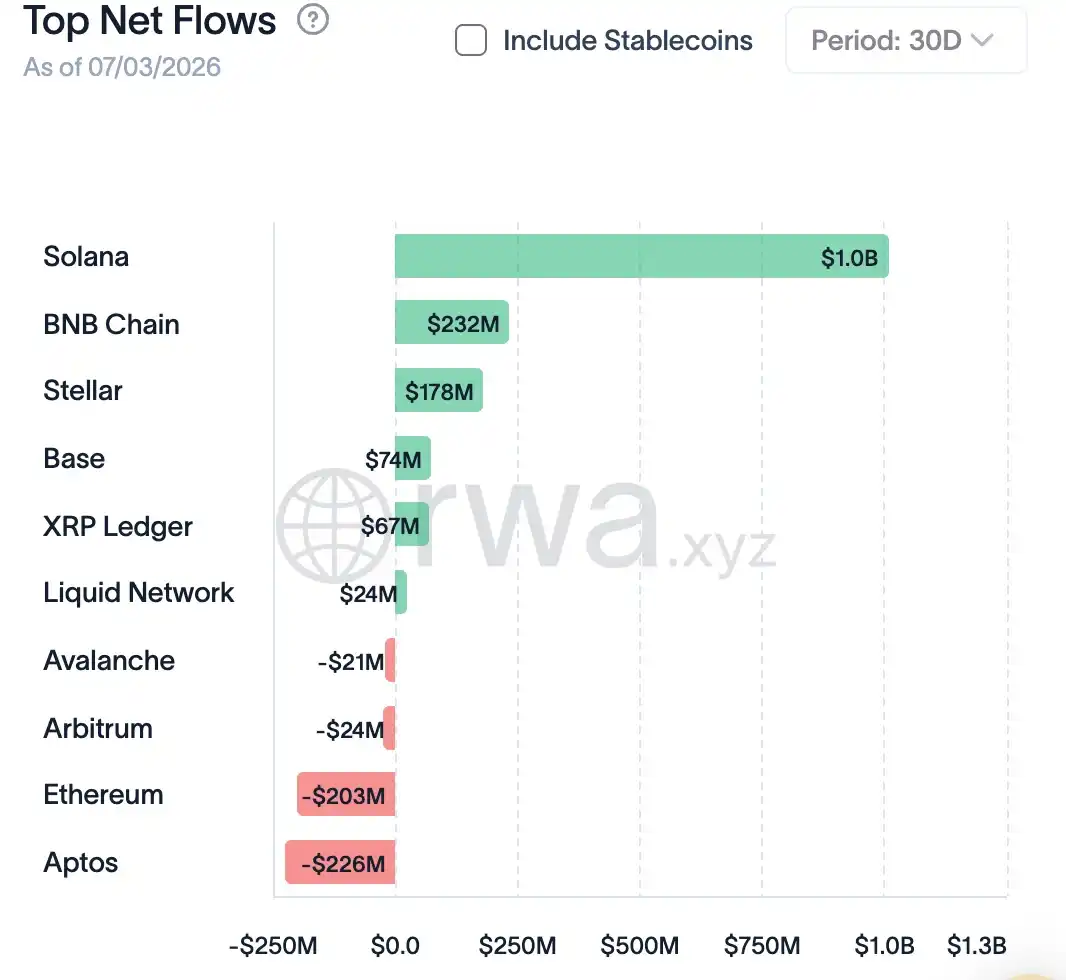
However, from the perspective of asset scale, Solana still has significant room for catch-up. Currently, the total value of RWAs on its chain is about $3.55 billion, still showing a considerable gap compared to Ethereum. But observing from capital flow, the net inflow of RWAs on the Solana chain over the past 30 days has exceeded $1 billion, significantly leading public chains such as Ethereum, BNB Chain, Arbitrum, Base, XRP Ledger, and Aptos, which confirms that funds have recently been flowing into the Solana ecosystem.

Behind this round of growth in the RWA market on Solana is the rapid expansion of the tokenized stock market.
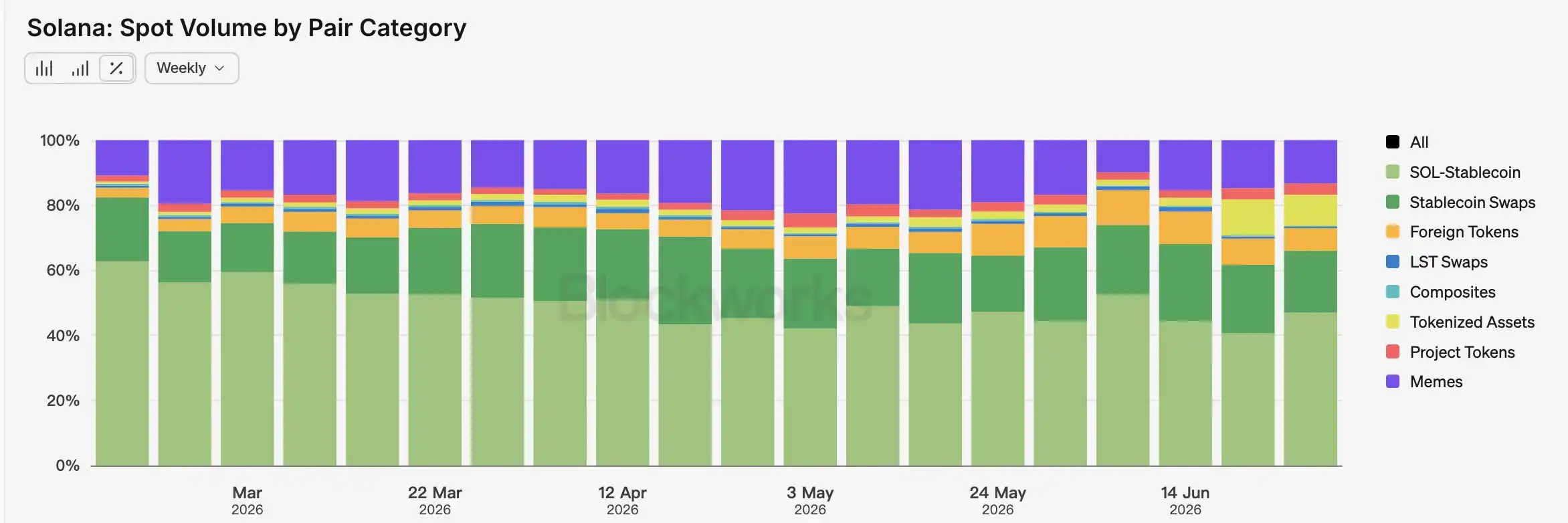
According to the latest data from Blockworks, tokenized assets now account for about 10% of Solana's weekly spot trading volume, a significant increase from just 1% at the beginning of the year. They have now become the second-largest trading category after meme coins.
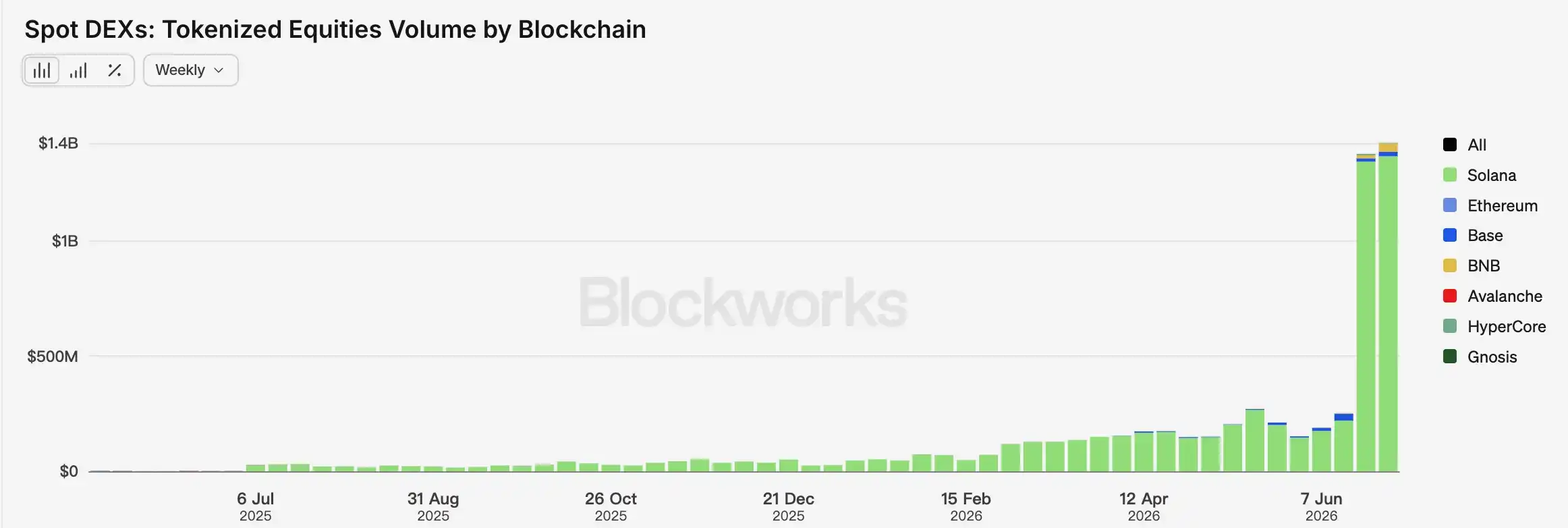
At the same time, the weekly trading volume of tokenized stocks on Solana has also reached a historical high, breaking $1.42 billion, a 30.9-fold increase compared to the beginning of the year, accounting for about 96% of the entire tokenized stock market's trading share. This growth mainly benefits from the tokenized stock business launched by Backpack last month. Currently, Backpack has become Solana's largest tokenized stock issuance platform. The tokenized stocks SPCX and MU it launched contribute about 95% and 99% of Solana's chain trading volume, respectively.

On the other hand, the meme coin market, which had been quiet for a long time, has also started to warm up.

Recently, crypto KOL Ansem publicly supported the eponymous meme coin ANSEM, quickly igniting "trench" trading enthusiasm on the Solana chain. Driven by factors such as celebrity endorsement, high concentration (Ansem holds 65% of the total token supply), and airdrop expectations, the market cap of ANSEM once surged to over $180 million within just a few days.

Dune data shows that as of July 3, Ansem has airdropped ANSEM tokens worth over $12.57 million to 979 addresses. Meanwhile, currently about 94.75% of ANSEM traders are in profit, further stimulating market sentiment.
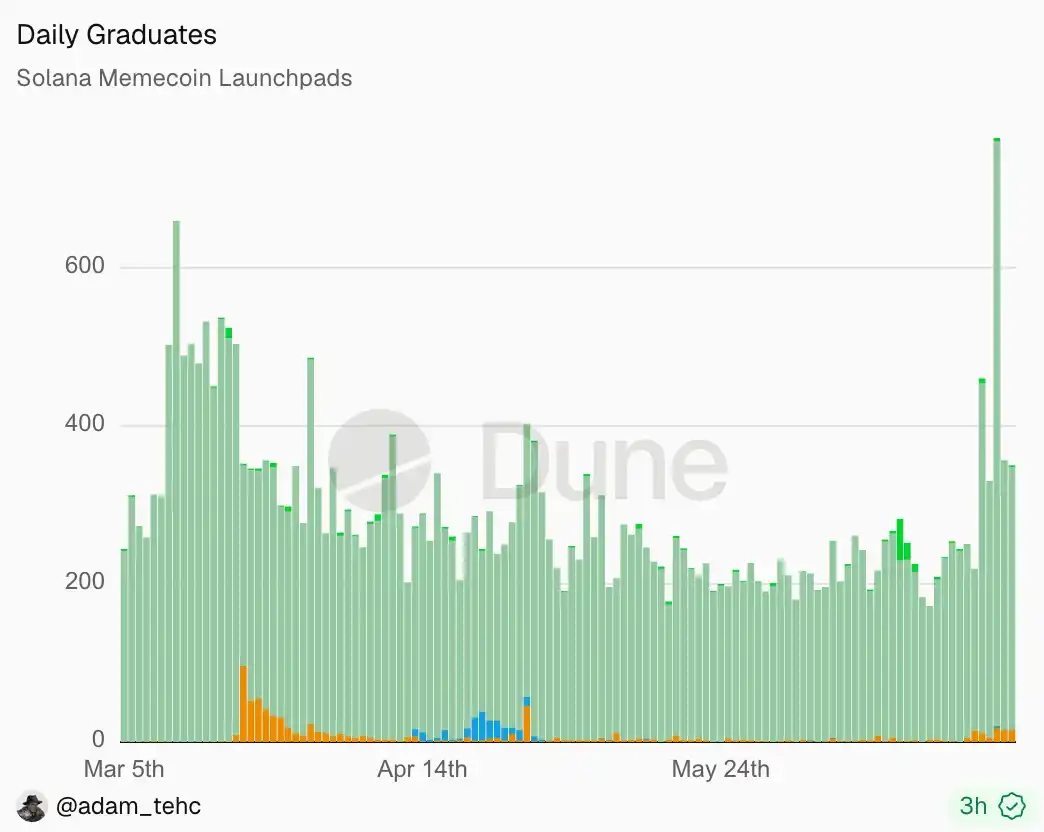
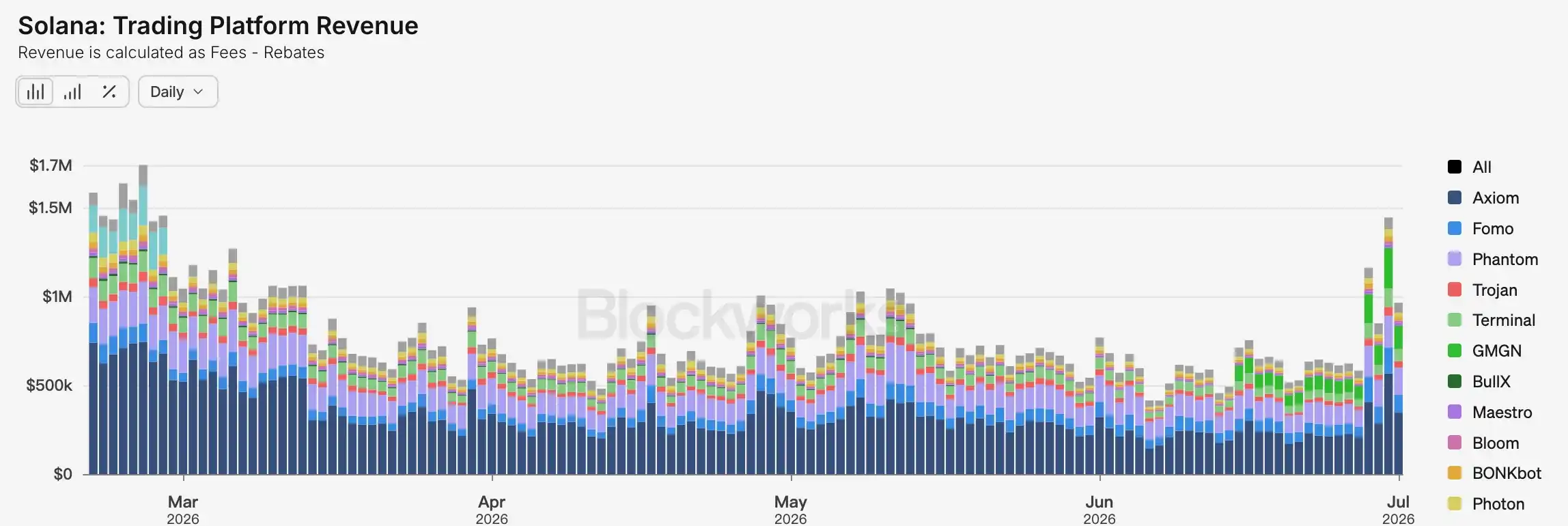
Driven by the ANSEM trend, the activity of the Solana meme ecosystem has also rebounded. Taking Pump.fun as an example, Dune data shows that the number of tokens successfully graduating from the platform daily has reached a new high since April, with daily trading volume more than doubling compared to a month ago. At the same time, Blockworks data shows that the daily revenue of Solana ecosystem trading platforms such as Axiom, Phantom, GMGN, and Fomo recently once again hit new highs since February of this year.
Solana On-Chain Governance Welcomes Key Upgrade: 100,000 SOL Required to Propose

Recently, Solana's on-chain governance mechanism has undergone an upgrade, further enhancing the decentralization of protocol decision-making, which is expected to promote the further healthy development of the ecosystem.

On July 2, the Solana Foundation announced the official launch of the on-chain governance mechanism Solana Governance Proposals (SGP). Validators can submit, support, and vote on core protocol decisions through SGP. The entire governance process is completed on-chain, employing a stake-weighted voting mechanism and verified through Merkle proofs.

According to the rules, any validator who has received at least 100,000 SOL delegated (approximately $8 million at the current price) can initiate a governance proposal. Previously, stakers mainly participated indirectly by delegating to validators. Voting weight will be calculated based on the amount staked. Additionally, delegates can override the voting choices of the validators they delegate to, which to some extent enhances community participation and further lowers the governance threshold.

Before the launch of SGP, Solana's protocol governance primarily relied on the SIMD (Solana Improvement Documents) process.

Developers typically submit technical proposals on GitHub. After open community discussion and review by core developers, the core team is responsible for completing the development and releasing a new client version. Subsequently, validators independently decide whether to upgrade their node software. When the active stake proportion running the new version reaches a sufficient threshold and the network is stable, the corresponding features are officially activated at a designated Slot or Epoch through Feature Gates.

This governance model is essentially off-chain consensus combined with practical client adoption, effectively avoiding network splits caused by hard forks while maintaining high iteration efficiency. However, direct community participation in major governance matters was relatively limited.

It is worth noting that SGP will not replace SIMD; the two will coexist in a division of labor. SIMD will continue to focus on protocol upgrades and technical improvements, while SGP will focus on important ecological governance issues, providing a unified, transparent, on-chain decision-making channel for the community and validators, also further lowering the governance threshold. This clear division of governance responsibilities both increases community engagement and helps maintain the independence and efficiency of core protocol development.

To prevent governance resources from being consumed by low-quality proposals, Solana has also set thresholds. Governance proposals must first be initiated through the SGP process and receive support from no less than 15% of the active stake before they can formally enter the on-chain voting stage. This ensures that proposals entering the voting stage have a certain foundation of community consensus. Currently, Solana's total staked amount is approximately 42.8 million SOL (about 68% of the total supply), meaning a proposal needs support from about 6.42 million SOL staked to enter the voting stage.

In addition to the governance mechanism upgrade, Solana is simultaneously advancing tokenomics optimization, with proposals SIMD-550 and SIMD-553 expected to be implemented in 2026. These two proposals aim to increase SOL's annual inflation reduction rate from 15% to 30% and are estimated to reduce the issuance of approximately 18.9 million new SOL over the next 6 years.

Looking at the entire ecosystem, the current recovery is still mainly concentrated in hot sectors. Whether it's the number of active on-chain addresses or the overall transaction scale, there is still a significant gap compared to the peak of the last bull market. This indicates that the Solana ecosystem is still in a stage of local recovery, with some distance to go before a full-scale recovery.

Trending Cryptos

Related Questions

QAccording to the article, what are the two key areas showing signs of recovery within the Solana ecosystem?

AAccording to the article, the two key areas showing signs of recovery within the Solana ecosystem are tokenized stocks (a subcategory of RWA) and the Meme coin market.

QWhat is the name of the new on-chain governance mechanism launched by the Solana Foundation, and what is the minimum delegation requirement for a validator to submit a proposal?

AThe new on-chain governance mechanism is called Solana Governance Proposals (SGP). A validator needs at least 100,000 SOL delegated to them (approximately $8 million at the time of the article) to submit a governance proposal.

QWhich platform is identified as the largest tokenized stock issuance platform on Solana, and which two stocks contributed the most to its trading volume?

ABackpack is identified as the largest tokenized stock issuance platform on Solana. The tokenized stocks SPCX and MU contributed approximately 95% and 99% of Solana's tokenized stock trading volume, respectively.

QWhat role did the meme coin ANSEM play in the recent activity on Solana, and what was a key factor in its rapid growth?

AThe meme coin ANSEM ignited trading enthusiasm on Solana, leading to a surge in its market cap to over $180 million in a few days. A key factor in its rapid growth was the public endorsement and high token holdings (65% of total supply) by the crypto influencer Ansem, along with airdrop expectations.

QHow do the new Solana Governance Proposals (SGP) and the existing SIMD process differ in their focus, according to the article?

AAccording to the article, the Solana Governance Proposals (SGP) focus on important ecological governance issues, providing a unified and transparent on-chain decision-making channel for the community and validators. The existing SIMD (Solana Improvement Documents) process continues to focus on protocol upgrades and technical improvements. They are designed to coexist and serve different purposes.

Related Reads

The Verdict in Choi Tae-won's Divorce Case: Revealing the Inheritance Undercurrent Behind SK Hynix's Trillion-Won Empire

SK Group Chairman Chey Tae-won's high-profile divorce case, involving a record 1.38 trillion won settlement, has drawn attention to the succession plans for Korea's second-largest conglomerate, especially its crown jewel, SK hynix. Unlike traditional chaebol scripts centered on the eldest son, Chey's three children from his marriage to former President Roh Tae-woo's daughter, Roh Soh-yeong, are carving distinct, non-traditional paths. Eldest daughter Chey Yun-jung (b. 1989) is seen as the most evident successor. With a scientific and consulting background, she holds executive roles at SK bioscience and SK Inc.'s growth support department, focusing on future strategy and biopharma. Her marriage is to an AI infrastructure entrepreneur, not a traditional business alliance. Second daughter Chey Min-jung (b. 1991) took a unique route, voluntarily serving as a South Korean naval officer, including an anti-piracy deployment. She later worked on policy and strategy for SK hynix in Washington D.C. before co-founding an AI-driven healthcare startup. She married a former U.S. Marine Corps officer, connecting her to U.S. defense and policy circles—networks crucial for a global semiconductor giant. The only son, Chey In-geun (b. 1995), who studied physics like his father, worked briefly at SK E&S before joining McKinsey. Despite fitting the traditional "heir" profile as the eldest son, he remains silent and holds no public position or shares in SK, suggesting the old succession playbook is obsolete. As SK hynix's valuation soars, becoming a geopolitical asset in the AI era, the heirs' legitimacy is no longer automatic. They must prove themselves in fields like AI biotech, global policy, and strategic consulting. Their marriages also reflect new elite networks in tech and defense, not old political alliances. Their inheritance is the complex challenge of navigating a globalized, tech-driven world, not just a corporate throne.

marsbit12h ago

The Verdict in Choi Tae-won's Divorce Case: Revealing the Inheritance Undercurrent Behind SK Hynix's Trillion-Won Empire

marsbit12h ago

From OpenSea to OpenRouter: Is Alex Atallah Repeating His 'Exit at the Peak' Playbook?

From OpenSea to OpenRouter: Is Alex Atallah Repeating His "Exit at the Peak" Playbook? According to the Wall Street Journal, payments giant Stripe is in talks to acquire the AI model aggregation platform OpenRouter in a potential deal valuing the company near $100 billion. This would mark founder Alex Atallah's second creation of a company reaching a $100 billion valuation, following his co-founding of NFT marketplace OpenSea. OpenRouter, founded just over three years ago, has grown rapidly by acting as a unified gateway for developers to access over 400 AI models. It currently has about 10 million users and processes over 200 trillion tokens monthly. While the platform's annualized revenue is around $50 million, its valuation has skyrocketed from $1.3 billion in March 2026. The potential acquisition by Stripe, a company OpenRouter's founder once likened it to, represents a major expansion into AI infrastructure for the payments leader. This move echoes Atallah's previous timing with OpenSea, where he departed before the NFT market's significant downturn. For OpenRouter, selling now may be strategic. Despite its scale, its business model—charging a 5-5.5% fee on AI inference calls—faces pressure from competition, open-source models, and potential price wars among model providers, limiting its profitability narrative for an IPO. A key asset for potential acquirers like Stripe is OpenRouter's vast repository of real-world AI usage data, which offers unique insights into model performance and developer preferences that are difficult to replicate. Whether this potential deal signifies a new valuation benchmark for AI infrastructure or another market peak signal remains to be seen.

链捕手12h ago

From OpenSea to OpenRouter: Is Alex Atallah Repeating His 'Exit at the Peak' Playbook?

链捕手12h ago

Trading

Spot

Hot Articles

Discussions

Welcome to the HTX Community. Here, you can stay informed about the latest platform developments and gain access to professional market insights. Users' opinions on the price of MEME (MEME) are presented below.

活动图片