OpenAI's Largest Internal Wealth Creation: 600 People Cash Out a Total of $6.6 Billion, 75 Take Home the Maximum $30 Million Each

链捕手Published on 2026-05-11Last updated on 2026-05-11

Abstract

A Wall Street Journal report reveals OpenAI's unprecedented pre-IPO wealth creation. In a single employee stock sale last October, over 600 current and former employees sold shares, collectively cashing out approximately $6.6 billion. Due to high investor demand, the company tripled the individual sale cap to $30 million, with about 75 employees selling the maximum amount. This event represents the largest such transaction in tech industry history for a private company. OpenAI's valuation was $500 billion for this tender offer. Employees with over two years of tenure were eligible, allowing many post-ChatGPT hires their first liquidity event. The company's stock has reportedly grown over 100-fold in seven years. Following a restructuring, employees collectively hold about 26% of OpenAI. The scale of executive wealth is also staggering. In court testimony related to Elon Musk's lawsuit, President and co-founder Greg Brockman confirmed his OpenAI stake is worth around $30 billion. Analysis indicates about 165 current and former employees hold a combined ~$164.9 billion in equity, averaging nearly $1 billion per person in paper wealth. OpenAI's per-employee stock-based compensation is estimated to be 34 times the average of major tech firms before their IPOs. OpenAI continues its rapid ascent, closing a $122 billion funding round at an $852 billion valuation in March. With monthly revenue hitting $2 billion, over 900 million weekly ChatGPT users, and plans for a potential tri...

Author: Claude, Deep Chao TechFlow

Deep Chao Introduction: The Wall Street Journal has revealed the scale of wealth creation inside OpenAI. In an employee stock sale last October, the company raised the individual cash-out cap from $10 million to $30 million. Over 600 current and former employees participated, cashing out a total of $6.6 billion, with about 75 individuals reaching the full $30 million limit each. President Brockman confirmed in court this week that his stake is worth approximately $30 billion. Never in Silicon Valley's history has a pre-IPO company created such a dense concentration of multi-millionaires.

Image source: Wall Street Journal

In the past Silicon Valley, the usual path for ordinary employees to become rich was one: wait for the company to go public. OpenAI is rewriting that rule.

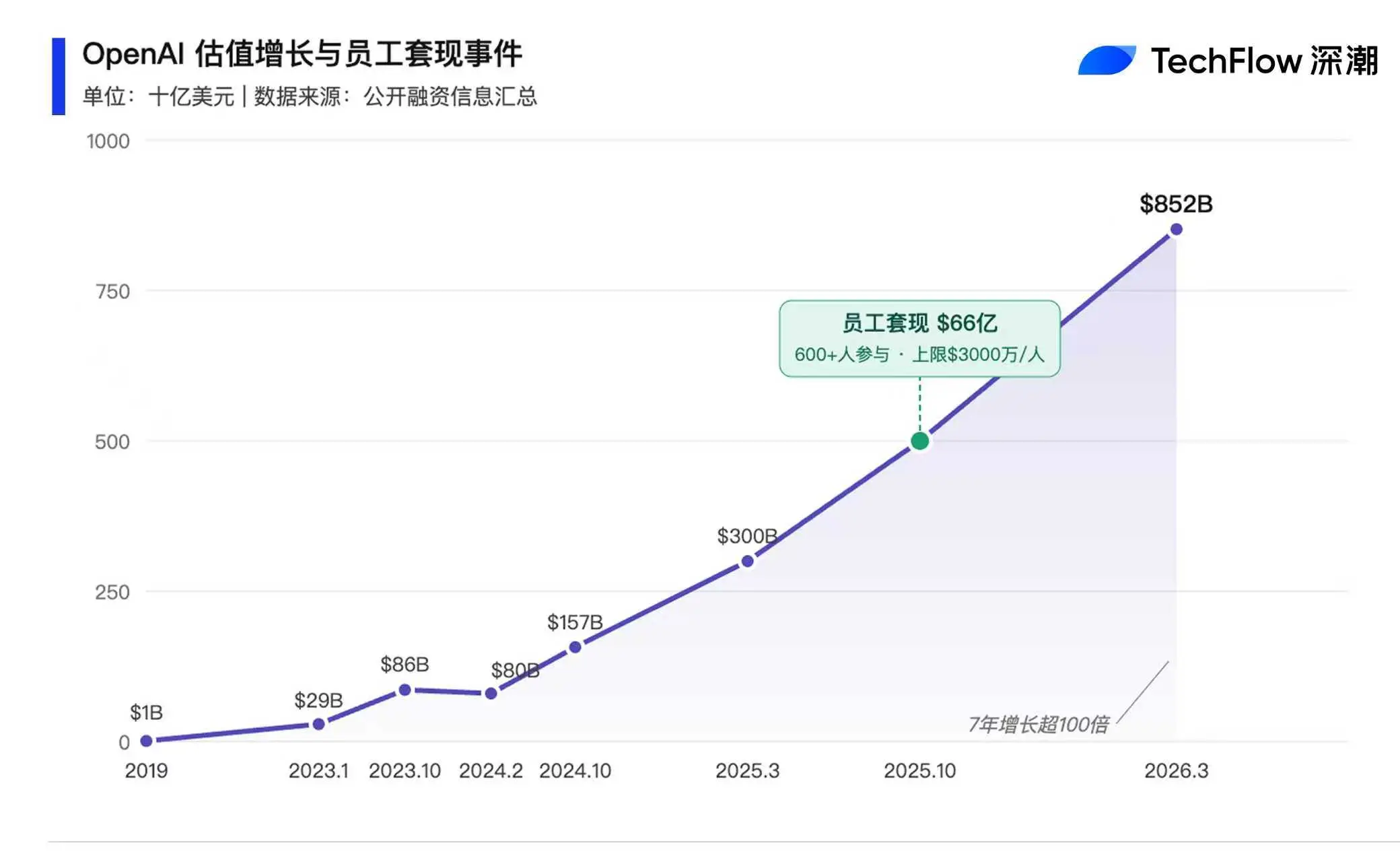
According to The Wall Street Journal, in an internal stock transaction completed last October, OpenAI allowed employees to sell up to $30 million worth of shares each. Over 600 current and former employees participated, cashing out a total of approximately $6.6 billion. Insiders revealed that about 75 of them reached the full $30 million limit each. This is the largest single employee stock sale event in the tech industry to date.

Cash-Out Cap Tripled, External Investor Demand Drove Up Limits

OpenAI originally set a single cash-out cap for employees at $10 million. However, due to external investor demand far exceeding expectations, the company tripled the limit to $30 million last autumn.

The transaction was completed at a valuation of $500 billion, with investors including Thrive Capital, SoftBank, Dragoneer Investment Group, Abu Dhabi MGX, and T. Rowe Price. According to a previous CNBC report, OpenAI initially planned a sale size of about $6 billion, which later expanded to $10.3 billion, but the final transaction settled at about $6.6 billion. Internally, the lower participation rate was interpreted as a vote of confidence by employees in the long-term prospects.

Under OpenAI's rules, employees can sell shares after being with the company for two years. This means many employees who joined only after ChatGPT's launch in late 2022 had their first opportunity to cash out options in this round. OpenAI's stock value has grown over 100 times in the past seven years.
Brockman Confirms $30 Billion Stake in Court, Musk's Lawyer Persistently Questions

The scale of wealth in the hands of executives is even more staggering. According to NBC, OpenAI President and co-founder Greg Brockman confirmed during his court testimony on May 4th that his current OpenAI equity is worth approximately $30 billion.

This figure was disclosed on the fourth day of the Musk v. OpenAI trial. Musk's lawyer, Steven Molo, repeatedly mentioned this number during over two hours of questioning, pressing Brockman on why he had not fulfilled a promised $100,000 donation while sitting on a $30 billion fortune. According to CNBC, Brockman admitted, "It is true, I did not ultimately make the donation."

According to Fortune, Musk's legal team also revealed multi-layered financial connections between Brockman and CEO Sam Altman: Altman provided Brockman with interests worth about $10 million in his family office as early as 2017; Brockman also holds stakes in AI chip startup Cerebras and fusion company Helion Energy. OpenAI had discussed acquiring Cerebras, and Altman has invested hundreds of millions in Helion. Musk's side argues these cross-holdings compromised Brockman's independence as a fiduciary.

Employees Hold 26% Stake, Average Paper Wealth Exceeds Total Returns of Most VC Funds

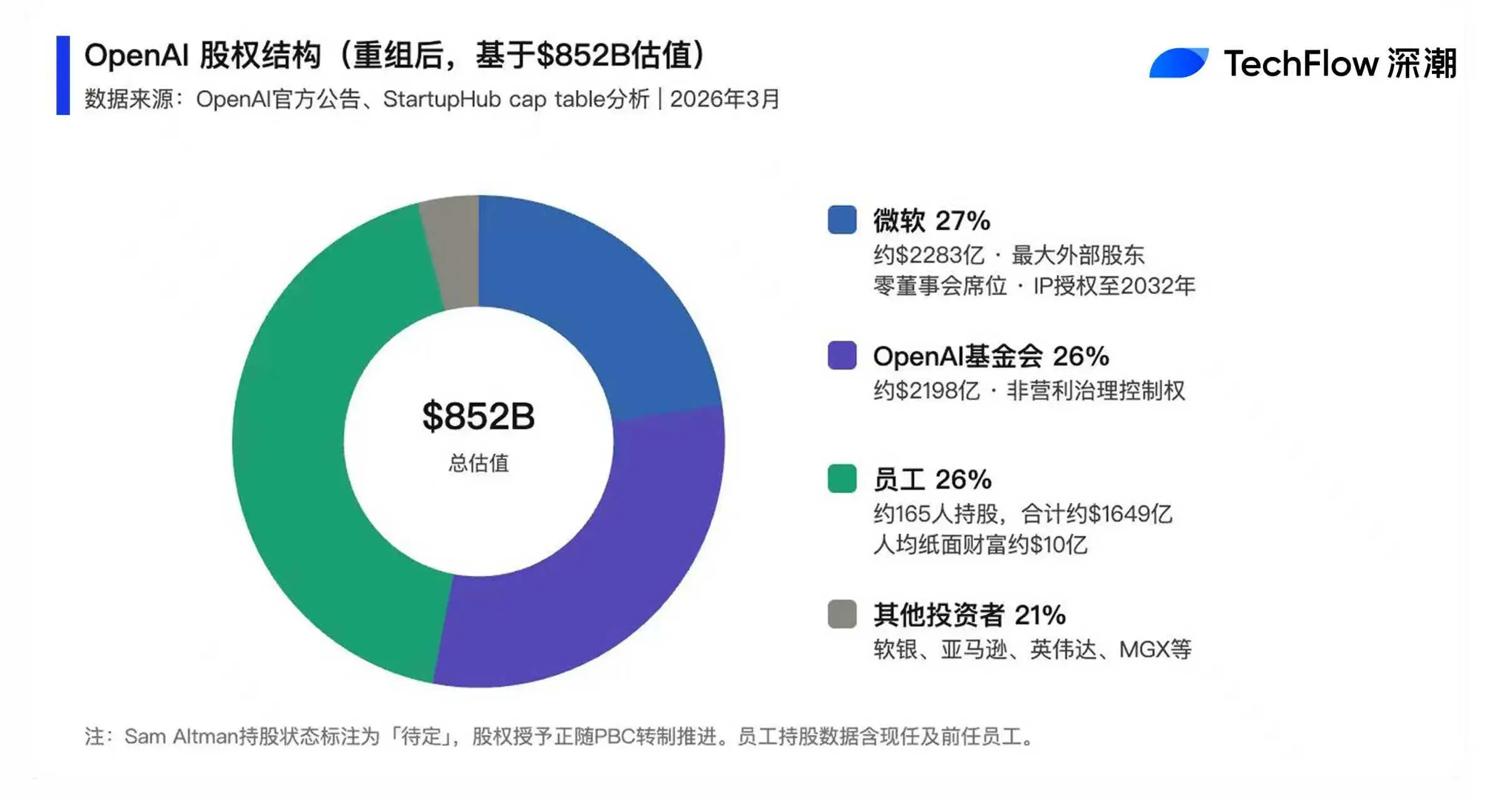
Following a company restructuring completed last October, OpenAI employees collectively hold about 26% of the company's equity.

According to StartupHub's analysis, approximately 165 current and former employees collectively hold equity worth about $164.9 billion, averaging about $1 billion in paper wealth per person, exceeding the total lifetime returns of most venture capital funds.

According to an analysis by The Wall Street Journal and data firm Equilar, OpenAI's per capita stock compensation in 2025 was about $1.5 million, which is over 7 times that of Google's in the year before its 2004 IPO, and 34 times the average of 18 large tech companies in the year before their IPOs over the past 25 years.

The company's equity incentive spending accounts for nearly half of its projected revenue, far exceeding peers like Palantir, Meta, and Salesforce.

$852 Billion Valuation, Trillion-Dollar IPO Ahead, Wealth Creation Machine Far From Stopping

OpenAI completed a $122 billion financing round at an $852 billion valuation on March 31st this year, setting a new record for the largest single private round in Silicon Valley history. Amazon led the investment with $50 billion, while Nvidia and SoftBank each invested $30 billion. The company currently has a monthly revenue of $2 billion, with ChatGPT's weekly active users exceeding 900 million and paid subscribers over 50 million.
According to multiple media reports, OpenAI is preparing to launch an IPO in the fourth quarter of 2026, with a target valuation potentially reaching $1 trillion. If successful, this would become one of the largest tech IPOs in history. CFO Sarah Friar previously stated at Davos that the company plans to allocate a portion of the IPO shares to retail investors.


Trending Cryptos

Related Questions

QWhat was the total amount cashed out by OpenAI employees and former employees in the reported stock sale?

AOver 600 current and former employees cashed out a total of approximately $6.6 billion in the reported secondary stock sale.

QTo what amount did OpenAI raise the per-employee cap for the stock sale, and why?

AOpenAI raised the per-employee cap from $10 million to $30 million for the sale due to exceptionally high demand from external investors.

QWhat did OpenAI co-founder Greg Brockman reveal about his OpenAI holdings in court?

ADuring a court testimony, Greg Brockman confirmed that the value of his OpenAI equity holdings is approximately $30 billion.

QWhat is the reported approximate total valuation of OpenAI following its March 2025 funding round?

AFollowing its March 2025 funding round, OpenAI's valuation reached approximately $852 billion.

QWhat is the reported target timeline for OpenAI's potential IPO, and what valuation might it aim for?

AOpenAI is reportedly preparing for a potential IPO in the fourth quarter of 2026, with a target valuation that could reach $1 trillion.

Related Reads

The Verdict in Choi Tae-won's Divorce Case: Revealing the Inheritance Undercurrent Behind SK Hynix's Trillion-Won Empire

SK Group Chairman Chey Tae-won's high-profile divorce case, involving a record 1.38 trillion won settlement, has drawn attention to the succession plans for Korea's second-largest conglomerate, especially its crown jewel, SK hynix. Unlike traditional chaebol scripts centered on the eldest son, Chey's three children from his marriage to former President Roh Tae-woo's daughter, Roh Soh-yeong, are carving distinct, non-traditional paths. Eldest daughter Chey Yun-jung (b. 1989) is seen as the most evident successor. With a scientific and consulting background, she holds executive roles at SK bioscience and SK Inc.'s growth support department, focusing on future strategy and biopharma. Her marriage is to an AI infrastructure entrepreneur, not a traditional business alliance. Second daughter Chey Min-jung (b. 1991) took a unique route, voluntarily serving as a South Korean naval officer, including an anti-piracy deployment. She later worked on policy and strategy for SK hynix in Washington D.C. before co-founding an AI-driven healthcare startup. She married a former U.S. Marine Corps officer, connecting her to U.S. defense and policy circles—networks crucial for a global semiconductor giant. The only son, Chey In-geun (b. 1995), who studied physics like his father, worked briefly at SK E&S before joining McKinsey. Despite fitting the traditional "heir" profile as the eldest son, he remains silent and holds no public position or shares in SK, suggesting the old succession playbook is obsolete. As SK hynix's valuation soars, becoming a geopolitical asset in the AI era, the heirs' legitimacy is no longer automatic. They must prove themselves in fields like AI biotech, global policy, and strategic consulting. Their marriages also reflect new elite networks in tech and defense, not old political alliances. Their inheritance is the complex challenge of navigating a globalized, tech-driven world, not just a corporate throne.

marsbit18h ago

The Verdict in Choi Tae-won's Divorce Case: Revealing the Inheritance Undercurrent Behind SK Hynix's Trillion-Won Empire

marsbit18h ago

From OpenSea to OpenRouter: Is Alex Atallah Repeating His 'Exit at the Peak' Playbook?

From OpenSea to OpenRouter: Is Alex Atallah Repeating His "Exit at the Peak" Playbook? According to the Wall Street Journal, payments giant Stripe is in talks to acquire the AI model aggregation platform OpenRouter in a potential deal valuing the company near $100 billion. This would mark founder Alex Atallah's second creation of a company reaching a $100 billion valuation, following his co-founding of NFT marketplace OpenSea. OpenRouter, founded just over three years ago, has grown rapidly by acting as a unified gateway for developers to access over 400 AI models. It currently has about 10 million users and processes over 200 trillion tokens monthly. While the platform's annualized revenue is around $50 million, its valuation has skyrocketed from $1.3 billion in March 2026. The potential acquisition by Stripe, a company OpenRouter's founder once likened it to, represents a major expansion into AI infrastructure for the payments leader. This move echoes Atallah's previous timing with OpenSea, where he departed before the NFT market's significant downturn. For OpenRouter, selling now may be strategic. Despite its scale, its business model—charging a 5-5.5% fee on AI inference calls—faces pressure from competition, open-source models, and potential price wars among model providers, limiting its profitability narrative for an IPO. A key asset for potential acquirers like Stripe is OpenRouter's vast repository of real-world AI usage data, which offers unique insights into model performance and developer preferences that are difficult to replicate. Whether this potential deal signifies a new valuation benchmark for AI infrastructure or another market peak signal remains to be seen.

链捕手18h ago

From OpenSea to OpenRouter: Is Alex Atallah Repeating His 'Exit at the Peak' Playbook?

链捕手18h ago

Trading

Spot

Hot Articles

How to Buy HOME

Welcome to HTX.com! We've made purchasing Defi.app (HOME) simple and convenient. Follow our step-by-step guide to embark on your crypto journey.Step 1: Create Your HTX AccountUse your email or phone number to sign up for a free account on HTX. Experience a hassle-free registration journey and unlock all features.Get My AccountStep 2: Go to Buy Crypto and Choose Your Payment MethodCredit/Debit Card: Use your Visa or Mastercard to buy Defi.app (HOME) instantly.Balance: Use funds from your HTX account balance to trade seamlessly.Third Parties: We've added popular payment methods such as Google Pay and Apple Pay to enhance convenience.P2P: Trade directly with other users on HTX.Over-the-Counter (OTC): We offer tailor-made services and competitive exchange rates for traders.Step 3: Store Your Defi.app (HOME)After purchasing your Defi.app (HOME), store it in your HTX account. Alternatively, you can send it elsewhere via blockchain transfer or use it to trade other cryptocurrencies.Step 4: Trade Defi.app (HOME)Easily trade Defi.app (HOME) on HTX's spot market. Simply access your account, select your trading pair, execute your trades, and monitor in real-time. We offer a user-friendly experience for both beginners and seasoned traders.

5.7k Total ViewsPublished 2025.06.10Updated 2026.06.10

How to Buy HOME

Discussions

Welcome to the HTX Community. Here, you can stay informed about the latest platform developments and gain access to professional market insights. Users' opinions on the price of HOME (HOME) are presented below.

活动图片













