Bitcoin Ends Q4 In The Red, Bear Market May Persist For 2–3 Months

bitcoinistPublished on 2025-12-27Last updated on 2025-12-27

Abstract

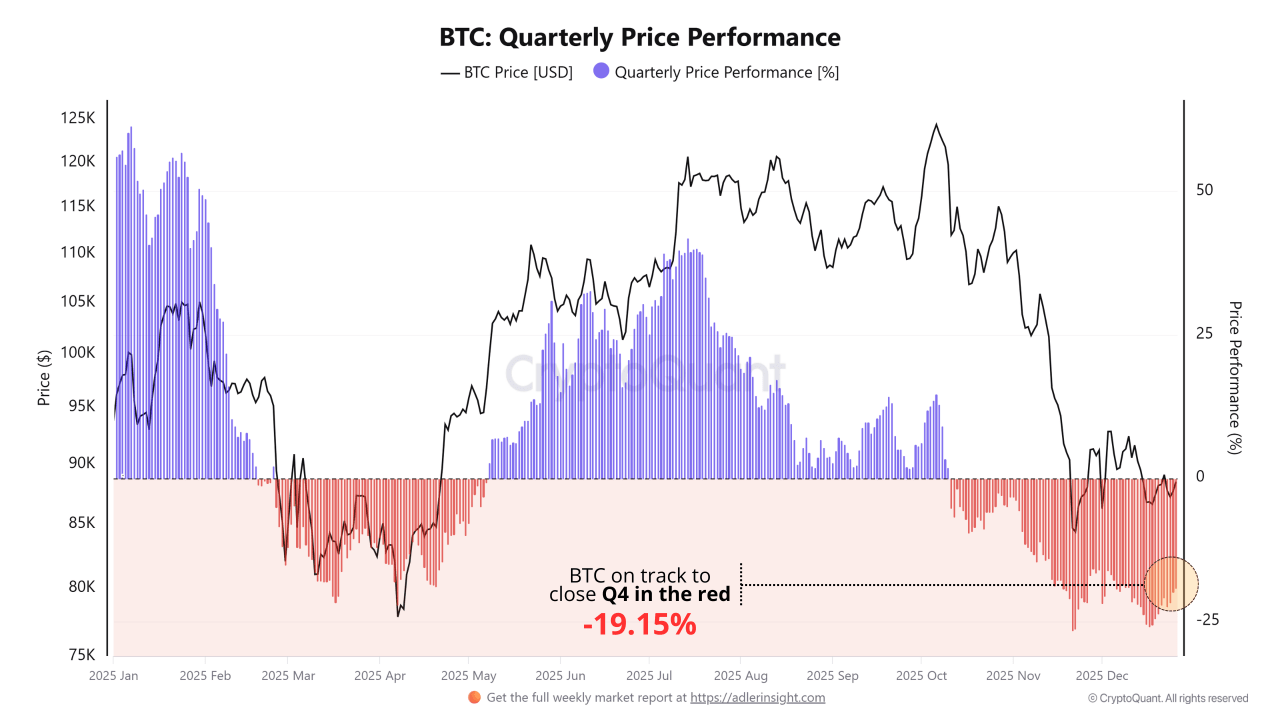
Bitcoin concludes Q4 2025 with a 19.15% decline, having fallen 30% from its October high of $126,200 to around $87,400. Analyst GugaOnChain warns the bearish trend may persist for 2-3 months into early 2026, citing multiple negative indicators. Key metrics include SOPR below 1, signaling investors are selling at a loss; MVRV-STH at 0.87, indicating short-term holders are underwater; and 35.66% of Bitcoin supply in loss. The Fear & Greed Index reflects extreme fear at 20. Institutional outflows from US spot ETFs and a negative Coinbase Premium Gap further confirm weak demand. Market cap growth is negative at -11.65%, reinforcing the expectation of continued corrections until capitulation signals ease.

Bitcoin is closing the fourth quarter of 2025 on a weak note, reinforcing concerns that the market’s correction phase is far from over. After peaking at around $126,200 in early October, the flagship cryptocurrency has slipped into a sustained downturn, losing 30% of its market value at press time.

Since that peak, Bitcoin has struggled to decisively reclaim the $92,000 level, with repeated rejection at higher prices highlighting fading demand and growing caution among investors. Notably, crypto analyst GugaOnChain warns that the poor quarterly close could extend downside pressure into early 2026, as both on-chain data and sentiment indicators point to a continuation of bearish conditions.

Capitulation Indicators Signal Market Stress To Remain In 2026

According to GugaOnChain in the QuickTake post on Friday, the BTC: Quarterly Price Performance indicator reports a negative Q4 performance of -19.15%, which serves as the foundation of this bearish outlook. Furthermore, several key capitulation indicators also suggest that the market is unprepared for any form of bullish revival.

For example, the Spent Output Profit Ratio (SOPR) currently sits below 1 at 0.99, indicating that investors are selling Bitcoin at a loss, a common feature of bear market phases. Similarly, the Short-Term Holder MVRV (MVRV-STH) remains below 1 at 0.87, signaling that short-term holders are deeply underwater and more prone to capitulation at the moment.

Further reinforcing this narrative, GugaOnChain points to the elevated percentage of Bitcoin supply in loss, currently standing at 35.66%, pushing more BTC holders into significant loss positions, thereby reducing confidence and driving market stress. In addition to these metrics, the Fear & Greed Index has dropped into the “extreme fear” zone at 20, suggesting widespread pessimism and risk aversion among participants.
Source: CryptoQuant

Bear Market Confirmation Indicators

Beyond capitulation metrics, GugaOnChain highlights additional confirmation indicators that suggest that downside risks will remain dominant in the near term. One of these indicators, the Market Cap Growth Rate, measured by the 30-day versus 365-day moving average gap ratio, is firmly negative at -11.65%, pointing to contracting market growth rather than expansion.

Institutional flows also reflect waning confidence. US Bitcoin spot ETFs recorded $825.7 million in net outflows between December 18 and December 24, 2025, highlighting reduced institutional appetite as the Q4 price struggles persist. Meanwhile, the Coinbase Premium Gap has remained negative at –66.11, signaling weaker demand from US-based investors compared to offshore markets.

In assessing these several metrics together, GugaOnChain concludes the crypto market is likely to remain in a bear phase for the next two to three months. Therefore, investors should anticipate further corrections in the first quarter of 2026 until the capitulation signals ease and demand is stabilized.

At press time, Bitcoin trades at $87,436, reflecting a slight market loss of 0.42% in the last day.

BTC trading at $87,660 on the daily chart | Source: BTCUSDT chart on Tradingview.com

Trending Cryptos

Related Questions

QWhat was Bitcoin's peak price in early October 2025, and what is its current percentage loss from that peak?

ABitcoin peaked at around $126,200 in early October 2025 and has lost 30% of its market value from that peak at press time.

QAccording to GugaOnChain, what is the two key capitulation indicators that signal investors are selling at a loss and are deeply underwater?

AThe two key capitulation indicators are the Spent Output Profit Ratio (SOPR) at 0.99, indicating selling at a loss, and the Short-Term Holder MVRV (MVRV-STH) at 0.87, signaling short-term holders are deeply underwater.

QWhat does the negative Market Cap Growth Rate of -11.65% indicate about the Bitcoin market?

AThe negative Market Cap Growth Rate of -11.65% indicates the market is contracting rather than expanding, pointing to dominant downside risks in the near term.

QHow did US Bitcoin spot ETFs perform in terms of net flows between December 18 and December 24, 2025, and what does this signify?

AUS Bitcoin spot ETFs recorded $825.7 million in net outflows during that period, highlighting reduced institutional appetite as the Q4 price struggles persist.

QWhat is the overall conclusion from the analyst regarding the expected duration of the current bear market phase?

AThe analyst concludes that the crypto market is likely to remain in a bear phase for the next two to three months, with further corrections expected in the first quarter of 2026.

Related Reads

UNI Doubles in Two Months Against the Trend: A 5-Year-Overdue Value Realization

Amidst a generally stagnant crypto market in June and July, UNI, the governance token of Uniswap, saw a significant surge, nearly doubling in price from around $2.3 to $4.6. This rally represents a delayed but significant value reassessment, triggered by the practical implementation of its long-debated "fee switch" mechanism. The key turning point was the on-chain execution of the UNIfication proposal in December 2025. It activated a protocol fee on select pools, directed Unichain sequencer revenue (net of costs) to a communal treasury, executed a one-time burn of 100 million UNI, and established a system where all protocol revenue flows into a "TokenJar" contract. This treasury has a single exit: purchasing and permanently burning UNI via a "Firepit" contract. Initially, the market reacted tepidly as the generated revenue and corresponding burn rate were modest. The narrative shifted dramatically in July 2025 with two major developments. First, the launch of Robinhood Chain, tailored for tokenized stocks, rapidly became a primary source of volume and fees for Uniswap, at one point contributing nearly half of its weekly fees. Second, governance votes successfully expanded the fee mechanism to v4 pools and initiated a temperature check for fees on Robinhood Chain. The activation of v4 fees caused the protocol's daily revenue earmarked for UNI burns to nearly triple. The core of UNI's recent price action is the transition from a pure governance token to a cash-flow asset with a permanent, protocol-funded buyer. Its effectiveness is amplified by UNI's mature and widely distributed supply, with no major impending unlocks to dilute the impact of the buybacks. The sustainability of this rally now hinges on whether the transaction volume, particularly on Robinhood Chain, persists after its initial gas subsidies expire, determining if this is a genuine value realization or a subsidy-fueled spike.

marsbit4m ago

UNI Doubles in Two Months Against the Trend: A 5-Year-Overdue Value Realization

marsbit4m ago

Breaking: Google Earth Urgently Pulls Back Nano Banana 2 Image Generation Feature!

Google Earth's newly launched "Create image" feature, powered by the Nano Banana 2 AI image generation model, was abruptly withdrawn shortly after its release due to being "played" by users. The feature allowed users to generate and overlay AI-created visuals directly onto real-world satellite and 3D maps in Google Earth. The tool enabled creative applications like historical recreations (e.g., visualizing ancient Pompeii), generating informational graphics for landmarks, and envisioning architectural projects or futuristic cityscapes on real terrain. It operated under "geospatial grounding," meaning the AI respected the underlying geography, topography, and perspective of the chosen map view. The model also integrated with Gemini to retrieve relevant factual information. However, upon release, users quickly tested its limits. A prominent example involved reimagining Philadelphia's historic Independence Hall as a post-apocalyptic ruin overrun by "happy" zombies, evil clowns, and giant alien mechs. This highlighted both the feature's playful potential and its risks regarding the generation of inappropriate or misleading content on realistic maps, leading to its swift temporary removal. Google stated it would re-release the feature after implementing "enhanced guardrails." Analysts note this move strategically leverages Google's vast proprietary geospatial data, positioning its AI not just for artistic generation but for spatially accurate world visualization—a unique advantage in the competitive AI image generation landscape.

marsbit1h ago

Breaking: Google Earth Urgently Pulls Back Nano Banana 2 Image Generation Feature!

marsbit1h ago

Altman Admits: Overestimated AI Snatching Jobs! Huang Renxun: The Unemployment Narrative Is Completely Backwards

Sam Altman has revised his earlier predictions about AI rapidly replacing jobs, admitting he overestimated the speed at which AI would eliminate entry-level white-collar roles. Speaking on the "Invest Like the Best" podcast, he stated that people do not truly want an AI CEO, as accountability and human connection remain critical. He found that individuals prefer interacting with people who can be held responsible for decisions. Similarly, NVIDIA's Jensen Huang argued that the narrative of AI destroying jobs is misguided. He distinguishes between tasks and jobs, noting that while AI can automate specific tasks, entire jobs—encompassing communication, judgment, coordination, and accountability—are not eliminated. He cited examples like radiologists and software engineers, where demand for these roles has increased as AI handles repetitive tasks, allowing for business expansion and the creation of more positions. Data from a University of Maryland and LinkUp study supports this, showing that U.S. job postings for new graduates have actually risen, countering the fear of vanishing entry-level roles. However, a significant shift is occurring: the traditional entry-level tasks that help newcomers gain experience are being automated, making initial career access more challenging. The key insight is that as AI takes over standardized tasks, the enduring value of human work shifts toward areas of responsibility, trust-building, and final decision-making—aspects that AI cannot replicate. The real "moat" for professionals lies in these irreplaceable human elements.

marsbit1h ago

Altman Admits: Overestimated AI Snatching Jobs! Huang Renxun: The Unemployment Narrative Is Completely Backwards

marsbit1h ago

Weekly Editor's Picks (0725-0731)

Weekly Editor's Picks (0725-0731) provides a curated selection of deep analysis, filtering out market noise. Key themes from this week include: **Macro & Policy:** The Federal Reserve's upcoming meeting is marked by high uncertainty, balancing cooling inflation data against persistent price pressures. Meanwhile, the U.S. crypto regulatory Clarity Act faces critical political hurdles, with its 2026 passage probability seen as low. **Investing & Crypto:** Analysis suggests long-term crypto success depends on conviction through volatile cycles, focusing on assets like Bitcoin and core smart contract platforms. A trend noted is the increasing similarity between global equity markets (especially tech) and crypto, driven by narrative and leverage. Several major crypto protocols show strong revenue growth, but this isn't always translating to token price appreciation due to sell pressure and structural factors. **AI & Semiconductors:** Nvidia's rising credit default swap rates signal market concern over AI infrastructure financing risks. The storage sector experienced volatility as markets began pricing in potential 2027 oversupply. Despite a record profitable quarter, SK Hynix's results were deemed "below expectations," reflecting heightened investor demands for future growth visibility. **Markets & DeFi:** TradeXYZ demonstrated remarkable accuracy in pre-market pricing for a major A股 listing. The token ONDO saw gains, linked to its growing role in the on-chain tokenized stock ecosystem. **Ethereum:** Post-Pectra upgrade, a major structural shift is underway as Lido begins migrating millions of ETH to new validator architectures designed for capital efficiency. **Also Highlighted:** Butian's bullish stock market move; OpenAI's Altman promising major advances; Samsung and SK Hynix securing large AI chip deals; Apple reaching a $5T market cap; and ongoing discussions around exchange security following Poolin's bankruptcy case.

marsbit2h ago

Weekly Editor's Picks (0725-0731)

marsbit2h ago

Trading

Spot

Hot Articles

What is $BITCOIN

DIGITAL GOLD ($BITCOIN): A Comprehensive Analysis Introduction to DIGITAL GOLD ($BITCOIN) DIGITAL GOLD ($BITCOIN) is a blockchain-based project operating on the Solana network, which aims to combine the characteristics of traditional precious metals with the innovation of decentralized technologies. While it shares a name with Bitcoin, often referred to as “digital gold” due to its perception as a store of value, DIGITAL GOLD is a separate token designed to create a unique ecosystem within the Web3 landscape. Its goal is to position itself as a viable alternative digital asset, although specifics regarding its applications and functionalities are still developing. What is DIGITAL GOLD ($BITCOIN)? DIGITAL GOLD ($BITCOIN) is a cryptocurrency token explicitly designed for use on the Solana blockchain. In contrast to Bitcoin, which provides a widely recognized value storage role, this token appears to focus on broader applications and characteristics. Notable aspects include: Blockchain Infrastructure: The token is built on the Solana blockchain, known for its capacity to handle high-speed and low-cost transactions. Supply Dynamics: DIGITAL GOLD has a maximum supply capped at 100 quadrillion tokens (100P $BITCOIN), although details regarding its circulating supply are currently undisclosed. Utility: While precise functionalities are not explicitly outlined, there are indications that the token could be utilized for various applications, potentially involving decentralized applications (dApps) or asset tokenization strategies. Who is the Creator of DIGITAL GOLD ($BITCOIN)? At present, the identity of the creators and development team behind DIGITAL GOLD ($BITCOIN) remains unknown. This situation is typical among many innovative projects within the blockchain space, particularly those aligning with decentralized finance and meme coin phenomena. While such anonymity may foster a community-driven culture, it intensifies concerns about governance and accountability. Who are the Investors of DIGITAL GOLD ($BITCOIN)? The available information indicates that DIGITAL GOLD ($BITCOIN) does not have any known institutional backers or prominent venture capital investments. The project seems to operate on a peer-to-peer model focused on community support and adoption rather than traditional funding routes. Its activity and liquidity are primarily situated on decentralized exchanges (DEXs), such as PumpSwap, rather than established centralized trading platforms, further highlighting its grassroots approach. How DIGITAL GOLD ($BITCOIN) Works The operational mechanics of DIGITAL GOLD ($BITCOIN) can be elaborated on based on its blockchain design and network attributes: Consensus Mechanism: By leveraging Solana’s unique proof-of-history (PoH) combined with a proof-of-stake (PoS) model, the project ensures efficient transaction validation contributing to the network's high performance. Tokenomics: While specific deflationary mechanisms have not been extensively detailed, the vast maximum token supply implies that it may cater to microtransactions or niche use cases that are still to be defined. Interoperability: There exists the potential for integration with Solana’s broader ecosystem, including various decentralized finance (DeFi) platforms. However, the details regarding specific integrations remain unspecified. Timeline of Key Events Here is a timeline that highlights significant milestones concerning DIGITAL GOLD ($BITCOIN): 2023: The initial deployment of the token occurs on the Solana blockchain, marked by its contract address. 2024: DIGITAL GOLD gains visibility as it becomes available for trading on decentralized exchanges like PumpSwap, allowing users to trade it against SOL. 2025: The project witnesses sporadic trading activity and potential interest in community-led engagements, although no noteworthy partnerships or technical advancements have been documented as of yet. Critical Analysis Strengths Scalability: The underlying Solana infrastructure supports high transaction volumes, which could enhance the utility of $BITCOIN in various transaction scenarios. Accessibility: The potential low trading price per token could attract retail investors, facilitating wider participation due to fractional ownership opportunities. Risks Lack of Transparency: The absence of publicly known backers, developers, or an audit process may yield skepticism regarding the project's sustainability and trustworthiness. Market Volatility: The trading activity is heavily reliant on speculative behavior, which can result in significant price volatility and uncertainty for investors. Conclusion DIGITAL GOLD ($BITCOIN) emerges as an intriguing yet ambiguous project within the rapidly evolving Solana ecosystem. While it attempts to leverage the “digital gold” narrative, its departure from Bitcoin's established role as a store of value underscores the need for a clearer differentiation of its intended utility and governance structure. Future acceptance and adoption will likely depend on addressing the current opacity and defining its operational and economic strategies more explicitly. Note: This report encompasses synthesised information available as of October 2023, and developments may have transpired beyond the research period.

1.3k Total ViewsPublished 2025.05.13Updated 2025.05.13

What is $BITCOIN

Discussions

Welcome to the HTX Community. Here, you can stay informed about the latest platform developments and gain access to professional market insights. Users' opinions on the price of BTC (BTC) are presented below.

活动图片