From Blockchain's First Share to the Edge of Delisting: Canaan Technology Trapped in a 'Fight for Survival'

Foresight NewsPublished on 2026-07-16Last updated on 2026-07-16

Abstract

Canaan Inc., once hailed as the "first global blockchain stock," is now fighting to avoid delisting from Nasdaq. On July 15, the company received a 180-day extension, until January 11, 2027, to regain compliance after its ADS price fell below $1 for 30 consecutive trading days. Its market cap has plummeted over 90% from its peak after its 2019 IPO. The financial picture is grim. Q1 2026 results showed a 24.3% year-over-year revenue decline to $62.7 million and a net loss of $88.7 million. The company recorded a gross loss, including approximately $25 million in non-cash inventory writedowns for its mining machines, signaling collapsing demand. Its Q2 revenue guidance is a weak $35-45 million. A costly strategic misstep contributed to its troubles. In June 2025, Canaan terminated its non-core AI chip business after years of development yielded minimal revenue but significant operating expenses, forcing a full retreat to its core Bitcoin mining hardware and proprietary mining operations. However, the core business faces intense pressure. The mining machine industry is highly cyclical and tied to Bitcoin's price. In the current "post-halving" environment with lower marginal returns, demand has cooled sharply. Canaan's product revenue crashed to $42.9 million in Q1 2026 from $164.9 million in Q4 2024. In response, management is pivoting from a pure hardware seller to a "computing power infrastructure service provider." It is expanding proprietary mining, with total hash rate ...


Author: Ma He, Foresight News


On July 15, Canaan Technology announced that it had received a written notification from Nasdaq, granting an additional 180-day grace period, extending the deadline to January 11, 2027. Previously, its ADS stock price had fallen below $1 for 30 consecutive trading days, triggering Nasdaq's compliance alert for the minimum bid price requirement.
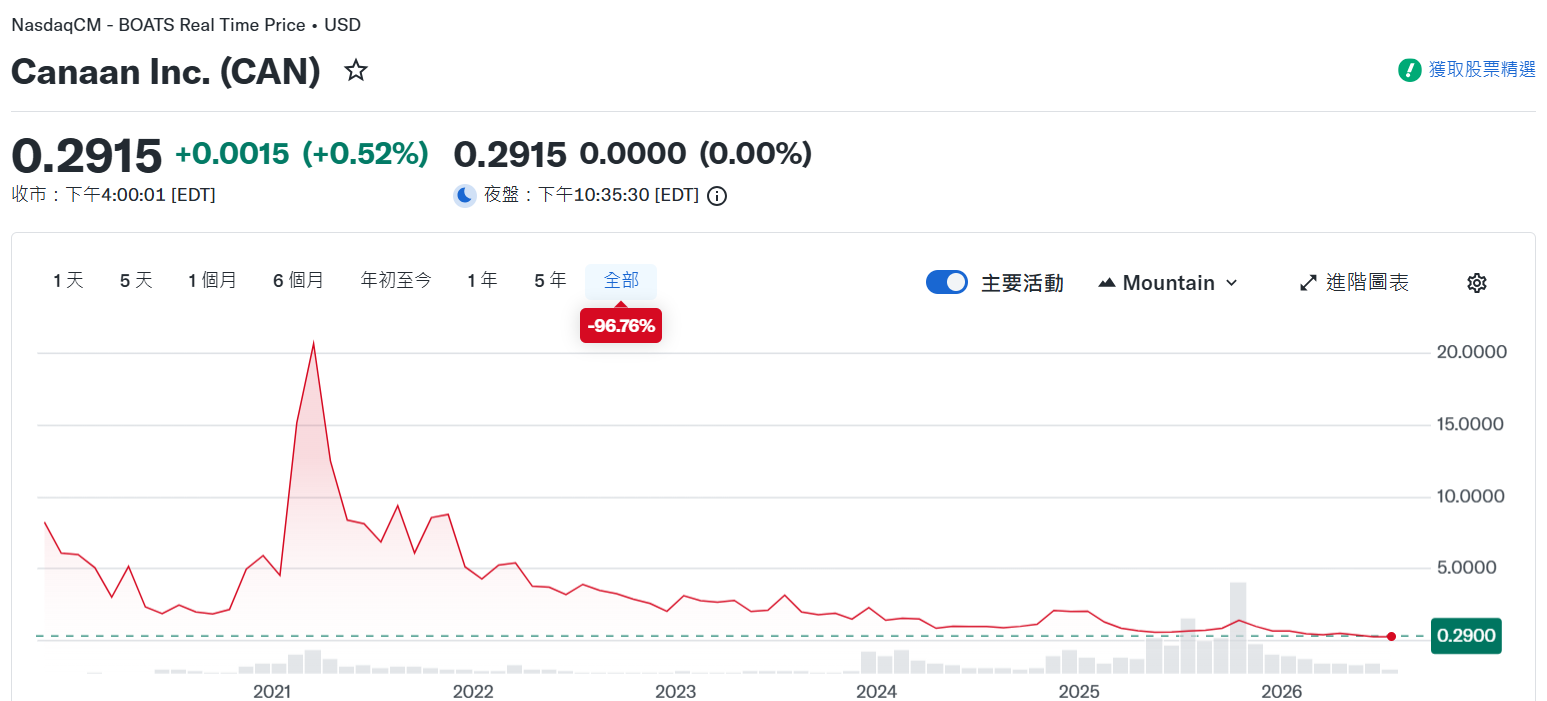


The market reaction was muted. By the close, Canaan Technology's stock was priced at $0.29, with a total market capitalization of approximately $217 million, a decline of over 90% from its peak market value following its IPO in November 2019. This company, once crowned as the "world's first blockchain stock," now stands on the edge of a delisting cliff.


The 180-Day Countdown to Delisting


Canaan Technology's tug-of-war with Nasdaq's compliance department began in May 2025. At that time, the company first received a delisting warning due to its stock price persistently staying below $1, and it temporarily resolved the crisis by riding a rebound in Bitcoin's price. However, the respite was short-lived. On January 14, 2026, Nasdaq issued another notification: Canaan's ADS closing price had been below $1 for 30 consecutive trading days. The company was required to regain compliance by July 13, meaning its closing price needed to reach or exceed $1 for 10 consecutive trading days.


July 13 arrived—the expiration of the initial grace period. Canaan Technology failed to meet the requirement. On July 1, the company urgently moved its listing from the Nasdaq Global Market to the less stringent Nasdaq Capital Market and submitted an application for an additional 180 days.


On July 15, the application was approved, setting a new survival deadline for January 11, 2027.


According to Nasdaq rules, if compliance is not restored by that time, Canaan Technology could face the final fate of delisting. The company has stated that if necessary, it will consider implementing a reverse stock split to boost the share price, although this is often viewed by the market as a sign of weakness.


2026 Q1 Financial Report: Total Revenue Down 24.3%, Net Loss of $88.7 Million


The low stock price of Canaan Technology is not without reason. Its latest financial report reveals the company is in a state of severe financial hemorrhage.


On May 19, 2026, Canaan Technology released its unaudited first-quarter financial results: total revenue was $62.7 million, a year-over-year decrease of 24.3% and a sharp quarter-over-quarter decline of 68%; the net loss was $88.7 million, widening further compared to the same period last year ($86.4 million). The company recorded a gross loss of $22.9 million, which included approximately $25 million in non-cash inventory impairment charges—indicating that Canaan had to massively write down the value of its miner inventory, reflecting a sharp contraction in market demand.


Even more severe is the company's revenue guidance for the second quarter, projected to be only $35 million to $45 million, suggesting continued pressure on performance in the near term. As of March 31, 2026, the company's cash balance was $43.5 million, significantly reduced from $80.8 million at the end of 2025; however, the company recovered approximately $42 million in customer receivables in April, providing some relief to liquidity.


Notably, despite losses in its main business, Canaan Technology's cryptocurrency reserves hit a record high: at the end of the first quarter, the company held 1,807.60 Bitcoin (valued at $142 million). These digital assets provide some hedge on the balance sheet but also tie its performance tightly to cryptocurrency price volatility.
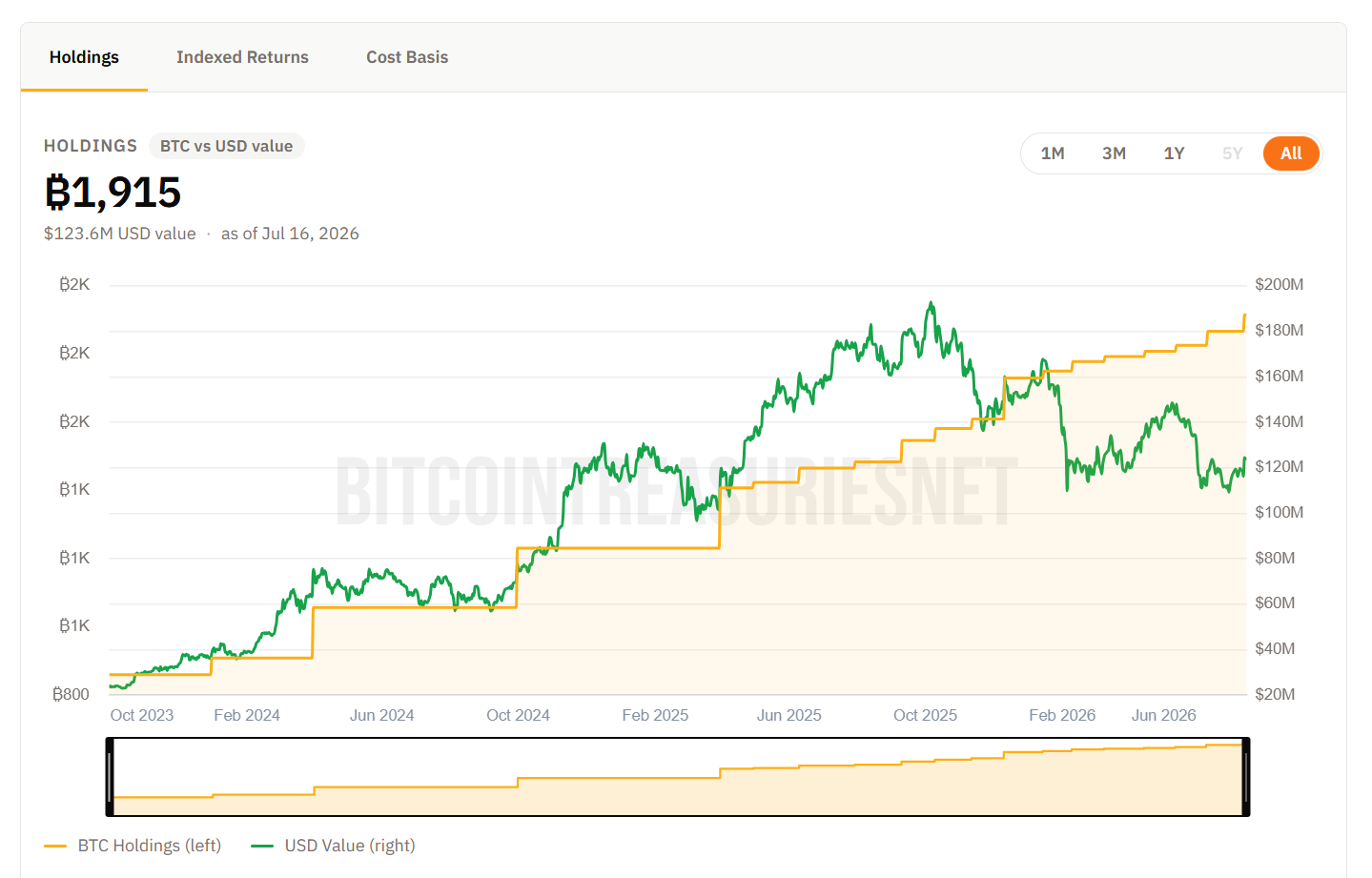


According to the latest data, Canaan Technology's Bitcoin reserves have increased to 1,915 coins, but their total value has fallen to $120 million.


AI Chip Dream Shattered and the "Selling Shovels" Dilemma


Part of Canaan Technology's predicament stems from a costly strategic miscalculation.


On June 24, 2025, the company announced the termination of its non-core AI chip business, fully returning its focus to Bitcoin mining machines and proprietary mining operations. Its years-long exploration of a "second curve" ended in failure. According to public information, Canaan Technology generated only about $900,000 in edge computing product revenue in fiscal year 2024, while the operational expenses for this related business were approximately $21.42 million, accounting for 15% of the company's total annual operating expenses. Under the pressure of a $249.8 million net loss in fiscal year 2024, this "money-burning, non-revenue-generating" business was decisively cut.


However, returning to its core business has not made things much easier for Canaan Technology. The mining machine industry is facing unprecedented competitive pressure. Compared to competitors like Bitmain, Canaan's market share continues to be squeezed. In the second quarter of 2025, the company's total sold computing power was 6.4 million TH/s, a mere 3% year-over-year increase; by the first quarter of 2026, product revenue had plummeted to $42.9 million, a cliff-like drop from $164.9 million in the fourth quarter of 2024.


Canaan Technology Founder, Zhang Nangeng


The nature of mining machine manufacturers is "selling shovels"—their fate is inextricably linked to the Bitcoin cycle. When Bitcoin prices are high and mining rewards are substantial, miners are willing to invest in capital expenditures; once prices slump and competition for network hash rate intensifies, demand for mining machines cools rapidly. Since 2025, despite some periods of strong Bitcoin price performance, the mining industry as a whole has entered a low-margin revenue stage in the "post-halving" era, severely impacting Canaan Technology's traditional business model.


Facing the dual pressures of potential delisting and ongoing losses, Canaan Technology's management is attempting to transform from a pure hardware seller into a "computing power infrastructure service provider," seeking survival through vertical integration and energy sector布局 (layout/positioning).


Proprietary mining has become a key focus. As of the end of the first quarter of 2026, Canaan Technology's total computing power in 10 joint mining projects globally reached approximately 11 EH/s, a year-over-year increase of 66% and a quarter-over-quarter increase of 10.7%. The company acquired a 49% stake in the Texas ABC Projects from Cipher Mining. Additionally, the company initiated a 3 MW pilot mining project in Canada, exploring the use of miner waste heat for greenhouse agriculture; and signed a 4.5 MW contract with a Japanese power engineering firm to participate in grid load regulation.


On the capital front, in November 2025, Canaan Technology secured a total of $72 million in strategic investment from institutions including BH Digital and Galaxy Digital, intended to strengthen the balance sheet and expand infrastructure. In December of the same year, the company's board approved a $30 million share repurchase plan in an attempt to signal confidence to the market.


However, its stock price trajectory shows that the market has not bought into this narrative.


Summary


The predicament of Canaan Technology is a microcosm of the broader crypto mining industry winter.


Since 2025, the global capital market narrative towards the crypto industry has shifted significantly. With the explosive demand for artificial intelligence computing power, a substantial amount of capital originally directed towards mining machines and mining has pivoted to AI data centers and high-performance computing (HPC) infrastructure. Miners have begun migrating computing power to AI projects, directly compressing the demand space for Bitcoin mining machines.


A deeper challenge lies in the sustainability of the business model. As an ASIC chip design company, Canaan Technology needs continuous investment in R&D to maintain product competitiveness.


From a broader perspective, Canaan Technology is undergoing a brutal baptism of deflation. When it went public in 2019, the company enjoyed high valuations based on the concept of being the first blockchain stock; today, the market no longer pays for concepts but demands tangible cash flow and profitability.


Before the arrival of Bitcoin's next bull market cycle, profitability for mining companies will remain under pressure. Canaan Technology must prove within the next 6 months that it possesses the capability to navigate through this cycle.


Trending Cryptos

Related Questions

QWhy was Canaan Inc. at risk of being delisted from Nasdaq, and what was the outcome of their initial compliance deadline?

ACanaan Inc. was at risk of delisting because its ADS stock price had been below $1 for 30 consecutive trading days, triggering Nasdaq's minimum bid price requirement. The initial 180-day grace period to regain compliance was set to expire on July 13, 2026, but Canaan failed to meet the requirement by that date.

QWhat were the key financial results reported by Canaan Inc. for Q1 2026, and what do these figures indicate about the company's performance?

AFor Q1 2026, Canaan Inc. reported total revenue of $62.7 million, a year-on-year decrease of 24.3% and a significant sequential drop of 68%. The net loss was $88.7 million, wider than the previous year's $86.4 million. A key issue was a $25 million non-cash inventory impairment charge, indicating a sharp decline in demand for their mining machines and severe financial strain.

QWhat strategic shift did Canaan Inc. make regarding its AI chip business, and what was the result of this decision?

AIn June 2025, Canaan Inc. announced the termination of its non-core AI chip business to fully refocus on Bitcoin mining machines and self-mining. This strategic 'second curve' exploration failed, as the business generated only about $900,000 in revenue in FY 2024 but incurred approximately $21.42 million in operating expenses, contributing to the company's overall net loss.

QHow is Canaan Inc. attempting to transform its business model to survive the current challenges in the crypto mining industry?

ACanaan Inc. is attempting to transform from a pure hardware seller into a 'computing power infrastructure service provider'. Key strategies include expanding self-mining operations (reaching ~11 EH/s in Q1 2026), investing in energy infrastructure projects (like a pilot project in Canada to use mining waste heat for agriculture), participating in grid load regulation, and seeking strategic investments to strengthen its balance sheet.

QWhat broader industry trends and challenges are contributing to Canaan Inc.'s困境, as mentioned in the article's conclusion?

AThe article concludes that Canaan's困境 reflects the broader 'crypto mining winter'. Key trends include a significant capital shift from crypto mining to AI data centers and high-performance computing, reducing demand for Bitcoin miners. The industry faces a post-halving era with lower marginal returns. Furthermore, the market is undergoing a 'de-bubbling' process, moving away from valuing concepts (like being the 'first blockchain stock') and demanding tangible profitability and cash flow, which puts sustained pressure on mining companies like Canaan.

Related Reads

The Verdict in Choi Tae-won's Divorce Case: Revealing the Inheritance Undercurrent Behind SK Hynix's Trillion-Won Empire

SK Group Chairman Chey Tae-won's high-profile divorce case, involving a record 1.38 trillion won settlement, has drawn attention to the succession plans for Korea's second-largest conglomerate, especially its crown jewel, SK hynix. Unlike traditional chaebol scripts centered on the eldest son, Chey's three children from his marriage to former President Roh Tae-woo's daughter, Roh Soh-yeong, are carving distinct, non-traditional paths. Eldest daughter Chey Yun-jung (b. 1989) is seen as the most evident successor. With a scientific and consulting background, she holds executive roles at SK bioscience and SK Inc.'s growth support department, focusing on future strategy and biopharma. Her marriage is to an AI infrastructure entrepreneur, not a traditional business alliance. Second daughter Chey Min-jung (b. 1991) took a unique route, voluntarily serving as a South Korean naval officer, including an anti-piracy deployment. She later worked on policy and strategy for SK hynix in Washington D.C. before co-founding an AI-driven healthcare startup. She married a former U.S. Marine Corps officer, connecting her to U.S. defense and policy circles—networks crucial for a global semiconductor giant. The only son, Chey In-geun (b. 1995), who studied physics like his father, worked briefly at SK E&S before joining McKinsey. Despite fitting the traditional "heir" profile as the eldest son, he remains silent and holds no public position or shares in SK, suggesting the old succession playbook is obsolete. As SK hynix's valuation soars, becoming a geopolitical asset in the AI era, the heirs' legitimacy is no longer automatic. They must prove themselves in fields like AI biotech, global policy, and strategic consulting. Their marriages also reflect new elite networks in tech and defense, not old political alliances. Their inheritance is the complex challenge of navigating a globalized, tech-driven world, not just a corporate throne.

marsbit2h ago

The Verdict in Choi Tae-won's Divorce Case: Revealing the Inheritance Undercurrent Behind SK Hynix's Trillion-Won Empire

marsbit2h ago

From OpenSea to OpenRouter: Is Alex Atallah Repeating His 'Exit at the Peak' Playbook?

From OpenSea to OpenRouter: Is Alex Atallah Repeating His "Exit at the Peak" Playbook? According to the Wall Street Journal, payments giant Stripe is in talks to acquire the AI model aggregation platform OpenRouter in a potential deal valuing the company near $100 billion. This would mark founder Alex Atallah's second creation of a company reaching a $100 billion valuation, following his co-founding of NFT marketplace OpenSea. OpenRouter, founded just over three years ago, has grown rapidly by acting as a unified gateway for developers to access over 400 AI models. It currently has about 10 million users and processes over 200 trillion tokens monthly. While the platform's annualized revenue is around $50 million, its valuation has skyrocketed from $1.3 billion in March 2026. The potential acquisition by Stripe, a company OpenRouter's founder once likened it to, represents a major expansion into AI infrastructure for the payments leader. This move echoes Atallah's previous timing with OpenSea, where he departed before the NFT market's significant downturn. For OpenRouter, selling now may be strategic. Despite its scale, its business model—charging a 5-5.5% fee on AI inference calls—faces pressure from competition, open-source models, and potential price wars among model providers, limiting its profitability narrative for an IPO. A key asset for potential acquirers like Stripe is OpenRouter's vast repository of real-world AI usage data, which offers unique insights into model performance and developer preferences that are difficult to replicate. Whether this potential deal signifies a new valuation benchmark for AI infrastructure or another market peak signal remains to be seen.

链捕手3h ago

From OpenSea to OpenRouter: Is Alex Atallah Repeating His 'Exit at the Peak' Playbook?

链捕手3h ago

Trading

Spot

Hot Articles

Discussions

Welcome to the HTX Community. Here, you can stay informed about the latest platform developments and gain access to professional market insights. Users' opinions on the price of S (S) are presented below.

活动图片