Standard Chartered Bank Places a 40x 'Bet', Calls for UNI to Rise to $100

marsbitОпубликовано 2026-06-16Обновлено 2026-06-16

Введение

Standard Chartered Bank’s digital asset research head, Geoff Kendrick, initiated coverage on Uniswap with a highly bullish long-term price target of $100 for its UNI token by 2030—a roughly 40-fold increase from its ~$2.60 trading price at the time of the report. The bank’s thesis hinges on the exponential growth of tokenized real-world assets (RWA), projected to surge from ~$340 billion to $4 trillion by 2028. It expects the share of these assets deployed in DeFi to rise from 3.5% to 30%, driving total DeFi TVL to around $2.7 trillion. As the leading decentralized exchange (DEX), Uniswap is positioned to capture a significant portion of this liquidity influx. A key catalyst is Uniswap’s “fee switch,” activated in late 2024, which directs a portion of protocol fees to UNI token buybacks and burns. This transforms UNI from a pure governance token into a yield-generating, deflationary asset, narrowing its valuation gap with centralized exchanges like Coinbase. The report draws an analogy: Coinbase operates like Netflix (centralized, high-cost), while Uniswap functions like YouTube (open, user-generated, network-effect driven). Despite its dominant market share and recent institutional adoption—such as BlackRock’s BUIDL fund and Fidelity’s stablecoin using Uniswap for liquidity—the path faces challenges. Competition from Solana-based DEXs and aggregators threatens user mindshare, while regulatory delays or setbacks in RWA adoption could slow the projected growth. Furthermore,...

Author: Jae, PANews

A research report from a traditional bank has ignited the somewhat quiet DeFi sector.

On June 15, Geoff Kendrick, Global Head of Digital Assets Research at Standard Chartered Bank, released a first-time coverage report on the DEX (decentralized exchange) Uniswap, making a radical prediction that turned heads in the crypto market: the price of Uniswap's governance token UNI is expected to surge approximately 40-fold before the end of 2030, reaching the $100 milestone.

At the time, UNI was trading at only around $2.6.

Once derided as a "governance token with no substance," UNI is being repriced by Wall Street as a productive asset with network effects. Although the distant narrative of a 40x gain is tempting enough, the journey to that endpoint may not be entirely smooth.

Wall Street's 40x Growth Script for UNI: Four Numbers, One Main Theme

In Standard Chartered's deconstruction logic, Uniswap is being embedded within a valuation framework for the deep integration of traditional finance and the on-chain world.

Exponential Expansion of RWA Tokenization ($340B → $4T)

The starting point for growth is the wave of RWA (Real World Asset) tokenization. Standard Chartered predicts that the global scale of on-chain tokenized assets will experience exponential growth, soaring from the current approximately $340 billion to $4 trillion by the end of 2028. Asset management giants like Fidelity and BlackRock are batch-uploading traditional assets like stocks, government bonds, and money market funds onto blockchains, meaning the liquidity of on-chain tokenized assets will expand at a pace far exceeding industry expectations.

This is equivalent to building a much larger reservoir for the DeFi track: the asset scale must be established first, and only then can subsequent financial activities like trading, lending, and staking have sufficient underlying assets to carry them.

DeFi Penetration Rate Leap (3.5% → 30%) Drives TVL Higher (37x)

Getting assets on-chain is only the first step; stagnant water needs to become flowing water. Simply put, only when assets flow into DeFi protocols can they be converted into protocol revenue and value. Standard Chartered expects that currently only about 3.5% of tokenized assets are deployed in the DeFi ecosystem. This proportion is projected to increase to 30% by 2030.

Driven by the dual engines of native crypto asset growth and RWA migration to chains, the overall DeFi TVL (Total Value Locked) is projected to skyrocket 37-fold from current levels by 2030, reaching approximately $2.7 trillion.

Fee Switch Provides Price Support (40x)

Uniswap, as the primary hub for on-chain liquidity, will become the biggest beneficiary of this tidal wave of capital. Its token, UNI, is also expected to rise from $2.6 to $100, capturing a near 40-fold increase.

The long-term price path for UNI provided by Standard Chartered is: $6.5 by end of 2026 → $20 by end of 2027 → $40 by end of 2028 → $65 by end of 2029 → $100 by end of 2030.

In the past, UNI was once mocked by the market as an "air token" because it only conferred governance rights and had no cash flow capture capability. At the end of last year, Uniswap activated the fee switch, officially ushering UNI into a deflationary era.

The report points out that on December 28th of last year, Uniswap destroyed 100 million UNI in a single move, and additionally burned 5 million UNI, reducing the total supply from 1 billion to 895 million. The circulating supply has also dropped to 622 million. This contraction in supply will provide support for the UNI price.

Furthermore, Uniswap has also generated approximately $21 million in protocol fees. The linear relationship between fees and trading volume means that as tokenized assets flood into the protocol, the fee switch will automatically trigger more burn. This signifies that UNI is transitioning from a "pure governance tool" to a "productive asset with deflationary properties," directly narrowing the valuation multiple gap between Uniswap and listed exchanges like Coinbase.

It is worth mentioning that Geoffrey Kendrick also proposed a vivid business analogy in the report: likening Uniswap to YouTube, and Coinbase to Netflix.

  • Coinbase (Netflix model): Centralized operation, heavy asset investment, requiring high capital support. Listing assets and compliance involve multi-layered screening, with high marginal costs for expansion, making it easier to limit the variety of asset classes covered.

  • Uniswap (YouTube model): An open liquidity pool architecture where any user can be a "content creator" (liquidity provider). The platform does not incur high costs for listing assets. In scenarios like stablecoin trading, liquid staking derivatives, and niche tokens, the network effects and long-tail advantages of this open model are hard for centralized exchanges (CEXs) to match.

This two-sided effect, which grows more prosperous with use, is precisely the moat that allows Uniswap to maintain its leading position in the long run.

More importantly, Standard Chartered believes Uniswap is far from a simple "retail DEX application." Its essence is a set of integrable market infrastructure. Once RWA scales up, traditional financial institutions can directly "plug" assets into Uniswap's liquidity pools for trading. This is a functionality that traditional financial markets themselves cannot achieve.

Uniswap Becomes Preferred On-ramp for Traditional Funds, Yet Faces Pincer Attack from Emerging DEXs and Aggregators

Wall Street's distant lens is captivating enough, but returning to the reality of the crypto market, Uniswap's actual situation is not as straightforwardly linear as portrayed in the research report.

Since its founding in 2018, Uniswap's cumulative trading volume has exceeded $3.7 trillion, with cumulative fees as high as $5.6 billion. Its TVL is approximately $2.88 billion.
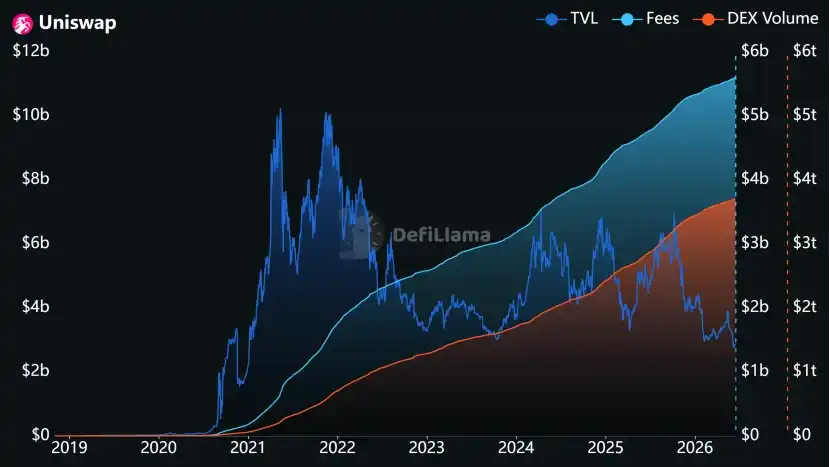
In terms of market share, Uniswap's DEX throne remains solid. Whether on the Ethereum mainnet or across major L2 ecosystems, Uniswap's trading volume and liquidity depth hold a dominant position, with no competitor posing a substantive threat.

More significant signals come from the institutional side. In February this year, BlackRock's tokenized money market fund BUIDL announced it would be available for trading on UniswapX and strategically purchased UNI tokens. With the adoption of UniswapX, which introduces features like off-chain routing, gasless transactions, and MEV (Miner Extractable Value) resistance, the experience gap between DEXs and CEXs is significantly narrowed, making it the preferred on-ramp for traditional capital.

Similarly, last Friday (June 12th), Fidelity also deployed liquidity for its stablecoin, FIDD, on Uniswap. The protocol's concentrated liquidity model is currently the most efficient pricing mechanism on-chain. Once compliant RWA assets are tokenized on a large scale, Uniswap is poised to become the "New York Stock Exchange" on-chain, holding the power of asset pricing.

Wall Street's water is flowing on-chain. And Uniswap is that faucet. Wall Street institutions are treating Uniswap as the on-chain interface for compliant assets, and UNI is also moving towards a pricing logic akin to "on-chain routing infrastructure."

Although the vision of a $100 endpoint is quite enticing, two major obstacles still lie in Uniswap's path to the summit, which could significantly delay or even nullify this distant promise.

  • Traffic Hijacking by Emerging DEXs and Aggregators (Competitive Risk): Solana-based DEXs like Jupiter and Raydium, riding on Meme mania and extremely low transaction costs, have captured a massive amount of retail traffic. Meanwhile, aggregators like 1inch and CowSwap intercept users at the front-end, reducing Uniswap to a mere "backend liquidity pool" in certain ecosystems, continuously eroding its brand premium and user mindshare.

  • Delays in Tokenization Adoption (Macro Risk): Standard Chartered's valuation heavily relies on the assumption that "DeFi TVL will reach $2.7 trillion by 2030." If global legislative progress on tokenization falls short of expectations, or if large-scale security incidents or systemic risks occur, the penetration rate of RWA could slow down significantly, potentially severely postponing the realization cycle of this grand narrative.

Returning to the most intuitive price perspective, UNI is currently trading below $3, down more than 92% from its all-time high in May 2021.

The fee switch brought deflation but not a price reversal. Market apathy towards the DeFi narrative, depleted liquidity, and high macro interest rates have all put significant pressure on UNI's valuation.

However, this might be precisely the source of the "40x potential" in Standard Chartered's eyes: starting from a low base.

Standard Chartered's first-time coverage of UNI with a $100 target price carries more symbolic significance than the price itself. In reality, the accuracy of the prediction is not the most important thing; what matters is that Wall Street's perception of DeFi is evolving: shifting from the early days of "unbridled growth and speculative bubbles" towards a rational business judgment based on "capital efficiency, network effects, and cash flow value."

It should be noted that Wall Street research reports are often strong on macro logic but short on micro risks. For investors immersed in this space, the 40x endpoint is undoubtedly attractive, but the road to 2030 is also destined to be strewn with thorns.

Whether UNI can truly capture the $4 trillion tokenization红利 depends on how skillfully it performs the high-difficulty dance between the principles of decentralization and global regulatory compliance in the real world.

More challenging than a 40x gain might be the four-year wait, which tests faith even more.

Трендовые криптовалюты

Связанные с этим вопросы

QWhat is the key prediction made by Standard Chartered Bank's research report on Uniswap's UNI token?

AStandard Chartered Bank predicts that Uniswap's governance token, UNI, will surge approximately 40 times, reaching $100 by the end of 2030.

QWhat are the two main business models Geoffrey Kendrick compares Uniswap and Coinbase to in the report?

AThe report compares Coinbase to Netflix (centralized, high capital costs, curated assets) and Uniswap to YouTube (open, user-generated liquidity, low marginal costs, strong network effects).

QAccording to the report, what two major factors are critical for achieving the $100 UNI price target?

AThe $100 price target relies on: 1) The massive expansion of tokenized real-world assets (RWA) to $4 trillion, and 2) A significant increase in the proportion of these assets flowing into DeFi, from 3.5% to 30% by 2030.

QWhat recent development changed UNI's economic model from a 'pure governance tool'?

AThe activation of the 'fee switch' mechanism. It initiated token burns (reducing total supply) and allows UNI to capture protocol fees, transforming it into a deflationary, revenue-generating asset.

QWhat are the two main challenges or risks identified for Uniswap's growth path to 2030?

AThe two main challenges are: 1) Competitive pressure from emerging DEXs (like Jupiter, Raydium) and aggregators that can divert user flow. 2) The macro risk of delayed adoption of tokenized assets if regulatory progress or market conditions slow down.

Похожее

После трёх кварталов падения: получится ли у крипторынка стабилизироваться в третьем квартале?

Криптовалютный рынок пережил худший квартал с 2022 года, общая капитализация упала на 12,6% до $2,1 трлн, а дневные объемы торгов снизились на 20,9%. Впервые за три года сократилась и капитализация стейблкоинов. Основные факторы спада — отток средств из биткоин-ETF, распродажа биткоинов корпоративным казначейством Strategy и ужесточение монетарной политики ФРС. Второй квартал завершился чистым оттоком $46,7 млрд из ETF, при этом в июне отток достиг рекордных $45 млрд. Ключевым событием третьего квартала станет заседание ФРС 28–29 июля. Мягкий сигнал может поддержать биткоин в диапазоне $68 000–84 000 и вернуть приток в ETF, тогда как жесткая риторика способна сместить торговый диапазон к $50 000–56 000. Законодательная неопределенность также давит на рынок: прогресс по закону CLARITY Act, определяющему регуляторные границы, замедлился, и вероятность его принятия в 2026 году упала до 40–45%. Несмотря на общий спад, два сегмента показали рост: объемы на рынках предсказаний выросли на 48,7%, а торговля токенизированными коллекционными предметами увеличилась на 143%. Сектор RWA продолжает стабильно развиваться, достигнув $28,1 млрд. Рынок, вероятно, миновал фазу острой распродажи, но для устойчивого восстановления необходимы ясность от ФРС и регуляторный прогресс.

marsbitВчера 08:38

После трёх кварталов падения: получится ли у крипторынка стабилизироваться в третьем квартале?

marsbitВчера 08:38

BIT Торговые часы: BTC по-прежнему под давлением 200 EMA на недельном графике, после отскока возможен перезапуск нисходящего движения; секторы хранения данных и полупроводников, выросшие ночью, начали падение в вечерней сессии

**Краткий обзор рынка: BTC под давлением, коррекция на рынке акций, внимание к данным и событиям** Рынок криптовалют демонстрирует осторожное восстановление. Bitcoin торгуется около $66 000, сталкиваясь со значительным сопротивлением в районе $68 000, где сосредоточены объемные "застрявшие" позиции. Ключевые технические уровни — 200-недельная скользящая средняя (~$63 333) и 200-недельная EMA (~$68 328). Аналитики отмечают низкую ликвидность, характерную для летнего периода. На фондовом рынке после сильного роста во вторник наблюдается коррекция. Фьючерсы на основные индексы США снижаются. Акции полупроводниковой и памяти, которые резко выросли накануне, падают в ночных торгах. Исключением стал SMCI, который вырос более чем на 15% после оптимистичного прогноза. На общий настрой негативно влияют рост цен на нефть (более $91 за баррель Brent) и доходности государственных облигаций США (10-летние — около 4,64%), что возрождает инфляционные опасения. Азиатские рынки показали нестабильную динамику. Индекс KOSPI в Корее вырос на 0,74%, а японский Nikkei 225 снизился на 0,18%. Основной риск для региона — ослабление японской иены до минимумов с 1986 года, что повышает вероятность вмешательства властей. **Ключевые события для наблюдения:** * **24 июля:** Финансовые отчеты Alphabet (Google), Tesla, IBM. Событие AMD, посвященное ИИ. * **25 июля:** Решение по процентной ставке ЕЦБ и пресс-конференция Кристин Лагард. Финансовые отчеты Intel, American Airlines, Honeywell и других. Данные по числу первичных заявок на пособие по безработице в США.

marsbitВчера 08:30

BIT Торговые часы: BTC по-прежнему под давлением 200 EMA на недельном графике, после отскока возможен перезапуск нисходящего движения; секторы хранения данных и полупроводников, выросшие ночью, начали падение в вечерней сессии

marsbitВчера 08:30

Бывший глава CFTC и президент Circle Тарберт: призывает к долгосрочной стратегии, но сам выводит $30 млн

Бывший председатель CFTC и президент Circle Хит Тарберт, публично пропагандируя долгосрочное видение компании для инвесторов на фоне падения акций на 70% с пиковых значений, сам активно распродавал свои акции CRCL. С момента IPO Circle он по плану 10b5-1 продал более 360 тысяч акций, выручив около 30 миллионов долларов, и при этом ни разу не докупал акции на открытом рынке. Эта разница между его публичными заявлениями и личными действиями вызвала критику. Карьера Тарберта демонстрирует классическое использование «вращающейся двери» между регулирующими органами и частным сектором. Уйдя с поста председателя CFTC в 2021 году, через 27 дней он занял должность главного юрисконсульта в маркет-мейкере Citadel Securities, который в тот момент находился под пристальным вниманием из-за скандала с акциями GameStop. Позже, уже работая в Citadel, Тарберт выступал за расширение полномочий CFTC на крипторынок, в то время как его работодатель планировал выход на этот рынок. В 2023 году Тарберт присоединился к Circle, где его опыт и связи сыграли ключевую роль в успешном проведении IPO компании в 2025 году. Однако его последующие массовые продажи акций, совпавшие с падением котировок и его же призывами к долгосрочным инвестициям, ставят под сомнение искренность его уверенности в будущем компании. Критики видят в его карьере образец превращения регуляторного опыта и политических связей в личную выгоду, в то время как риски несут обычные инвесторы, верящие его нарративам.

marsbitВчера 08:07

Бывший глава CFTC и президент Circle Тарберт: призывает к долгосрочной стратегии, но сам выводит $30 млн

marsbitВчера 08:07

Gate Research: Взлет «уолл-стритизации» криптофинансовых продуктов — это конкуренция или интеграция?

**Аналитический обзор Gate Research Institute: Волна "уолл-стритизации" криптофинансовых продуктов — конкуренция или интеграция?** Создание биткоина в 2009 году было ответом на финансовый кризис и стремлением построить децентрализованную систему без доверенных посредников. Однако к 2026 году значительная часть биткоинов (около 7,14%) хранится через ETF таких гигантов, как BlackRock. Это символизирует глубокую интеграцию традиционных финансов (TradFi) и крипторынка. С появлением биткоин-ETF, фьючерсов, RWA (токенизированных реальных активов) и государственных облигаций на блокчейне, традиционные институты получают всё больше влияния на выпуск, ценообразование, кастодию и дистрибуцию криптоактивов. Однако это не одностороннее поглощение, а взаимодополняющая конвергенция. Криптосфера приносит TradFi глобальную 24/7 ликвидность и программируемость, а TradFi предоставляет криптосфере регулируемые каналы, институциональное доверие и массовый доступ. Яркий пример — две противоположные, но ведущие к одной цели траектории: * **Путь А:** Криптобиржи, такие как Gate, начинают с токенизированных акций и CFD, а затем напрямую подключаются к инфраструктуре традиционных брокеров, предлагая реальную торговлю акциями США, Гонконга и Кореи за стейблкоины. * **Путь Б:** Традиционные брокеры, такие как Robinhood, интегрируют криптоактивы, а затем создают собственные Layer 2 для токенизации своих акций, стремясь к круглосуточной торговле. Обе стратегии нацелены на создание **универсального финансового аккаунта будущего** — единой точки доступа к акциям, криптовалютам, ETF, токенизированным облигациям и другим активам. Ключевой конкурентной борьбой становится не между CEX и брокерами, а между этими "супераккаунтами". Параллельно, слой RWA и токенизированных гособлигаций растёт даже на медвежьем рынке, становясь "прослойкой" для объединения капиталов. Хотя этот рынок (около $150 млрд токенизированных казначейских облигаций) ещё мал по сравнению с традиционным ($30 трлн), он демонстрирует устойчивый структурный тренд, привлекающий крупнейшие финансовые институты (JPMorgan, DTCC и др.). **Вывод:** "Уолл-стритизация" — это не поражение идеалов децентрализации, а формирование новой гибридной модели. Децентрализованные протоколы продолжают работать на базовом уровне, в то время как на уровне приложений и пользовательского опыта формируется более эффективный, глобальный и свободный объединённый рынок капитала, где активы TradFi и DeFi торгуются бок о бок в одном интерфейсе. Уолл-стрит не завоевала криптосферу, а криптосфера не обошла Уолл-стрит — они совместно строят новые финансовые рельсы.

marsbitВчера 08:04

Gate Research: Взлет «уолл-стритизации» криптофинансовых продуктов — это конкуренция или интеграция?

marsbitВчера 08:04

S&P Dow Jones и Pantera выпускают криптоиндекс, биткоин оставлен за бортом из-за «отсутствия прибыли»

Стандард энд Пурс (S&P Dow Jones Indices) совместно с Pantera Capital запускает индекс S&P Pantera Digital Asset Index. Новый индекс включает 18 токенов, но исключает биткоин, XRP и мем-токены. Критерием отбора послужила «финансовая жизнеспособность», по аналогии с S&P 500: протокол должен демонстрировать положительный доход в течение нескольких кварталов и распределять стоимость среди держателей токенов. Это первое применение фундаментального подхода к оценке криптоактивов со стороны крупнейшего в мире провайдера индексов. В первую пятерку активов вошли Ethereum (ETH), BNB, Solana (SOL), TRON (TRX) и Hyperliquid (HYPE). Pantera отмечает, что совокупный годовой доход всех протоколов индекса превышает $30 млрд. Биткоин был исключен по трем причинам: он рассматривается как монетарный актив, доступный через отдельные ETF; он не генерирует доход протокола; а смешивание его в индексе с доходными активами затрудняет фундаментальный анализ для институциональных инвесторов. Пока индекс является эталонным, но Pantera ведет переговоры о создании на его основе ETF и других инвестиционных продуктов. Компания также отмечает значительный разрыв на рынке: многие институциональные инвесторы готовы к аллокации в криптоактивы, но им не хватает структурированных продуктов, фокусирующихся на активах с реальной экономической деятельностью.

marsbitВчера 08:02

S&P Dow Jones и Pantera выпускают криптоиндекс, биткоин оставлен за бортом из-за «отсутствия прибыли»

marsbitВчера 08:02

Торговля

Спот

Популярные статьи

Как купить UNI

Добро пожаловать на HTX.com! Мы сделали приобретение Uniswap (UNI) простым и удобным. Следуйте нашему пошаговому руководству и отправляйтесь в свое крипто-путешествие.Шаг 1: Создайте аккаунт на HTXИспользуйте свой адрес электронной почты или номер телефона, чтобы зарегистрироваться и бесплатно создать аккаунт на HTX. Пройдите удобную регистрацию и откройте для себя весь функционал.Создать аккаунтШаг 2: Перейдите в Купить криптовалюту и выберите свой способ оплатыКредитная/Дебетовая Карта: Используйте свою карту Visa или Mastercard для мгновенной покупки Uniswap (UNI).Баланс: Используйте средства с баланса вашего аккаунта HTX для простой торговли.Третьи Лица: Мы добавили популярные способы оплаты, такие как Google Pay и Apple Pay, для повышения удобства.P2P: Торгуйте напрямую с другими пользователями на HTX.Внебиржевая Торговля (OTC): Мы предлагаем индивидуальные услуги и конкурентоспособные обменные курсы для трейдеров.Шаг 3: Хранение Uniswap (UNI)После приобретения вами Uniswap (UNI) храните их в своем аккаунте на HTX. В качестве альтернативы вы можете отправить их куда-либо с помощью перевода в блокчейне или использовать для торговли с другими криптовалютами.Шаг 4: Торговля Uniswap (UNI)С легкостью торгуйте Uniswap (UNI) на спотовом рынке HTX. Просто зайдите в свой аккаунт, выберите торговую пару, совершайте сделки и следите за ними в режиме реального времени. Мы предлагаем удобный интерфейс как для начинающих, так и для опытных трейдеров.

1.1k просмотров всегоОпубликовано 2024.03.29Обновлено 2026.06.02

Как купить UNI

Обсуждения

Добро пожаловать в Сообщество HTX. Здесь вы сможете быть в курсе последних новостей о развитии платформы и получить доступ к профессиональной аналитической информации о рынке. Мнения пользователей о цене на UNI (UNI) представлены ниже.

活动图片