Legendary Altcoin From a Bygone Era Is Shutting Down: Users Need to Take Action

cryptonews.ruPublished on 2026-08-06Last updated on 2026-08-06

Abstract

The Step App project, a blockchain-based fitness and earning platform, has announced its shutdown after four years of operation. All services will cease on August 21, and the team has urged users to unlock their tokens and manage any open positions before that date. According to the press release, the decision to close was long-considered and difficult. The project reported over 1 million downloads, tracked billions of steps, and formed various Web2 and Web3 partnerships. Step App was a prominent Move-to-Earn model, allowing users to earn digital assets for physical activity. Despite its user base and data, the team decided to terminate the project. The project's governance token, FITFI, once reached an all-time high of approximately $0.73, representing a 150x increase from its initial IDO price of $0.0049 at its peak. The closure follows recent announcements from South Korean exchanges Upbit and Bithumb, which discontinued support for FITFI trading on July 16. FITFI holders must check and manage their locked tokens and other platform positions before the August 21 deadline.

The Step App project, focused on earning through blockchain, announced its shutdown after four years of operation. The project team stated that all services will cease on August 21st and urged users to unlock their tokens and manage open positions before this date.

The Step App press release noted that the decision to shut down was considered for a long time and that the full termination of activities was not easy. The team added that the project achieved over 1 million downloads, tracked billions of steps, and established various partnerships bridging the Web2 and Web3 worlds.

The Step App, which combined blockchain technology with fitness applications, was one of the prominent projects in the Move-to-Earn model, where users could earn digital assets in exchange for physical activity. However, despite the collected data on users and activity, the team decided to terminate the project.

The project's governance token, FITFI, previously reached an all-time high of approximately $0.73. Considering the token's IDO price of $0.0049, FITFI grew roughly 150 times compared to its initial sale price at its peak.

Step App's decision to shut down followed announcements from exchanges regarding FITFI. South Korean cryptocurrency exchanges Upbit and Bithumb announced on July 16th the termination of support for FITFI trading. Due to the project's closure, FITFI holders need to check their locked tokens and other positions on the platform before August 21st.

*This is not investment advice.

end-content

Trending Cryptos

Related Questions

QWhat is the main reason the Step App project is shutting down?

AThe project team has announced a closure after four years of operation, stating that the decision was considered for a long time and that a full shutdown was not an easy choice. All services will cease on August 21.

QWhat was the core concept of the Step App project?

AStep App was a blockchain-based fitness application that utilized the Move-to-Earn model, allowing users to earn digital assets in exchange for physical activity. It aimed to bridge the Web2 and Web3 worlds.

QWhat is the name of the project's governance token and what was its peak performance?

AThe project's governance token is called FITFI. It reached an all-time high of approximately $0.73, which represented a growth of about 150 times compared to its IDO price of $0.0049.

QWhat action must users of Step App take before the shutdown date?

AUsers are urged to unlock their tokens and manage their open positions on the platform before August 21, 2024, when all services will be terminated.

QWhich major exchanges recently announced the delisting of the FITFI token?

ASouth Korean cryptocurrency exchanges Upbit and Bithumb announced on July 16 that they would cease support for FITFI trading, preceding the project's own closure announcement.

Related Reads

Strategy Sells BTC at Loss, Trump Media Cuts Crypto Business, Grayscale Withdraws Altcoin ETFs: Crypto Market Experiences Sharp Retreat Within a Week

In a single week, three key players in the crypto world pulled back simultaneously, signaling a market-wide retreat. MicroStrategy sold 1,690 BTC at a loss to repurchase its discounted preferred shares. Trump Media reported a quarterly net loss of $238.1 million, largely due to a $190.4 million crypto asset impairment, and announced a scaling back of its crypto ambitions. Grayscale withdrew its filings for spot ETFs tied to Cardano (ADA), Polkadot (DOT), and Hedera (HBAR) within minutes. Individually, these are company updates; together, they point to a sharp ebb tide in crypto. However, in this industry, such contractions are not an end but a prelude. Unlike traditional markets, crypto lacks institutional buffers. Its cleansing happens violently through price crashes and leverage implosions, which are painful but necessary to purge weak hands—speculators, over-leveraged entities, and undisciplined corporate buyers—and transfer their holdings to stronger ones. Previous cycles washed out retail and projects, laying groundwork for DeFi and institutional products like spot Bitcoin ETFs. The current phase targets corporate and institutional excess. MicroStrategy's sale shows even "forever holders" face balance sheet realities. Trump Media's retreat highlights the perils of undisciplined corporate treasury management. Grayscale's product pruning reflects a cooling institutional appetite for altcoins beyond BTC and ETH. This painful process creates a cleaner market structure. It shifts the focus from speculative narratives to fundamentals like cash flow and asset quality. As weak hands exit, selling pressure subsides, paving the way for sustainable growth. The last cycle built ETFs on FTX's ashes. This one may forge a more mature, resilient foundation from the lessons of the corporate "buy-the-dip" era. The path forward, while uncertain, holds promise for a healthier market.

marsbit15m ago

Strategy Sells BTC at Loss, Trump Media Cuts Crypto Business, Grayscale Withdraws Altcoin ETFs: Crypto Market Experiences Sharp Retreat Within a Week

marsbit15m ago

Why do people like Luke still want to fork Bitcoin despite having no support? BIP-100 has already been declared a failure!

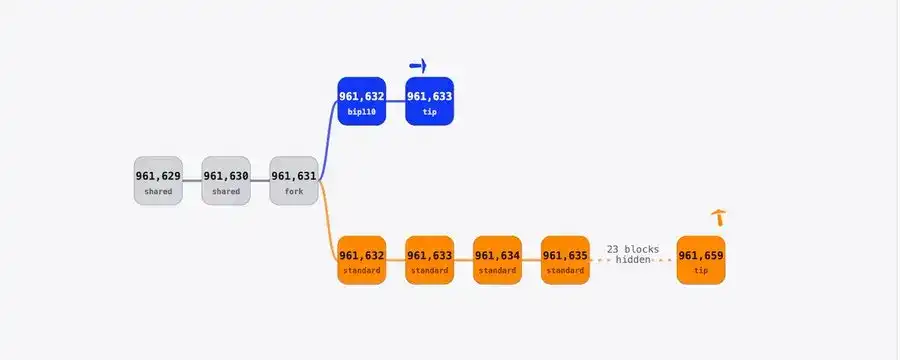
On August 8th, the Bitcoin network experienced a contentious fork triggered by BIP-110, despite the proposal having only 2.53% miner signaling support in the prior period. Led primarily by developer Luke Dashjr and based on his Bitcoin Knots implementation (not merged into Bitcoin Core), this User-Activated Soft Fork (UASF) aimed to impose strict new limits on non-financial data (like Ordinals inscriptions) within blocks to reduce long-term node costs. The fork activated at block height 961632, with BIP-110 nodes rejecting blocks without the required signaling. This created two chains: the dominant original chain continuing normally, and a low-hashrate BIP-110 chain which quickly fell behind. The core conflict is between those viewing block space as a fee market open to all data and those prioritizing Bitcoin as a monetary network, seeking to ban what they see as blockchain "spam." BIP-110's strategy relied on economic nodes (exchanges, wallets) adopting the new rules first, hoping to force miners to follow. However, this has not materialized. The BIP-110 chain now faces severe challenges: extremely slow block times potentially stretching over 1.9 years before its rules would even activate, a lack of broad economic support, and no automatic replay protection. For most users, Bitcoin's main chain operates unchanged. The immediate technical impact is limited to services running BIP-110 software, which now see a different blockchain. The event highlights ongoing ideological disputes within Bitcoin but, given its minimal support, is unlikely to alter the main network's trajectory.

marsbit21m ago

Why do people like Luke still want to fork Bitcoin despite having no support? BIP-100 has already been declared a failure!

marsbit21m ago

Trading

Spot

Hot Articles

Ethena: Building a New Era of Web3‑Native Digital Dollars

Ethena is an Ethereum‑based synthetic dollar protocol that delivers crypto‑native monetary solutions, including USDe, a synthetic dollar, and sUSDe, a globally accessible U.S. dollar savings asset.

53.7k Total ViewsPublished 2026.03.16Updated 2026.03.16

Ethena: Building a New Era of Web3‑Native Digital Dollars

Discussions

Welcome to the HTX Community. Here, you can stay informed about the latest platform developments and gain access to professional market insights. Users' opinions on the price of ERA (ERA) are presented below.

活动图片