ZetaChain 2.0 Launches With Anuma, Bringing Private Memory and AI Interoperability to Creators

TheNewsCryptoОпубликовано 2026-01-27Обновлено 2026-01-27

Введение

ZetaChain has launched ZetaChain 2.0, introducing Anuma—a privacy-first AI interface and interoperability layer. Anuma brings private, user-owned memory and cross-AI model interoperability to creators, enabling applications to operate across multiple AI models and blockchains without lock-in. Built by core contributor Ankur Nandwani (co-creator of Basic Attention Token), the platform emphasizes user control, encrypted memory, and built-in monetization. ZetaChain 2.0 includes an AI Portal for unified model routing and a Private Memory Layer for secure, permissioned context retention. The release also features an SDK for developers to build privacy-preserving, multi-model AI apps with global payment support. A waitlist for Anuma is now open.

San Francisco, USA, January 27th, 2026, Chainwire

What Brave helped mainstream for private browsing, Anuma brings to AI with private, user-owned memory and AI Portal-based interoperability powered by ZetaChain 2.0.

ZetaChain today announced the beta launch and public waitlist for Anuma, a privacy-first AI interface built on ZetaChain 2.0. ZetaChain also introduced ZetaChain 2.0, a new AI interoperability layer designed to help developers build applications and agents that work across AI models, preserve private user context, and monetize globally without backend infrastructure.

ZetaChain Core Contributor Ankur Nandwani previously co-created Basic Attention Token (BAT), which powers the Brave browser ecosystem with over 100M monthly active users. Brave helped mainstream privacy-first browsing by blocking trackers and ads by default. Anuma applies that same “privacy and user control by default” approach to the next major consumer interface of AI where context and memory increasingly define user experience.

AI adoption is accelerating at internet scale: McKinsey notes that ChatGPT reached 100 million users in two months, and OpenAI has reported 800 million weekly active users by late 2025. Yet the ecosystem remains fragmented, with only 9% of consumers paying for more than one AI subscription across major assistants. This combination creates lock-in at the model layer and forces developers to repeatedly rebuild the same integration, routing, state, and billing infrastructure, while privacy and data are routinely shared across applications, agents, and model providers.

ZetaChain was built to address fragmentation in Web3 by enabling universal apps — applications that can natively access assets like BTC and execute across multiple blockchains through a single platform. In 2025, the ZetaChain network scaled to more than 11.5 million users and processed more than 225 million transactions. With ZetaChain 2.0, ZetaChain is extending this unification thesis to AI so applications can operate across both chains and models, with permissions and private context built in.

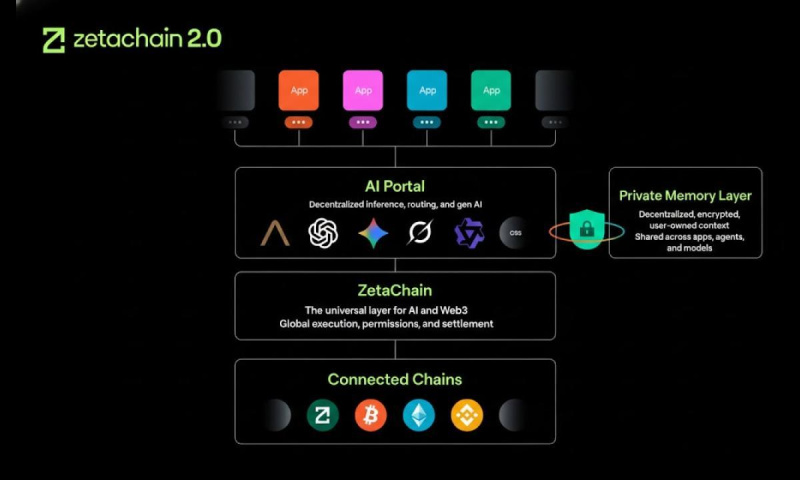
ZetaChain 2.0 is composed of two core components:

  • AI Portal: A unified routing and execution layer that allows applications to access multiple AI model providers without lock-in, with built-in support for availability, fallback, and cost-performance optimization.
  • Private Memory Layer: A protocol-level memory system designed to keep user context encrypted and permissioned, enabling persistent experiences across sessions while maintaining user control over what applications and agents can access.

Developer SDK and Platform

ZetaChain 2.0 is designed to scale as a developer platform. Alongside the protocol components, ZetaChain is releasing a developer SDK that packages private persistent memory, cross-model interoperability, and monetization primitives into a single toolkit. The goal is to make it straightforward to build privacy-first apps and agents that can maintain continuity across sessions, connect to multiple model providers, and support global monetization rails from onchain settlement to traditional payment processors without requiring teams to build bespoke infrastructure.

Anuma: First Consumer Showcase

Anuma is the first consumer AI interface built on ZetaChain 2.0. The product provides access to multiple leading AI models through a single experience, supports switching between models without losing context, and is designed so memory remains private and user-controlled. Users can request early access through the public waitlist.

“Brave and BAT proved that privacy-first defaults can win at consumer scale,” said Ankur Nandwani, Core Contributor at ZetaChain. “We’ve already unified the blockchain experience at scale, powering more than 225 million transactions. ZetaChain 2.0 extends that same approach to AI, enabling the next generation of apps and agents that run across models and chains with private, permissioned memory and global monetization by default.”

In 2023, ZetaChain announced a $27 million funding round with participation from Blockchain.com, Human Capital, VY Capital, Sky9 Capital, Jane Street Capital, VistaLabs, CMT Digital, Foundation Capital, Lingfeng Capital, GSR, and others.

About ZetaChain

ZetaChain is the universal layer for AI and Web3, letting developers build apps that run across chains and models, keep memory private, and monetize without infrastructure. With native connectivity across major blockchains and an AI interoperability stack powered by a Private Memory Layer, ZetaChain is building the foundation for the next generation of apps, agents, and experiences.

Users can follow ZetaChain on X (Twitter) and join the conversation on Discord and Telegram.

Contact

CMO
Jonathan Covey
ZetaChain
[email protected]

Связанные с этим вопросы

QWhat is the core innovation that ZetaChain 2.0 introduces with the launch of Anuma?

AZetaChain 2.0 introduces an AI interoperability layer with two core components: the AI Portal, a unified routing and execution layer for accessing multiple AI models, and the Private Memory Layer, a protocol-level system that keeps user context encrypted and permissioned.

QWho is Ankur Nandwani and what is his previous significant contribution mentioned in the article?

AAnkur Nandwani is a Core Contributor at ZetaChain who previously co-created the Basic Attention Token (BAT), which powers the Brave browser ecosystem with over 100 million monthly active users.

QWhat problem in the current AI ecosystem does ZetaChain 2.0 aim to solve?

AZetaChain 2.0 aims to solve the fragmentation and lock-in in the AI ecosystem, where developers are forced to repeatedly rebuild integration, routing, state, and billing infrastructure, while user privacy and data are routinely shared across applications and model providers.

QWhat are the key features of the Anuma AI interface as the first consumer showcase on ZetaChain 2.0?

AAnuma provides access to multiple leading AI models through a single experience, supports switching between models without losing context, and is designed so that user memory remains private and user-controlled.

QHow did ZetaChain demonstrate its scalability in the Web3 space prior to this announcement?

AIn 2025, the ZetaChain network scaled to more than 11.5 million users and processed more than 225 million transactions, demonstrating its ability to unify the blockchain experience at scale.

Похожее

Has Hook Summer Really Arrived? sato, Lo0p, FLOOD Ignite the New Narrative of Uniswap v4

"Hook Summer" Arrives? Sato, Lo0p, FLOOD Ignite Uniswap v4 Narrative Amidst a slight market recovery, attention within the Ethereum ecosystem has shifted to Meme coins built on Uniswap v4's Hook protocol. Following ASTEROID, tokens like sato, sat1, Lo0p, and FLOOD have become market focal points, with market caps ranging from millions to tens of millions, bringing concentrated liquidity to a narrative-dry market. Uniswap v4 Hooks are "plugin smart contracts" that allow developers to inject custom logic at key points in a liquidity pool's lifecycle (initialization, adding/removing liquidity, swaps, etc.), making the AMM programmable. Recent representative projects include: * **sato**: Market cap peaked over $38M; uses a v4 curve mechanism for minting/burning, locking ETH as reserve. * **sat1**: Market cap briefly exceeded $10M, positioning as an "optimized sato," but later declined significantly. * **Lo0p**: Market cap neared $6.6M; a "lending AMM protocol" allowing users to borrow ETH against deposited LO0P tokens without immediate selling pressure. * **FLOOD**: Market cap approached $6M; channels trading reserves into Aave v3 to generate yield, which is retained in the pool. The emergence of these Hook-based tokens could drive long-term growth for the Uniswap ecosystem by attracting users and liquidity to v4 pools. Combined with Uniswap's activated fee switch (partially used to burn UNI), the long-term outlook for UNI appears positive. However, short-term UNI price appreciation is not directly guaranteed. Factors include the sustainability and lifecycle of these new tokens, their price volatility, overall market conditions, and regulatory pressures. Currently, Uniswap v4's TVL ($595M) lags behind v3 and v2, indicating Hook adoption still requires time to mature. In summary, the Hook ecosystem serves as "long-term nourishment" for UNI, but acts more as a "catalyst" than a direct "booster" in the short term. Note: These are early-stage experimental tokens and may carry unknown risks.

marsbit21 мин. назад

Has Hook Summer Really Arrived? sato, Lo0p, FLOOD Ignite the New Narrative of Uniswap v4

marsbit21 мин. назад

Has Hook Summer Truly Arrived? sato, Lo0p, FLOOD Ignite the New Uniswap v4 Narrative

With the broader market showing signs of recovery, a new wave of interest has emerged around Ethereum-based meme coins. Following ASTEROID, tokens like sato, sat1, Lo0p, and FLOOD, built upon the Uniswap v4 Hook protocol, are capturing market attention. Their market capitalizations range from millions to tens of millions of dollars, injecting much-needed focused liquidity into a market lacking narratives. This article explores whether this trend signifies an incoming "Hook Summer" and its potential impact on UNI's price. Hooks are essentially plug-in smart contracts for Uniswap v4 liquidity pools, allowing developers to inject custom logic at key points in a pool's lifecycle (like initialization, adding/removing liquidity, swaps). This transforms the AMM into programmable building blocks. Key highlighted projects include: * **sato**: Peaked over $38M market cap. It utilizes a v4 curve for minting/burning; buying locks ETH as reserve to mint new tokens, while selling redeems ETH from the reserve and burns tokens. * **sat1**: Market cap briefly exceeded $10M, promoted as an "optimized sato," but later declined significantly. * **Lo0p**: Reached nearly $6.6M. It's a lending AMM protocol where buying LO0P tokens locks them as collateral, allowing users to borrow ETH from the pool reserve at 40% LTV, aiming to improve capital efficiency for idle ETH in LPs. * **FLOOD**: Peaked near $6M. Its mechanism directs asset reserves from buys into Aave v3 to generate yield, with fees and interest retained in the pool to potentially influence the token's price long-term. In the long term, the development of the Hook ecosystem can attract users and liquidity to Uniswap v4, benefiting UNI's fundamentals—especially combined with the recent activation of the protocol fee switch, where a portion of fees is used to burn UNI. However, in the short term, these Hook-based tokens are unlikely to directly drive significant UNI price appreciation. Their impact is moderated by factors like token sustainability, price volatility, and broader market and regulatory conditions. Currently, Uniswap v4's TVL ($595M) still trails behind v2 and v3, indicating adoption and growth will take time. The article concludes that while the Hook ecosystem provides long-term "nourishment" for UNI, its short-term role is more of a "catalyst" than a "booster." Readers are cautioned that these are early-stage experimental tokens and may carry unknown risks.

Odaily星球日报33 мин. назад

Has Hook Summer Truly Arrived? sato, Lo0p, FLOOD Ignite the New Uniswap v4 Narrative

Odaily星球日报33 мин. назад

Interview with Michael Saylor: I Did Say I Would Sell Bitcoin, But Never a Net Sale

Interview with Michael Saylor: I Said We'd Sell Bitcoin, But Never Be a Net Seller In a recent podcast, MicroStrategy Executive Chairman Michael Saylor clarified the company's stance on potentially selling Bitcoin. Following MicroStrategy's earnings call statement about being prepared to sell BTC to fund dividends for its STRC (Strategic) credit product, Saylor emphasized the distinction between selling and being a "net seller." Saylor explained the core business model: MicroStrategy sells credit instruments like STRC and uses the proceeds to buy Bitcoin, which is viewed as "digital capital" expected to appreciate around 30-40% annually. A portion of these capital gains can then be used to pay the dividends on the credit products. He stressed that even if the company sells some Bitcoin for dividends, it simultaneously buys much more with new credit issuance. For example, after raising $3.2 billion from STRC sales in April, the dividend obligation was only $80-90 million, making the company a net buyer. The clarification aims to counter market narratives questioning the value of Bitcoin on MicroStrategy's balance sheet if it were never sold, and to dismiss claims of a "Ponzi scheme." Saylor reiterated his personal philosophy for investors: "Don't be a net seller of bitcoin" and ensure your Bitcoin holdings increase each year. Saylor also discussed Bitcoin's role as the foundation for "digital credit," noting that STRC has become the largest and most liquid preferred stock issue in the U.S., offering high risk-adjusted returns (Sharpe ratio). He highlighted Bitcoin's deep liquidity, stating that even large purchases by MicroStrategy do not move the market significantly, which is driven by macro factors, geopolitical tensions, and capital flows from ETFs and credit products. Finally, Saylor reflected on his early inspiration from sci-fi books, which motivated his path to MIT, and maintained his fundamental thesis on Bitcoin remains unchanged: it is superior digital capital enabling superior digital credit.

链捕手37 мин. назад

Interview with Michael Saylor: I Did Say I Would Sell Bitcoin, But Never a Net Sale

链捕手37 мин. назад

Торговля

Спот
Фьючерсы
活动图片