Zero Funding Rate? The New Contract Design of HyperEVM That Foreigners Are Talking About

marsbitОпубликовано 2026-05-14Обновлено 2026-05-14

Введение

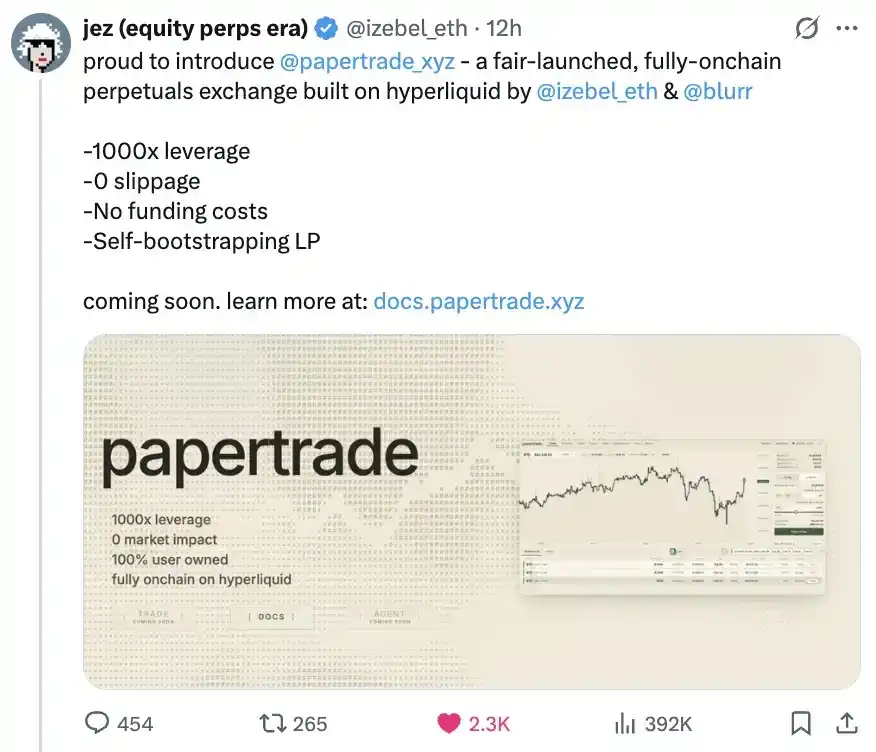
Jez, a prominent crypto trader, announced his new protocol PaperTrade on HyperEVM, sparking significant discussion. PaperTrade is a perpetual DEX with zero fees, no slippage, and no funding rates. The protocol's mechanism draws from the historical "bucket shop" model, where trades are settled directly against a public LP pool based on Hyperliquid's order book prices, without ever interacting with Hyperliquid's matching system. It combines perpetual contracts with P2P lending and DeFi Ponzi elements. User losses go into the LP pool, while a portion of user profits is taken as protocol fees. Crucially, the LP pool is seeded solely by user losses, not external deposits. If a user's profit exceeds the pool's balance, the profit enters an on-chain queue, to be paid out sequentially by subsequent user losses. The protocol mints its PAPER token based on user losses, with a minting rate that decays as the LP pool grows. Staking PAPER yields dividends from protocol fees and excess pool funds above a $5M cap. A key uncertainty is its deployment on HyperEVM. Since PaperTrade essentially uses Hyperliquid as a free oracle, its logic could be replicated on any high-performance chain with an external price feed, potentially offering better performance or incentives. The launch also serves as a stress test for HyperEVM's network capabilities.

Today, crypto trader Jez announced his new protocol, PaperTrade, developed on HyperEVM, sparking heated discussions in the English-speaking crypto community.

Jez is a long-term evangelist for perpetual contracts. He heavily invested in Hyperliquid early on, with his account address ranking high on the airdrop leaderboards of Lighter and Variational. This time, he has taken matters into his own hands, creating a Perp DEX with no fees, no slippage, and no funding rate.
Old-School Gambling House Exiles to the Chain

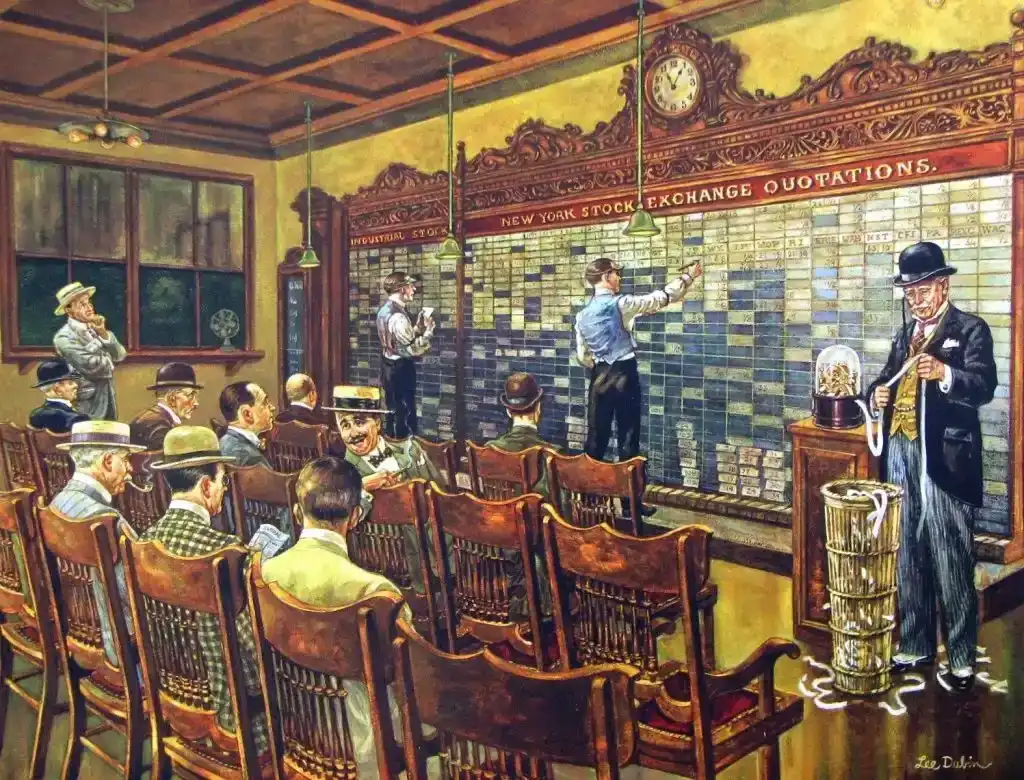
The mechanism of PaperTrade has a notorious predecessor in financial history: the bucket shops in American small towns in the 1900s. These establishments, operating under the guise of securities firms, would chalk up real-time quotes from the New York Stock Exchange behind their counters, but clients' orders never left the shop owner's drawer. Essentially, it was a gamble between the client and the shop owner. This business was outlawed by New York State legislation in 1909 and largely disappeared by the 1920s.
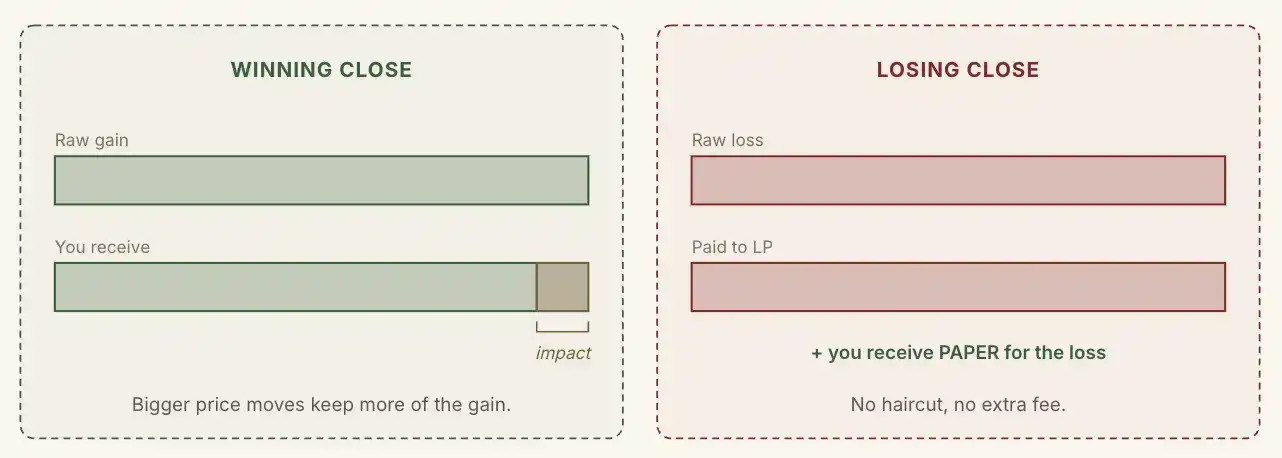
When users open or close a position on PaperTrade, the platform directly reads the order book price from Hyperliquid and settles directly with the public LP pool based on the difference between the opening and closing prices. No orders enter Hyperliquid's matching system during this entire process, and no real perpetual contracts are exchanged. The trading parties are always the user and the LP pool, with no third-party counterparty.

Perpetual Contracts + P2P + DeFi Ponzi

PaperTrade simultaneously borrows models from DeFi mining and P2P lending.

User losses on PaperTrade are placed directly into the protocol's LP pool, while user profits are taxed by the platform. The smaller the price fluctuation, the more profit is taken. In other words, the more users earn, the less the protocol taxes.

Unlike HLP, PaperTrade's LP pool has no team pre-deposit, no VC investment, and does not accept any form of external deposits whatsoever. Its sole source of funds is user-lost margin.

The question arises: if the LP pool only has $100, but a user makes $5,000, how does the protocol pay?

PaperTrade has brought the creditor queue from traditional P2P lending onto the chain.

This $5,000 enters a sequential on-chain queue, waiting for the next losing trade to come in and fill the gap, with payments made in order from the front of the queue. User principal is always returned immediately, only the profit portion is queued.
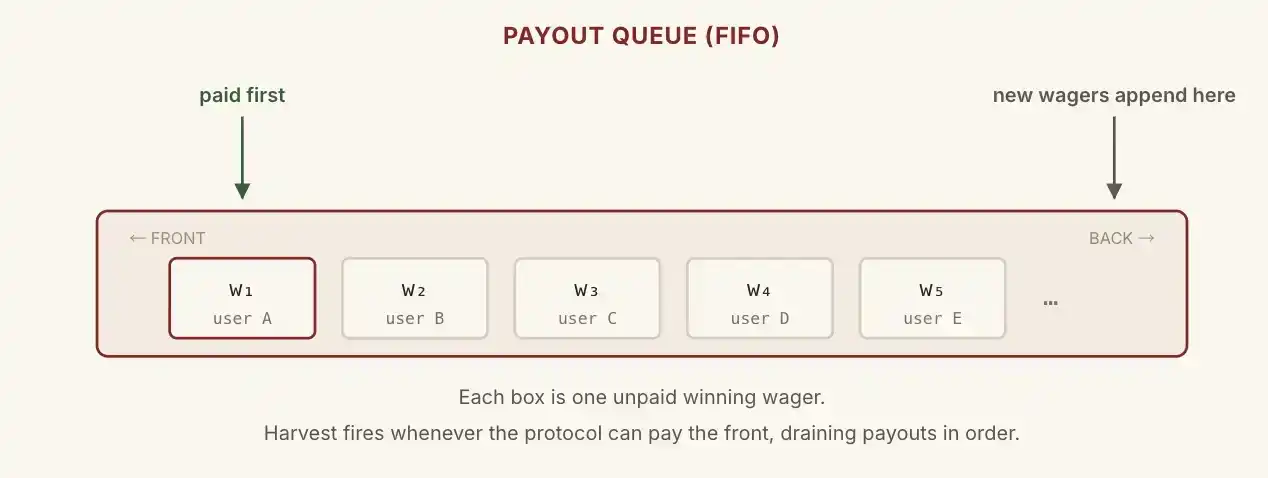
In theory, the LP can be "bankrupt" in stages, but every winner will eventually be paid in full, unless the losses from losers are insufficient to cover the profits the platform owes the winners.

If the story ended here, this project would be doomed to failure. Because if the LP pool runs out of money, it means winners might have to wait a long time in the queue to receive their profits, naturally losing motivation to trade. As traders leave, even losers disappear, and the money the platform owes winners becomes bad debt.

The essence of PaperTrade lies in its token, PAPER.

For every dollar a user loses, the protocol mints a certain amount of PAPER according to a curve.
When the LP balance is below $2 million, the minting ratio is fixed at 100 PAPER per $1 loss; after the LP exceeds $2 million, the rate begins to decay—the higher the LP balance, the less PAPER is minted.
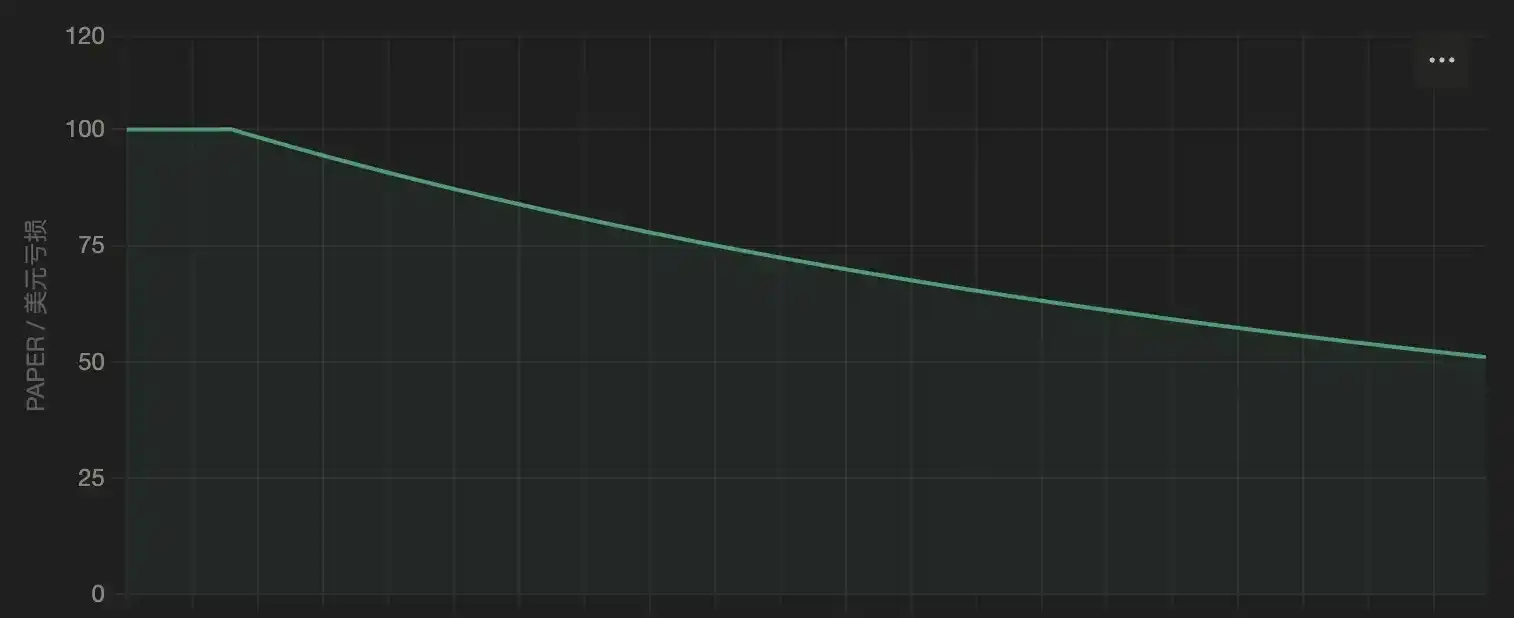
X-axis: Amount of PAPER obtained per unit of loss; Y-axis: LP Balance (each grid represents 1M)

Staking PAPER yields two parts of dividends: first, the protocol's fee income; second, when the balance exceeds $5 million, all excess funds are allocated entirely to stakers.

In other words, the LP pool's scale is designed with a $5 million ceiling. Beyond this size, user losses are fully returned to PAPER holders. This forms a closed loop: "Losers get platform shares, winners take losers' money, the platform taxes winners to subsidize losers."

Therefore, a reasonable participation strategy can be summarized as: betting to lose money to mint PAPER when the LP pool's TVL is low, and staking PAPER to collect dividends when the LP pool's TVL is high.

A Stress Test for HyperEVM

In my opinion, the biggest uncertainty for PaperTrade lies in the HyperEVM on which it is deployed.

PaperTrade merely uses Hyperliquid's quotes as a free, native oracle, with all remaining logic residing in the contracts on HyperEVM.

This means any high-performance chain with similar capabilities could replicate PaperTrade's entire mechanism on its own chain, as long as it is willing to integrate an external price oracle. The replicator could even offer things HyperEVM cannot: lower gas fees, higher TPS, more generous early subsidies, more aggressive token incentives.

During the HyperEVM meme season in Q1 of last year, there was a period of slow on-chain speeds and high gas fees. The launch of PaperTrade is another test for HyperEVM.

Связанные с этим вопросы

QWhat is the key innovation of the new protocol PaperTrade announced on HyperEVM?

AThe key innovation of PaperTrade is its design as a perpetual DEX with zero fees, zero slippage, and zero funding rates. It operates by using Hyperliquid's orderbook as a price oracle and settling trades directly against a public LP pool without actual orders entering Hyperliquid's matching system, creating a peer-to-contract model.

QWhat is the historical inspiration for PaperTrade's mechanism, and why was it considered disreputable?

APaperTrade's mechanism is inspired by the 'bucket shops' of early 1900s America. These were fraudulent operations that posted real stock exchange prices but clients were simply betting against the shop owner, with no real trades ever executed. This practice was banned and died out due to its deceptive and purely gambling-based nature.

QHow does the PaperTrade protocol handle a situation where a user's profit exceeds the current balance of the LP pool?

AWhen a user's profit exceeds the LP pool balance, the profit amount (not the principal) is placed into a sequential on-chain queue. It will be paid out in order as future user losses replenish the pool. This means winners are guaranteed payment over time, provided there are enough subsequent losers to cover the debts.

QWhat is the role of the PAPER token in the PaperTrade ecosystem?

AThe PAPER token is minted when users incur losses on the platform. The minting rate decreases as the LP pool grows. Staking PAPER entitles holders to two types of dividends: a share of the protocol's revenue from profitable trades, and all excess funds in the LP pool once it surpasses a $5 million cap, effectively distributing user losses back to token holders.

QAccording to the article, what is the main challenge or uncertainty facing PaperTrade's implementation?

AThe main uncertainty lies in its deployment on HyperEVM. Since the core logic resides on-chain and merely uses Hyperliquid for price feeds, any high-performance chain with a similar external oracle could replicate the entire mechanism. Competitors could offer lower gas fees, higher TPS, or better incentives, posing a significant challenge to PaperTrade's sustainability on HyperEVM.

Похожее

Fei-Fei Li's Team Clarifies the Concept of 'World Models', Sora Merely a Renderer

"World Models" has become a widely used yet confusing term in AI. To address this, a team led by Fei-Fei Li and World Labs proposed a functional taxonomy based on the Partially Observable Markov Decision Process framework. This taxonomy categorizes systems called "world models" into three distinct projections: Renderers, Simulators, and Planners. Renderers, like OpenAI's Sora and other video generation models, focus on producing photorealistic visual outputs for human perception. They prioritize visual fidelity over physical accuracy. Simulators, such as NVIDIA Omniverse, aim to compute precise future environmental states for computational tasks like engineering analysis or digital twins. Planners, like Vision-Language-Action models, take in observations and goals to output executable actions for robots or agents. The article clarifies that most current "world models," including Sora, are primarily Renderers. They generate convincing visuals but lack the core ability to simulate state transitions based on actions, a key requirement for a true world model in classic reinforcement learning definitions. This conceptual confusion has practical implications, leading to potential misalignment in technology selection, investment, and public understanding of AI capabilities. Clear categorization is crucial. It helps enterprises avoid costly mistakes (e.g., using a renderer for robot training), allows investors to accurately assess markets, and enables researchers to build comparable benchmarks. While future systems may integrate these functions, recognizing current boundaries is essential for honest assessment and progress.

marsbit24 мин. назад

Fei-Fei Li's Team Clarifies the Concept of 'World Models', Sora Merely a Renderer

marsbit24 мин. назад

Bloomberg Uncovered: How Do China's Wealthy Circumvent the Annual $50,000 Limit to Transfer Assets?

**Summary: How Wealthy Chinese Circumvent $50,000 Annual Foreign Exchange Limits** Despite China's strict capital controls, including an annual $50,000 per person foreign exchange quota, an estimated $150 billion in funds still leaves the country annually via various gray and underground channels. This report outlines the evolution of China's "capital wall" and the methods used to bypass it. **The Evolving Capital Controls:** * **Foundation (1994):** The system of "current account convertibility with strict capital account controls" was established. * **Quota Set (2007):** The $50,000 individual annual forex purchase limit was formalized. * **Crackdown Begins (2015-2017):** Following market volatility, enforcement tightened. Banks were required to scrutinize transactions, and channels like using UnionPay cards for Hong Kong insurance premiums or buying overseas property were blocked. * **Digital & Legal Upgrades (2024-2026):** Enhanced algorithms now flag suspicious patterns (e.g., "smurfing"). The Common Reporting Standard (CRS) provides Chinese tax authorities with data on citizens' offshore accounts. Unlicensed cross-border brokers have been targeted. **Five Primary Methods for Moving Capital:** 1. **Underground Banking / "Hawala" (Duiqiao):** The largest-scale method. No money crosses borders. Clients pay RMB to a domestic account; an overseas associate deposits equivalent foreign currency into the client's offshore account. Risks include high fees, account freezes, and legal penalties. 2. **"Smurfing" or "Ant Moving":** Using multiple individuals' $50,000 quotas to pool funds for one offshore recipient. Increasingly detected by anti-money laundering algorithms. 3. **Trade Invoice Manipulation:** Businesses over-invoice imports or under-invoice exports via offshore shell companies, creating a pretext to transfer excess funds abroad under the guise of trade. 4. **Channel Migration:** After a crackdown on internet brokers, funds flow toward more compliant but costly channels like major banks' cross-border wealth management services or Qualified Domestic Institutional Investor (QDII) quotas. 5. **Structural Arrangements:** High-net-worth individuals use complex, high-cost legal structures involving offshore trusts, insurance, and investment migration programs to transfer asset ownership. **Regulatory Response: Focusing on People, Not Just Money** The current strategy extends oversight from enterprises to **individual residents**. Tools like CRS allow retroactive visibility into offshore assets. Cryptocurrencies, once seen as a potential loophole, are now actively monitored and prosecuted as an illegal channel. The underlying driver remains: with significant wealth concentrated among millions of affluent households seeking diversification amid domestic economic shifts, the incentive to move assets offshore persists despite regulatory barriers.

marsbit44 мин. назад

Bloomberg Uncovered: How Do China's Wealthy Circumvent the Annual $50,000 Limit to Transfer Assets?

marsbit44 мин. назад

Торговля

Спот
Фьючерсы
活动图片