XRP Dev Predicts Market Cap To Hit $300 Billion Soon, What Would The Price Be?

bitcoinistОпубликовано 2026-02-17Обновлено 2026-02-17

Введение

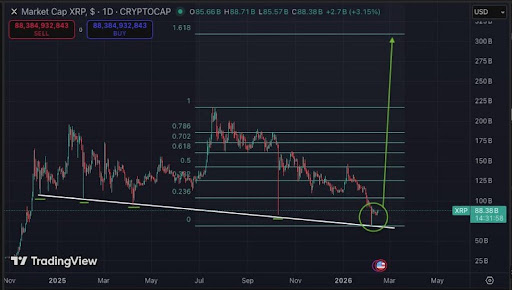
A pseudonymous XRP Ledger developer and analyst known as Bird has projected that XRP's market capitalization will soon surge to $300 billion. This would represent a significant increase of over 239% from its current valuation of approximately $88.38 billion. Based on XRP's circulating supply of 60.91 billion tokens, this market cap would translate to a price of around $5 per token—a 271% increase from its current trading price of $1.47. Bird's technical analysis, shared on X, includes a TradingView chart indicating a potential breakout after a prolonged period of selling pressure. The chart uses Fibonacci extension levels, with the 1.618 level aligning with the $300 billion target. While this is a highly optimistic forecast, some members of the crypto community have expressed that even this projection is too low, believing XRP could eventually reach a multi-trillion dollar valuation. The prediction reflects growing optimism despite recent market downturns.

A new technical projection is circulating in the crypto market after pseudonymous analyst and XRP Ledger (XRPL) developer Bird forecast a sharp rise in the cryptocurrency’s market capitalization. The analyst predicts that the altcoin could soon reach a valuation of $300 billion, accompanied by a significant price increase from current levels.

XRP Market Cap Forecasted To Surge To $300 Billion

In a post on X, Bird boldly declared that a “$300 billion XRP market cap is coming very soon.” The assertive forecast clearly shows his strong confidence in the token’s near-term growth potential, suggesting a major increase from current levels and reflecting growing optimism around the token despite recent price swings and a broader market downtrend.

Bird’s forecasts were accompanied by a detailed TradingView chart illustrating a potential breakout scenario for XRP’s market capitalization. At the time of the analysis, its valuation stood at $88.38 billion. Technical levels on the chart highlight a prolonged downturn stretching from early 2025 into early 2026. Additionally, a descending white trendline can be seen connecting multiple lower lows, indicating sustained selling pressure over several months.

Source: Chart from Bird on X

The most recent price action shows the market cap revisiting a long-term support zone between $100 billion and $80 billion, an area circled on the chart to emphasize its significance. Fibonacci retracement and extension levels are plotted from a price swing high to a major now, marking key levels at 0.236, 0.382, 0.5, 0.618, 0.702, 0.786, 1, and 1.618.

The 1 level aligns near the $225 billion region, while the 1.618 extension points above toward Bird’s projected $300 billion market cap. The chart illustrates a large upward green arrow extending from $88.38 billion valuation at the time of the analysis toward $300 billion, representing an increase of more than $211 billion. This suggests that Bird expects its valuation to skyrocket by more than 239%.

Price At A $300 Billion Market Cap

Analysts calculate XRP’s price by dividing its market capitalization by its circulating supply. Based on its current circulating supply of approximately 60.91 billion tokens and a projected market cap of $300 billion, this would imply a price increase to approximately $5 per token. At the time of writing, the cryptocurrency is trading near $1.47, meaning a surge to this level would represent a rally of approximately 271%.

Although $5.45 is a big jump from present lows, many in the crypto community have expressed dissatisfaction with the bullish projection. Some say it’s too low, voicing out frustration and criticizing XRP’s slow price growth over the past decade.

Others believe the altcoin is still undervalued at a $300 billion market cap, with some members projecting that the cryptocurrency’s valuation could eventually reach trillions of dollars.

XRP trading at $1.47 on the 1D chart | Source: XRPUSDT on Tradingview.com

Связанные с этим вопросы

QWhat is the projected market cap for XRP as predicted by the developer Bird?

ABird predicts that XRP's market cap will reach $300 billion very soon.

QHow much would the price of XRP be if it reaches a $300 billion market cap?

ABased on the current circulating supply of approximately 60.91 billion tokens, the price would be around $5 per token.

QWhat is the current market cap of XRP as mentioned in the analysis?

AAt the time of the analysis, XRP's market cap was $88.38 billion.

QWhat percentage increase does the $300 billion market cap represent from the current valuation?

AA $300 billion market cap would represent an increase of more than 239% from the $88.38 billion valuation at the time of the analysis.

QHow are some members of the crypto community reacting to the $300 billion market cap projection?

ASome community members expressed dissatisfaction, believing the projection is too low, and think XRP is still undervalued, with some projecting it could eventually reach a valuation in the trillions of dollars.

Похожее

Only a 50% Chance of Passing This Year, Can the CLARITY Bill Succeed Before the Midterm Elections?

The CLARITY Act, which passed the House in July 2025 with strong bipartisan support (294-134), faces a critical juncture in the Senate. The Senate Banking Committee is expected to hold a markup soon, but key issues remain unresolved, including stablecoin yield provisions, DeFi regulations, and securing full Republican committee support. Other contentious points involve the Blockchain Regulatory Certainty Act (BRCA), ethics amendments for government officials, and SEC-related matters. The legislative calendar is tight, with limited time before the midterm elections. If the committee markup is delayed beyond mid-May, the chances of passage in 2026 drop significantly. Senator Cynthia Lummis has warned that failure this year could delay comprehensive crypto market structure legislation until 2030 or later. Galaxy estimates the probability of the CLARITY Act becoming law in 2026 is only about 50%. The bill provides crucial regulatory clarity by defining jurisdictional boundaries between the SEC and CFTC, establishing a path for decentralization, and bringing digital commodity intermediaries under federal regulation. Its passage is seen as vital before potential power shifts in the next Congress, which could bring less favorable leadership to key committees. The timeline is compressed, and the bill must compete for floor time with other priorities like Iran authorization and DHS appropriations. Key hurdles include finalizing the stablecoin yield compromise text, addressing law enforcement concerns about BRCA, and navigating political dynamics around SEC nominations. The outcome of the Banking Committee markup and the level of bipartisan support will be critical indicators of its future success.

marsbit2 мин. назад

Only a 50% Chance of Passing This Year, Can the CLARITY Bill Succeed Before the Midterm Elections?

marsbit2 мин. назад

Dialogue with Xinhuo Chief Economist Fu Peng: Macro Bear Market Expected to End This Year, Prioritize Allocation to Value Assets

Fu Peng, Chief Economist at New Huo Group, discusses the integration of crypto assets into traditional finance, marking a shift from a speculative phase to institutionalization. He highlights the current era as the second major fusion of finance and technology, driven by AI, data, and computing power, with crypto assets becoming part of the FICC+C (Fixed Income, Currencies, Commodities + Crypto) framework. Regulatory clarity in the U.S., such as the GENIUS and Clarity Acts, has paved the way for institutional adoption by defining digital assets as financial instruments. Fu views RWA (Real World Assets) as a tool for asset tokenization rather than a standalone asset class, noting that financial innovation differs between Eastern and Western markets due to cultural approaches to risk and regulation. He emphasizes that stablecoins are essential for future finance, but Asian markets, including Hong Kong, will adopt them cautiously. Macro liquidity now significantly influences crypto markets, as institutional participation increases correlation with traditional assets. Fu suggests the macro-driven bear market may end by year-end, reducing the relevance of Bitcoin’s four-year cycle. For asset allocation, he recommends value-oriented AI stocks for stability, Bitcoin for moderate certainty, and Ethereum for higher volatility.

marsbit9 мин. назад

Dialogue with Xinhuo Chief Economist Fu Peng: Macro Bear Market Expected to End This Year, Prioritize Allocation to Value Assets

marsbit9 мин. назад

Only a 50% Chance of Passing This Year, Can the CLARITY Bill Succeed Before the Midterm Elections?

The CLARITY Act, which passed the U.S. House in July 2025 with strong bipartisan support (294-134), faces a critical juncture in the Senate. The Senate Banking Committee is expected to hold a markup soon, but key issues remain unresolved, including stablecoin yield provisions, DeFi regulations, and securing full Republican committee support. Additional challenges involve the Blockchain Regulatory Certainty Act (BRCA), ethics amendments for government officials, and SEC-related concerns. Galaxy estimates only a 50% chance of the bill becoming law in 2026. The tight legislative calendar, competing priorities like Iran military authorization and DHS appropriations, and the impending midterm elections create significant time pressure. If the bill is not passed before the new Congress convenes in 2027, comprehensive crypto market structure legislation could be delayed until 2030 or later, especially if leadership changes result in less favorable committee chairs. The act provides crucial regulatory clarity by defining the jurisdictional boundaries between the SEC and CFTC, establishing a path for decentralized networks to be classified as non-securities, and bringing digital commodity intermediaries under federal regulation. The outcome of ongoing Senate negotiations, particularly the release of revised text on stablecoin yields, will be a key indicator of its future prospects.

Odaily星球日报12 мин. назад

Only a 50% Chance of Passing This Year, Can the CLARITY Bill Succeed Before the Midterm Elections?

Odaily星球日报12 мин. назад

Four-Dimensional Resonance: Hong Kong Web3 Carnival Sub-Forum Co-Creates Blueprint for Global Financial New Infrastructure

The "Four-Dimensional Resonance: 2026 Global Financial New Infrastructure" forum, a core event of the Hong Kong Web3 Festival, was successfully held at the Hong Kong Convention and Exhibition Centre. Co-hosted by Web3Labs and DeShang Singularity Tech, with joint support from Bitroot, Injective, Microsoft, and Z Oracle, the event gathered policymakers, industry leaders, and investors to explore the integration and innovation of global financial infrastructure, focusing on RWA, AI, DeFi, and compliant payments. Policy speakers, including Hong Kong Legislative Council Member Mr. Wu Jiezhuang, South Korean National Assembly Member Mr. Min Byung-duk, and ACED Chairman Mr. Yun Seok-hun, emphasized the importance of cross-border regulatory collaboration and an open policy environment for fintech innovation. Web3Labs CEO Caspar and DeShang Singularity Tech CEO Chang Shuai highlighted Hong Kong’s role as a financial innovation center and the approaching "singularity moment" for global financial infrastructure. Technical insights were shared by MagnetX, Bitroot, Microsoft, and Injective on topics including AI Agent economies, the evolution of public blockchains, and AI’s transformative role in finance. Key partnerships and initiatives were launched: - GWDC 2026 Korea collaboration between Hong Kong and South Korea. - A strategic agreement between Web3Labs and Microsoft. - The launch of a public anti-fraud alliance by Z Oracle and partners. - The "Injective Rising Star" program to support AI and Web3 projects. Panel discussions delved into AI-driven smart payments, compliant cross-border transactions, and the fusion of RWA and DeFi. Participants agreed that integrating RWA with DeFi is crucial for the next stage of financial infrastructure, enabling a shift from physical to digital finance. The forum underscored Hong Kong’s pivotal role in advancing a globalized and sustainable Asian fintech ecosystem.

marsbit20 мин. назад

Four-Dimensional Resonance: Hong Kong Web3 Carnival Sub-Forum Co-Creates Blueprint for Global Financial New Infrastructure

marsbit20 мин. назад

Торговля

Спот
Фьючерсы
活动图片