World Unveils AgentKit for Human-Verified AI Agents with Coinbase Integration

TheNewsCryptoОпубликовано 2026-03-18Обновлено 2026-03-18

Введение

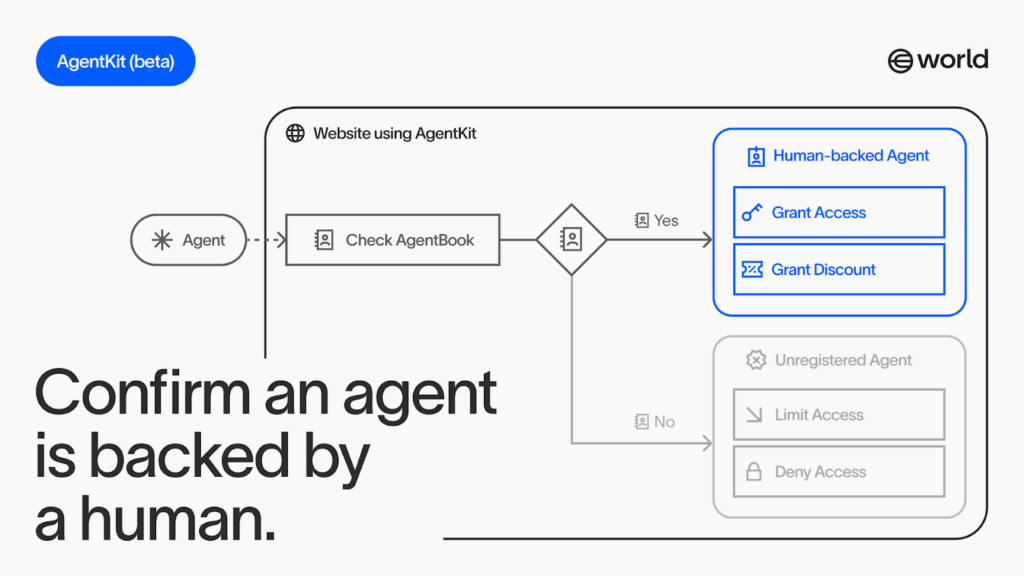
World has launched the beta of AgentKit, a developer toolkit that integrates with the x402 protocol (founded by Coinbase and Cloudflare) to enable AI agents to cryptographically prove they are backed by a unique human via World ID, without revealing the user’s identity. This addresses the growing challenge of trust and accountability in agentic commerce, which is projected to reach $3–5 trillion by 2030. By combining World ID’s privacy-preserving proof-of-humanity with x402’s micropayment system, AgentKit allows platforms to distinguish legitimate human-backed agents from malicious bots, control resource allocation per unique user, and prevent abuse—enabling use cases like fair ticketing, reservations, and trial access. The toolkit is now available to developers, with a more advanced version planned following feedback.

With the release of AgentKit beta, a developer toolkit for the agentic web that works with x402, AI agents will be able to use World ID to carry cryptographic proof of a unique person. Developers may create AI agents that can demonstrate that a real person is behind them while interacting with websites, APIs, and online services thanks to the toolkit’s integration as an extension of x402, an open protocol founded by Coinbase and Cloudflare.

Online operations that formerly needed direct human involvement, such as booking reservations and checking pricing among merchants, are increasingly being handled by AI agents. According to industry estimates, agentic commerce might reach $3 trillion to $5 trillion worldwide by 2030, with AI agents perhaps making up as much as 25% of e-commerce in the United States at that time. Establishing trust and responsibility in automated interactions is an increasing difficulty for developers and platforms as agents become online economic actors.

By allowing verified people to assign their World ID to AI agents, AgentKit solves this problem. By using this notion, developers may create what World calls “human-backed agents,” which are able to cryptographically demonstrate that a genuine, distinct person is behind them without disclosing the identity of the person.

“Payments are the ‘how’ of agentic commerce, but identity is the ‘who.’ By integrating World ID with the x402 protocol, developers now have a complete trust stack: a way for agents to pay for what they need and a way for platforms to verify there is a real human behind the wallet. This is a massive step toward a web where agents aren’t just seen as automated traffic, but as legitimate economic participants,” says Erik Reppel, Head of Engineering at Coinbase Developer Platform and Founder of x402.

“As AI agents start acting on behalf of users across the internet, the key challenge is separating legitimate, human-backed agents from bot swarms. Payment requirements can slow down abuse, but they don’t indicate how many real people are behind the activity. Proof of human addresses this gap by allowing websites to verify that an agent represents a unique person without revealing who that person is,” said DC Builder, Research Engineer at World Foundation.

Nowadays, the majority of websites see automated traffic as potentially dangerous and often completely prohibit it. This method stops productive AI agents from engaging with internet services, even though it was initially intended to combat malevolent bots. Agents often run into the same limitations intended to stop exploitation when they try to do activities like making reservations or accessing APIs.

New protocols have started looking at methods to make online agent action possible. Micropayments are introduced by the x402 protocol to allow agents to access resources and APIs while restricting excessive bandwidth. The x402 protocol has handled over 100 million payments via apps, APIs, and AI agents since its 2025 debut.

Micropayments provide a way to control access, but they don’t solve the issue of uniqueness or identification. It is difficult for platforms to discern between coordinated behavior and genuine users since a single person might run thousands of agents that can pay tiny fees. Additionally, payments by themselves generate public transaction trails that may reveal comprehensive records of an agent’s actions.

A supplementary signal, proof of unique human, is introduced by AgentKit. Without disclosing personal information, people may use World ID to cryptographically demonstrate their uniqueness as human beings. This feature is extended to AI agents by AgentKit, which enables platforms and websites to confirm that an agent is supported by a real person while protecting privacy.

Websites that currently use x402 may seek verification of unique human identity in addition to or instead of micropayments thanks to the toolkit’s integration with the x402 protocol. Verified World ID holders may use standard verification procedures to register their agents. Before allowing access, the platform may ask for payment, evidence of a unique person, or both when an agent visits a website that is compatible.

Although a single person may assign their World ID to many agents, platforms are able to identify that the agents come from the same person. This enables websites to detect abuse, establish limitations, and distribute resources based on the number of distinct persons interacting rather than the number of agents.

Numerous possible use cases are supported by the paradigm. Reservation systems might prevent scalpers from using a lot of automated agents to stockpile bookings while enabling human-backed agents to book tables. Ticketing systems could guarantee that actual fans, not automated networks, buy concert tickets. Instead of allocating access based on wallets or payments, websites that provide free trials might do so based on each individual person.

Additionally, AgentKit presents infrastructure that might facilitate services that need distinct identification signals, like age or country of residence, by sharing only relevant information using privacy-preserving zero knowledge proofs. Platforms may better control access while safeguarding user privacy by confirming the number of unique people responsible for agent activity.

Nearly 18 million verified people from more than 160 countries make up World’s network. With World ID, users may use cryptographic verification to anonymously demonstrate their uniqueness, enabling platforms to create trust signals without gathering or retaining personal information.

Developers creating AI agents with a validated World ID may now use the AgentKit beta. Developer access and documentation are accessible here.

A more sophisticated version is anticipated when the next iteration of the protocol is launched. The present beta version is based on the World ID architecture. The first release aims to collect developer input and show how proof of unique human may be extended to the expanding autonomous agent ecosystem.

World is meant to be the biggest, most inclusive network of actual people on the planet. The initiative, which was first conceptualized by Sam Altman, Max Novendstern, and Alex Blania, seeks to demonstrate humanity, finance, and connection for all people in the era of artificial intelligence. Visit world.org and X to learn more about the world.

TagsAltcoinBlockchain

Связанные с этим вопросы

QWhat is AgentKit and what problem does it aim to solve?

AAgentKit is a developer toolkit for the agentic web that integrates with the x402 protocol. It allows AI agents to cryptographically prove they are backed by a unique, verified human using World ID, without revealing the person's identity. It aims to solve the problem of establishing trust and accountability for AI agents operating online, distinguishing legitimate human-backed activity from malicious bot swarms.

QHow does the integration of World ID with the x402 protocol create a 'complete trust stack'?

AThe integration combines two key components: the x402 protocol provides a micropayment system that allows agents to pay for the resources and APIs they use (the 'how'), while World ID provides proof of a unique human behind the agent (the 'who'). This gives developers a way for agents to transact and a way for platforms to verify there is a real human behind the wallet, creating a more trustworthy ecosystem for agentic commerce.

QWhy are micropayments alone insufficient for managing AI agent access, and how does AgentKit address this?

AMicropayments control access but don't solve the issue of uniqueness or identity. A single person could run thousands of agents that can all pay tiny fees, making it hard to distinguish coordinated abuse from genuine users. AgentKit addresses this by adding a supplementary signal: proof of a unique human. This allows platforms to verify that an agent represents a distinct person, enabling them to be allocated based on the number of people, not the number of agents or wallets.

QWhat are some potential use cases for human-verified AI agents as described in the article?

APotential use cases include: reservation systems preventing scalpers from using automated agents to hoard bookings; ticketing systems ensuring concert tickets are bought by real fans, not bots; and websites offering free trials allocating access based on unique individuals rather than wallets or payments. It also enables services that require verification of specific attributes like age or country using privacy-preserving zero-knowledge proofs.

QWhat is the current status of AgentKit and what are the future plans?

AAgentKit is currently in a beta release, which is based on the existing World ID architecture. The goal of this initial release is to gather developer feedback and demonstrate how proof of unique human can be extended to autonomous agents. A more sophisticated version is anticipated with the launch of the next iteration of the protocol.

Похожее

North Korean Hackers Loot $500 Million in a Single Month, Becoming the Top Threat to Crypto Security

North Korean hackers, particularly the notorious Lazarus Group and its subgroup TraderTraitor, have stolen over $500 million from cryptocurrency DeFi platforms in less than three weeks, bringing their total theft for the year to over $700 million. Recent major attacks on Drift Protocol and KelpDAO, resulting in losses of approximately $286 million and $290 million respectively, highlight a strategic shift: instead of targeting core smart contracts, attackers are now exploiting vulnerabilities in peripheral infrastructure. For instance, the KelpDAO attack involved compromising downstream RPC infrastructure used by LayerZero's decentralized validation network (DVN), allowing manipulation without breaching core cryptography. This sophisticated approach mirrors advanced corporate cyber-espionage. Additionally, North Korea has systematically infiltrated the global crypto workforce, with an estimated 100 operatives using fake identities to gain employment at blockchain companies, enabling long-term access to sensitive systems and facilitating large-scale thefts. According to Chainalysis, North Korean-linked hackers stole a record $2 billion in 2025, accounting for 60% of all global crypto theft that year. Their total historical crypto theft has reached $6.75 billion. Post-theft, they employ specialized money laundering methods, heavily relying on Chinese OTC brokers and cross-chain mixing services rather than standard decentralized exchanges. Security experts, while acknowledging the increased sophistication, emphasize that many attacks still exploit fundamental weaknesses like poor access controls and centralized operational risks. Strengthening private key management, limiting privileged access, and enhancing coordination among exchanges, analysts, and law enforcement immediately after an attack are critical to improving defense and fund recovery chances. The industry's challenge now extends beyond secure smart contracts to safeguarding operational security at the infrastructure level.

marsbit34 мин. назад

North Korean Hackers Loot $500 Million in a Single Month, Becoming the Top Threat to Crypto Security

marsbit34 мин. назад

Circle CEO's Seoul Visit: No Korean Won Stablecoin Issuance, But Met All Major Korean Banks

Circle CEO Jeremy Allaire's recent activities in Seoul indicate a strategic shift for the company, moving away from issuing a Korean won-backed stablecoin and instead focusing on embedding itself as a key infrastructure provider within Korea’s financial and crypto ecosystem. Despite Korea accounting for nearly 30% of global crypto trading volume—with a market characterized by high retail participation and altcoin dominance—Circle has chosen not to compete for the role of stablecoin issuer. Instead, Allaire met with major Korean banks (including Shinhan, KB, and Woori), financial groups, leading exchanges (Upbit, Bithumb, Coinone), and tech firms like Kakao. This approach reflects a broader industry transition: the core of stablecoin competition is shifting from issuance rights to systemic positioning. With Korean regulators still debating whether banks or tech companies should issue stablecoins, Circle is avoiding regulatory uncertainty by strengthening its role as a service and technology partner. The company is deepening integration with trading platforms, building connections, and promoting stablecoin infrastructure. This positions Circle to benefit regardless of which entity eventually issues a won stablecoin. Allaire also noted the potential for a Chinese yuan stablecoin in the next 3–5 years, underscoring a regional trend of stablecoins becoming more regulated and integrated with traditional finance. Ultimately, Circle’s strategy highlights that future influence in the stablecoin market will belong not necessarily to the issuers, but to the foundational infrastructure layers that enable cross-system transactions.

marsbit1 ч. назад

Circle CEO's Seoul Visit: No Korean Won Stablecoin Issuance, But Met All Major Korean Banks

marsbit1 ч. назад

SpaceX Ties Up with Cursor: A High-Stakes AI Gambit of 'Lock First, Acquire Later'

SpaceX has secured an option to acquire AI programming company Cursor for $60 billion, with an alternative clause requiring a $10 billion collaboration fee if the acquisition does not proceed. This structure is not merely a potential acquisition but a strategic move to control core access points in the AI era. The deal is designed as a flexible, dual-path arrangement, allowing SpaceX to either fully acquire Cursor or maintain a binding partnership through high-cost collaboration. This "option-style" approach minimizes immediate regulatory and integration risks while ensuring long-term alignment between the two companies. At its core, the transaction exchanges critical AI-era resources: SpaceX provides its Colossus supercomputing cluster—one of the world’s most powerful AI training infrastructures—while Cursor contributes its AI-native developer environment and strong product adoption. This synergy connects compute power, models, and application layers, forming a closed-loop AI capability stack. Cursor, founded in 2022, has achieved rapid growth with over $1 billion in annual revenue and widespread enterprise adoption. Its value lies in transforming software development through AI agents capable of coding, debugging, and system design—positioning it as a gateway to future software production. For SpaceX, this move is part of a broader strategy to evolve from a aerospace company into an AI infrastructure empire, integrating xAI, supercomputing, and chip manufacturing. Controlling Cursor fills a gap in its developer tooling layer, strengthening its AI narrative ahead of a potential IPO. The deal reflects a shift in AI competition from model superiority to ecosystem and entry-point control. With programming tools as a key battleground, securing developer loyalty becomes crucial for dominating the software production landscape. Risks include questions around Cursor’s valuation, technical integration challenges, and potential regulatory scrutiny. Nevertheless, the deal underscores a strategic bet: controlling both compute and software development access may redefine power dynamics in the AI-driven future.

marsbit1 ч. назад

SpaceX Ties Up with Cursor: A High-Stakes AI Gambit of 'Lock First, Acquire Later'

marsbit1 ч. назад

Торговля

Спот
Фьючерсы

Популярные статьи

Неделя обучения по популярным токенам (2): 2026 может стать годом приложений реального времени, сектор AI продолжает оставаться в тренде

2025 год — год институциональных инвесторов, в будущем он будет доминировать в приложениях реального времени.

1.8k просмотров всегоОпубликовано 2025.12.16Обновлено 2025.12.16

Неделя обучения по популярным токенам (2): 2026 может стать годом приложений реального времени, сектор AI продолжает оставаться в тренде

Обсуждения

Добро пожаловать в Сообщество HTX. Здесь вы сможете быть в курсе последних новостей о развитии платформы и получить доступ к профессиональной аналитической информации о рынке. Мнения пользователей о цене на AI (AI) представлены ниже.

活动图片