Source:Wintermute
Compiled by | Odaily Planet Daily (@OdailyChina); Translator | Azuma (@azuma_eth)
Editor's Note: On January 13, Wintermute released an analysis report on the cryptocurrency over-the-counter (OTC) market for 2025. As the industry's top market maker, Wintermute is undoubtedly highly sensitive to trends in market liquidity. In this 28-page report, the institution reviews the changes in cryptocurrency market liquidity in 2025 and concludes that — the market is transitioning from clear, narrative-driven cyclical fluctuations to a mechanism with stronger structural constraints and execution dominance. Based on this conclusion, Wintermute also outlines three key scenarios necessary for the market to achieve recovery in 2026.
Below is the content of Wintermute's original report, compiled and edited by Odaily Planet Daily (with some abridgments).

Report Summary
2025 marked a fundamental shift in the liquidity mechanism of the cryptocurrency market. Capital is no longer widely dispersed across the entire market; liquidity has become more concentrated and unevenly distributed, leading to an intensified divergence between returns and market activity. Consequently, a large volume of trading is confined to a few tokens. Rallies have shorter durations, and price performance is more dependent than in previous years on the channels through which liquidity enters the market and how it is deployed.
The following report summarizes the main changes in liquidity and trading dynamics observed by Wintermute in 2025:
- Trading activity is concentrated in a few large tokens. BTC, ETH, and a selection of altcoins account for the majority of trading activity. This reflects the gradual expansion of ETF and Digital Asset Treasury (DAT) products to a broader range of altcoins, as well as the fading of the Meme coin cycle in early 2025.
- Narrative conviction fades faster; altcoin rallies exhaust twice as quickly. Investors no longer follow narratives with sustained conviction but engage in opportunistic trading around themes like Meme coin launch platforms, perpetual contract exchanges, emerging payment and API infrastructure (e.g., x402), with limited follow-through.
- Trading execution becomes more cautious as professional counterparties gain influence. This is manifested in more prudent cyclical trading execution (breaking the previous four-year fixed cycle), broader use of leveraged OTC products, and diversified application of options as core asset allocation tools.
- The way capital enters the crypto market is as important as the overall liquidity environment. Capital is increasingly flowing in through structured channels like ETFs and DATs, affecting where liquidity ultimately flows and accumulates in the market.
This report is primarily based on Wintermute's proprietary OTC data to interpret these market developments. As one of the largest OTC platforms in the industry, Wintermute provides liquidity services across regions, products, and diverse counterparties, offering a unique and comprehensive off-chain perspective on crypto OTC trading. Price movements reflect market outcomes, while OTC activity reveals how risk is deployed, how participant behavior evolves, and which parts of the market remain active. From this perspective, the market structure and liquidity dynamics in 2025 have significantly shifted compared to earlier cycles.
Part1: Spot
Wintermute's OTC data shows that trading activity in 2025 has shifted from being purely volume-driven to a more mature, strategic trading environment. Trading volumes continue to grow, but execution has become more planned, with OTC trading increasingly favored for its block trading capabilities, privacy, and controllability.
Market position deployment has also shifted from simple directional trading to more customized execution solutions and broader use of derivatives and structured products. This indicates that market participants are becoming more experienced and disciplined.
In Wintermute's spot OTC activity, this structural shift is mainly reflected in three aspects:
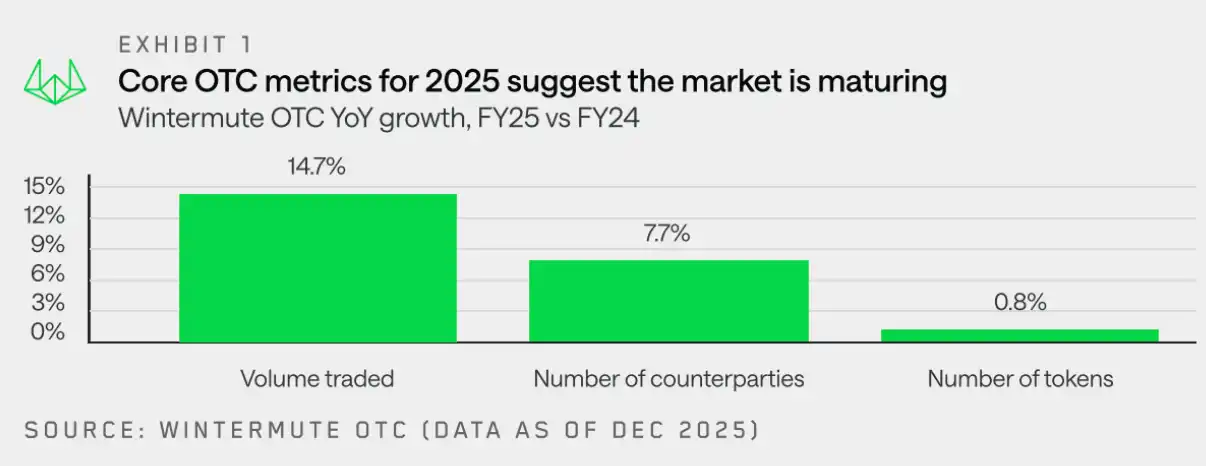
- Volume Growth: OTC trading volume continues to grow, highlighting the persistent market demand for off-chain liquidity and efficient execution of large trades (while limiting market impact).
- Counterparty Growth: The range of participants has expanded further, driven by venture capital funds shifting from pure private placements to liquid markets; corporations and institutions executing block trades via OTC channels; and individual investors seeking traditional venue alternatives beyond centralized and decentralized exchanges.
- Token Landscape: The overall active token range has expanded beyond BTC and ETH, with funds flowing into a broader set of altcoins via DATs and ETFs. Nevertheless, full-year position data shows that both institutions and retail returned to major tokens after the major liquidation on October 11, 2025. Altcoin rallies were shorter-lived and more selective, reflecting the fading Meme coin cycle and an overall contraction in market breadth as liquidity and venture capital became more selective.
Next, Wintermute provides further detailed analysis on these three aspects.
Volume Growth: Cyclical Patterns Replaced by Short-Term Volatility
"2025 was characterized by choppy markets, with price movements driven primarily by short-term trends rather than longer-term seasonal changes."
Wintermute's OTC data shows that trading activity in 2025 exhibited a distinctly different seasonal pattern, significantly diverging from previous years. Market optimism about the new pro-crypto US administration quickly faded, and risk sentiment deteriorated sharply by the end of Q1 as Meme coin and AI Agent narratives cooled. Top-down negative news, such as Trump's announcement of tariffs on April 2, 2025, further pressured the market.
As a result, market activity in 2025 was concentrated in the first half of the year, starting strong before weakening broadly through spring and early summer. The year-end rally seen in 2023 and 2024 did not materialize, breaking what had seemed like an established seasonal pattern — often reinforced by narratives like "Uptober." In reality, this was never a true seasonal pattern but rather year-end rallies driven by specific catalysts, such as the ETF approval in 2023 and the new US administration in 2024.
Entering Q1 2025, the upward momentum from Q4 2024 never fully recovered. Market volatility increased, and with macro factors dominating market direction, price action featured more short-term swings than sustained trends.
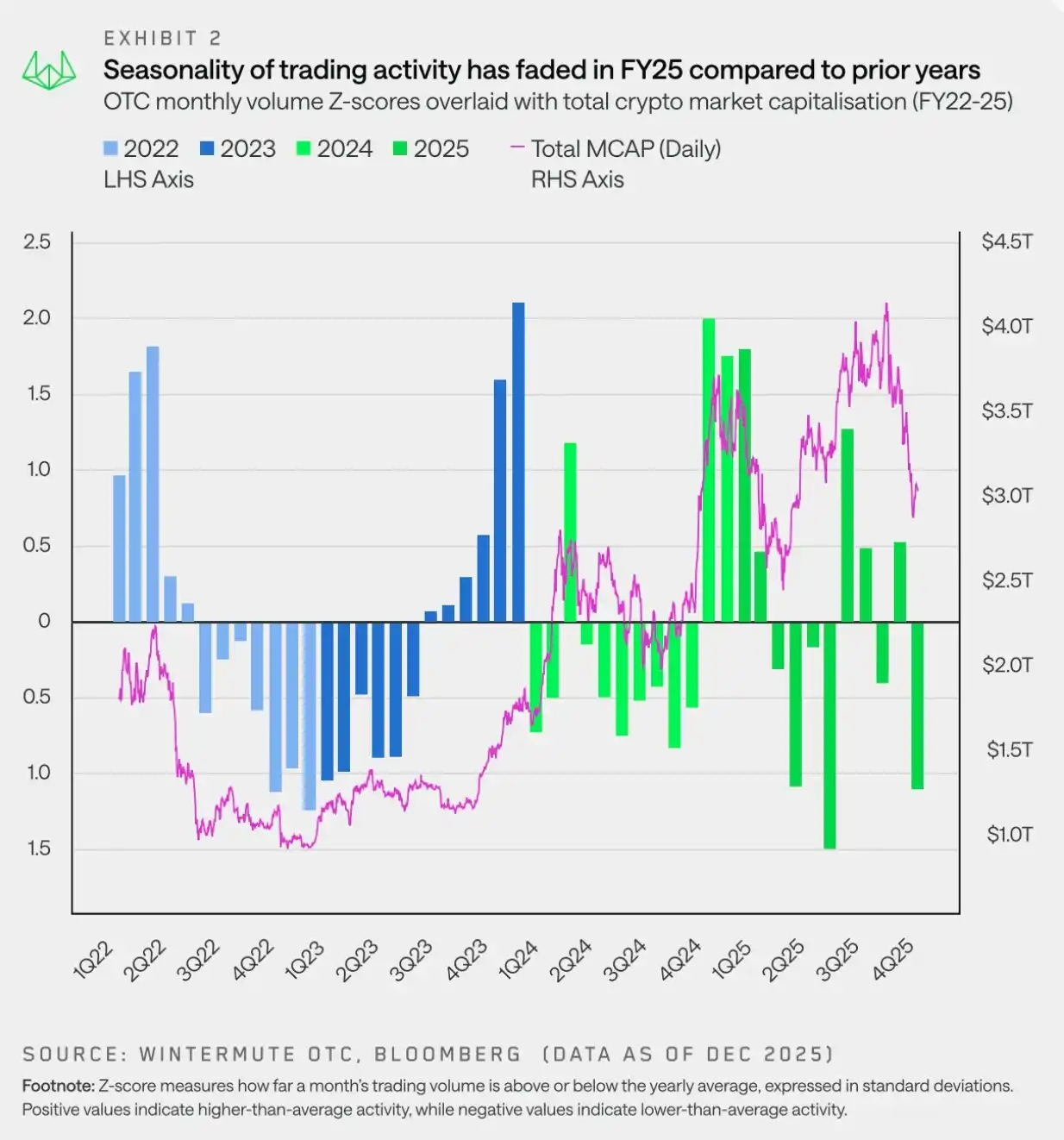
In short, flows became passive and intermittent, pulsing around macro headlines but showing no sustained momentum. In this choppy environment, OTC trading remained the execution method of choice as market liquidity thinned and execution certainty became increasingly important.
Counterparties: Deepening Institutional Roots
"Despite flat price action in 2025, institutional counterparties are here to stay."
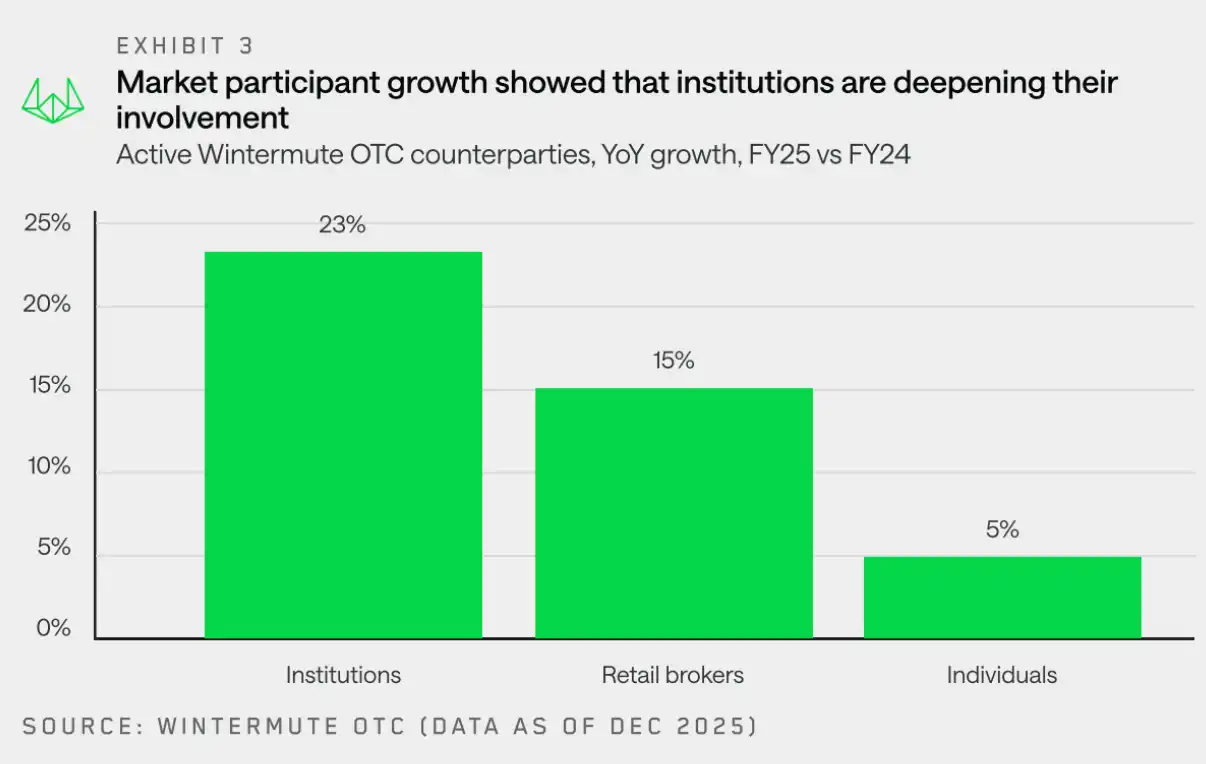
Wintermute observed strong growth across most counterparty types, with the largest increases coming from institutions and retail brokers. Within the institutional category, growth from traditional financial institutions and corporations remained modest, but their participation deepened significantly — activity became more sustained and increasingly focused on prudent execution strategies.
Despite the flat market performance in 2025, institutions have clearly established a foothold. Compared to last year's more tentative and sporadic participation, 2025 was characterized by deeper integration, larger trade sizes, and more frequent activity. These are constructive and positive signals for the industry's long-term future.
Token Landscape: Increasing Diversification at the Top
"Volume is increasingly flowing to large tokens beyond BTC and ETH, a trend driven by both DATs and ETFs."
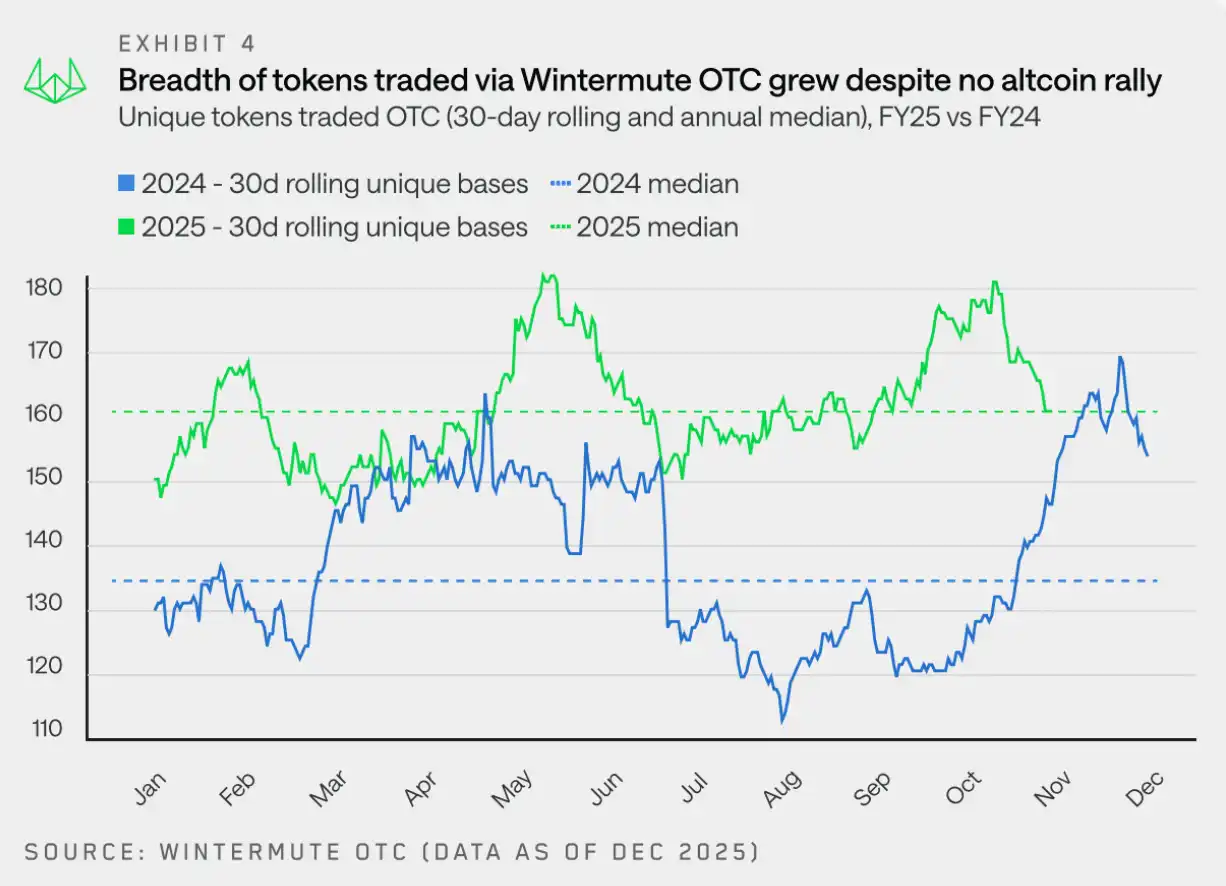
In 2025, the total number of tokens traded overall remained steady. However, based on a 30-day rolling average, Wintermute traded an average of 160 different tokens, up from 133 in 2024. This indicates that OTC activity expanded to a broader and more stable range of tokens.
The key difference from 2024 is: token activity in 2025 was less driven by hype cycles — the range of tokens traded remained relatively stable throughout the year, rather than experiencing sharp spikes in token breadth around specific themes or narratives.
Since 2023, Wintermute's total notional trading volume has become increasingly diversified, and the share of volume from other segments has surpassed that of BTC plus ETH. Although BTC and ETH remain significant components of the trading flow, their combined share of total volume has decreased from 54% in 2023 to 49% in 2025.
Notably, where did these flows go — while the share of volume from long-tail tokens continued to decline, blue-chip assets (top 10 assets by market cap, excluding BTC, ETH, wrapped assets, and stablecoins) increased their share of total notional volume by 8 percentage points over the past two years.
Although there was some concentration into large-cap tokens by funds and individuals this year, the growth in volume was also aided by ETFs and DATs expanding their investment scope beyond the very largest assets. DATs gained mandates to invest in these assets, and ETFs also broadened their offerings, including staking ETFs (e.g., for SOL) and index funds.
These investment vehicles continue to favor OTC trading over exchange trading, especially where the required liquidity is not available on exchanges.
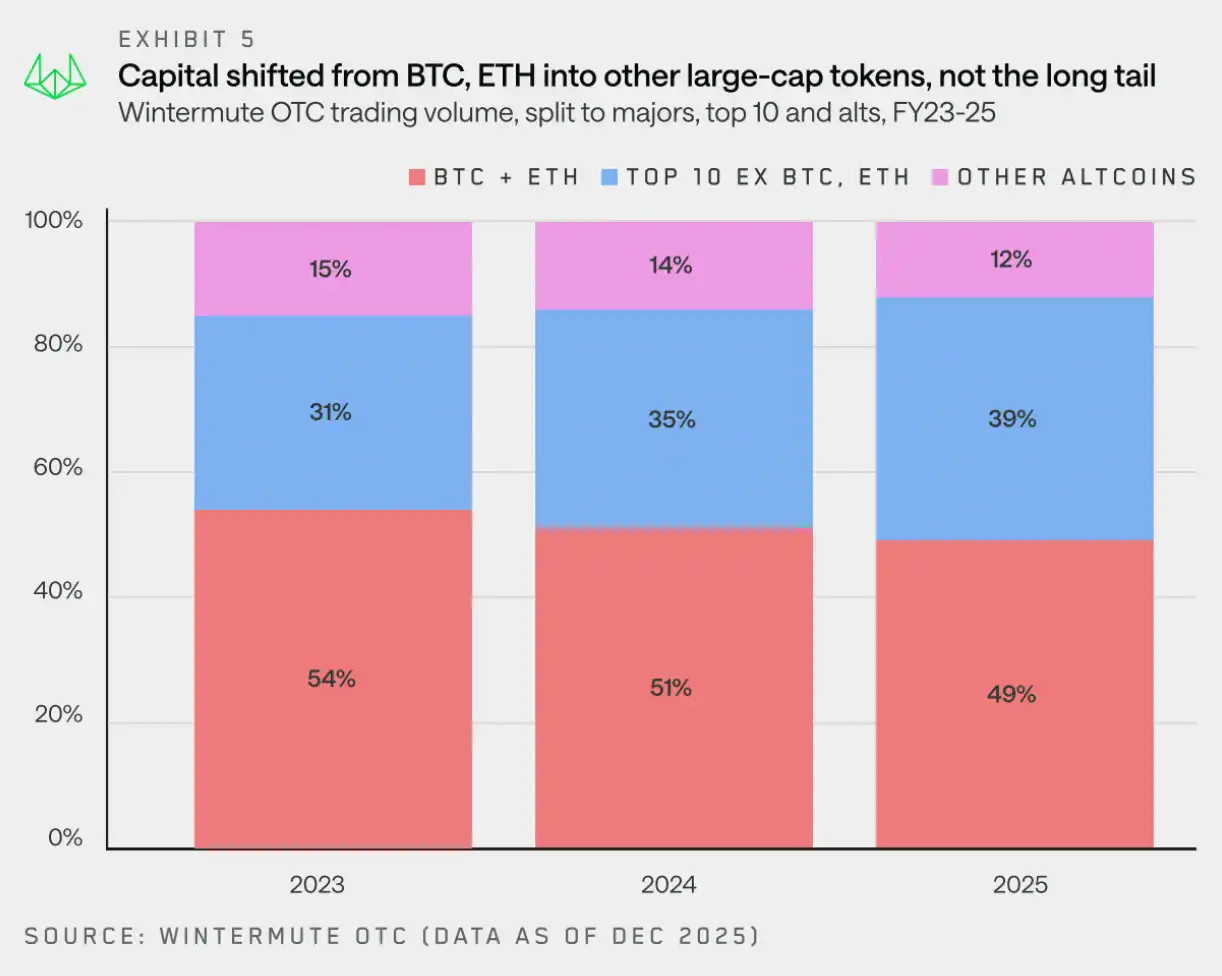
Spot Flow Analysis by Token Type
Major Coins: Gradual Return of Funds by Year-End
"By the end of 2025, both institutions and retail investors were reallocating back to major coins, suggesting they anticipate major coins will lead any recovery before altcoins."
As altcoin narratives faded and macro uncertainties resurfaced in early 2025, capital allocation shifted back to BTC and ETH. Wintermute's OTC flow data shows that institutional investors maintained an overweight in major coins starting in Q2 2025; however, retail investors shifted to altcoins in Q2 and Q3 2025, hoping for an altcoin market rebound, but quickly rotated back to major coins after the October 11 deleveraging event.
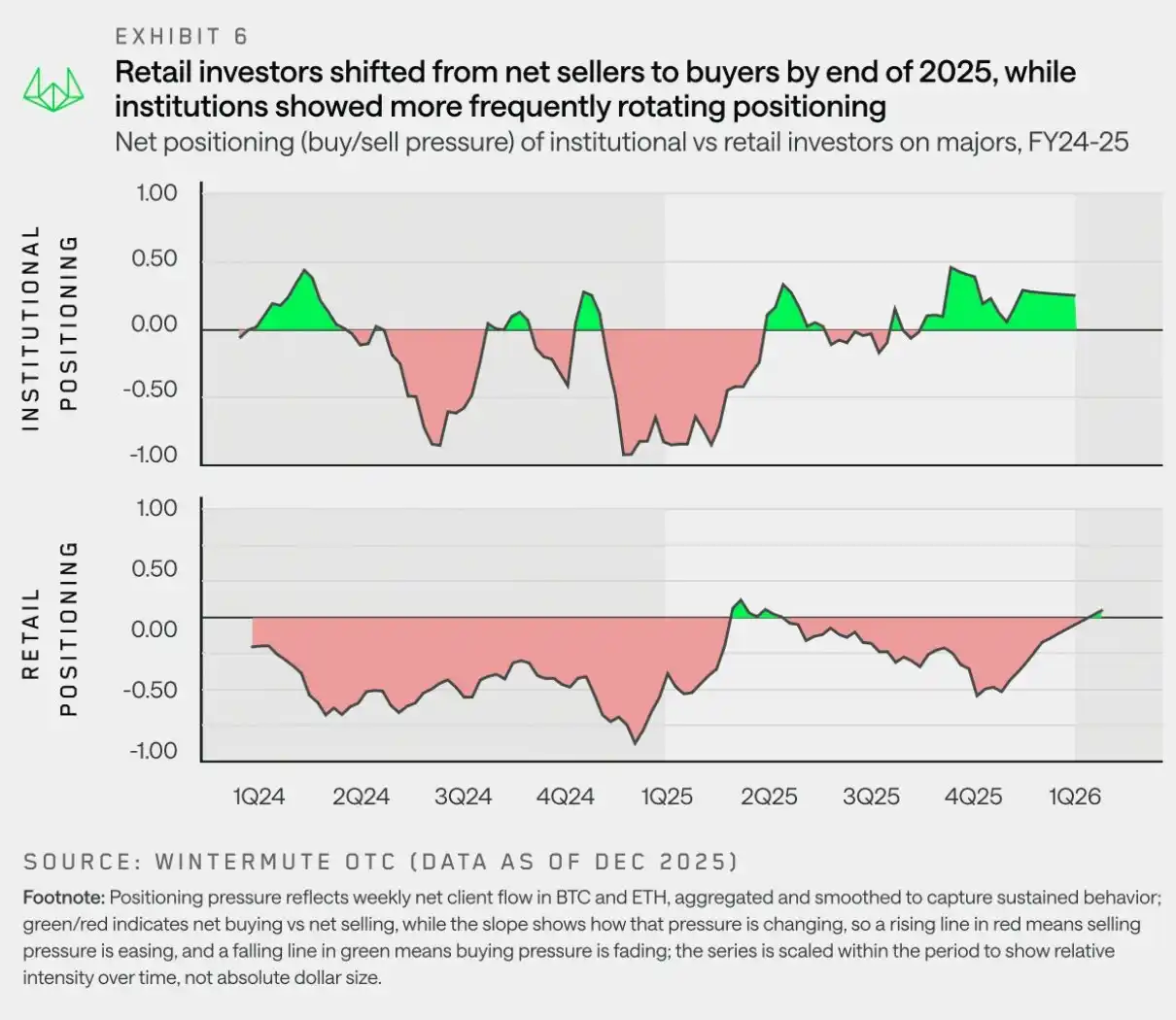
The shift towards major coins was driven by market fatigue, as the "altseason" never truly commenced, leading to gradual disappointment. This trend was initially led by institutions (long-term net buyers of major coins), but by year-end, retail also became net buyers.
This positioning aligns with the prevailing market view: BTC (and ETH) needs to lead the market first before risk appetite returns to altcoins. Retail now seems to increasingly share this view.
Altcoins: Shorter-Lived Rallies
"In 2025, the average duration of narrative-driven altcoin rallies was approximately 19 days, significantly shorter than the 61 days of the previous year, indicating a degree of fatigue after last year's excessive gains."
Altcoins significantly underperformed overall in 2025, with comprehensive annual returns sharply negative and failing to achieve any meaningful sustained recovery beyond brief bounces. While individual themes attracted attention sporadically, they struggled to build momentum or translate into broader market participation. From a flow perspective, this was not due to a lack of narratives but clear signs of exhaustion — rallies were repeatedly tested but quickly faded as conviction failed to materialize.
To understand this dynamic, we look beyond price and focus on persistence analysis. Here, "persistence" is defined as the duration for which altcoin participation in OTC flows remains above recent normal levels. Operationally, the persistence metric measures whether a rally attracts sustained follow-through or if market activity dissipates quickly after initial volatility. This perspective allows us to distinguish sustained altcoin rallies from intermittent, rotational bursts that fail to evolve into broad trends.
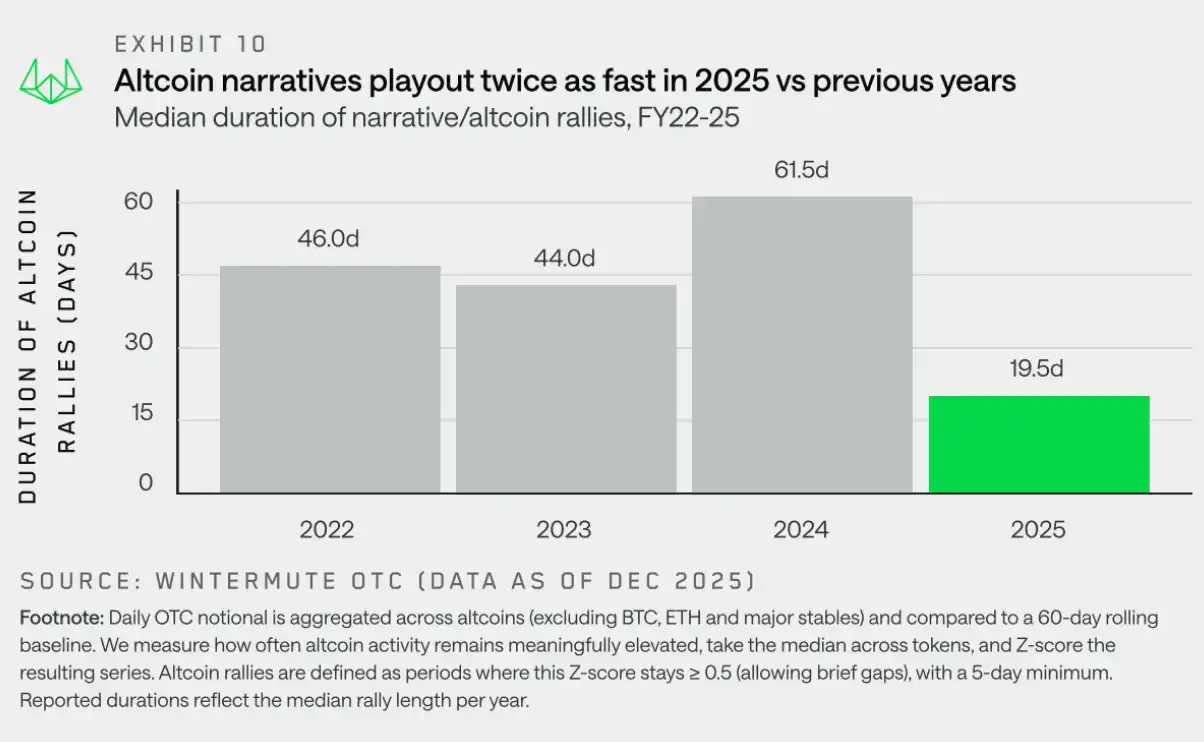
The chart above shows a clear shift in altcoin rally dynamics. Between 2022 and 2024, altcoin rallies typically lasted around 45 to 60 days, with 2024 being a strong year for BTC, driving wealth effects rotating into altcoins and sustaining narratives like Meme coins and AI. In 2025, despite new narratives emerging, including Meme coin launch platforms, Perp DEXs, and the x402 concept, the median persistence plummeted to around 20 days.
These narratives could trigger brief market activity but failed to develop into lasting, market-wide rallies. This reflects the volatile macro environment, market fatigue after last year's excessive gains, and insufficient altcoin liquidity to support narratives beyond the initial stages. The result is that altcoin rallies resemble tactical trades rather than high-conviction trend plays.
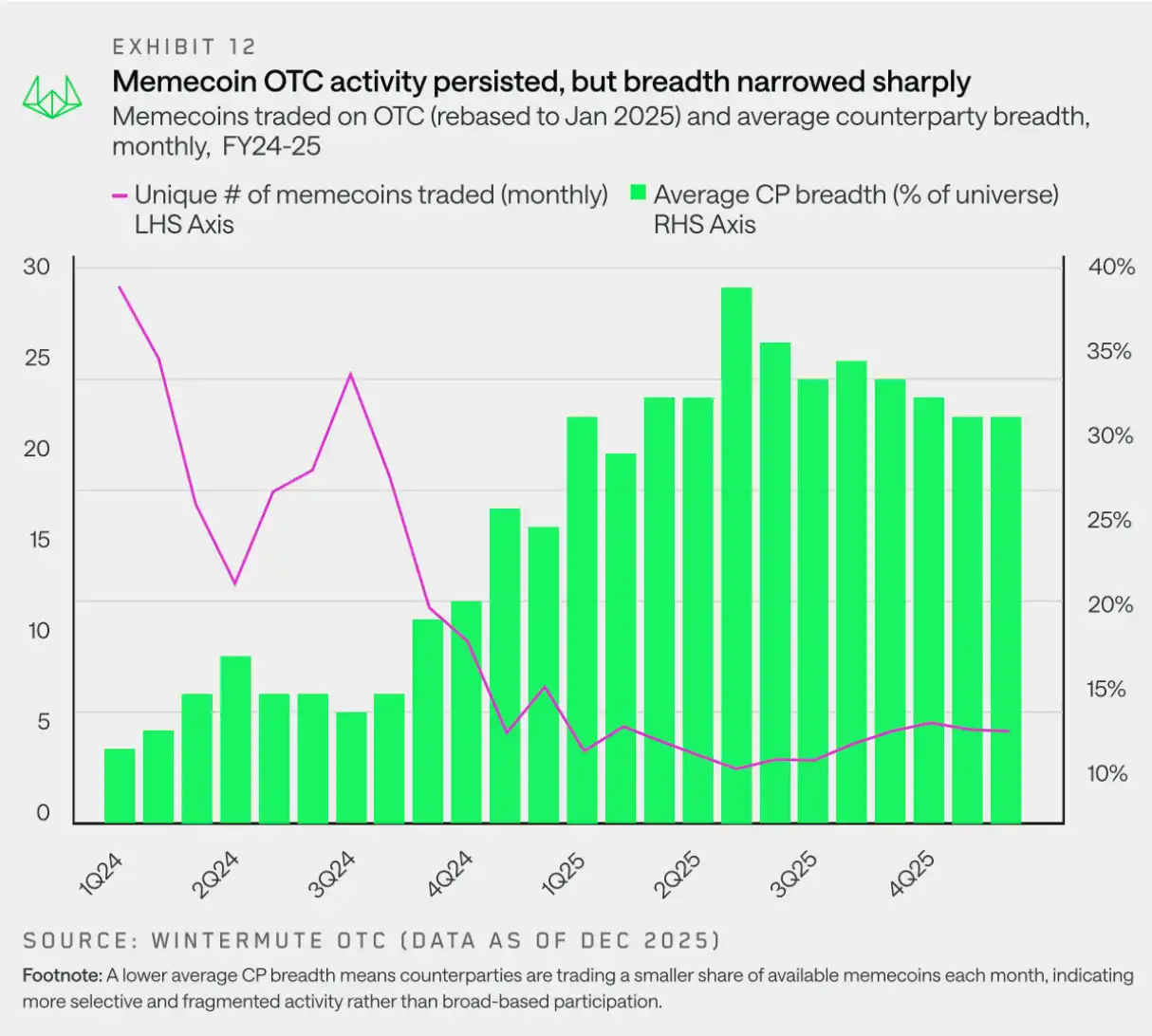
Meme Coins: Narrowing Active Range
"Meme coins failed to recover after peaking in Q1 2025, as trading became fragmented and narrow, unable to regain support."
Meme coins entered 2025 as the most crowded segment, characterized by intense issuance, persistently bullish sentiment, and price action reinforcing narratives, but this came to an abrupt halt. Unlike other higher-beta segments, meme coins turned down earlier and more decisively and never regained upward momentum.
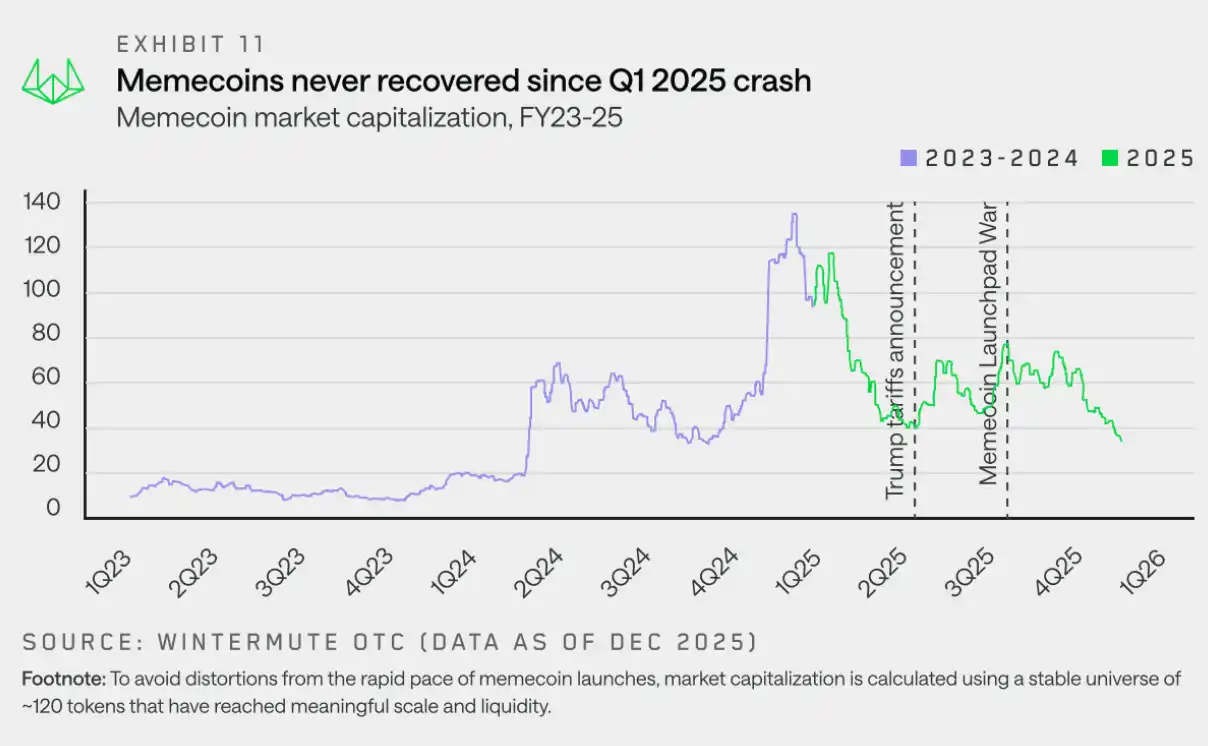
Alongside the sharp price retracement, the absolute number of Meme coins traded OTC remained healthy at any given time. Even by the end of 2025, the monthly number of tokens traded remained above 20, indicating that trading interest did not disappear. The change was in how activity manifested. In practice, this meant a significant reduction in the number of tokens counterparties traded per month, with activity concentrated in specific tokens rather than broad trading across the Meme coin universe.
Part 2: Derivatives
Wintermute's OTC derivatives data shows strong growth, with increased market volatility and larger trades making OTC the preferred venue for executing complex, capital-efficient structured products, offering price certainty and operational privacy.
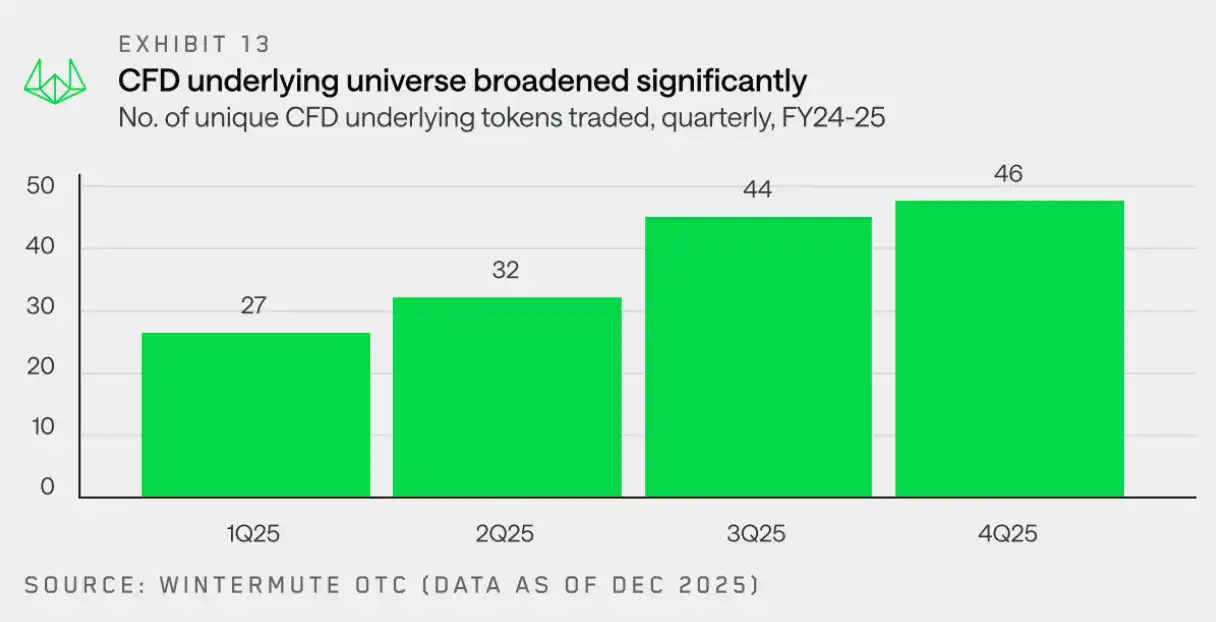
CFDs: Expanding Underlying Assets
"In 2025, the range of underlying assets for CFDs further expanded, with futures increasingly favored as a capital-efficient way to gain market exposure."
The number of tokens used as underlying assets for CFDs on Wintermute's OTC desk tripled year-over-year, growing from 15 in Q4 2024 to 46 in Q4 2025. This continued growth reflects the market's increasing adaptation to CFDs as a capital-efficient way to gain exposure to a wider range of assets, including long-tail tokens.
The growing demand for CFDs reflects a broader market shift towards using futures for capital-efficient exposure. Perpetual futures open interest grew from $120 billion at the start of the year to $245 billion in October, before risk appetite sharply retreated during the October 11 liquidation event.
Options: Increasing Strategic Complexity
"As systematic strategies and yield generation become key drivers of volume growth, the options market is rapidly maturing."
Building on the earlier升温 of CFD and futures activity, Wintermute's OTC data shows that counterparties are increasingly turning to options to build more customized and complex crypto asset exposure.
This shift drove sharp growth in options market activity: from Q4 2024 to Q4 2025, both notional turnover and trade count grew approximately 2.5x year-over-year. This was primarily driven by more counterparties — especially crypto funds and digital asset treasuries — adopting options strategies for passive yield generation.
The chart below tracks quarterly OTC options activity relative to Q1 2025, clearly showing growth throughout 2025. By Q4, notional turnover reached 3.8x that of Q1, and trade count reached 2.1x, highlighting continued growth in both average trade size and trade frequency.
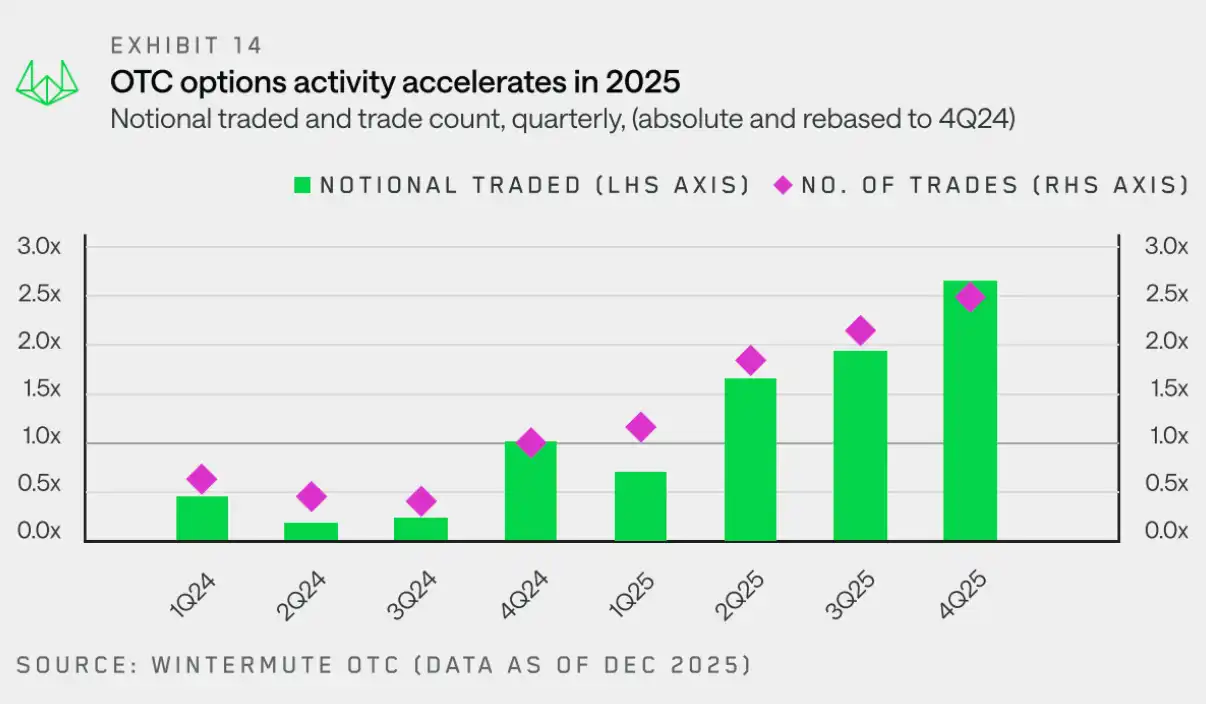
Part of the growth in notional turnover stemmed from the rise of systematic options strategies, which involve continuously maintaining exposure and rolling positions over time. This marks an important shift from previous years — when options were more often used to express pure directional views.
To understand the evolution of options flows, we look further at BTC (which still constituted a large share of 2025 notional volume). The chart below shows the quarterly distribution of long/short call/put positions.
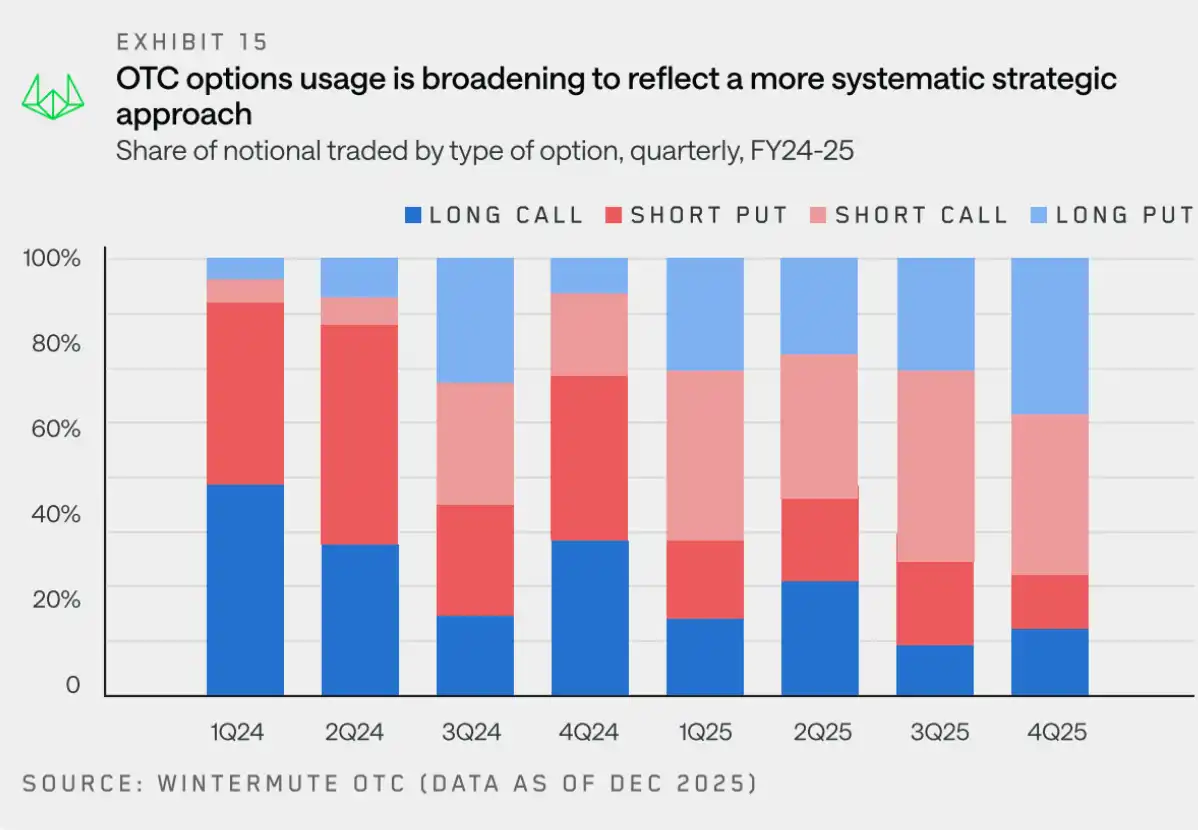
The composition of BTC options flows in 5 reflects a clear shift: from focus on upside via call buying to a more balanced use of calls and puts, with activity重心 increasingly on yield generation and structured, repeatable strategies. Yield strategies have become more prevalent, with investors selling puts and covered calls to earn yield, adding a steady supply of options and suppressing volatility. Meanwhile, demand for downside protection remained strong as BTC failed to break to new highs, with put buying consistently used. Overall, the market focused more on earning yield and managing risk than betting on further upside.
The reduction in naked call buying further confirms that options are being used less for directional upside exposure and more for executing systematic strategies. These dynamics collectively indicate that the options market matured significantly in 2025 compared to previous years, with a more professional user base.
Part 3: Liquidity
Cryptocurrencies have historically been an outlet for excess risk appetite. With weak valuation anchors, embedded leverage, and high dependence on marginal flows, cryptocurrency prices are extremely sensitive to changes in the global financial environment. When liquidity is loose, risk tolerance rises, and capital naturally flows into crypto; when the environment tightens, the lack of structural buying is quickly exposed. Therefore, cryptocurrencies have been and will remain fundamentally dependent on global liquidity.
In 2025, the macro environment was a key driver of crypto prices. Although the current backdrop features moderating interest rates, improving liquidity, and strong economic growth — factors that typically support risk asset prices — the crypto market's performance remained weak. We believe this disconnect stems from two key reasons: retail attention and new liquidity channels.
Retail Attention: Crypto is No Longer the "Go-To" Risk Asset
"In 2025, cryptocurrency lost its status as the go-to risk asset for retail investors."
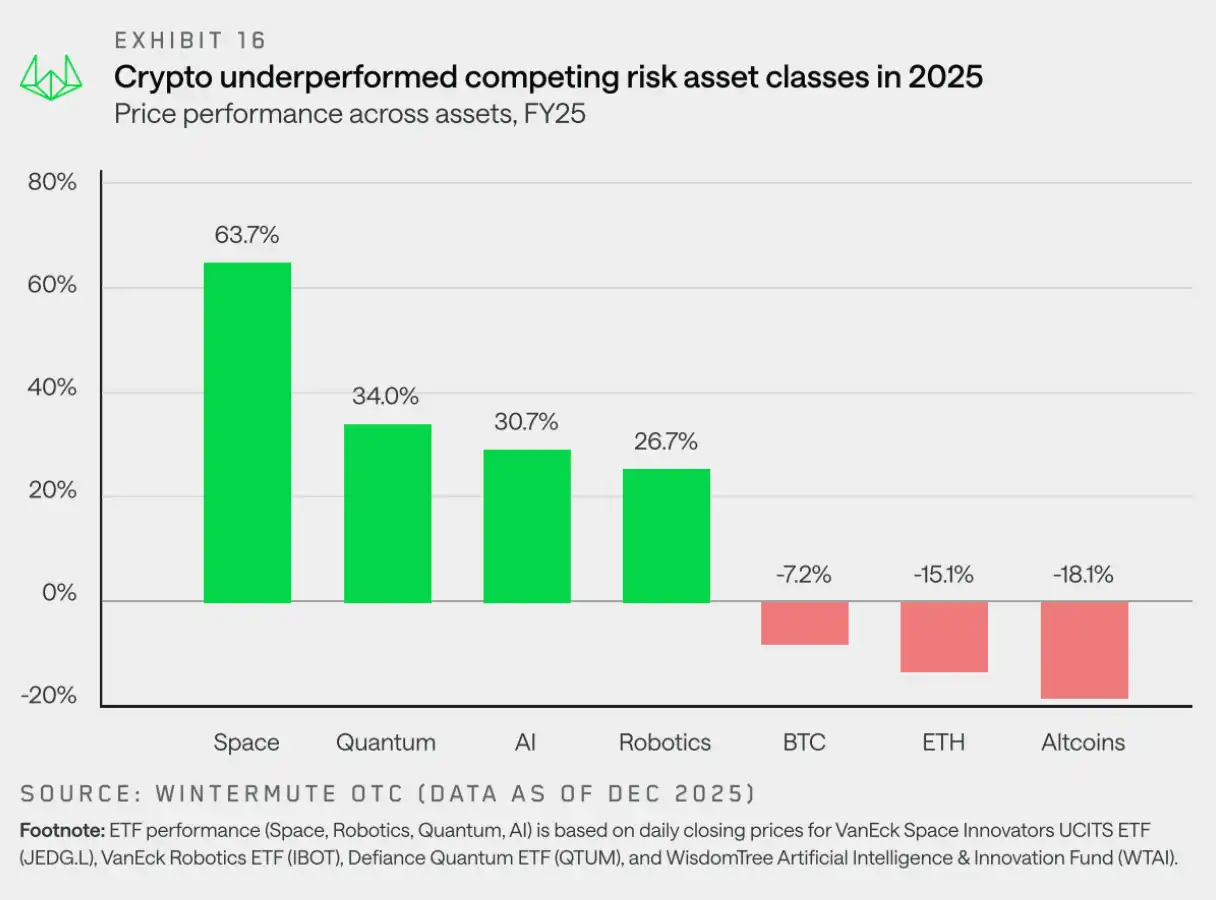
Despite increased institutional participation, retail remains the cornerstone of the crypto market. A significant reason for the poor market performance in 2025 was the fragmentation of retail attention and the diminished rotation effect of crypto assets as the preferred risk asset.
While many factors are at play, two stand out: Technological advancements have lowered market entry barriers, making other investment opportunities (especially in areas like AI) more accessible; these assets offer similar risk profiles, narratives, and return potential, diverting attention from the crypto space. Simultaneously, we are experiencing a normalization post-2024 — a year of extremely high retail participation, first concentrated in Meme coins and later shifting to AI agents in year-end. A return to normalcy was inevitable.
Consequently, retail investors favored equity themes like AI, robotics, and quantum technology, while BTC, ETH, and most altcoins lagged among major risk assets. Cryptocurrency is no longer the default outlet for excess risk-taking.
Liquidity Channels: ETFs and DATs as New Pathways
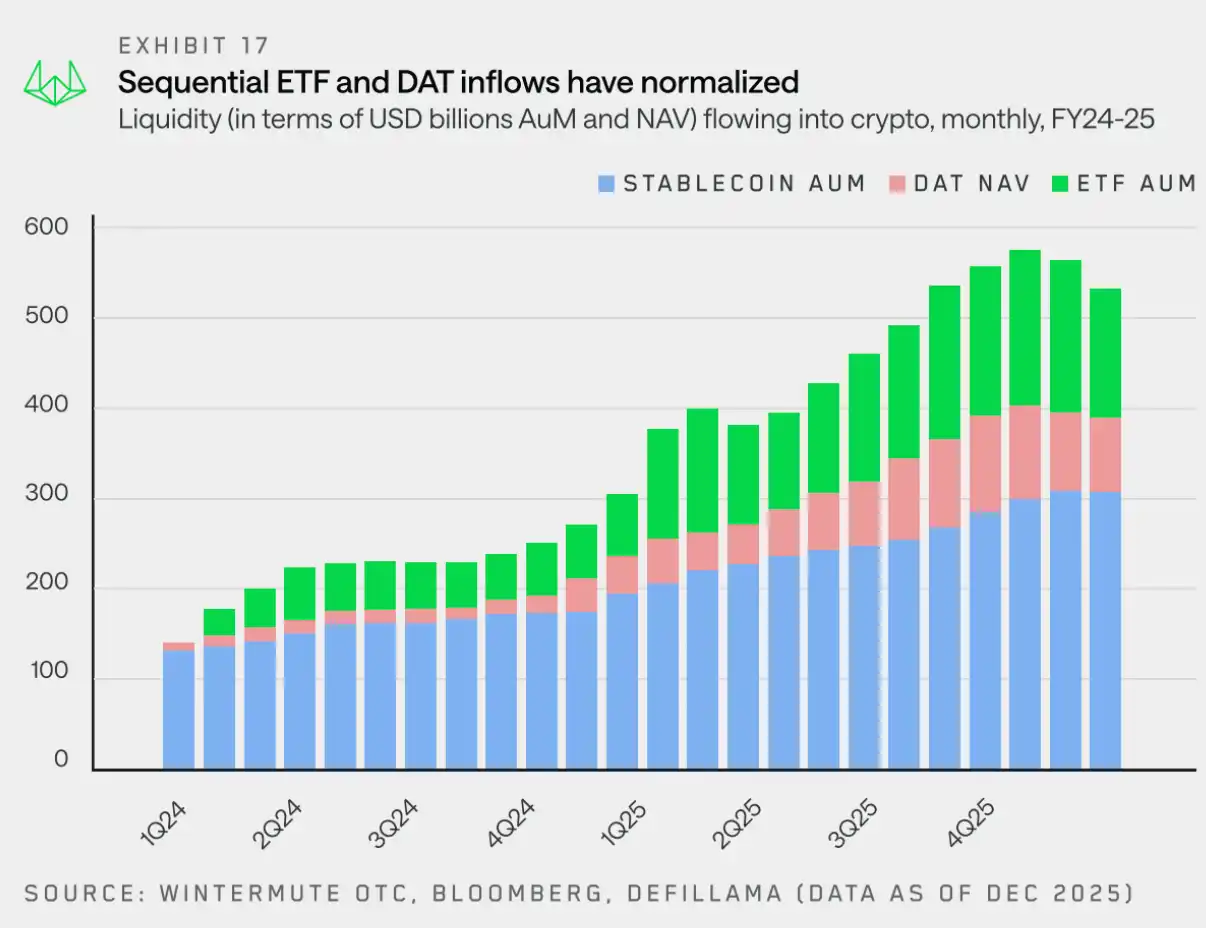
"Today, ETFs and DATs, alongside stablecoins, have become significant channels driving capital into the crypto market."
BTC and ETH prices declined slightly, but the largest relative weakness appeared in the altcoin space. Beyond weak retail participation, a key factor is the shift in how liquidity and capital enter the market.
Until two years ago, stablecoins and direct investment were the primary channels for capital entering the crypto market. However, ETFs and DATs have structurally altered the path through which liquidity enters the ecosystem.
Earlier this year, we categorized crypto liquidity into three core pillars: stablecoins, ETFs, and DATs. Together, they constitute the main channels for capital inflows into the crypto market.
- Stablecoins became one of many entry points: They remain crucial for settlement and collateral but now share the role of capital entry rather than dominating it.
- ETFs channel liquidity to the top two assets: Constrained inflows enhance the depth and resilience of major assets but have limited spillover effects beyond BTC and ETH.
- DATs introduce stable, non-recycled demand: Treasury allocations further reinforce concentration in major assets, absorbing liquidity without naturally broadening risk appetite.
Liquidity doesn't flow solely through ETFs and DATs, but the chart above shows how significant these channels have become. As mentioned earlier, their investment scope is expanding and beginning to allow exposure beyond BTC and ETH, primarily involving other blue-chip tokens. However, this process is gradual, so benefits for the altcoin market will take time to materialize.
In 2025, cryptocurrencies were no longer driven by broad market cycles. Instead, rallies were limited to the few assets where liquidity concentrated, while the majority of the market underperformed. Looking ahead to 2026, market performance will depend on whether liquidity diffuses to more tokens or continues to concentrate in a few large ones.
2026 Market Outlook: Moving Beyond Pure Cyclical Models
"2025's failure to deliver the expected rally may signal that cryptocurrency is beginning to transition from a speculative asset to a mature asset class."
Market performance in 2025 proved that the traditional four-year cycle model is gradually becoming ineffective. Our observations suggest that market performance is no longer driven by self-fulfilling four-year narratives but depends on liquidity flows and investor focus.
Historically, native crypto wealth acted like a single, fungible pool of capital, where Bitcoin gains would naturally spill over into major coins and then into altcoins. Wintermute's OTC data shows that this trickle-down effect has significantly weakened. New capital instruments — especially ETFs and DATs — have evolved into "walled gardens." While they provide sustained demand for a few blue-chip assets, the capital does not naturally rotate into the broader market. With retail interest大幅 shifting to stocks and prediction markets, 2025 became a year of extreme concentration — a handful of major assets absorbed the vast majority of new funds, while the rest of the market struggled to sustain rallies.
Three Possible Paths for 2026
2025 was a year of significantly narrowed market breadth; as mentioned, the average duration of altcoin rallies shortened from about 60 days last year to about 20 days. Only a select few tokens performed well, while the broader market bled under unlock selling pressure.
To reverse this trend, at least one of the following three conditions needs to occur:
- ETFs & DATs Expand Investment Scope: Most new liquidity remains confined to institutional channels like ETFs and DATs. A broader market recovery requires these institutions to expand their investable universe; initial signs are emerging, with more ETF filings for SOL and XRP submitted.
- Major Coins Lead the Rally: As in 2024, a strong rally in Bitcoin (and/or ETH) could generate wealth effects and spill over into the broader market. However, how much capital would ultimately flow back into digital assets remains to be seen.
- Market Attention Returns: A less likely scenario is a significant return of retail investor attention from equities (including themes like AI, rare earths) back to the crypto space, bringing new capital inflows and stablecoin issuance.
The direction of the market in 2026 will depend on: whether at least one of these catalysts can effectively push liquidity beyond the few major assets, or conversely, if the concentration persists.







