Will the Fed Still Cut Interest Rates? Tonight's Data Is Crucial

marsbitОпубликовано 2026-04-21Обновлено 2026-04-21

Введение

The core debate surrounding the Federal Reserve's potential interest rate cuts is intensifying amid geopolitical conflict and rebounding inflation. The key question is whether high energy prices will cause persistent inflation or weaken consumer demand enough to force the Fed to cut rates. Citigroup presents a bullish case for cuts, arguing that oil supply disruptions from the Strait of Hormuz are temporary and will not lead to lasting inflationary pressure. They point to receding bond yields and oil prices as evidence the market is pricing in a short-lived shock. Citi's data also shows tightening financial conditions, a stabilizing labor market, and healthy tax returns, supporting their view that the path to lower rates remains open. Conversely, Deutsche Bank offers a starkly contrasting, more hawkish outlook. They argue the Fed's current policy is already neutral and expect rates to remain unchanged indefinitely. Their view is based on stalled disinflation progress and a shift toward more hawkish rhetoric from key Fed officials like Waller, who cited risks from prolonged Middle East conflict and tariffs. Other officials, including Williams and Hammack, signaled rates would likely stay on hold for a "considerable time." The market pricing has shifted dramatically, now forecasting zero cuts in 2026. The imminent release of the March retail sales "control group" data is highlighted as a critical test. This metric, which excludes gas station sales, will reveal if high gasoli...

Amid the dual pressures of geopolitical conflict and rebounding inflation, market expectations for a Fed rate cut are experiencing dramatic swings. The core of the current market博弈 lies in: will soaring energy prices trigger persistent inflation, or will they backfire on consumer demand and force the Fed to cut rates?

On April 21, according to Wind Information, Citi provided a clear bullish case for rate cuts in its latest research report, arguing that oil supply disruptions are merely temporary disturbances, and the path to rate cuts, though bumpy, is clear in direction; while Deutsche Bank poured cold water on this, warning that Fed policy is already in a neutral position and is expected to maintain current rates indefinitely.

As these two major investment banks clash, the upcoming March retail sales data will be a key litmus test to break the deadlock. This data will not only reveal the true destructive impact of high oil prices on core consumption but will also directly determine the Fed's near-term policy path.

Citi: Geopolitical Disturbances Temporary, Direction Towards Rate Cuts Unchanged

Although the market continues to be affected by geopolitical developments, Citi firmly believes that the path to lower rates and a more dovish Fed policy still exists.

The core logic behind this judgment is: the impact of the Strait of Hormuz situation on oil supply is increasingly likely to be short-lived, not a persistent source of inflation. On April 18, there were reports that the Strait of Hormuz would reopen. Although this was later questioned, Treasury yields and oil prices have both retreated from Thursday's highs and remained at lower levels—this in itself is the market pricing in a "transient shock" scenario.

The report points out that Citi's logic chain is clear: Geopolitical conflict is temporary → oil price shock is not persistent → inflationary pressure does not spread → the Fed has the conditions to return to the rate-cutting path.

Furthermore, a series of underlying economic data tracked by Citi shows subtle changes in the macro-financial environment:

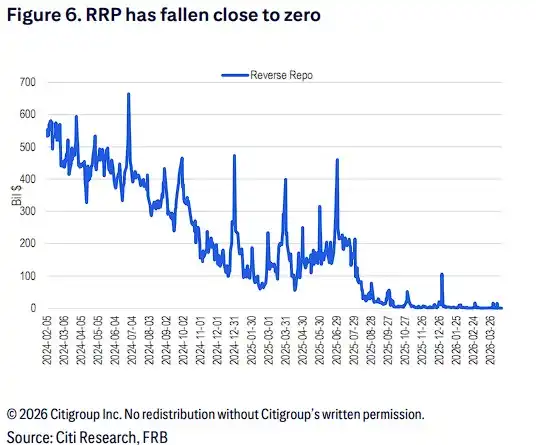
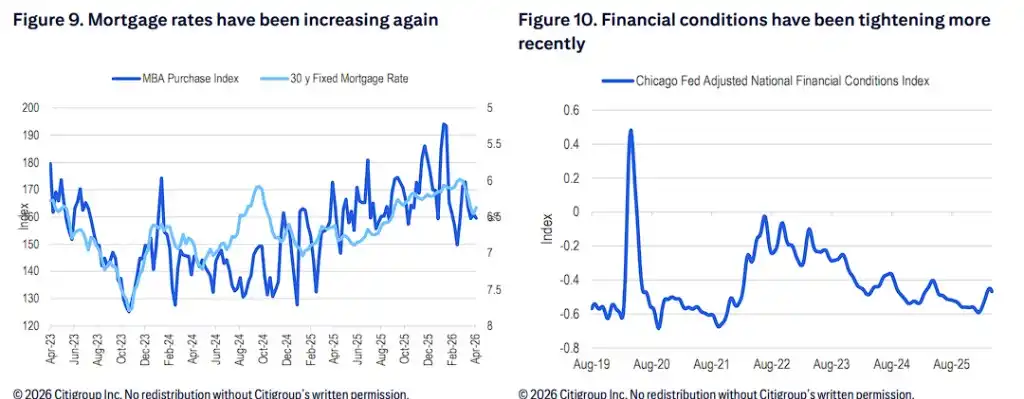
Liquidity and Financial Conditions: The Fed's reverse repo (RRP)规模 has fallen sharply to near zero; meanwhile, recent financial conditions are tightening, and mortgage rates are also trending up again.

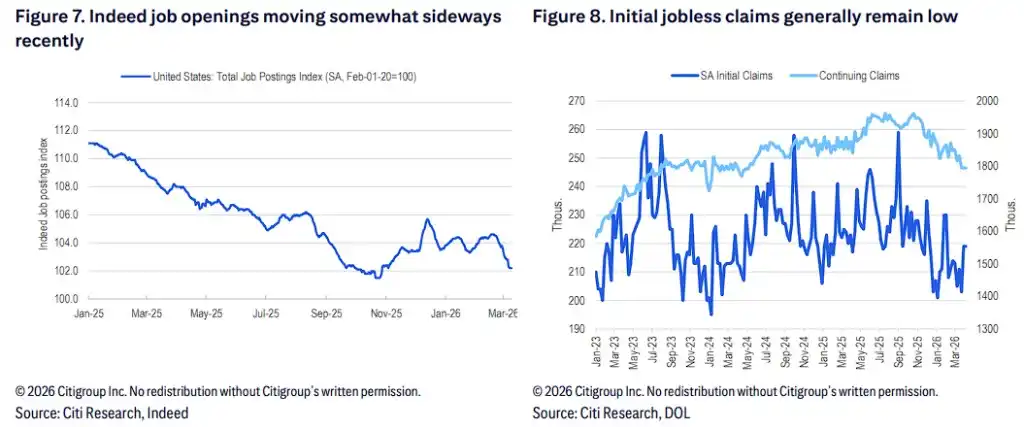
Labor Market: Indeed job openings data has recently shown a sideways trend, although initial jobless claims overall remain low.

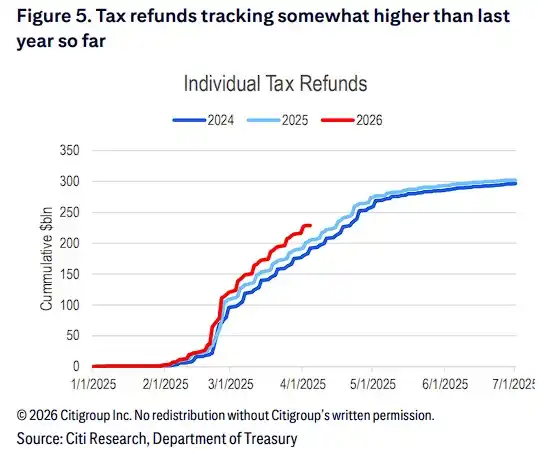
Capital Flows: So far this year, personal tax refunds (cumulative amount in billions of dollars) are slightly higher than the same period last year.

Tonight's Litmus Test: Why is the March "Control Group" Retail Sales Data Key?

As rate cut expectations waver, the upcoming March retail sales data will provide investors with first-hand clues, revealing the extent to which high gasoline prices have cut into consumer spending on other categories of goods.

Citi emphasizes that investors must "look past the surface" when interpreting this data. Due to rising gasoline prices, nominal retail sales for March are bound to surge. However, what truly determines the Fed's policy direction is the "Control group" sales data.

The report points out that this data excludes sales at gas stations and certain specific categories, allowing for a more genuine and accurate reflection of whether high oil prices are causing consumer weakness in other areas. If the "control group" data unexpectedly weakens, it will strongly corroborate that high inflation is backlashing on demand, thereby providing key data support for the Fed's rate-cutting logic.

Deutsche Bank's Cold Water: Policy Already Neutral, Fed May Hold Steady Indefinitely

In stark contrast to Citi's optimistic expectations, Deutsche Bank offered a very cautious judgment on the rate cut outlook. Deutsche Bank clearly stated in its report: The Fed is expected to maintain current rates indefinitely because current policy is already in a neutral position.

Deutsche Bank's pessimistic expectations are mainly based on the following core points:

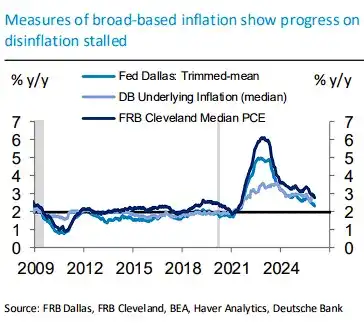
Stalled Disinflation: Broad inflation indicators show that progress in the US fight against inflation has stalled.

Officials Turn Hawkish: Deutsche Bank's tracking of Fed officials' speeches shows that officials like Waller and Miran (Note: likely a typo, possibly meant Mester or another official) have adopted a more hawkish tone, while most other officials continue to believe the current policy stance is "very appropriate" (well positioned). Details as follows:

· Waller: Leaning hawkish. He noted that a prolonged Middle East conflict would block the path to rate cuts; a series of shocks (tariffs叠加 oil prices) could trigger more persistent inflation rises; he also emphasized that core inflation, excluding tariff effects, is close to 2%, and the labor market has vulnerabilities;

· Miran (Note: likely a reference to another official, possibly a misspelling): Is currently the most dovish voice, supporting 3 or even 4 rate cuts this year, believes the war has not changed the inflation outlook 12 to 18 months out, views the oil price shock as temporary;

· Williams: Believes policy is "right where it needs to be," raised 2026 inflation forecast to about 2.75%, lowered 2026 economic growth forecast to 2% to 2.5%;

· Hammack (Note: likely Harker): Clearly stated that rates will "remain unchanged for quite some time";

· Goolsbee: Warned that if oil prices persist at $90 per barrel, it could spill over to other prices; further rate cuts in 2026 are unlikely, cuts might have to wait until 2027;

· Daly: Believes current policy is in a "very good place," if the oil price shock lasts until year-end, it wouldn't be surprising for market pricing to shift to "zero cuts".

The Fed's March meeting minutes also showed that the vast majority of officials believe the process of inflation returning to the 2% target will be delayed; some officials even discussed the necessity of adding "two-sided risks" wording to the meeting statement,暗示 the possibility of rate hikes is not completely ruled out.

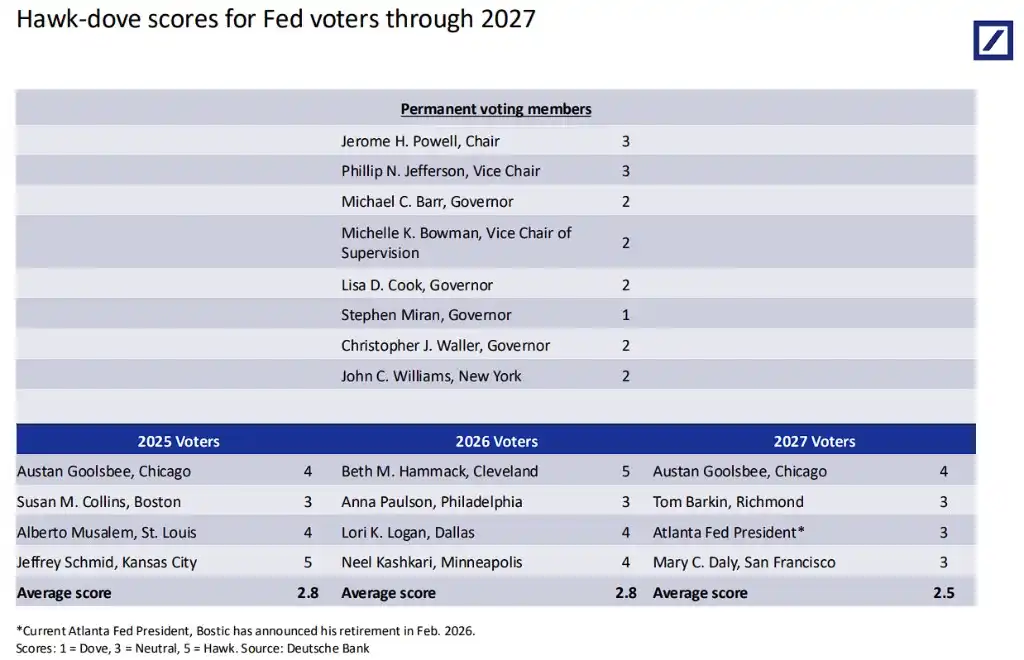
Deutsche Bank's hawk-dove scoring of Fed officials shows the 2026 voting committee has an average score of 2.8 (1 being the most dovish, 5 the most hawkish), overall leaning neutral-slightly dovish, but dovish voices are clearly in the minority.

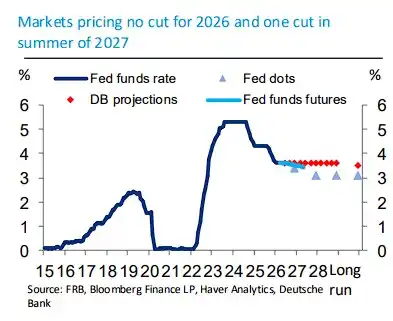
Market Pricing Completely Reversed: Facing persistent inflationary pressures and strong economic resilience, market expectations have drastically changed. According to Deutsche Bank's data, current market pricing expects "zero rate cuts" for the entirety of 2026, with the first cut not until Summer 2027.

Deutsche Bank expects, under its baseline scenario, the federal funds rate will remain at 3.63% throughout 2026 to 2028, with no rate cuts for the entire year.

Связанные с этим вопросы

QWhat is the core market dilemma regarding the Federal Reserve's interest rate policy, as described in the article?

AThe core market dilemma is whether high energy prices will trigger persistent inflation or instead erode consumer demand to the point of forcing the Federal Reserve to cut interest rates.

QWhich two major banks present opposing views on the likelihood of Fed rate cuts, and what are their stances?

ACitigroup presents an optimistic view, arguing that geopolitical disruptions are temporary and the path to lower rates remains clear. Conversely, Deutsche Bank presents a pessimistic view, warning that Fed policy is already neutral and rates will likely remain unchanged indefinitely.

QWhy is the March retail sales 'control group' data considered a crucial test for the Fed's policy path?

AThe 'control group' data, which excludes sales at gas stations and other specific items, is crucial because it reveals whether high gas prices are causing consumer spending to weaken in other categories. A weak reading would support the argument that high inflation is destroying demand, thus bolstering the case for rate cuts.

QAccording to Deutsche Bank's analysis, what is the current market pricing for Fed rate cuts in 2026?

AAccording to Deutsche Bank, the current market pricing expects zero rate cuts for the entirety of 2026, with the first cut not anticipated until the summer of 2027.

QWhat key reason does Citigroup give for believing the path to lower interest rates remains open despite geopolitical tensions?

ACitigroup's core logic is that the impact on oil supplies from the Hormuz Strait situation is increasingly likely to be brief rather than a source of persistent inflation, thus allowing the Fed conditions to return to a rate-cutting path.

Похожее

After Marvell's 32% Surge, the Chinese Chip Family Behind It Emerges

The stock price of Marvell Technology surged 32.5% on June 2nd, driven by NVIDIA CEO Jensen Huang highlighting its custom ASICs and optical interconnects as core to AI data center architecture. This event brought attention to the Chinese semiconductor family behind Marvell: the Dai siblings. The story centers on three siblings, all UC Berkeley graduates, whose three-decade entrepreneurial journey aligns with major semiconductor industry shifts. In 1995, youngest sister Dai Wei Li co-founded Marvell with her husband Sehat Sutardja and his brother, focusing on storage controllers. Eldest brother Dai Wei Min founded EDA company Ultima, later sold to Cadence, and later founded VeriSilicon (芯原) in China, becoming a leading semiconductor IP provider. Second brother Dai Wei Jin co-founded EDA firm Silicon Perspective (sold to Cadence) and GPU IP company Vivante, later acquired by VeriSilicon. The combined "Dai-Sutardja" family network extends beyond Marvell. Their ventures and investments form a comprehensive ecosystem for the post-Moore's Law, chiplet era. Key holdings include: Dream Big Semiconductor (AI SuperNICs, acquired by Arm), Alphawave (high-speed SerDes IP, acquired by Qualcomm), and Silicon Box (a chiplet advanced packaging foundry). VeriSilicon itself thrives on the AI ASIC and IP boom in China. Collectively, the family's AI infrastructure-related portfolio is estimated at over $22 billion. Their strategy represents a distinct path: building critical components for open standards and key manufacturing capacity in the chiplet era, rather than pursuing standalone AI chip dominance. While this path may not create the next NVIDIA, it has enabled repeated successful exits and sustained influence within the global semiconductor industry.

marsbit1 ч. назад

After Marvell's 32% Surge, the Chinese Chip Family Behind It Emerges

marsbit1 ч. назад

Microsoft is Afraid of Being Marginalized by AI Giants

Microsoft, once the defining force of the PC era, now faces a familiar challenge in the AI age: the risk of being relegated to a profitable but invisible infrastructure provider. This anxiety was laid bare at Build 2026, where CEO Satya Nadella unveiled a major strategic pivot. The catalyst was a quiet April agreement that dissolved Microsoft's exclusive licensing and cloud-hosting deal with OpenAI, its once-vital partner. This erased Microsoft's key AI moat. With OpenAI and Anthropic defining AI applications and gaining enterprise traction—even within Microsoft's own ranks—Nadella had to answer: without exclusivity, what is Microsoft's role? The answer was a suite of seven in-house AI models, a developer-focused AI workstation (Surface RTX Spark Dev Box), and, most crucially, the Agent 365 platform for enterprise AI governance. The models, notably targeting Anthropic's strengths in coding and enterprise, signal a defensive move. However, the broader strategy is to make the models themselves less decisive. Financially, Microsoft's AI revenue is strong, driven largely by Azure running others' models. Yet its user-facing products like Copilot show weak penetration and engagement. Microsoft earns infrastructure money but lacks direct user mindshare. Nadella's core fear is being "hollowed out." As OpenAI and Anthropic prepare for IPOs and gain financial independence, they may build their own infrastructure, threatening Azure's lucrative AI revenue stream. Microsoft's window is to entrench itself deeper: not as the model creator, but as the indispensable platform for securely deploying, managing, and governing all AI models within the enterprise through Agent 365. Build 2026 revealed Microsoft's bet: in the AI era, the ultimate power lies not in any single model, but in the enterprise "operating system" that controls them. Nadella is determined to ensure Microsoft is the driver of this new era, not just a passenger.

marsbit1 ч. назад

Microsoft is Afraid of Being Marginalized by AI Giants

marsbit1 ч. назад

CPU, Quietly Returning to the Center of the AI Computing Power Stage

Over the past three years, AI computing power narratives have been dominated by GPUs. However, starting in 2026, this story began to shift. While training large models remains GPU-intensive, the rapid growth of inference and AI agent workloads, which require high levels of task orchestration, concurrency, and data flow management, has highlighted a renewed critical role for CPUs. These are tasks GPUs are not designed to handle. Intel's recent launch of the Xeon 6+ processor, built on its Intel 18A process and featuring up to 288 efficiency cores (E-cores), exemplifies this strategic pivot. It is positioned not as a mere companion to GPUs but as the essential "control plane" for AI infrastructure, optimized for high-density, energy-efficient, and high-throughput workloads characteristic of AI agents and inference. This "CPU resurgence" is not about CPUs outperforming GPUs in raw computation. It reflects a systemic bottleneck: as AI scales from training single models to deploying countless intelligent agents, the demand for coordination and data handling surges. Major cloud providers are also developing their own high-density ARM-based server CPUs for similar workloads. However, Intel's success with this strategy faces significant challenges. Competition includes NVIDIA's integrated CPU-GPU solutions, the expanding adoption of cloud vendors' in-house ARM CPUs, and the crucial market test of Intel's 18A manufacturing process against rivals like TSMC's N2. In conclusion, CPUs are indeed reclaiming a central, though redefined, role in AI compute—managing the complex orchestration that enables massive-scale AI deployment. While the trend is clear, which company will ultimately lead this CPU resurgence remains an open question to be decided in the data centers of 2027 and beyond.

marsbit1 ч. назад

CPU, Quietly Returning to the Center of the AI Computing Power Stage

marsbit1 ч. назад

Торговля

Спот
Фьючерсы

Популярные статьи

Как купить S

Добро пожаловать на HTX.com! Мы сделали приобретение Sonic (S) простым и удобным. Следуйте нашему пошаговому руководству и отправляйтесь в свое крипто-путешествие.Шаг 1: Создайте аккаунт на HTXИспользуйте свой адрес электронной почты или номер телефона, чтобы зарегистрироваться и бесплатно создать аккаунт на HTX. Пройдите удобную регистрацию и откройте для себя весь функционал.Создать аккаунтШаг 2: Перейдите в Купить криптовалюту и выберите свой способ оплатыКредитная/Дебетовая Карта: Используйте свою карту Visa или Mastercard для мгновенной покупки Sonic (S).Баланс: Используйте средства с баланса вашего аккаунта HTX для простой торговли.Третьи Лица: Мы добавили популярные способы оплаты, такие как Google Pay и Apple Pay, для повышения удобства.P2P: Торгуйте напрямую с другими пользователями на HTX.Внебиржевая Торговля (OTC): Мы предлагаем индивидуальные услуги и конкурентоспособные обменные курсы для трейдеров.Шаг 3: Хранение Sonic (S)После приобретения вами Sonic (S) храните их в своем аккаунте на HTX. В качестве альтернативы вы можете отправить их куда-либо с помощью перевода в блокчейне или использовать для торговли с другими криптовалютами.Шаг 4: Торговля Sonic (S)С легкостью торгуйте Sonic (S) на спотовом рынке HTX. Просто зайдите в свой аккаунт, выберите торговую пару, совершайте сделки и следите за ними в режиме реального времени. Мы предлагаем удобный интерфейс как для начинающих, так и для опытных трейдеров.

1.4k просмотров всегоОпубликовано 2025.01.15Обновлено 2026.06.02

Как купить S

Sonic: Обновления под руководством Андре Кронье – новая звезда Layer-1 на фоне спада рынка

Он решает проблемы масштабируемости, совместимости между блокчейнами и стимулов для разработчиков с помощью технологических инноваций.

2.3k просмотров всегоОпубликовано 2025.04.09Обновлено 2025.04.09

Sonic: Обновления под руководством Андре Кронье – новая звезда Layer-1 на фоне спада рынка

HTX Learn: Пройдите обучение по "Sonic" и разделите 1000 USDT

HTX Learn — ваш проводник в мир перспективных проектов, и мы запускаем специальное мероприятие "Учитесь и Зарабатывайте", посвящённое этим проектам. Наше новое направление .

1.8k просмотров всегоОпубликовано 2025.04.10Обновлено 2025.04.10

HTX Learn: Пройдите обучение по "Sonic" и разделите 1000 USDT

Обсуждения

Добро пожаловать в Сообщество HTX. Здесь вы сможете быть в курсе последних новостей о развитии платформы и получить доступ к профессиональной аналитической информации о рынке. Мнения пользователей о цене на S (S) представлены ниже.

活动图片