Will ONDO's 'Tokenization Narrative' Change After Its CEO's Unexpected Passing?

marsbitОпубликовано 2026-05-27Обновлено 2026-05-27

Введение

Ondo Finance founder and CEO Nathan Allman has passed away unexpectedly. Allman, a Brown University graduate with a background in private credit and Goldman Sachs' digital asset team, was a key architect of Ondo's pivot from DeFi structured yield products to becoming a leading Real-World Asset (RWA) protocol. He drove the strategy to tokenize traditional financial assets like US Treasuries (OUSG), yield-generating dollar assets (USDY), and US stocks/ETFs (Ondo Global Markets) for on-chain accessibility. The company announced that President Ian De Bode, a former McKinsey partner with a strong institutional strategy and operations background, will succeed Allman as CEO. While Allman's sudden departure presents a near-term challenge, testing market confidence and Ondo's continuity, the project is seen as more than a founder-driven narrative. It has an established product suite and a management team with deep traditional finance experience. The long-term impact hinges on the new leadership's ability to execute. De Bode's expertise in compliance, distribution, and institutional partnerships aligns with RWA's next phase of scaling infrastructure. The core question is whether Ondo can maintain its product momentum and institutional relationships. Ondo's native ONDO token represents governance and RWA narrative value, not direct revenue from the underlying assets. Its future as a "top tokenization play" will depend on the team's continued delivery of product growth, asset scale, an...

Nathan Allman, founder and CEO of Ondo Finance, has unexpectedly passed away.

For the RWA sector, Nathan Allman was not just a frontman telling stories. He was one of the core driving forces behind Ondo's evolution from a DeFi structured yield product towards the tokenization of US Treasury bonds, dollar-yield assets, stocks, and ETFs. In a sense, the market often refers to ONDO today as the "primary tokenization play"—a status built significantly on the product roadmap and institutional narrative that Nathan Allman had been constructing over the past few years.

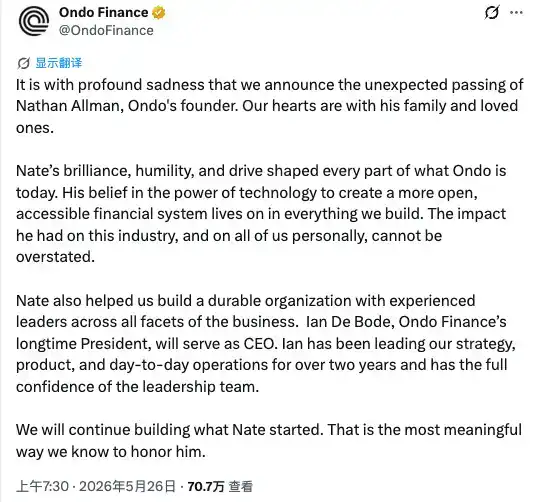
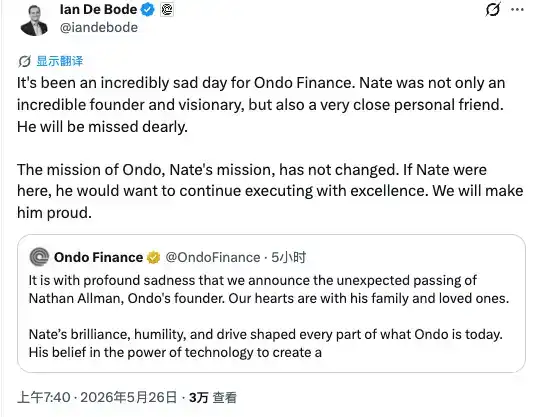
According to an official announcement from Ondo Finance, Nathan Allman has passed away unexpectedly, with the specific cause of death not yet disclosed. Ondo also stated that company president Ian De Bode will assume the role of CEO. The announcement specifically mentioned that Nathan's talent, humility, and execution shaped today's Ondo, and the company will continue to advance the work he pioneered.

Nathan Allman was not a typical pure-crypto entrepreneur. He graduated from Brown University, had early experience in private credit investing, and later worked on the digital assets team at Goldman Sachs. It was precisely this background that gave Ondo a strong traditional finance DNA from the start: its goal was not to create a DeFi protocol completely detached from the real-world financial system, but rather to repack the most mature and liquid assets from traditional finance into products that could be held, transferred, combined, and settled on-chain.

Ondo was not the RWA leader we know today in its early days. In 2021, Ondo resembled more of a DeFi structured yield protocol, designing different yield tiers for users with varying risk appetites.

Later, as the on-chain yield environment changed and demand grew for stablecoin and US Treasury yields, Ondo's path became clearer: instead of recreating high-risk yields on-chain, it was better to bring the most stable, largest, and most institutionally accepted assets from off-chain onto the chain.

This pivot was the real beginning of Ondo entering the mainstream spotlight.

OUSG, USDY, and Ondo Global Markets essentially constitute Ondo's three main pillars today. OUSG targets qualified investors, offering on-chain exposure to short-term US Treasury and money market-like assets; USDY is more akin to a dollar-yield product for non-US investors; Ondo Global Markets further tokenizes US stocks and ETFs into on-chain assets, allowing investors outside the US to gain exposure to traditional securities markets on-chain.

In other words, Ondo's narrative is not simply "putting US Treasuries on-chain." What it truly aims to do is turn Wall Street assets into foundational building blocks that the crypto world can utilize. Stablecoins solve the problem of dollar circulation on-chain, while Ondo seeks to address how dollar assets, Treasury yields, and securities exposure can enter the on-chain financial system.

This was also Nathan Allman's position within the RWA sector. He represented not the most radical crypto-native approach, but another path: making traditional financial assets acceptable for on-chain settlement and connecting on-chain markets to traditional financial assets. Over the past two years, RWA has been able to transform from an old concept back into a main narrative, not by empty slogans of "everything on-chain," but because products like US Treasury yields, money market fund tokenization, and stock tokenization have begun to see real demand, scale, and a path to compliance. Ondo is one of the most typical projects in this regard.

So, will Nathan Allman's passing affect Ondo?

In the short term, an impact certainly exists. The sudden loss of a founder is a significant event for any project, especially for one like Ondo, which heavily relies on institutional partnerships, regulatory communication, and long-term product roadmaps. The market's immediate concerns will likely be threefold: First, whether the founder's vision can continue; second, whether institutional partners will reassess their collaboration timelines; and third, whether ONDO, as a tokenization narrative play, will be repriced due to the departure of a key figure.

However, in the medium to long term, Ondo is not a project sustained solely by the personal brand of a single founder. Over the past few years, it has built a relatively complete product matrix and assembled a management team with strong traditional finance backgrounds. Especially the new CEO, Ian De Bode, is not a stranger parachuted in temporarily; he is a key figure within Ondo who has long been responsible for strategy, products, and daily operations.

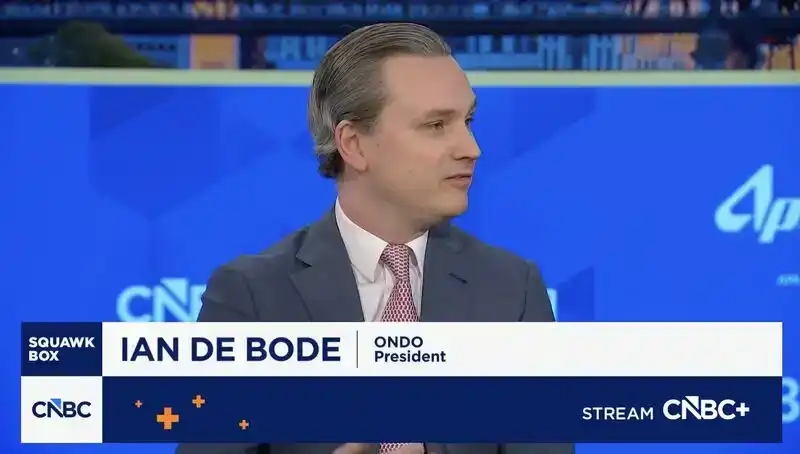
Ian De Bode was previously a partner at McKinsey & Company, where he led its digital assets-related business. After joining Ondo in 2024, he initially served as Chief Strategy Officer before becoming President. The Ondo announcement also noted that Ian has led the company's strategy, products, and daily operations for over two years and has the full support of the management team.

Judging by their resumes, Ian De Bode and Nathan Allman share similarities: neither are purely from the crypto world; both entered the digital assets industry from traditional finance, consulting, and institutional services. Nathan was more of a product and visionary founder, responsible for taking Ondo from zero to where it is today; Ian leans more towards institutional strategy and execution, familiar with the real demands of large corporations, financial institutions, and executives regarding tokenization.

This might be precisely what's crucial for Ondo's next phase. The first half of RWA was about narrative and product validation; the second half will inevitably be about compliance, distribution, liquidity, and institutional partnerships. Whoever can scale asset size, connect brokers, custodians, market makers, public blockchains, wallets, and trading scenarios, will have the chance to turn "tokenization" from a concept into market infrastructure. Ian De Bode's background aligns more closely with the requirements of this stage.

Of course, this doesn't mean Ondo is without risks. ONDO holders need to distinguish one thing clearly: the growth of Ondo's product scale does not inherently equate to the ONDO token receiving direct revenue sharing. ONDO primarily carries governance, ecosystem, and RWA narrative premium, not the yield from Ondo's underlying assets. When the market calls it the "primary tokenization play," it's buying into Ondo's representativeness and growth expectations within the RWA sector, not directly buying the cash flow from the assets under Ondo's umbrella.

Therefore, Nathan Allman's passing is also a stress test for Ondo. It tests whether this project is merely a founder-driven narrative or has matured into a sustainable financial infrastructure system.

If Ian De Bode can maintain the product roadmap, sustain institutional partnerships, and continue to drive the expansion of Ondo Global Markets, USDY, and OUSG, then the short-term emotional shock may gradually be absorbed by business continuity.

However, if subsequent product development slows, institutional partnership news diminishes, or the market begins to question ONDO's value capture ability, then this event could also become a point for re-evaluating its valuation and narrative.

For the RWA sector, Nathan Allman's passing is a regret. What he truly leaves behind is not just the Ondo project itself, but a clearer path: the crypto industry doesn't necessarily have to create new assets on-chain; it can also bring the world's largest, most mature financial asset markets into the on-chain world. Whether ONDO can continue to hold its position as the "primary tokenization play" in the future will depend not on words of mourning, but on whether the new team can continue to deliver products, asset scale, and real demand.

Связанные с этим вопросы

QWho was Nathan Allman and what was his role in Ondo Finance?

ANathan Allman was the founder and CEO of Ondo Finance. He was a key driver in transforming Ondo from a DeFi structured yield protocol into a leading platform for tokenizing real-world assets like U.S. Treasury bonds, dollar-yield assets, stocks, and ETFs.

QWhat immediate concerns does the market have following Nathan Allman's passing?

AThe market's immediate concerns are whether the founder's vision can be sustained, if institutional partners will reassess their collaboration pace, and if the ONDO token will be repriced due to the departure of its core figure.

QWho is taking over as the new CEO of Ondo Finance and what is his background?

AIan De Bode, the President of Ondo Finance, is taking over as CEO. He is a former McKinsey & Company partner who led its digital assets practice and has been leading Ondo's strategy, product, and daily operations for over two years.

QWhat are the three main product lines that constitute Ondo's current business?

AOndo's three main product lines are OUSG (offering on-chain exposure to short-term U.S. Treasuries for qualified investors), USDY (a dollar-yield product for non-U.S. investors), and Ondo Global Markets (tokenizing U.S. stocks and ETFs for non-U.S. investors).

QAccording to the article, what does the ONDO token primarily represent for holders?

AThe ONDO token primarily represents governance rights, ecosystem participation, and the premium from the RWA narrative. It does not grant direct revenue sharing from the underlying asset yields; its value is tied to Ondo's代表性 and growth expectations in the tokenization sector.

Похожее

Why Sam Altman's 'Water and Electricity Theory' Sparks Copyright Controversy

OpenAI CEO Sam Altman's recent statement that "intelligence will become a utility like electricity or water" has sparked significant controversy, primarily around copyright issues and the nature of AI development. While positioning AI as a utility serves as a compelling narrative for infrastructure investors, critics argue the analogy is flawed in three key areas. First, there's a fundamental "property gap." Traditional utilities like water and power create new, physical infrastructure from scratch. In contrast, major AI models are trained by reorganizing vast amounts of existing human-created content—books, articles, code, etc.—often scraped from the web without explicit permission or compensation to creators. This "free acquisition, paid resale" model is seen by many as ethically problematic. Second, there's a "pricing gap." True public utilities are typically regulated to ensure universal service with non-discriminatory, cost-plus pricing. AI's token-based pricing, however, involves significant price discrimination (e.g., output tokens costing much more than input tokens) and is designed for revenue maximization, not equitable access. Third, a "governance gap" exists. Utilities operate under public oversight, while AI pricing and development are currently controlled by a few private companies. Furthermore, the industry's own shift toward buying licensed training data (e.g., deals with Reddit or news publishers) undermines its previous legal reliance on "fair use" for freely scraped data. In conclusion, while AI is indeed becoming a foundational technology, calling it a public utility remains contentious. The title requires not just scale and a pay-per-use model, but also credible solutions for data provenance, equitable pricing, and public governance.

marsbit5 мин. назад

Why Sam Altman's 'Water and Electricity Theory' Sparks Copyright Controversy

marsbit5 мин. назад

From ZEC's Surge to Vitalik's Support: Will the Privacy Narrative Resurface?

From ZEC's surge to Vitalik's endorsement, is privacy making a comeback? The recent rally in ZEC has refocused attention on the crypto privacy sector. This resurgence stems from a growing market realization: while blockchain transparency builds trust, full exposure of user balances, trading strategies, and risk positions can become a vulnerability, especially for large traders and institutions on platforms like Hyperliquid. The privacy landscape has evolved beyond classic anonymity coins like ZEC, XMR, and DASH. It now encompasses privacy infrastructure projects such as Railgun (bringing privacy to DeFi) and Aztec (a privacy-focused L2), as well as newer entrants like Genius Terminal, SilentSwap, and 0xBow that emphasize transaction privacy while attempting to balance compliance. Industry trends confirm privacy is becoming integrated, not a niche feature. Perp DEX Aster has introduced a "Shield Mode," and Vitalik has discussed the need for native privacy at the Ethereum protocol level, including proposals like EIP-8182 for standardized private transfers. In conclusion, this revival is more than a simple sector rotation. It reflects a critical reassessment of transparency's limits. As on-chain finance matures, the challenge is finding a sustainable balance between necessary transparency for trust and essential privacy for protecting assets and strategies, making privacy a potential cornerstone of next-generation infrastructure.

marsbit15 мин. назад

From ZEC's Surge to Vitalik's Support: Will the Privacy Narrative Resurface?

marsbit15 мин. назад

Trump, the "Stock Market Manipulator" in U.S. Stocks, Lifts Up the Entire Quantum Computing Sector

"Trump, the 'U.S. Stock Market Mastermind,' Boosts the Entire Quantum Computing Sector" This article details how former U.S. President Donald Trump's policies and public statements have significantly influenced the stock market, particularly in the quantum computing sector. A key example is the U.S. government's direct investment in Intel stock in August 2025, which yielded over $45 billion in gains within seven months. Trump publicly credited himself for this profit. Recently, the Trump administration announced a new $2 billion initiative. Through the Department of Commerce, funding from the CHIPS and Science Act will be provided to nine quantum computing companies in exchange for minority, non-controlling equity stakes. The recipients include IBM ($1B for its subsidiary Anderon), GlobalFoundries ($375M), and listed companies like D-Wave, Infleqtion, and Rigetti ($100M each). Private firms such as Atom Computing and PsiQuantum also received $100M. This "investment-for-equity" strategy marks a shift from pure subsidies to an "active investor" model under the CHIPS Act. The announcement immediately boosted quantum computing stocks. The article frames this as part of Trump's "America First" industrial policy, aimed at securing U.S. technological leadership, similar to past investments in semiconductors, rare earths, and lithium. The author suggests this pattern of government-backed market intervention, alongside Trump's personal stock endorsements, is a hallmark of his approach to driving market gains and may continue in sectors like defense and advanced energy.

marsbit55 мин. назад

Trump, the "Stock Market Manipulator" in U.S. Stocks, Lifts Up the Entire Quantum Computing Sector

marsbit55 мин. назад

Торговля

Спот
Фьючерсы

Популярные статьи

Как купить S

Добро пожаловать на HTX.com! Мы сделали приобретение Sonic (S) простым и удобным. Следуйте нашему пошаговому руководству и отправляйтесь в свое крипто-путешествие.Шаг 1: Создайте аккаунт на HTXИспользуйте свой адрес электронной почты или номер телефона, чтобы зарегистрироваться и бесплатно создать аккаунт на HTX. Пройдите удобную регистрацию и откройте для себя весь функционал.Создать аккаунтШаг 2: Перейдите в Купить криптовалюту и выберите свой способ оплатыКредитная/Дебетовая Карта: Используйте свою карту Visa или Mastercard для мгновенной покупки Sonic (S).Баланс: Используйте средства с баланса вашего аккаунта HTX для простой торговли.Третьи Лица: Мы добавили популярные способы оплаты, такие как Google Pay и Apple Pay, для повышения удобства.P2P: Торгуйте напрямую с другими пользователями на HTX.Внебиржевая Торговля (OTC): Мы предлагаем индивидуальные услуги и конкурентоспособные обменные курсы для трейдеров.Шаг 3: Хранение Sonic (S)После приобретения вами Sonic (S) храните их в своем аккаунте на HTX. В качестве альтернативы вы можете отправить их куда-либо с помощью перевода в блокчейне или использовать для торговли с другими криптовалютами.Шаг 4: Торговля Sonic (S)С легкостью торгуйте Sonic (S) на спотовом рынке HTX. Просто зайдите в свой аккаунт, выберите торговую пару, совершайте сделки и следите за ними в режиме реального времени. Мы предлагаем удобный интерфейс как для начинающих, так и для опытных трейдеров.

1.4k просмотров всегоОпубликовано 2025.01.15Обновлено 2025.03.21

Как купить S

Sonic: Обновления под руководством Андре Кронье – новая звезда Layer-1 на фоне спада рынка

Он решает проблемы масштабируемости, совместимости между блокчейнами и стимулов для разработчиков с помощью технологических инноваций.

2.3k просмотров всегоОпубликовано 2025.04.09Обновлено 2025.04.09

Sonic: Обновления под руководством Андре Кронье – новая звезда Layer-1 на фоне спада рынка

HTX Learn: Пройдите обучение по "Sonic" и разделите 1000 USDT

HTX Learn — ваш проводник в мир перспективных проектов, и мы запускаем специальное мероприятие "Учитесь и Зарабатывайте", посвящённое этим проектам. Наше новое направление .

1.8k просмотров всегоОпубликовано 2025.04.10Обновлено 2025.04.10

HTX Learn: Пройдите обучение по "Sonic" и разделите 1000 USDT

Обсуждения

Добро пожаловать в Сообщество HTX. Здесь вы сможете быть в курсе последних новостей о развитии платформы и получить доступ к профессиональной аналитической информации о рынке. Мнения пользователей о цене на S (S) представлены ниже.

活动图片