Why Only Dollar-Cost Averaging Can Capture Bitcoin's Long-Term Dividends?

marsbitОпубликовано 2026-03-06Обновлено 2026-03-06

Введение

The article argues that dollar-cost averaging (DCA) is the optimal strategy for capturing Bitcoin's long-term gains, supported by backtested data and forward-looking models. Historical analysis shows that a weekly DCA investment of $250 in Bitcoin starting in January 2021 would have yielded a 76% return by mid-2026, with significant upside potential at higher price levels. Even shorter-term DCA strategies, while susceptible to short-term drawdowns, show strong performance over time. Comparisons with the S&P 500 indicate that Bitcoin DCA outperforms traditional equity DCA despite higher risk. Long-term projections based on Bitcoin’s power-law growth model suggest substantial returns by 2030, with mid-range estimates around $430,000 per BTC. The key conclusion is that while entry timing affects short-term returns, long-term consistency is the primary driver of wealth accumulation in Bitcoin.

Written by: Cointelegraph

Compiled by: AididiaoJP, Foresight News

Both backtest data and forward-looking models indicate that using a dollar-cost averaging (DCA) strategy to buy Bitcoin is the best way to invest in BTC. Will this method still work in the next bull market?

Bitcoin has experienced a 50% crash over the past 5 months, and savvy investors adjust their strategies during such bear markets and correction periods. This strategy is called dollar-cost averaging (DCA), which involves investing a fixed amount regularly, regardless of market conditions.

By examining historical market cycle data and forward-looking BTC price simulations, we can more clearly see how this steady investment approach performs across different entry times and investment horizons.

Five Years of DCA in Bitcoin Yields Substantial Net Gains

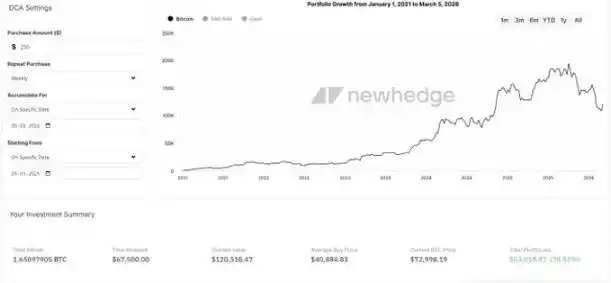
Starting from January 2021, investing $250 weekly in Bitcoin via DCA, the total investment over five years would be $67,500. According to DCA simulation data, this strategy would have accumulated 1.65097905 BTC, with an average purchase price of $40,884.

At Bitcoin's current price of nearly $71,000, this 1.65097905 BTC is worth approximately $120,500, resulting in a profit of $53,000 (a 76% increase). If Bitcoin rises to $100,000, the holdings would be worth about $165,000; and at the cycle peak of around $126,000 in October 2025, the holdings would reach a value of $208,000.

2021-2026 Bitcoin DCA Cycle Source: Newhedge

Now, consider a shorter investment period to see the impact of entry timing on early returns. Starting from January 2024, investing $250 weekly, the total investment would be $28,500, accumulating 0.36863166 BTC with an average purchase price of $77,312.

At the current price of $71,000, these bitcoins are worth approximately $26,909, representing a 6% paper loss. If the price reaches $100,000, the holdings would be worth $36,863; and at the cycle peak of $126,000, the holdings would be valued at $46,448.

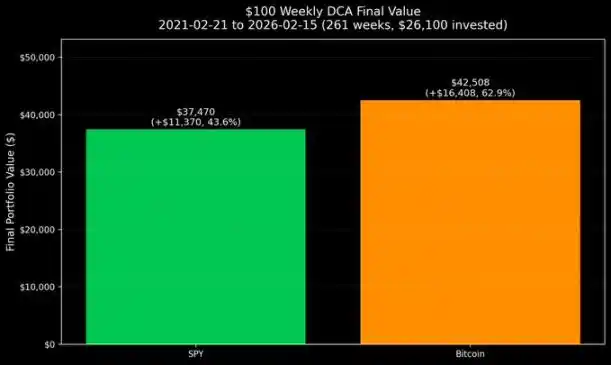
In February of this year, Swan Bitcoin analyst Adam Livingston compared on platform X the returns of DCA into BTC versus the S&P 500 over the past five years. Investing $100 weekly, BTC yielded $42,508, while the S&P 500 yielded $37,470, with returns of 62.9% and 43.6% respectively.

Livingston noted that although Bitcoin is highly volatile, historical data shows that persisting with DCA during downturns leads to higher long-term gains.

Weekly $100 DCA: BTC vs. S&P 500 Source: Adam Livingston/X

Long-Term Model: Time is the Key Factor

Forward-looking simulation studies have also tested the effectiveness of DCA starting in 2026. From January 2026, investing $250 weekly until March 2030, the total investment would be approximately $54,250.

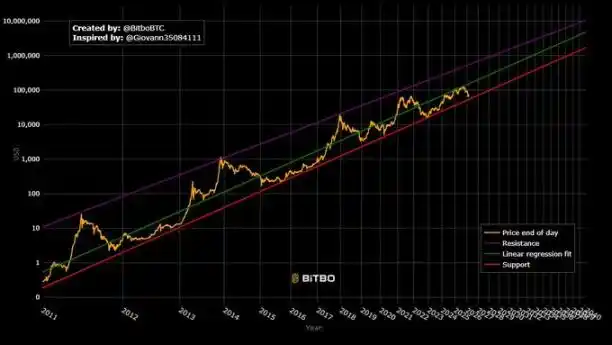
The price prediction is based on Bitcoin's long-term power law growth curve (which tracks the relationship between Bitcoin's historical price and time on a logarithmic scale). This model generates a rising support band and a median trendline, which aligns well with previous market cycles.

Bitcoin Power Law Growth Curve Source: Bitbo.io

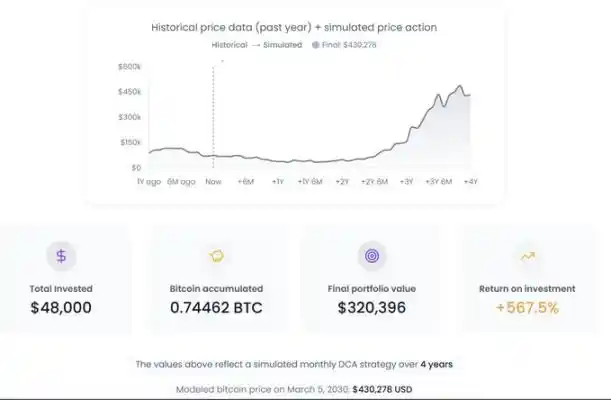
Based on this model, analysts estimate that the long-term trend support level could break through $100,000 by 2028, which also serves as the foundational assumption for future DCA modeling. Bitcoin Well's simulation shows that by March 2030, the median price projection is approximately $430,000.

Considering potential price deviations, the model also accounts for the upper and lower bounds of the power law channel, providing a lower estimate (around $274,000) and a higher estimate (around $900,000).

Based on these assumptions, four years of DCA would accumulate roughly 0.30 BTC:

  • If BTC price is $274,000, the holdings are worth approximately $82,200.
  • If BTC price is $430,000 (median projection), the holdings are worth approximately $129,000.
  • If BTC price is $900,000, the holdings are worth approximately $270,000.

DCA Investment Results as of March 2030 Source: Bitcoin Well

In November 2025, Bitcoin researcher Sminston With conducted a study using a similar predictive model to test the impact of entry time on long-term returns. The results found that even buying at a price 20% higher than the then price of $94,000 and selling at a price 20% lower than the projected 2035 median price, the remaining holdings after ten years would still yield a profit of nearly 300%.

In this simulation, the final total assets were 7.7 times the initial investment.

The study concluded: Entry timing affects the level of returns, but long-term holding is the key determinant of the magnitude of gains.

Связанные с этим вопросы

QWhat is the main investment strategy discussed in the article for capturing Bitcoin's long-term gains?

AThe main strategy discussed is Dollar-Cost Averaging (DCA), which involves investing a fixed amount of money at regular intervals, regardless of market conditions.

QAccording to the article, how much profit was generated from a 5-year DCA strategy starting in January 2021 with a weekly investment of $250?

AThe 5-year DCA strategy generated a profit of $53,000, representing a 76% return on the initial investment of $67,500.

QWhat model is used to predict Bitcoin's long-term price growth in the article?

AThe article uses Bitcoin's long-term power law growth curve model, which tracks the historical relationship between Bitcoin's price and time on a logarithmic scale to predict future prices.

QHow does the performance of DCA in Bitcoin compare to the S&P 500 over a 5-year period, as mentioned in the article?

AOver a 5-year period, a weekly DCA of $100 in Bitcoin yielded $42,508 (62.9% return), while the same strategy in the S&P 500 yielded $37,470 (43.6% return).

QWhat is the key factor that determines the magnitude of returns in Bitcoin investment, according to the research cited in the article?

AThe key factor is the length of time the investment is held. While entry timing affects the level of returns, long-term holding is crucial for determining the overall magnitude of gains.

Похожее

You Bet on the News, the Pros Read the Rules: The True Cognitive Gap in Losing Money on Polymarket

The article explains that the key to profiting on Polymarket, a prediction market platform, lies not just predicting real-world events correctly, but in meticulously understanding the specific rules that govern how each market will be resolved. It illustrates this with examples, such as a market on Venezuela's 2026 leader, where the official rules defining "officially holds" the office overruled the intuitive answer of who was in practical control. Other examples include debates over the definition of a "token" or what constitutes an "agreement." The core argument is that a "reality vs. rules" gap creates pricing discrepancies that savvy traders ("车头" or "whales") exploit. The platform has a formal dispute resolution process managed by UMA token holders to settle ambiguous outcomes. This process involves proposal submission, a challenge window, a discussion period, and a final vote. However, the article highlights a critical flaw in this system compared to a traditional court: the lack of separation between the arbiters (UMA voters) and the interested parties (traders with financial stakes in the outcome). This conflict of interest undermines the discussion phase, leads to herd mentality, and results in opaque final decisions without explanatory rulings. Consequently, the system lacks a body of precedent, making it difficult for users to learn from past disputes. The ultimate takeaway is that success on Polymarket requires a lawyer-like scrutiny of the rules to identify and capitalize on the cognitive gap between how events appear and how they are contractually defined for settlement.

marsbit36 мин. назад

You Bet on the News, the Pros Read the Rules: The True Cognitive Gap in Losing Money on Polymarket

marsbit36 мин. назад

Will the Fed Still Cut Interest Rates? Tonight's Data Is Crucial

The core debate surrounding the Federal Reserve's potential interest rate cuts is intensifying amid geopolitical conflict and rebounding inflation. The key question is whether high energy prices will cause persistent inflation or weaken consumer demand enough to force the Fed to cut rates. Citigroup presents a bullish case for cuts, arguing that oil supply disruptions from the Strait of Hormuz are temporary and will not lead to lasting inflationary pressure. They point to receding bond yields and oil prices as evidence the market is pricing in a short-lived shock. Citi's data also shows tightening financial conditions, a stabilizing labor market, and healthy tax returns, supporting their view that the path to lower rates remains open. Conversely, Deutsche Bank offers a starkly contrasting, more hawkish outlook. They argue the Fed's current policy is already neutral and expect rates to remain unchanged indefinitely. Their view is based on stalled disinflation progress and a shift toward more hawkish rhetoric from key Fed officials like Waller, who cited risks from prolonged Middle East conflict and tariffs. Other officials, including Williams and Hammack, signaled rates would likely stay on hold for a "considerable time." The market pricing has shifted dramatically, now forecasting zero cuts in 2026. The imminent release of the March retail sales "control group" data is highlighted as a critical test. This metric, which excludes gas station sales, will reveal if high gasoline prices are eroding consumer spending in other areas. A weak reading could support the case for imminent rate cuts, while a strong one would bolster the argument for the Fed to hold steady. This data is pivotal for determining the near-term policy path.

marsbit56 мин. назад

Will the Fed Still Cut Interest Rates? Tonight's Data Is Crucial

marsbit56 мин. назад

Торговля

Спот
Фьючерсы
活动图片