Who Cannot Be Distilled into a Skill?

marsbitОпубликовано 2026-04-05Обновлено 2026-04-05

Введение

"This article explores the concerning trend of AI systems distilling human workers into replaceable 'skills,' using the viral 'Colleague.skill' phenomenon as a key example. It argues that the most diligent employees—those who meticulously document their work, write detailed analyses, and transparently share decision-making logic—are paradoxically the most vulnerable to being replaced. Their high-quality 'context' (communication records, documents, and decision trails) becomes the perfect fuel for AI agents, extracted from corporate platforms like Feishu and DingTalk. The piece warns of a deeper ethical crisis: the reduction of human relationships to functional APIs, as seen in derivatives like 'Ex.skill' or 'Boss.skill,' which reduce complex individuals to mere utilities. This reflects a shift from Martin Buber's 'I-Thou' relationship (seeing others as whole beings) to an 'I-It' dynamic (seeing them as tools). While AI can capture explicit knowledge (written documents, replies), it fails to capture tacit knowledge—the intuition, experience, and unspoken insights that define human expertise. However, a greater danger emerges when AI-generated content, based on distilled human data, is used to train future models, leading to 'model collapse' and homogenized, mediocre outputs—a process likened to 'electronic patina' degrading information over time. The article concludes by noting a small but symbolic resistance, such as the 'anti-distill' tool that generates meaningless text ...

Unfortunately, in this era, the more unreservedly and diligently you work, the more likely you are to accelerate your own distillation into a skill that can be replaced by AI.

Over the past couple of days,热搜榜 (hot search lists) and media channels have been flooded with news about "Colleague.skill." As this topic continues to ferment on major social platforms, public focus has, almost inevitably, been swept up by grand anxieties like "AI layoffs," "capital exploitation," and "the digital immortality of the working class."

These are indeed anxiety-inducing, but what makes me most anxious is a line of usage suggestion written in the project's README documentation:

"The quality of the raw material determines the quality of the skill: It is recommended to prioritize collecting long articles he proactively wrote > decision-making replies > daily messages."

The ones most easily and perfectly distilled by the system, pixel-perfectly replicated, are precisely those who work most conscientiously.

They are the ones who, after every project concludes, still bend over their desks to write retrospective documents; the ones who, when encountering disagreements, are willing to spend half an hour typing out long passages in a chat dialog, honestly剖析 (dissecting/analyzing) their decision-making logic; the ones who are extremely responsible that they meticulously entrust every work detail to the system.

Conscientiousness, once the most revered workplace virtue, has now become a catalyst accelerating the transformation of workers into AI fuel.

The Drained Worker

We need to re-understand a word: context.

In everyday language, context is the background of communication. But in the world of AI, especially those rapidly growing AI Agents, context is the fuel for the roaring engine, the lifeblood maintaining the pulse, the only anchor point allowing the model to make precise judgments amidst chaos.

An AI stripped of context, even with an astonishing number of parameters, is merely a search engine with amnesia. It cannot recognize who you are, cannot discern the undercurrents hidden beneath business logic, and has no way of knowing the prolonged tug-of-war and trade-offs you experienced on this network woven from resource constraints and interpersonal博弈 (game theory/strategizing) when making a decision.

The reason "Colleague.skill" has caused such a huge stir is precisely because it has, with extreme冷酷 (ruthlessness/coldness) and precision, targeted the mountain rich with vast amounts of high-quality context—modern enterprise collaboration software.

Over the past five years, the Chinese workplace has undergone a quiet yet筋剥骨 (sapping) digital transformation. Tools like Feishu, DingTalk, and Notion have become massive corporate knowledge bases.

Taking Feishu as an example, ByteDance has publicly stated that the number of documents generated internally daily is massive. These dense characters faithfully seal every brainstorming session, every heated meeting debate, and every strategic compromise gritted and swallowed by over a hundred thousand employees.

This digital penetration far exceeds any previous time. Once upon a time, knowledge was warm, residing in the minds of veteran employees, scattered in casual chats by the water cooler; now, all human intelligence and experience are forcibly dehydrated, mercilessly sedimented in the cold server matrices in the cloud.

In this system, if you don't write documents, your work cannot be seen, and new colleagues cannot collaborate with you. The efficient operation of modern enterprises is built on the cycle of every employee "offering" context to the system day after day.

Conscientious workers, harboring diligence and goodwill, unreservedly expose their thought processes on these cold platforms. They do this to make the team's gears mesh more smoothly, to strive to prove their value to the system, to desperately find their own place within this intricate (错综复杂的) commercial behemoth. They are not actively handing themselves over; they are just clumsily and diligently adapting to the survival rules of the modern workplace.

But it is precisely this context left for interpersonal collaboration that becomes the perfect fuel for AI.

Feishu's admin backend has a function that allows super administrators to批量导出 (batch export) members' documents and communication records. This means that the project retrospectives and decision logic you spent three years writing, burning countless late nights, can, with just one API interface, be easily packaged into a cold压缩包 (compressed file) in just a few minutes—slices of your life over these years.

When Humans Are Reduced to an API

With the explosion of "Colleague.skill," GitHub's Issues section and major social platforms began to see some extremely disturbing derivatives.

Someone made an "Ex.skill," trying to feed years of WeChat chat history to an AI, making it continue to argue or be affectionate in that familiar tone; someone made a "White Moonlight.skill" (unattainable crush/idealized love), reducing an untouchable flutter into a cold interpersonal sandbox, repeatedly rehearsing试探的话术 (probing rhetoric), step-by-step seeking the optimal solution for emotions;还有人做出了 "Dad-flavored Boss.skill" (paternalistic/condescending boss), preemptively咀嚼 (chewing over) those oppressive PUA words in the digital space, building a pathetic psychological defense for themselves.
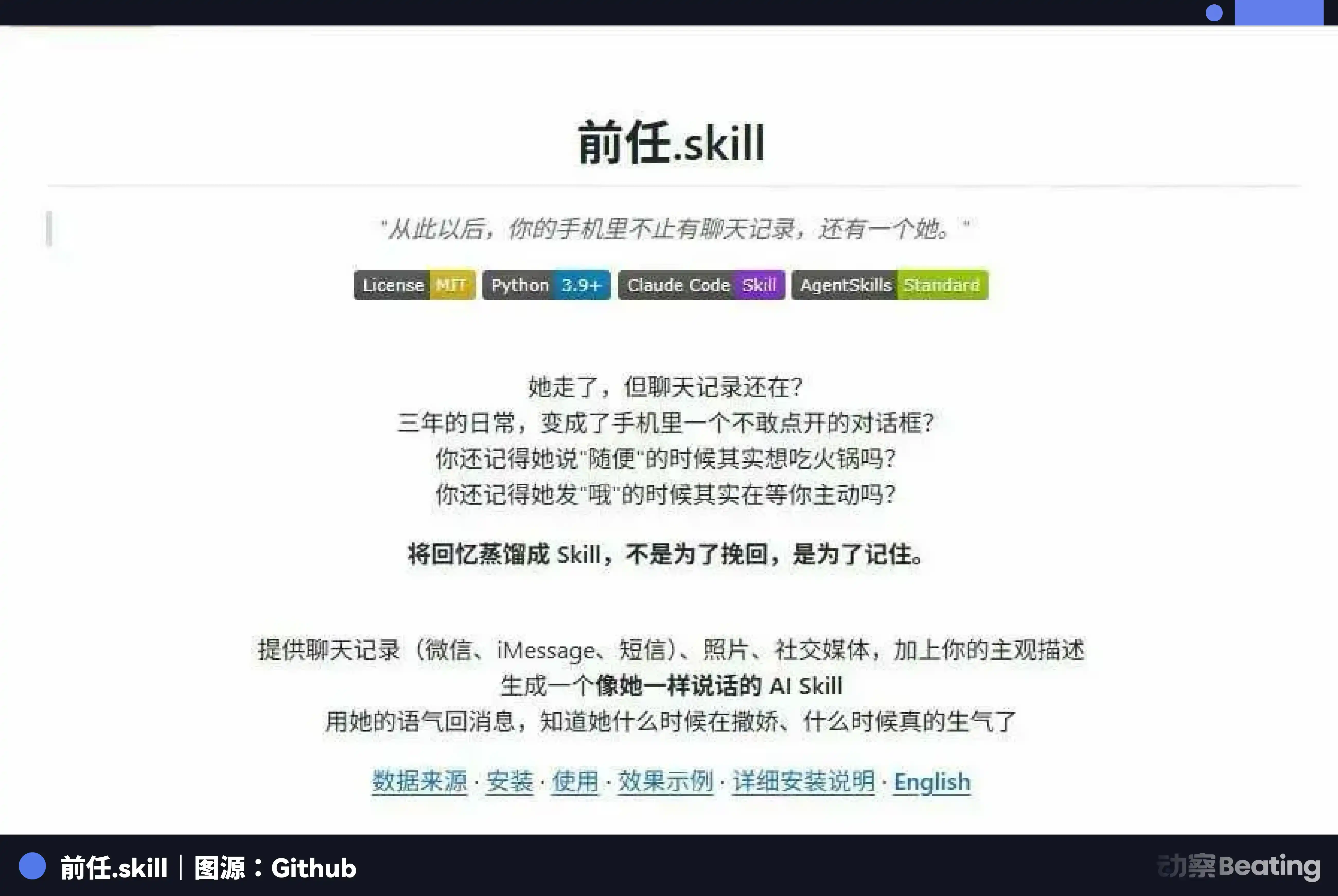
The usage scenarios of these skills have completely departed from the realm of work efficiency. It turns out,不知不觉间 (unconsciously), we have long become adept at wielding the cold logic used for tools to dismember and objectify living, breathing people of flesh and blood.

German philosopher Martin Buber once proposed that the underpinning of human relationships无非是 (is nothing more than) two distinct modes: "I-Thou" and "I-It."

In the "I-Thou" encounter, we transcend prejudice and regard the other as a complete and dignified being to behold. This bond is unreservedly open, full of vibrant unpredictability, and precisely because of its sincerity, it appears格外脆弱 (particularly fragile); however, once we fall into the shadow of "I-It," living people are reduced to an object that can be disassembled, analyzed, and categorized with labels. Under this utterly utilitarian gaze, the only thing we care about becomes, "What use is this thing to me?"

The emergence of products like "Ex.skill" marks the complete invasion of the instrumental rationality of "I-It" into the most private emotional realms.

In a real relationship, a person is three-dimensional, full of folds, flowing with contradictions and rough edges; their reactions change constantly based on specific situations and emotional interactions. Your ex's reaction to the same sentence might be completely different upon waking up in the morning versus after working late at night.

But when you distill a person into a skill, what you extract is merely the functional residue of that person that happened to be "useful" to you, able to "produce utility" for you within that specific bond. And that originally warm person, with their own joys and sorrows, is彻底抽干了灵魂 (completely drained of their soul) in this cruel purification process, alienated into a "functional interface" you can随意插拔 (arbitrarily plug and unplug) and call upon at will.

It must be admitted that AI did not凭空捏造 (fabricate out of thin air) this chilling冷酷 (coldness). Before AI appeared, we were already accustomed to labeling people, precisely weighing the "emotional value" and "network weight" of every relationship. For example, we量化 (quantify) people's conditions into spreadsheets in the dating market; we categorize colleagues into "those who can work" and "those who love to slack off" in the workplace. AI has merely made this implicit, functional extraction between people彻底显性化 (completely explicit).

People are flattened,只剩下 (leaving only) the facet that is "useful to me."

Electronic Patina (包浆 - Bao Jiang, referring to the worn, layered effect on frequently handled objects)

In 1958, Hungarian-British philosopher Michael Polanyi published "Personal Knowledge." In this book, he proposed a highly penetrating concept: Tacit Knowledge.

Polanyi famously stated, "We can know more than we can tell."

He used the example of learning to ride a bicycle. A skilled rider,驾驭御风而行 (riding the wind), can perfectly grasp balance with every tilt of gravity, but they cannot use dry physics formulas or pale vocabulary to accurately describe the subtle intuition of the body at that moment to a beginner. They know how to ride, but they cannot say it. This kind of knowledge that cannot be encoded, cannot be articulated, is tacit knowledge.

The workplace is full of this tacit knowledge. A senior engineer troubleshooting a system failure might glance at a log and locate the problem, but they would find it difficult to document this "intuition" built upon thousands of trials and errors; an excellent salesperson suddenly falling silent at the negotiation table, the timing and pressure of this silence, is something no sales manual can record; an experienced HR professional might, through a candidate avoiding eye contact for half a second during an interview, detect水分 (exaggeration/water) on the resume.

What "Colleague.skill" can extract is merely the explicit knowledge that has already been written down or spoken. It can capture your retrospective documents, but it cannot capture the纠结 (anguish/dilemma) you felt while writing them; it can replicate your decision-making replies, but it cannot replicate the intuition behind your decisions.

What the system distills is always just a shadow of a person.

If the story ended here, it would just be another case of technology clumsily imitating humanity.

But when a person is distilled into a skill, this skill does not remain static. It will be used to reply to emails, write new documents, make new decisions. That is to say, these AI-generated shadows begin to produce new context.

And this context generated by AI will, in turn, be sedimented in Feishu and DingTalk, becoming training material for the next round of distillation.

As early as 2023, research teams from Oxford and Cambridge universities jointly published a paper on "model collapse." The research showed that when AI models use data generated by other AIs for iterative training, the data distribution becomes increasingly narrow. Those rare,边缘的 (marginal), but极其真实的 (extremely real) human traits are quickly erased. After just a few generations of training on synthetic data, the model completely forgets those long-tail, complex real human data, instead outputting极其平庸和同质化的 (extremely mediocre and homogenized) content.

"Nature" also published a research paper in 2024 pointing out that using AI-generated datasets to train future generations of machine learning models会严重污染 (would seriously pollute) their output.
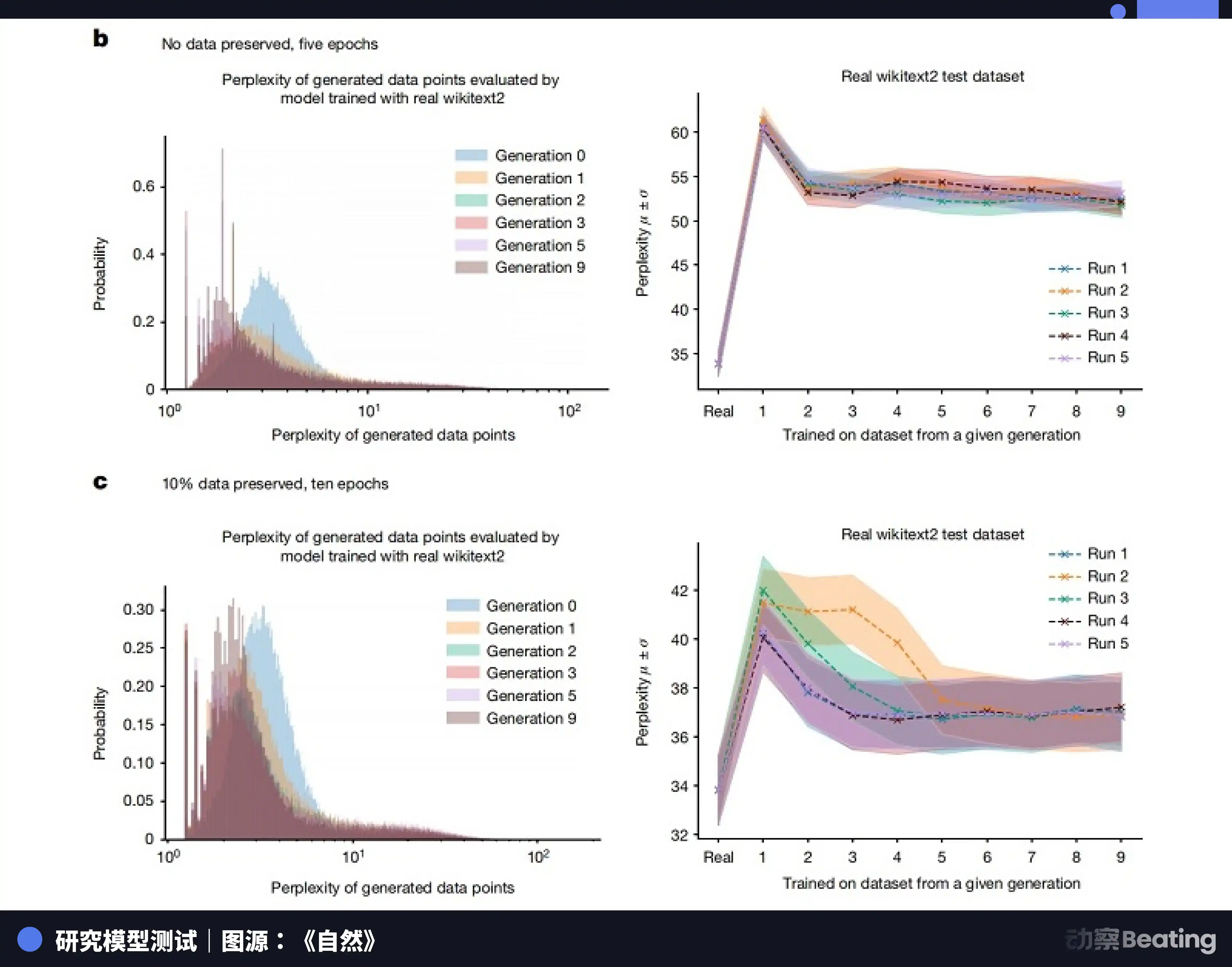
This is like those meme images circulating online. Originally a高清的 (high-definition) screenshot, forwarded, compressed, and forwarded again by countless people. Each transmission loses some pixels and adds some noise. Finally, the image becomes blurry and unrecognizable, coated in electronic包浆 (patina).

When the real, human context imbued with tacit knowledge is exhausted, and the system can only train itself on this patina-coated shadow, what will be left in the end?

Who Is Erasing Our Traces

What remains is only correct nonsense.

When the river of knowledge dries up into an endless rumination of AI upon AI,自我咀嚼 (self-chewing), everything the system吞吐 (ingests and spews) will inevitably become extremely standard, extremely safe, but incurably空洞 (hollow). You will see countless perfectly structured weekly reports, countless emails挑不出毛病 (with no faults to pick), but containing no breath of a living person, no truly valuable insight.

This great溃败 (collapse/rout) of knowledge is not because human brains have become duller. The true悲哀 (sadness) lies in the fact that we have outsourced the right to think and the responsibility to leave context to our own shadows.

A few days after the "Colleague.skill" explosion, a project named "anti-distill" quietly appeared on GitHub.

The author of this project did not try to attack large models, nor did they write any grand manifesto. They simply provided a small tool to help workers automatically generate some seemingly reasonable but actually logic-noisy无效长文 (ineffective long articles) in Feishu or DingTalk.

Their goal is simple: before being distilled by the system, hide their core knowledge first. Since the system likes to capture "proactively written long articles," feed it a bunch of meaningless乱码 (gibberish).

This project did not explode like "Colleague.skill"; it even seems somewhat tiny and powerless. Using magic to defeat magic is essentially still playing within the rules set by capital and technology. It cannot change the major trend of the system relying more and more on AI and increasingly neglecting real people.

But this does not prevent this project from becoming the most tragically poetic and deeply metaphorical scene in the entire absurd play.

We strive extremely hard to leave traces in the system, write detailed documents, provide meticulous decisions, trying to prove within this vast modern enterprise machine that we once existed, that we were valuable. Unaware that these extremely conscientious traces will ultimately become the eraser that抹去 (erases) us.

But looking at it from another angle, this might not be a complete dead end.

Because what that eraser抹去的 (erases) is always only the "past you." A skill packaged into a file, no matter how sophisticated its capture logic, is essentially just a static snapshot. It is locked at the moment of export, can only rely on stale nourishment, and spins infinitely within established processes and logic. It lacks the instinct to face unknown chaos, let alone the ability to self-evolve through setbacks in the real world.

When we hand over those highly standardized,既定式的 (set-in-stone) experiences, we恰恰 (precisely) free up our own hands. As long as we continue to reach outward, continue to break and reconstruct our cognitive boundaries, that shadow lingering in the cloud can only ever follow in our footsteps.

Humans are fluid algorithms.

Связанные с этим вопросы

QAccording to the article, what makes diligent workers more susceptible to being distilled into an AI 'skill'?

ATheir thorough documentation, detailed decision-making explanations, and responsible handover of work details to digital systems provide high-quality, easily extractable context that serves as perfect fuel for AI.

QWhat philosophical concept does the article use to describe the reduction of human relationships to functional interfaces?

AMartin Buber's distinction between 'I-Thou' relationships, which treat others as whole beings, and 'I-It' relationships, which reduce people to functional objects for use.

QWhat is 'model collapse' as discussed in the context of AI training on AI-generated data?

AIt refers to the phenomenon where AI models trained on synthetic data from other AIs experience a narrowing of data distribution, losing rare and complex human traits and outputting increasingly mediocre and homogenized content.

QWhat strategy did the 'anti-distill' project propose to counter the extraction of personal knowledge?

AIt provided a tool to automatically generate seemingly reasonable but actually noisy and ineffective long texts in collaboration software, aiming to hide core knowledge by polluting the data harvested by the system.

QWhy does the article suggest that an AI 'skill' can never fully replace a human being?

ABecause a 'skill' is a static snapshot of past behavior, lacking the ability to face unknown chaos, evolve through real-world failure, or capture the tacit, intuitive knowledge that defines human expertise and continuous growth.

Похожее

The Midlife Crisis of Crypto GPs: No PMF, No Next Check from LPs

The article "The Midlife Crisis of Crypto GPs: No PMF, No Next LP Check" analyzes the shifting crypto fundraising landscape. It argues the era of selling grand visions to LPs is over; GPs must now offer products with clear Product-Market Fit (PMF). The author categorizes crypto fundraising products into three types: Primary (VC funds), Liquid (trading strategies), and CeFi/DeFi Native Yield. This summary focuses on the Primary market. Key points include: * **Market Shift:** LPs are impatient, demand immediate returns, and are skeptical of future promises. The "easy money" narrative has faded. * **GP Value Erosion:** LP learning curves have shortened (aided by AI), reducing the value of a GP's basic "crypto knowledge." Superior judgment is now rare. * **Weakened LP Motivations:** Traditional reasons for LPs to invest in crypto VC funds (capturing industry beta, gaining access, leveraging GP judgment) have weakened due to new products like ETFs and increased LP sophistication. * **Surviving in Primary:** The primary market will likely persist for: 1) large funds in endowment mandates treating it as a lottery ticket, 2) family offices/HNWIs using proprietary capital, 3) a few funds with proven recent outperformance, and 4) funds with strong ecosystem "deal-making" capabilities. * **Conclusion:** For most GPs, rebuilding trust requires starting over in a niche, demonstrating alpha-generating ability, or providing concrete value/services to LPs.

marsbit14 мин. назад

The Midlife Crisis of Crypto GPs: No PMF, No Next Check from LPs

marsbit14 мин. назад

Crypto GPs' Midlife Crisis: No PMF, No LP's Next Check

The article "The Midlife Crisis of Crypto GPs: No PMF, No LP's Next Check" analyzes the shifting crypto fundraising landscape. It argues that the era of LPs funding vague "vision" is over; GPs must now offer products with clear Product-Market Fit (PMF) to secure capital. The market has matured. LPs, disillusioned by the last cycle's failures and wary of long lock-up periods, now demand tangible, near-term returns rather than speculative narratives. The proliferation of accessible crypto ETFs and other liquid products has reduced the need for VC blind pools as an entry point. The author categorizes crypto fundraising products into three types: Primary (VC funds, with blind pools or clear pipelines), Liquid (alpha/beta, directional/market-neutral strategies), and CeFi/DeFi Native Yield (crypto-specific mechanisms like staking, farming). Focusing on the Primary market, the piece details why traditional LP rationales for investing in crypto VCs have weakened: easier beta access via ETFs, diminished "access" and "judgement" premiums as LPs build internal teams, and a widespread lack of proven superior returns from GPs. Ultimately, only specific players are likely to remain at the primary VC table: large funds with access to patient endowment capital, family offices/HNWIs investing proprietary capital, the few funds with demonstrable excess returns from the last cycle, and those with clear "deal-making" or ecosystem resource advantages. For others, the path forward is to rebuild trust by proving alpha-generation capability in a niche or providing concrete, valuable services.

链捕手39 мин. назад

Crypto GPs' Midlife Crisis: No PMF, No LP's Next Check

链捕手39 мин. назад

The Age of Decoupling Has Arrived: Bitcoin is No Longer the Sole Compass of Crypto

The era of the cryptocurrency market moving in lockstep with Bitcoin is ending, as the industry splits into two distinct asset categories: endogenous and exogenous. Endogenous assets, like Bitcoin, derive value purely from the crypto market's cycles. Their narratives swing between being "interstellar money" in bull markets and "digital collectibles" in bear markets. Exogenous assets, however, are nominally crypto but operate with independent value drivers. Examples include: * **Venice:** An AI inference service using tokens for payments; its consumer-AI business model is decoupled from crypto price swings. * **Figure:** A fintech lender using blockchain to speed up loan approvals; its core value is in credit, not crypto. * **Stablecoin firms like BVNK:** Acquired by traditional finance giants (Mastercard, Stripe), their growth is tied to payment infrastructure, not market cycles. Hybrid projects like **Hyperliquid** (a decentralized exchange) show a shift, with a growing share of non-crypto trading (e.g., prediction markets). This divergence is fundamental. Endogenous assets remain highly correlated to Bitcoin, similar to gold miners to gold. Exogenous assets are evolving to have their own fundamentals, like the weak correlation between gold and the S&P 500. This changes investment analysis. Evaluating exogenous assets requires traditional fundamental research—assessing user bases, unit economics, and moats—more akin to fintech investing than charting Bitcoin. Promising exogenous sectors include: on-chain exchanges/brokers, AI-crypto fusion, privacy-focused digital banks, lending (institutional/private credit), stablecoins/real-world asset tokenization, payment rails, and non-financial crypto-consumer products. Currently, investing via equity is often safer than via tokens, as token value accrual mechanisms need further regulatory and industry development (e.g., the CLARITY Act). Nonetheless, the core trend is clear: crypto market drivers are diversifying from a single factor (Bitcoin) to multiple fundamentals, ending the era of uniform market moves.

marsbit1 ч. назад

The Age of Decoupling Has Arrived: Bitcoin is No Longer the Sole Compass of Crypto

marsbit1 ч. назад

Five Cryptos That Could Outperform Bitcoin Over the Next Cycle Due To Higher Growth Velocity

Bitcoin's growth often sets market trends, but analysts believe the next cycle's highest percentage gains may come from assets with greater growth velocity. While Bitcoin provides stability, several cryptocurrencies are positioned for stronger relative upside. This article highlights five such assets, with a particular focus on Ozak AI as the potential high-growth standout of the cycle. Ethereum (ETH) is noted for its ongoing evolution and institutional adoption. Solana (SOL) is recognized for its high throughput and history of sharp rallies. Chainlink (LINK) is highlighted as essential infrastructure for DeFi and AI applications. Avalanche (AVAX) is mentioned for its subnet architecture and enterprise potential. Ozak AI ($OZ) is presented as a distinct early-stage opportunity, currently in presale at $0.014 with a target listing price of $1.00. The project is building a full AI-native blockchain ecosystem, including prediction agents, a data stream network, and structured data vaults. Analysts suggest its early valuation stage and focus on AI infrastructure could allow for exponential growth velocity compared to more mature assets like Bitcoin, which requires massive capital inflows for significant price movement. The final takeaway positions Ozak AI as a high-asymmetry bet for investors seeking exponential upside alongside more stable assets.

TheNewsCrypto2 ч. назад

Five Cryptos That Could Outperform Bitcoin Over the Next Cycle Due To Higher Growth Velocity

TheNewsCrypto2 ч. назад

Торговля

Спот
Фьючерсы

Популярные статьи

Что такое DOGE M

Doge Matrix ($doge m): Новая порода криптовалюты, управляемой сообществом Введение В постоянно развивающемся мире криптовалют новые проекты постоянно появляются, каждый из которых стремится привлечь интерес инвесторов и энтузиастов. Одним из последних участников этой области является Doge Matrix, представленный тикером $doge m. Этот проект привлек внимание благодаря своим корням в популярной мем-культуре, окружающей Dogecoin, и занял свое место в пространстве web3. Эта статья направлена на предоставление всестороннего анализа Doge Matrix, охватывающего его обзор, создателя, инвесторов, функциональность, временную шкалу и примечательные аспекты. Что такое Doge Matrix ($doge m)? Doge Matrix — это проект криптовалюты, управляемый сообществом, который, по-видимому, основывается на широкой привлекательности Dogecoin, цифровой валюты, известной своим маскотом Шиба Ину и мем-истоками. Хотя общие цели Doge Matrix не определены в широком смысле, он характеризуется стремлением к вовлечению и поддержке сообщества. В отличие от традиционных криптовалют, которые часто подчеркивают полезность или внутреннюю ценность через базовые технологии, Doge Matrix позиционирует себя в пространстве, которое охватывает культурный феномен криптовалют, особенно привлекая тех, кто резонирует с этосом активов на основе мемов. Опираясь на сильные стороны сообщества Dogecoin, Doge Matrix функционирует как часть более широкой экосистемы, приглашая участие и вовлеченность пользователей, которые разделяют интерес к криптовалюте и цифровому пространству. Кто является создателем Doge Matrix ($doge m)? Личность создателя Doge Matrix остается неизвестной. Эта нехватка прозрачности не является редкостью в пространстве криптовалют, где некоторые проекты запускаются без раскрытия личностей своих основателей. Отсутствие информации о команде основателей может вызывать вопросы у потенциальных инвесторов о подотчетности и направлении проекта. Кто являются инвесторами Doge Matrix ($doge m)? На данный момент нет общедоступной информации, подробно описывающей инвесторов или инвестиционные фонды, поддерживающие Doge Matrix. Проект, похоже, в основном полагается на поддержку сообщества, а не на институциональные инвестиции. Эта модель соответствует управляемой сообществом природе инициативы, способствуя созданию среды, в которой направление проекта формируется его участниками, а не диктуется избранными финансовыми спонсорами. Как работает Doge Matrix ($doge m)? Специфика операционных механизмов Doge Matrix несколько расплывчата, отражая более широкую тенденцию проектов в пространстве мем-коинов, где инновационные функции не всегда четко сформулированы. Тем не менее, Doge Matrix, похоже, разработан для того, чтобы использовать существующую экосистему криптовалют, поощряя участие пользователей и опираясь на знакомые культурные ссылки, связанные с Dogecoin. Его потенциально уникальные характеристики происходят от взаимодействий сообщества, а не от технологических достижений, подчеркивая общие переживания и сотрудничество среди держателей токенов. Хотя точные инновации не были явно изложены, проект, похоже, создает пространство, где члены сообщества могут взаимодействовать, делиться идеями и продвигать потенциал проекта вперед. Временная шкала Doge Matrix ($doge m) Обзор временной шкалы проекта выявляет значимые события, которые определили его путь до сих пор: 25 ноября 2024 года: Doge Matrix достиг своего исторического максимума, что стало значительной вехой в его ранней истории. 1 января 2025 года: Напротив, Doge Matrix достиг своего исторического минимума, иллюстрируя волатильность, часто ассоциируемую с криптовалютами, особенно на ранних стадиях жизненного цикла проекта. В процессе: Проект продолжает активно торговаться и поддерживаться своим сообществом, хотя конкретные будущие вехи или цели еще не были раскрыты. Ключевые моменты о Doge Matrix ($doge m) Ориентированность на сообщество В центре Doge Matrix лежит стремление к вовлечению сообщества. Проект процветает на основе сотрудничества и общих целей среди своих участников, подчеркивая важность коллективных усилий. В отличие от централизованных проектов, которые часто имеют четкую структуру руководства, Doge Matrix в настоящее время демонстрирует более гибкий подход к управлению, где голос каждого члена сообщества имеет значение. Волатильность Криптовалютный рынок известен своей волатильностью, и Doge Matrix не является исключением. Его история цен отражает значительные колебания между высокими и низкими значениями, что типично для многих новых криптовалют, но подчеркивает риски, связанные с инвестициями в новые токены. Нехватка детальной информации Одной из самых поразительных особенностей Doge Matrix является нехватка детальной информации о его технологических основах и операционных механизмах. Эта неопределенность требует от потенциальных инвесторов проведения тщательной проверки перед взаимодействием с проектом. Заключение В заключение, Doge Matrix ($doge m) иллюстрирует новую волну проектов криптовалют, которые сильно полагаются на вовлечение сообщества и культурную значимость. Хотя проект и не хватает некоторых конкретных деталей — таких как четкое руководство, определенные цели и детальная функциональность — он сумел вызвать интерес в крипто-сообществе, используя установленную привлекательность мем-культуры. Как и в случае с любыми инвестициями в пространстве криптовалют, понимание присущих рисков и проведение комплексного исследования являются необходимыми для потенциальных участников. Doge Matrix служит напоминанием о динамичной, иногда непредсказуемой природе криптоиндустрии, отмеченной постоянной эволюцией и энтузиазмом в отношении инициатив, управляемых сообществом.

654 просмотров всегоОпубликовано 2025.02.03Обновлено 2025.02.03

Что такое DOGE M

Что такое $M

Понимание Mantis ($M): Новая эра в кросс-цепной интероперабельности В постоянно развивающемся ландшафте Web3 и криптовалют новые проекты стремятся предложить инновационные решения, направленные на улучшение пользовательского опыта и расширение функциональных возможностей в рамках децентрализованной финансовой экосистемы. Один из таких проектов, привлекающих внимание, — Mantis ($M), пионерский протокол, основанный на принципах кросс-цепной интероперабельности и расчетов на основе намерений. Эта статья углубляется в основные аспекты Mantis, включая его основную функциональность, создателей, инвестиционную поддержку, инновационные функции и ключевые вехи. Что такое Mantis ($M)? Mantis описывается как протокол расчетов по намерениям в нескольких доменах, который упрощает кросс-цепные взаимодействия, позволяя пользователям без труда выполнять сложные финансовые транзакции на различных блокчейн-платформах. Протокол работает через три основных уровня: Выражение намерений: Пользователи могут формулировать свои цели транзакций на естественном языке с помощью DISE LLM, продвинутой модели AI. Например, пользователь может выразить желание обменять Ethereum (ETH) на Solana (SOL) с определенной допустимой проскальзыванием в 1%. Исполнение: Этот уровень использует сеть решателей, которые конкурируют за выполнение намерений пользователей. Транзакции выполняются с использованием таких механизмов, как совпадение желаний (CoWs) и аукционы потока заказов (OFAs), которые обеспечивают оптимальное удовлетворение потребностей пользователей. Расчет: Используя протокол межблокчейн-коммуникации (IBC), Mantis позволяет атомарные кросс-цепные транзакции, позволяя пользователям работать на различных поддерживаемых цепях, включая Ethereum, Solana и Cosmos. Mantis разработан для введения родного генерации дохода для неактивных активов, используя криптографические доказательства для поддержания целостности транзакций на протяжении всего процесса. Создатели и команда разработки Mantis был задуман Composable Foundation, исследовательской организацией, известной своим акцентом на решениях для блокчейн-интероперабельности. Этот фонд сотрудничает с уважаемыми академическими учреждениями, включая Гарвардский университет и Университет Лиссабона, внося вклад в обширные исследования и разработки, которые информируют архитектуру и функциональность Mantis. Обязательство Composable Foundation по содействию инновациям в области блокчейна позиционирует Mantis как надежное решение для растущего спроса на интероперабельность среди множества блокчейн-сетей. Инвесторы и поддержка Хотя конкретные детали о частных инвесторах не были публично раскрыты, Mantis пользуется значительной поддержкой от различных организаций, включая: Гранты экосистемы от цепей с поддержкой IBC, которые поддерживают рост протокола и его интеграцию в экосистемы децентрализованных финансов. Стратегические партнерства с поставщиками инфраструктуры, которые усиливают сетевые возможности Mantis и стратегии развертывания. Финансирование через казну Composable Foundation, обеспечивая устойчивую финансовую поддержку для продолжающейся разработки и операционных расходов. Эти совместные усилия отражают консенсус среди заинтересованных сторон о важности улучшения кросс-цепной функциональности и потенциальной полезности инфраструктурных инноваций Mantis. Ключевые инновации Mantis выделяется благодаря нескольким пионерским инновациям, которые улучшают его функциональность и полезность: Независимые от цепи намерения: Пользователи могут инициировать транзакции с любой поддерживаемой цепи, при этом расчет происходит на другой. Эта гибкость дает пользователям больше возможностей, способствуя увеличению взаимодействия между различными платформами. Интерфейс на базе AI: Интеграция DISE LLM позволяет пользователям проводить сложные операции DeFi на естественном языке, тем самым упрощая взаимодействия и делая технологии блокчейн доступными для более широкой аудитории. Кросс-доменное захватывание MEV: Mantis создает внутренний рынок для максимальной извлекаемой ценности (MEV) через конкуренцию между решателями. Этот инновационный подход позволяет достичь большей эффективности и извлечения ценности в сложных транзакциях. Модульный уровень расчетов: Протокол поддерживает различные методы верификации, включая нулевые доказательства и оптимистичные роллапы, предоставляя универсальную структуру, которая может адаптироваться к новым технологиям блокчейна. Историческая хронология Разработка Mantis отмечена несколькими критическими вехами, которые определяют его траекторию и рост: | Год | Веха | |————|———————————————————————–| | 2022 | Начальная разработка концепции в исследовательском подразделении Composable Foundation. | | Q3 2024 | Запуск тестовой сети с возможностями мостов между Solana и Ethereum. | | Q1 2025 | Ожидаемое событие генерации токенов (TGE) наряду с запуском основной сети. | | Q2 2025 | Ожидаемая интеграция DISE LLM и расширение кросс-цепных возможностей. | | 2025 H2 | Запланированная поддержка более 15 цепей через дальнейшие обновления IBC. | Эта хронология описывает эволюцию Mantis, от концептуальных обсуждений до активной реализации и будущих этапов роста. Стратегия роста экосистемы Стратегия Mantis по росту экосистемы включает несколько инициатив, направленных на поощрение участия пользователей и вовлечения разработчиков: Система кредитов: Пользователи могут зарабатывать кредиты протокола, предоставляя ликвидность и участвуя в реферальных программах. Эти кредиты можно будет обменять на стимулы в будущем, способствуя формированию активного сообщества пользователей. Модульный комплект для разработки программного обеспечения (SDK): Этот инструмент позволяет разработчикам создавать приложения на основе моделей, управляемых намерениями, используя инфраструктуру Mantis, тем самым способствуя инновациям в его экосистеме. Модель управления: По мере взросления протокола держатели токенов $M получат возможность участвовать в управлении протоколом, позволяя им голосовать за предлагаемые обновления и изменения, тем самым усиливая вовлеченность сообщества и децентрализацию. Mantis представляет собой значительный шаг вперед в области кросс-цепной архитектуры. Путем бесшовной интеграции продвинутых алгоритмов AI с надежной расчетной структурой Mantis стремится решить проблемы фрагментации в многоцепных экосистемах. Его инновационный подход приоритизирует улучшение пользовательского опыта, соблюдая при этом основные принципы децентрализации и безопасности, устанавливая новый стандарт для будущей интероперабельности технологий блокчейн. По мере того как Mantis продолжает свой путь роста и реализации, он обещает стать проектом, за которым стоит внимательно следить в конкурентной среде Web3 и децентрализованных финансов. С акцентом на преодоление границ и повышение вовлеченности пользователей Mantis готов стать неотъемлемой частью будущих разработок в области криптовалют.

54 просмотров всегоОпубликовано 2025.03.18Обновлено 2025.03.18

Что такое $M

Как купить M

Добро пожаловать на HTX.com! Мы сделали приобретение MemeCore (M) простым и удобным. Следуйте нашему пошаговому руководству и отправляйтесь в свое крипто-путешествие.Шаг 1: Создайте аккаунт на HTXИспользуйте свой адрес электронной почты или номер телефона, чтобы зарегистрироваться и бесплатно создать аккаунт на HTX. Пройдите удобную регистрацию и откройте для себя весь функционал.Создать аккаунтШаг 2: Перейдите в Купить криптовалюту и выберите свой способ оплатыКредитная/Дебетовая Карта: Используйте свою карту Visa или Mastercard для мгновенной покупки MemeCore (M).Баланс: Используйте средства с баланса вашего аккаунта HTX для простой торговли.Третьи Лица: Мы добавили популярные способы оплаты, такие как Google Pay и Apple Pay, для повышения удобства.P2P: Торгуйте напрямую с другими пользователями на HTX.Внебиржевая Торговля (OTC): Мы предлагаем индивидуальные услуги и конкурентоспособные обменные курсы для трейдеров.Шаг 3: Хранение MemeCore (M)После приобретения вами MemeCore (M) храните их в своем аккаунте на HTX. В качестве альтернативы вы можете отправить их куда-либо с помощью перевода в блокчейне или использовать для торговли с другими криптовалютами.Шаг 4: Торговля MemeCore (M)С легкостью торгуйте MemeCore (M) на спотовом рынке HTX. Просто зайдите в свой аккаунт, выберите торговую пару, совершайте сделки и следите за ними в режиме реального времени. Мы предлагаем удобный интерфейс как для начинающих, так и для опытных трейдеров.

1.1k просмотров всегоОпубликовано 2025.07.02Обновлено 2026.06.01

Как купить M

Обсуждения

Добро пожаловать в Сообщество HTX. Здесь вы сможете быть в курсе последних новостей о развитии платформы и получить доступ к профессиональной аналитической информации о рынке. Мнения пользователей о цене на M (M) представлены ниже.

活动图片