Where Are Risk Assets Headed Amid the Bank of Japan's Gradual Hawkish Signals?

marsbitОпубликовано 2025-12-22Обновлено 2025-12-22

Введение

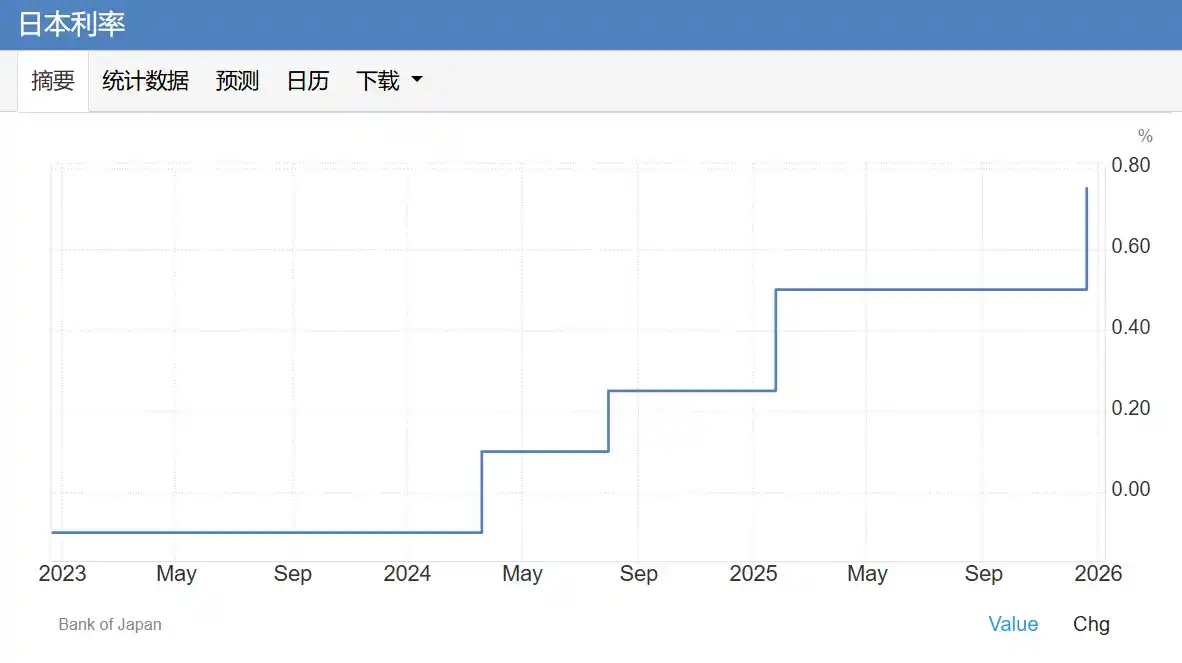
The Bank of Japan (BOJ) raised its policy rate by 25 basis points to 0.75% on December 19, 2025, marking its second hike since January and the highest rate since 1995. The unanimous decision was widely anticipated. Governor Kazuo Ueda indicated that the current rate remains below the neutral level and future adjustments will depend on economic data, wage growth, and inflation trends. Market reaction was muted: USD/JPY rose slightly to 156.06, the 30-year JGB yield edged up, the Nikkei 225 gained 1.5%, and Bitcoin surpassed $87,000. Strong core CPI growth of 3.0% in November and sustained wage increases supported the move. Analysts are divided on the timing of the next hike, with some expecting it in mid-2026. The end of ultra-loose policy may gradually reduce global yen carry trades, potentially increasing funding costs and pressuring risk assets like cryptocurrencies. While some fear a repeat of past post-hike crypto corrections (20-30% declines), others argue the hike was well-priced. The BOJ's planned ETF sales starting in early 2026 could further impact global liquidity.

Author: Zhou, ChainCatcher

At the monetary policy meeting concluding on December 19, 2025, the Bank of Japan (BOJ) decided to raise the policy rate by 25 basis points, from 0.5% to 0.75%. This marks the second rate hike since January this year, bringing interest rates to their highest level since 1995.

The decision was passed unanimously with a 9:0 vote, fully in line with market expectations. All 50 economists surveyed had predicted this rate hike, making it the first unanimous expectation for a hike under Governor Kazuo Ueda's tenure.

At a press conference, BOJ Governor Kazuo Ueda stated that short-term interest rates being at a 30-year high holds no special significance and that the central bank will closely monitor the impact of interest rate changes. He mentioned that there is still some distance to the lower bound of the neutral interest rate range and that the market should not expect a precise neutral interest rate range to be provided in the short term. The pace of future adjustments to monetary support policies will depend on economic growth, price performance, and financial market conditions at the time.

Ueda emphasized that the BOJ will update its assessments of the economic outlook, price risks, and the likelihood of achieving targets at each meeting and make decisions accordingly. He acknowledged that estimates for Japan's neutral interest rate span a wide range, making precise calculations difficult, and that it is necessary to observe the actual feedback from the economy and prices after each interest rate change. If wage increases continue to translate into price rises, further rate hikes are indeed possible.

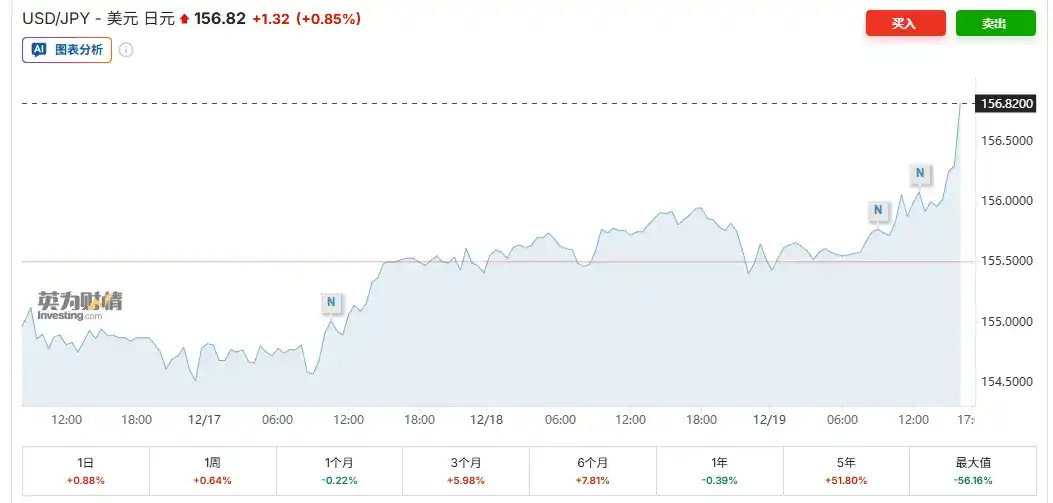
Capital markets reacted relatively calmly: The USD/JPY exchange rate rose slightly by 0.3% to 156.06; the yield on Japan's 30-year government bonds edged up 1 basis point to 3.385%; the Nikkei 225 index rose 1.5% during the session to 49,737.92 points; and Bitcoin surpassed $87,000, with a daily increase of 1.6%. Risk assets, as a whole, did not show significant selling pressure for the time being.

Looking back at the fundamentals, this rate hike by Japan was well-supported by data. In November, core CPI grew by 3.0% year-on-year, in line with expectations, indicating that inflationary pressures remain strong and have now exceeded the 2% policy target for 44 consecutive months. Additionally, wage growth momentum is solid, large manufacturers' confidence has reached a four-year high, and even amid U.S. tariff pressures, corporate supply chain adjustments have shown significant resilience, with the impact being lower than expected.

Meanwhile, Japan's major labor unions have set wage hike targets for the upcoming "Shunto" spring wage negotiations that are on par with last year's. Given that last year saw the largest wage increases in decades, this suggests that wage growth momentum continues.

Overall, although the rate hike was small, it marks Japan's formal departure from the long era of ultra-loose monetary policy and could become a significant turning point for global risk asset liquidity at year-end.

Has the Market Fully Priced In Expectations?

Current market pricing suggests that the Bank of Japan may raise rates again as early as June or July next year. Yuxuan Tang of J.P. Morgan Private Bank believes that, due to full market expectations, the rate hike's boost to the yen will be limited. It is expected that there will be one more rate hike in 2026, bringing the rate to 1%, with USD/JPY fundamentals remaining high around 150, with 160-162 as a potential defense range. Negative interest rate differentials and fiscal risks will continue to limit the yen's appreciation potential.

However, some analysts question this timeline as too aggressive, suggesting that October 2026 is a more realistic window, as it would allow sufficient time to assess the impact of rising borrowing costs on corporate financing, bank credit, and household consumption. By then, the results of the spring wage negotiations and the yen exchange rate will be the core evaluation indicators.

Additionally, Morgan Stanley expects that after the 25 basis point hike, the BOJ will still emphasize the accommodative nature of the policy environment, with interest rates still below neutral levels. The future tightening path will be gradual and highly data-driven, without a preset aggressive route.

Investinglive analyst Eamonn Sheridan believes that since real interest rates remain negative and policy is generally accommodative, the next rate hike is expected no earlier than mid-to-late 2026 to observe the actual penetration of borrowing costs into the economy.

For a long time, Japan's ultra-low interest rate environment has provided vast amounts of cheap liquidity to global markets. Through the "yen carry trade," investors borrow yen at low cost and invest in high-yield assets such as U.S. stocks and cryptocurrencies. This mechanism, on a massive scale, has been a key support for the risk asset bull market over the past years.

Although the latest TIC data show that Japanese capital has not yet seen large-scale repatriation from the U.S. Treasury market (holdings increased to $1.2 trillion in October), as the attractiveness of Japanese Government Bonds (JGBs) rises, this trend may gradually emerge, pushing up U.S. Treasury yields and global dollar funding costs, thereby putting pressure on risk assets.

Currently, most major central banks are in a rate-cutting cycle, while the BOJ's rate hike creates a policy divergence. This contrast is highly likely to trigger unwinding of carry trades, and the cryptocurrency market, with its high leverage and 24-hour trading characteristics, is often the first to feel the liquidity shock.

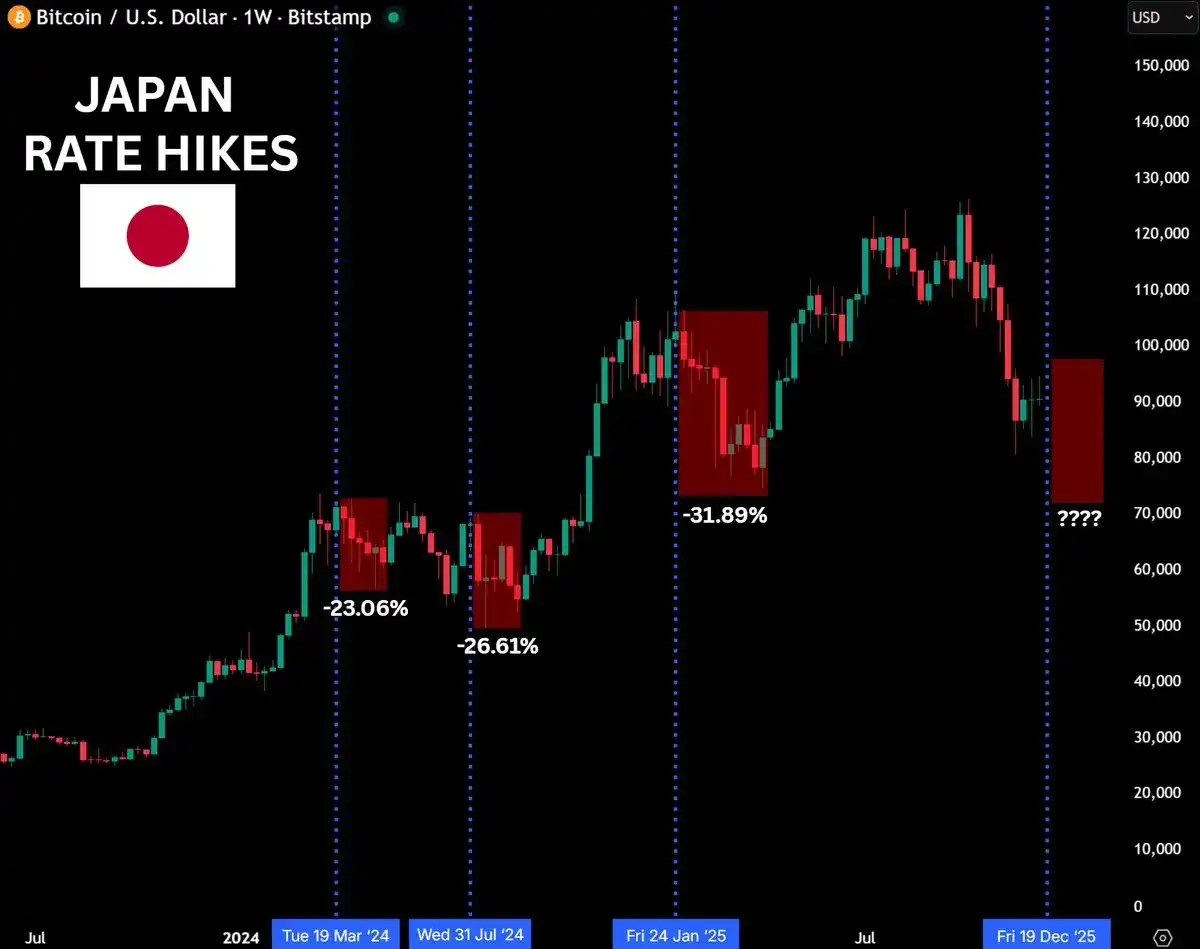
Macro analysts had warned that if the BOJ hiked rates on December 19, Bitcoin could face a risk of retesting $70,000. Historical data show that Bitcoin experienced significant pullbacks after the past three rate hikes, typically falling 20%-30% within 4-6 weeks. For example, it fell 23% in March 2024, 26% in July, and 31% in January 2025. The market was highly concerned that this hike would repeat this historical pattern.

Those sounding the alarm believe that Japan's rate hike remains one of the biggest variables in current asset pricing, and its role in global capital markets is underestimated. A policy shift could trigger broad deleveraging effects.

A more neutral view holds that attributing historical declines solely to Japan's rate hikes is overly simplistic, and that expectations for this hike were extremely well-anticipated (the crypto market had already corrected in advance since last week). Most panic sentiment has been priced in. Analysts note that the market fears uncertainty more than tightening itself.

It is worth mentioning that, according to Bloomberg, the BOJ may begin the gradual liquidation of its ETF assets as early as January 2026. As of the end of September, its ETF holdings were valued at approximately 83 trillion yen. If accompanied by multiple rate hikes in 2026, bond selling could accelerate. The continued unwinding of the yen carry trade would trigger risk asset sell-offs and yen repatriation, having a profound impact on stock markets and cryptocurrencies.

Click to learn about open positions at ChainCatcher

Связанные с этим вопросы

QWhat was the outcome of the Bank of Japan's December 2025 monetary policy meeting regarding interest rates?

AThe Bank of Japan (BOJ) decided to raise the policy rate by 25 basis points, from 0.5% to 0.75%, marking its second rate hike since January of that year and bringing the rate to its highest level since 1995.

QHow did major risk assets like the Nikkei 225 and Bitcoin react immediately to the BOJ's rate hike announcement?

AThe market reaction was relatively calm. The Nikkei 225 index rose 1.5% to 49,737.92 points, and Bitcoin broke above $87,000 with a 1.6% intraday gain. Risk assets did not show significant selling pressure initially.

QAccording to the article, what is a major global financial mechanism that could be impacted by the BOJ's policy shift?

AThe 'yen carry trade' is a major mechanism that could be impacted. In this trade, investors borrow cheap yen to invest in higher-yielding assets like U.S. stocks and cryptocurrencies. The BOJ's policy normalization could lead to the unwinding of these trades, potentially increasing global dollar funding costs and putting pressure on risk assets.

QWhat historical pattern has been observed with Bitcoin's price following previous BOJ rate hikes, and what was the market's concern for this latest hike?

AHistorical data shows that after the past three BOJ rate hikes, Bitcoin experienced significant corrections, typically falling 20%-30% within 4-6 weeks. There was a high level of concern in the market that this pattern would repeat after the December 2025 hike.

QWhat future action is the Bank of Japan reportedly planning regarding its ETF holdings, and what potential impact could it have?

AAccording to the article, the BOJ is expected to begin gradually selling its ETF holdings as early as January 2026. With its portfolio valued at approximately 83 trillion yen, such sales, combined with potential further rate hikes, could accelerate bond selling, trigger yen repatriation, and have a profound impact on global stock markets and cryptocurrencies.

Похожее

KOL's Perspective: Why Is SOL Set to Rise from This Point?

**Summary: Why SOL is Positioned for Growth at This Level** The article argues that SOL is poised for an upward move from its current price point, citing several key factors. Primarily, SOL has just broken out of a 4-month consolidation phase. This breakout signals a return of risk appetite to the broader crypto market, as SOL is seen as a key indicator of overall crypto health. The token's ownership has reportedly shifted from short-term traders and tourists to long-term accumulators, leading to low volume. Any meaningful increase in trading activity could thus trigger significant upward momentum. Fundamental strengths include strong institutional adoption, integration with DeFi and RWAs (Real-World Assets), and the potential benefits from the Clarity Act. Despite its high volatility—having dropped 70% from its all-time high but still up 12x from its bear market low—SOL is highlighted as one of the few tokens from the last cycle to reach new highs. It boasts a robust ecosystem of applications, users, and protocols. Future catalysts include the expected influx of AI developers following the Miami Accelerate conference, which focused on AI on Solana. Furthermore, Solana is positioned as the premier chain for memecoin activity, a trend expected to continue and drive network usage and fees. The article concludes that recent price action reflects a healthy transfer to long-term holders, setting the stage for growth.

marsbit6 мин. назад

KOL's Perspective: Why Is SOL Set to Rise from This Point?

marsbit6 мин. назад

Those Pre-Bitcoin PoW Protocols Have Recently Been Reimplemented

This article details a recent surge in replicating pre-Bitcoin Proof-of-Work (PoW) protocols, specifically focusing on Hal Finney's 2004 RPOW (Reusable Proofs of Work). Within five days in May 2026, multiple independent builders in the Bitcoin/cypherpunk community launched projects inspired by this early electronic cash proposal. The initiative began with Fred Krueger's `rpow2.com`, a centralized but auditable system that replaced RPOW's original IBM 4758 hardware with Ed25519 signatures. Initially a faithful replica, it later adopted Bitcoin-like features (21M supply cap, difficulty adjustment) and a controversial 5.24% founder allocation. This sparked rapid forks, including `rpow4.com` which incorporated full Bitcoin parameters, a prediction market (`rpowmarket.com`), and a DEX (`rpow2swap.com`). Concurrently, Mike In Space created a prototype of Wei Dai's 1998 b-money proposal (`b-money.replit.app`), pushing the historical exploration even further back. The article contrasts these centralized, server-dependent experiments with Bitcoin's core innovation of decentralized, trustless consensus. It also highlights a parallel development: the `HASH` project on Ethereum, which uses smart contract hooks to enable a purely fair-launch, browser-mineable PoW token with 0% allocations to team or VCs. The collective activity is framed as a meme-driven, educational exploration of cypherpunk history rather than a serious financial movement, with all projects heavily disclaiming any investment value.

marsbit11 мин. назад

Those Pre-Bitcoin PoW Protocols Have Recently Been Reimplemented

marsbit11 мин. назад

South Korean Exchanges 'Battle' Regulators, Challenging the Boundaries of Enforcement and Legislation

South Korea's cryptocurrency industry is engaged in a rare, direct confrontation with regulators. The Financial Intelligence Unit (FIU), the primary anti-money laundering (AML) watchdog, has recently imposed heavy penalties on major exchanges like Upbit and Bithumb for alleged violations involving unregistered overseas VASPs and AML procedures. However, exchanges are now actively challenging these actions in court and through industry associations. In a significant shift, the Seoul Administrative Court ruled in favor of Upbit's operator, Dunamu, overturning part of an FIU-ordered business suspension. The court found the FIU's penalty criteria and justification insufficiently clear. Similarly, the court suspended the enforcement of a six-month business suspension against Bithumb pending a final ruling, citing potential irreversible harm to the exchange. Beyond legal battles, the industry is contesting proposed legislative amendments. The Digital Asset eXchange Alliance (DAXA) strongly opposes a draft rule that would mandate Suspicious Transaction Reports (STRs) for all crypto transfers over 10 million KRW (~$6,800). DAXA argues this "poison pill" clause violates legal principles and would overwhelm the STR system, increasing reports from 63,000 to an estimated 5.45 million annually for major exchanges, thereby crippling effective AML monitoring. This conflict highlights a structural tension in South Korea's crypto governance: comprehensive digital asset laws are still developing, while regulators rely heavily on AML enforcement. The industry's move from passive compliance to active legal and legislative challenges signifies a new phase, pressing for clearer rules and more proportionate enforcement. While short-term disputes may intensify, this clash could ultimately lead to a more mature and sustainable regulatory framework for South Korea's vibrant crypto market.

marsbit1 ч. назад

South Korean Exchanges 'Battle' Regulators, Challenging the Boundaries of Enforcement and Legislation

marsbit1 ч. назад

After 50x Storage Surge, Justin Sun Always Looks to the Next Decade

Sun Yuchen, known for his controversial stunts like a $30 million lunch with Warren Buffett (canceled due to a kidney stone) and eating a $6.2 million duct-taped banana, is often overshadowed by a significant fact: his decade-long track record of spotting major investment trends. In 2016, he famously advised young people to invest in Bitcoin, Nvidia, Tesla, and Tencent instead of buying property. A hypothetical $20,000 investment in Nvidia and Tesla from that list would now be worth over 50 million RMB. His latest major call was on November 6, 2025, predicting a "50x storage opportunity" tied to the AI boom, which materialized with Sandisk's stock surging nearly 50-fold by 2026. Looking ahead, Sun now focuses on the next frontier: Physical AI. He identifies four key areas: 1. **Embodied AI/Robotics**: He sees this reaching its "iPhone moment," with companies like UBTech and Galaxy General leading in commercialization. 2. **Drones**: Viewed as the first commercially viable form of Physical AI, revolutionizing sectors from warfare (e.g., AeroVironment's Switchblade) to logistics. 3. **Spatial Computing**: Beyond VR, it's about AI understanding physical space, a foundational technology for robotics and autonomous systems, exemplified by Apple's Vision Pro. 4. **Space Exploration**: After a 2025 suborbital flight with Blue Origin, Sun advocates for space as the ultimate frontier, discussing blockchain's potential role in space asset management and data transactions. His investment philosophy involves betting on entire, inevitable trends rather than single companies. For robotics, he sees Tesla (the body/manufacturer) and Nvidia (the brain/AI platform) as complementary plays. In defense drones, he highlights companies making tanks obsolete (AeroVironment) and those augmenting fighter jets (Kratos). For space, he participated in Blue Origin's flight and anticipates SpaceX's potential IPO to redefine the sector's valuation. Sun Yuchen's vision frames the next two decades not as a revolution in information flow (like the internet), but in the fundamental operation of the physical world through AI-powered robots, autonomous systems, and spatial intelligence, ultimately extending human and AI activity into space. While many still focus on conventional assets, he continues to look toward the next technological horizon.

marsbit2 ч. назад

After 50x Storage Surge, Justin Sun Always Looks to the Next Decade

marsbit2 ч. назад

Торговля

Спот
Фьючерсы

Популярные статьи

Как купить S

Добро пожаловать на HTX.com! Мы сделали приобретение Sonic (S) простым и удобным. Следуйте нашему пошаговому руководству и отправляйтесь в свое крипто-путешествие.Шаг 1: Создайте аккаунт на HTXИспользуйте свой адрес электронной почты или номер телефона, чтобы зарегистрироваться и бесплатно создать аккаунт на HTX. Пройдите удобную регистрацию и откройте для себя весь функционал.Создать аккаунтШаг 2: Перейдите в Купить криптовалюту и выберите свой способ оплатыКредитная/Дебетовая Карта: Используйте свою карту Visa или Mastercard для мгновенной покупки Sonic (S).Баланс: Используйте средства с баланса вашего аккаунта HTX для простой торговли.Третьи Лица: Мы добавили популярные способы оплаты, такие как Google Pay и Apple Pay, для повышения удобства.P2P: Торгуйте напрямую с другими пользователями на HTX.Внебиржевая Торговля (OTC): Мы предлагаем индивидуальные услуги и конкурентоспособные обменные курсы для трейдеров.Шаг 3: Хранение Sonic (S)После приобретения вами Sonic (S) храните их в своем аккаунте на HTX. В качестве альтернативы вы можете отправить их куда-либо с помощью перевода в блокчейне или использовать для торговли с другими криптовалютами.Шаг 4: Торговля Sonic (S)С легкостью торгуйте Sonic (S) на спотовом рынке HTX. Просто зайдите в свой аккаунт, выберите торговую пару, совершайте сделки и следите за ними в режиме реального времени. Мы предлагаем удобный интерфейс как для начинающих, так и для опытных трейдеров.

1.3k просмотров всегоОпубликовано 2025.01.15Обновлено 2025.03.21

Как купить S

Sonic: Обновления под руководством Андре Кронье – новая звезда Layer-1 на фоне спада рынка

Он решает проблемы масштабируемости, совместимости между блокчейнами и стимулов для разработчиков с помощью технологических инноваций.

2.2k просмотров всегоОпубликовано 2025.04.09Обновлено 2025.04.09

Sonic: Обновления под руководством Андре Кронье – новая звезда Layer-1 на фоне спада рынка

HTX Learn: Пройдите обучение по "Sonic" и разделите 1000 USDT

HTX Learn — ваш проводник в мир перспективных проектов, и мы запускаем специальное мероприятие "Учитесь и Зарабатывайте", посвящённое этим проектам. Наше новое направление .

1.8k просмотров всегоОпубликовано 2025.04.10Обновлено 2025.04.10

HTX Learn: Пройдите обучение по "Sonic" и разделите 1000 USDT

Обсуждения

Добро пожаловать в Сообщество HTX. Здесь вы сможете быть в курсе последних новостей о развитии платформы и получить доступ к профессиональной аналитической информации о рынке. Мнения пользователей о цене на S (S) представлены ниже.

活动图片