When Silver Became a Meme Stock, Retail Investors Ultimately Caught the Falling Knife

marsbitОпубликовано 2026-02-05Обновлено 2026-02-05

Введение

The article details the dramatic rise and crash of silver prices in early 2026, which saw a 40% plunge in three days after retail investors, inspired by the GameStop phenomenon, poured a record $1 billion into silver ETFs. The crash was triggered not by a change in Fed leadership, as initially reported, but by the CME raising margin requirements by 50%, forcing over-leveraged retail traders into a cascade of automatic liquidations. While散户 suffered significant losses, institutional players like JPMorgan capitalized on the chaos. They accessed emergency Fed liquidity unavailable to retail, executed profitable arbitrage on the discounted SLV ETF, and strategically bought physical silver at the bottom. The piece concludes that the event highlights the structural advantages institutions hold in an asymmetric market, where散户, attempting to challenge Wall Street, ultimately became the victims of a "mass grave" they helped create.

Author: Xu Chao, Wall Street News

"I lost an entire year's after-tax salary today."
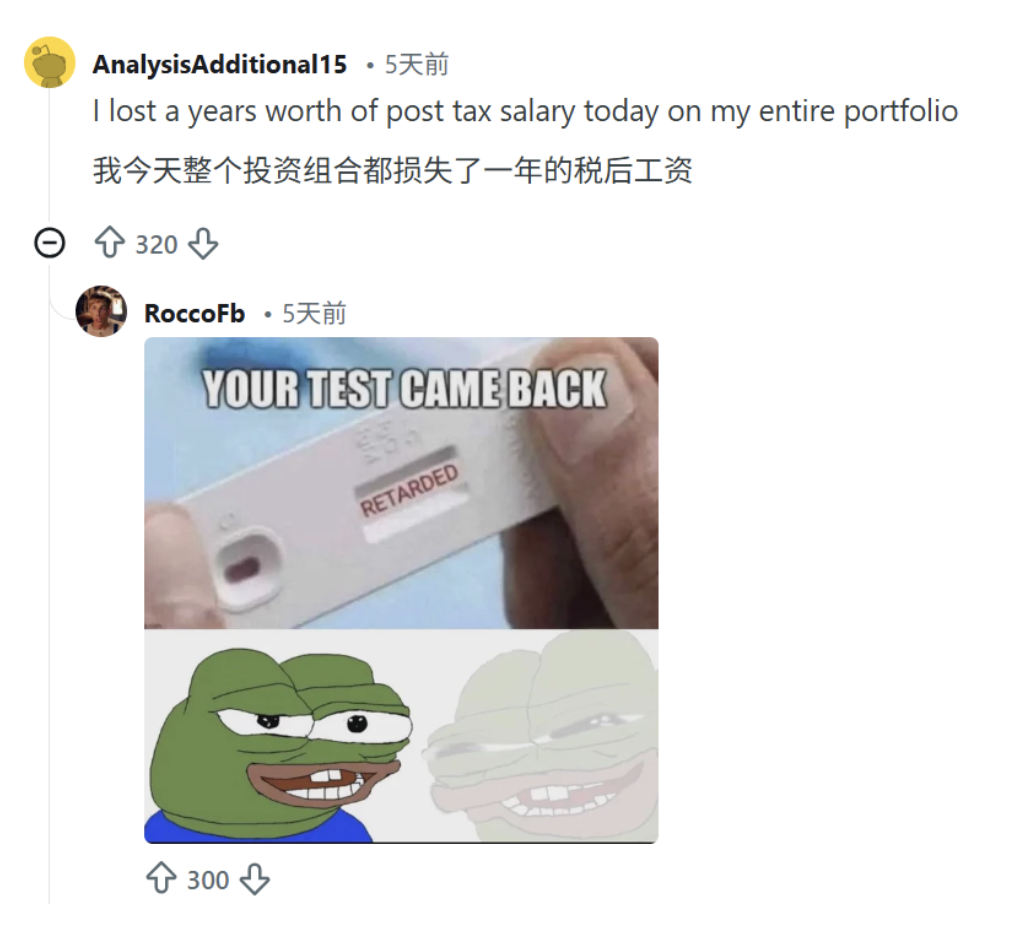
This was the desperate cry left by a Reddit user on the forum last Friday.

Just a few days ago, silver was seen as the "GameStop of 2026," a symbol of retail investors banding together to fight against Wall Street. Reddit forums were flooded with "Diamond Hands" memes, vowing to send silver to the moon.
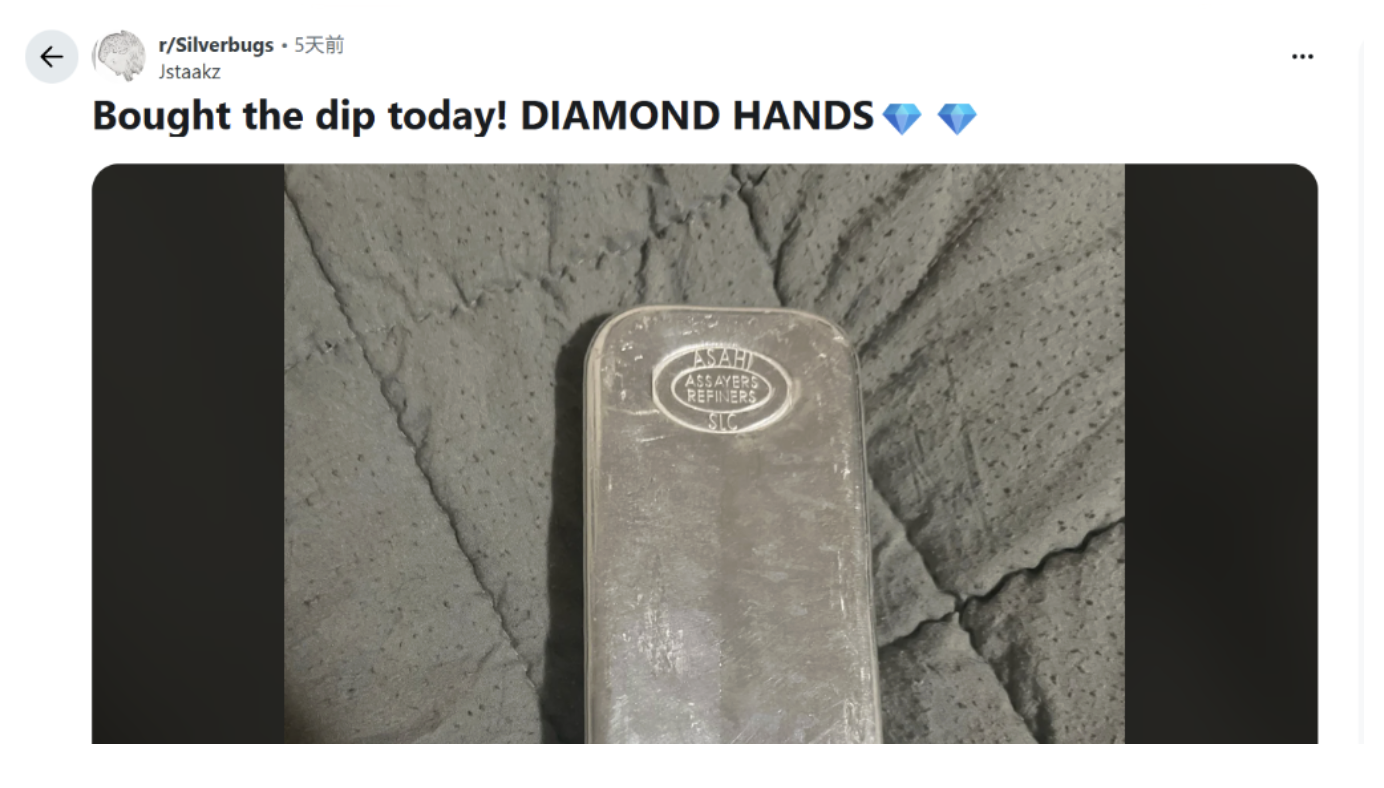
However, the狂欢 (carnival/euphoria) came to an abrupt halt within just three days.

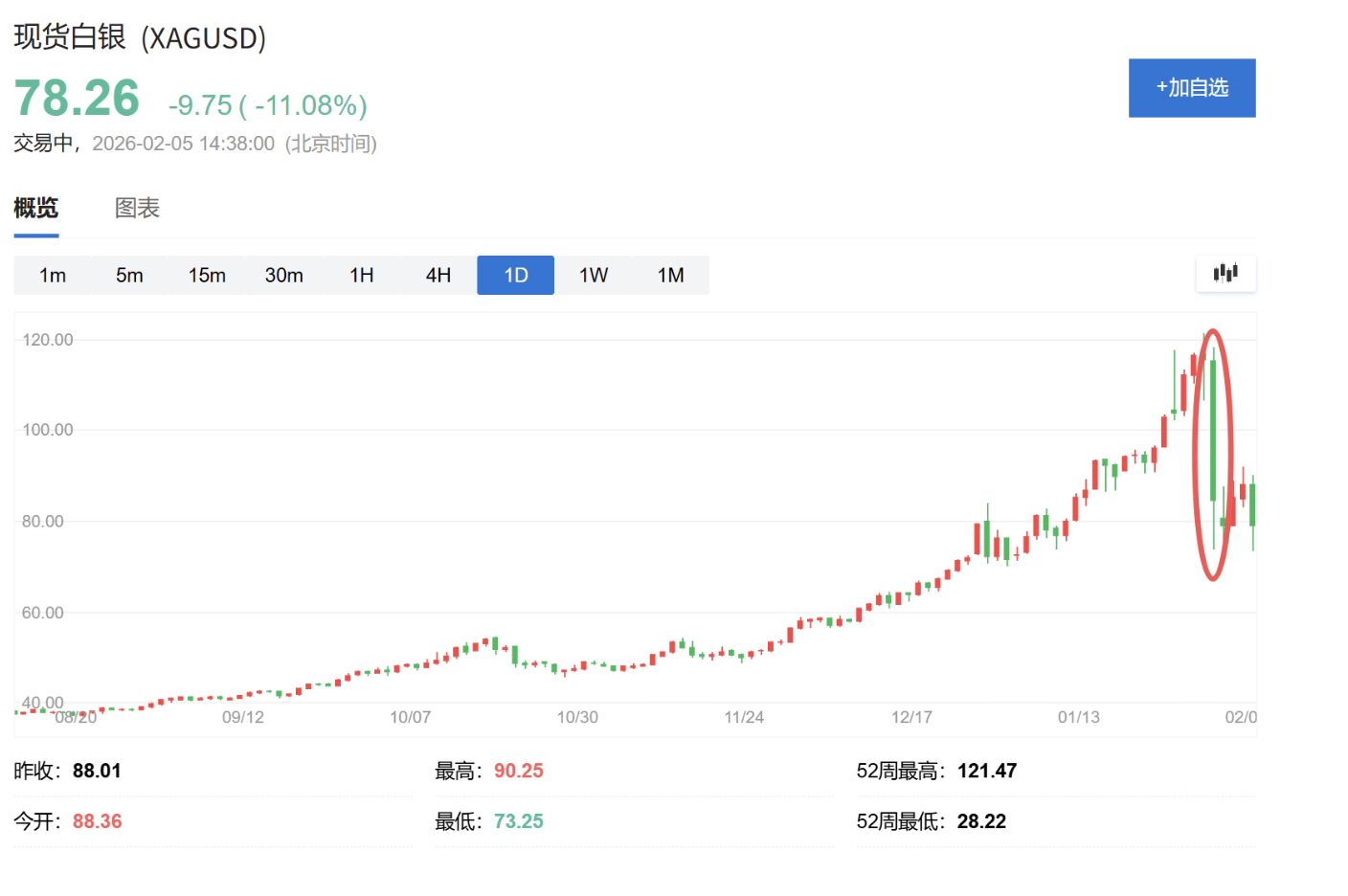
Silver prices plummeted in free fall from a high of over $120 per ounce, crashing 40% in three days, not only erasing recent gains but also leaving a terrifying cliff on the chart.

For retail investors who bought at the peak, this wasn't a correction; it was a massacre. The silver market, once承载着 (carrying/hosting) dreams of sudden wealth, has been turned into a "mass grave" where retail investors buried themselves.
How did this happen? While we were talking about a "short squeeze," Wall Street's giants had already opened their bloody maws.

The Crazy Casino: When Silver Became a "Meme Stock"

The silver market in January 2026 could no longer be described as rational.

According to VandaTrack data, individual investors poured a record $1 billion net into silver ETFs in January alone.

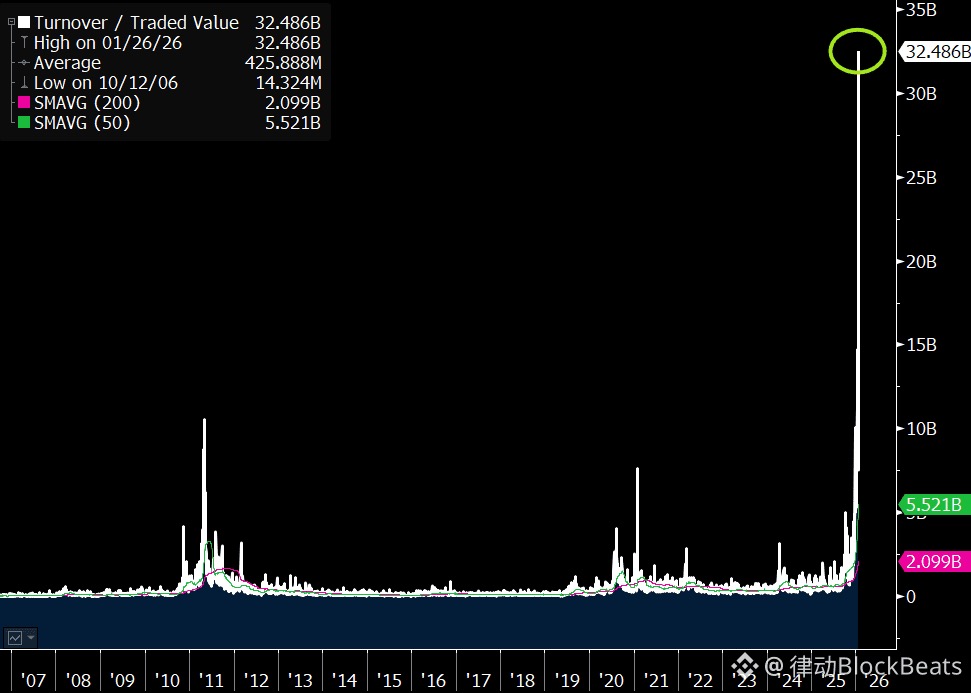
This狂热 (frenzy) peaked on January 26th—trading volume for the silver ETF (SLV) reached a staggering $39.4 billion, almost matching the S&P 500 ETF (SPY)'s $41.9 billion.

Remember, this is an ETF for a single metal; its popularity nearly rivaled that of the entire U.S. stock market.
StoneX market analyst Rhona O’Connell was blunt: "Silver is severely overvalued, caught in a self-fulfilling madness. It's behaving like Icarus, flying too close to the sun, and will eventually get burned."

Social media acted as an accelerant for this狂欢 (carnival/euphoria).

On Reddit's WallStreetBets and Silverbugs sections, posts about silver surged to 20 times the five-year average. Retail investors, like they did rushing into GameStop in 2021, flocked en masse into this notoriously volatile market, trying to drown out fundamentals with sheer capital.

Bull and Baird market strategist Michael Antonelli told CNBC helplessly: "Silver has completely become the GameStop of 2026. The price doubled in three months, completely detached from industrial demand fundamentals, purely a vertical climb built on retail money."

But they forgot silver has a nickname: "gold on steroids." It rises疯狂 (crazily), and falls even more ruthlessly.

Crash Truth: Who Pulled the Trigger?

On January 30th, the惨案 (disaster) occurred. Silver experienced an epic sell-off within hours.

Media and analysts quickly found a perfect scapegoat: Kevin Warsh's nomination as Fed Chair.
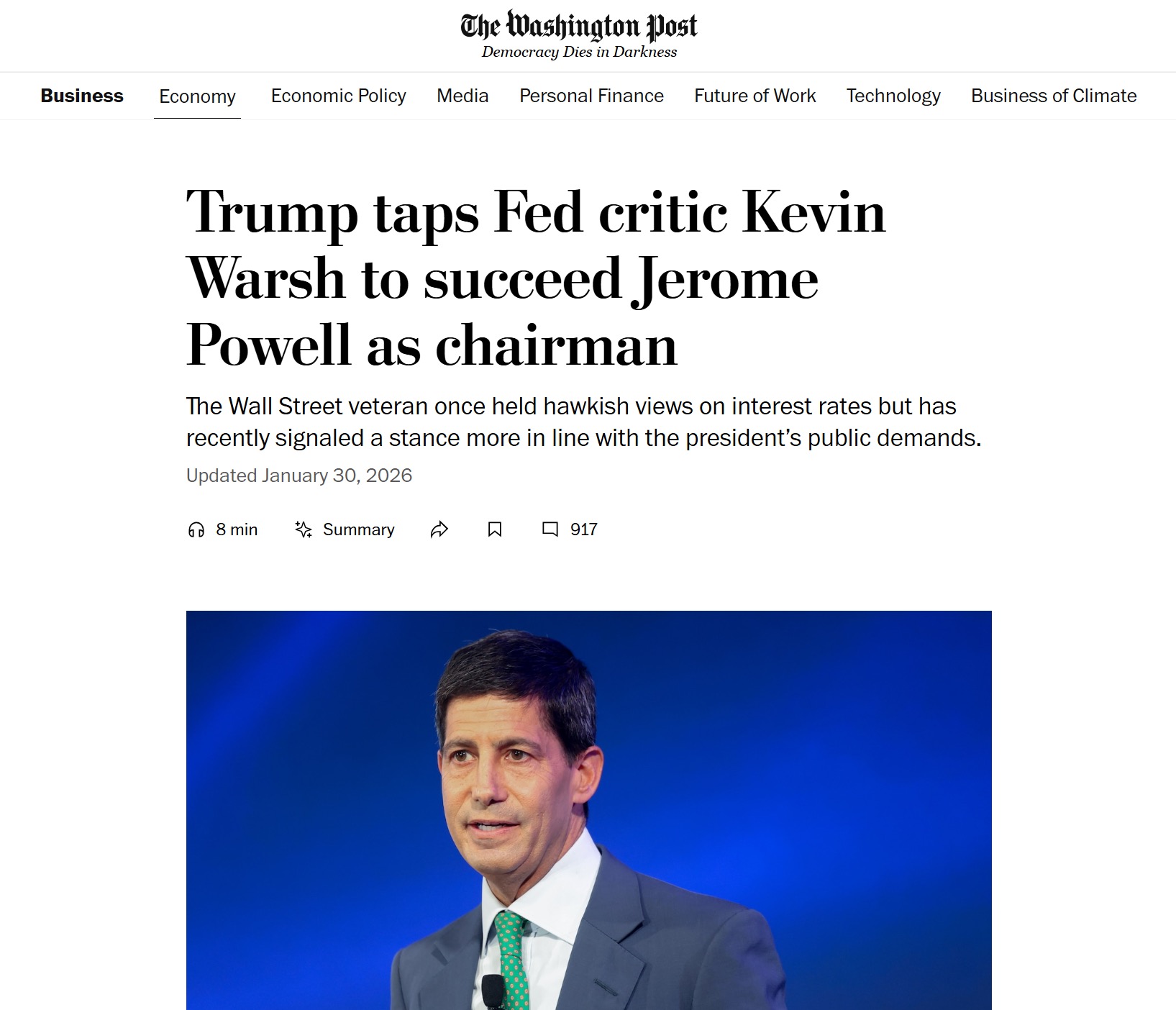
The market's reasoning seemed logical: Warsh is a hawk, implying rates will stay high, which is bearish for non-yielding precious metals.

But the truth often lies in the details.

Warsh's nomination was announced at 1:45 PM ET (1:45 AM Beijing Time on Feb 1st). However, silver's crash began as early as 10:30 AM on the 30th. In the three-plus hours before the news was public, silver prices had already plunged 27%.
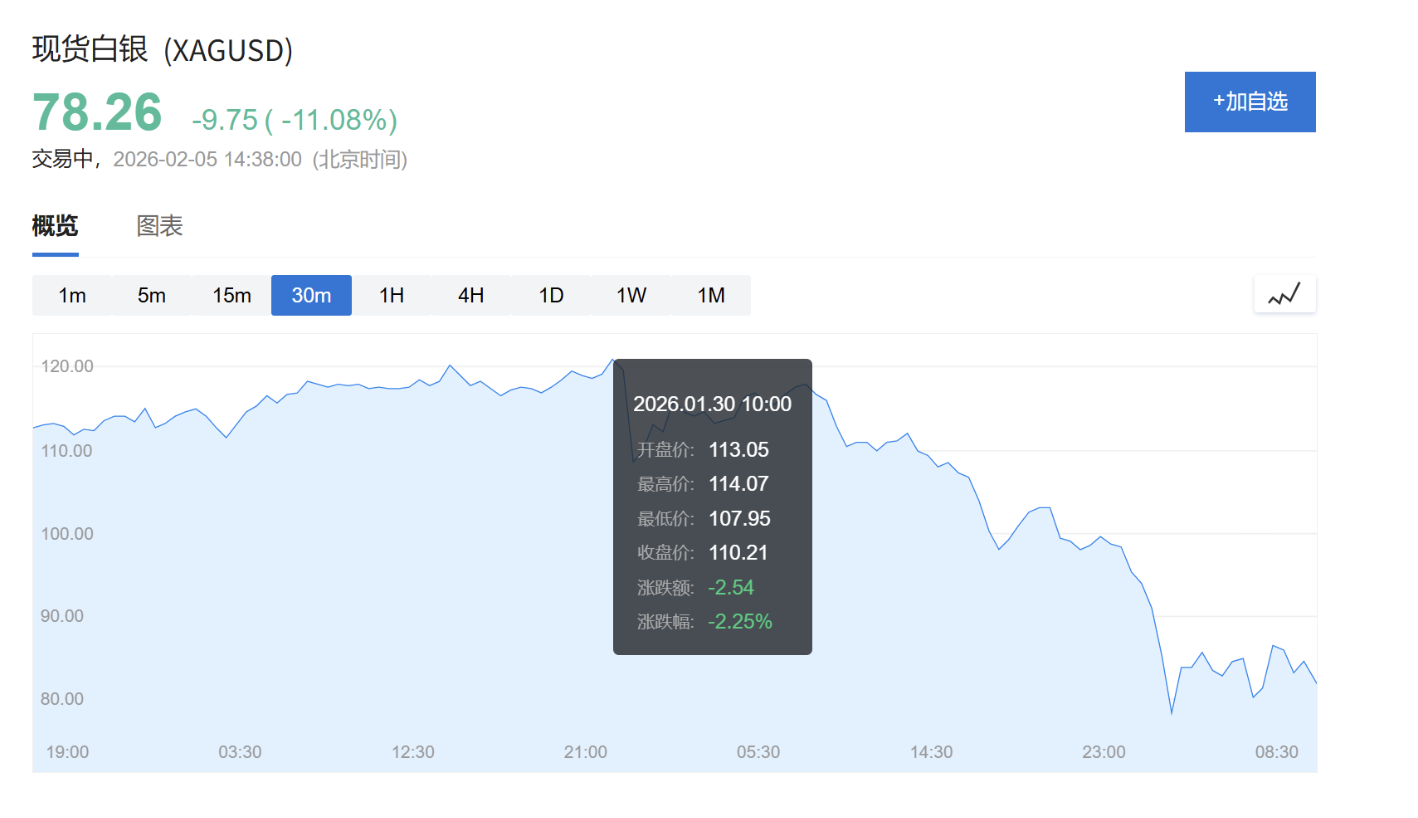
Blaming the Fed nomination was just a cover for the real "tool of slaughter"—margin requirements.

In reality, the true catalyst for this "mass grave" tragedy was a change in exchange rules. The Chicago Mercantile Exchange (CME) raised margin requirements for silver futures twice in the week before the crash, for a total increase of 50%.

What does this mean?

If you were a retail investor fully leveraged, your account previously only needed $22,000 to maintain the position. Suddenly, the exchange demanded you come up with $32,500. Can't produce the extra $10,500? Sorry, the system will automatically liquidate your position,不问价格 (regardless of price),不计成本 (regardless of cost).

This is why the crash was so rapid. Margin hikes triggered the first wave of forced liquidations, which caused prices to fall, which in turn triggered more people's liquidation thresholds. It's a vicious cycle, and retail investors are at the very bottom of this cycle.

An Asymmetric Game

While retail investors were wailing in the "mass grave," what were the institutions doing?

The answer might send a chill down your spine: They were waiting for retail sell-offs to buy low and profit. And this isn't illegal; it's a structural advantage built into the market's operation.

According to disclosures by columnist Luis Flavio Nunes, institutions, represented by JPMorgan, demonstrated textbook "profit-taking" methods during this crash:

Step 1: Access Emergency Liquidity.

While the exchange was raising margin requirements for retail investors, banking institutions were enjoying a "blood transfusion" from the Fed.

Data shows that on December 31st, banks borrowed a record $74.6 billion from the Fed's emergency lending window (SRF). This mechanism exists precisely to provide short-term liquidity to eligible financial institutions. Its design初衷 (original intention) is to prevent funding crises. But the reality is: Only specific institutions qualify to use this tool.
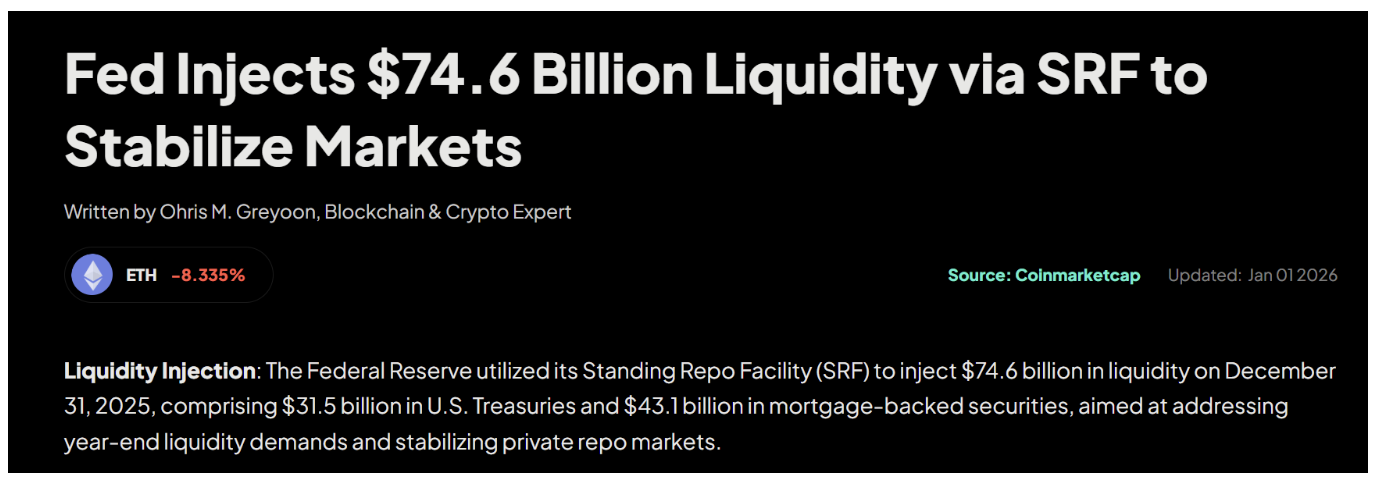

At the same time, the exchange raised silver margin requirements (by) 50% within a week. The Fed's emergency funding tool provides cash to eligible institutions at favorable rates. Retail investors have no access to equivalent channels of emergency central bank funding. This isn't favoritism. It's determined by the financial system's architecture: central banks lend to banks, not to individuals.

Step 2: Wait for the Market Chaos Caused by Margin Hikes.

The core mechanism of the silver crash lies in the difference in ability between retail and institutions to respond to increased margin requirements.

On December 26th and 30th, just before the crash, the CME raised margin requirements for silver trading by 50% in a short period. This meant a trader holding a position needed to immediately come up with 50% more cash.

For most retail investors, this sudden capital pressure directly triggered brokers' automatic liquidation mechanisms, forcing them to sell at any cost during the market plunge.

Meanwhile, institutions with access to Fed tools had more options.

They could draw on credit lines, obtain emergency loans, or quickly transfer funds between accounts. This doesn't prevent all liquidations, but it gives them more time and flexibility. Thus, retail positions were sold off during the panic, often at the worst prices. Institutional positions could be managed more strategically.

Step 3: Fully Utilize Authorized Participant Privileges for Arbitrage.

Take JPMorgan as an example. This bank plays a dual role in the silver market: they store all the physical silver for the largest silver fund (SLV), and they are also an "Authorized Participant," meaning they can create or destroy shares of that fund in large batches.

During the panic selling on January 30th, the SLV ETF's share price traded at an abnormal discount, falling to $64.50 per share, while the physical silver it represented was worth $79.53, a spread as high as 19%.

This provided huge arbitrage opportunities for institutions with "Authorized Participant" (AP) status through specific market mechanisms. Authorized Participants (a small group of large financial institutions) fully exploited this spread, buying ETF shares and redeeming them for higher-value physical silver.

Data shows approximately 51 million shares of SLV were redeemed that day, implying an arbitrage profit of about $765 million from this operation alone.

This operation helps maintain the link between the ETF price and its net asset value (NAV) and is a compliant market function, but it's a source of profit inaccessible to ordinary investors. Retail investors could see the discount but couldn't benefit from it due to lack of AP status.

Step 4: Strategic Positioning in Derivatives.

JPMorgan also held significant silver short positions, meaning they were betting on lower silver prices, or hedging other positions. As silver rose to $121 in late January, these positions were underwater.

The most ironic moment occurred at the price bottom. On January 30th, when retail investors were being forcibly liquidated at the low of $78.29 due to insufficient margin, JPMorgan stepped in. CME records show JPMorgan took over 633 contracts at this price, acquiring 3.1 million ounces of physical silver.

These crucial four steps happened almost on the same day. Did Wall Street orchestrate this series of events? This cannot be confirmed. But they were structurally positioned to benefit in multiple ways simultaneously: only institutions with their unique combination of roles and permissions could possibly do this.

"Silver is Always a Death Trap"

In this wave of行情 (market action/movement), countless retail investors like the Reddit user at the beginning of the article lost years of savings.

StoneX analyst Rhona O’Connell was right: "Silver is always a death trap."

Financial markets have never been a level playing field. When retail investors try to challenge the steel machine composed of algorithms, leverage, and rule-makers with "sentiment" and "memes," the outcome is often predetermined.

Silver is not GameStop either; it's a much more brutal arena than stocks.

Retail investors thought they were charging at Wall Street. Little did they know, they were unknowingly digging a huge "mass grave" with their own hands, then lining up to jump in.


Связанные с этим вопросы

QWhat was the main reason behind the silver market crash in January 2026, according to the article?

AThe primary reason was the Chicago Mercantile Exchange (CME) raising the margin requirements for silver futures by 50% over a week, which triggered a cascade of forced liquidations among leveraged retail investors.

QHow did institutional players like JPMorgan benefit from the silver market crash?

AJPMorgan benefited by using its status as an authorized participant to arbitrage the price difference between the SLV ETF and physical silver, acquiring physical silver at a discount, and using emergency liquidity facilities to avoid forced selling while buying assets from distressed retail investors.

QWhat role did social media play in the silver market frenzy?

ASocial media platforms like Reddit's WallStreetBets and Silverbugs fueled the frenzy, with posts about silver surging to 20 times their five-year average, encouraging retail investors to pile into silver as a meme stock, similar to GameStop in 2021.

QWhy was the nomination of Kevin Warsh as Fed Chair not the actual cause of the crash?

AThe crash began three hours before the announcement of Warsh's nomination, with silver prices already down 27%, indicating that the margin requirement hikes were the true trigger, not the Fed news.

QWhat structural advantages do institutions have over retail investors in such market events?

AInstitutions have access to emergency liquidity facilities like the Fed's Standing Repo Facility, the ability to meet margin calls without immediate forced selling, and privileges such as authorized participant status for ETFs, allowing arbitrage opportunities unavailable to retail investors.

Похожее

Торговля

Спот
Фьючерсы

Популярные статьи

Как купить MEME

Добро пожаловать на HTX.com! Мы сделали приобретение memecoin (MEME) простым и удобным. Следуйте нашему пошаговому руководству и отправляйтесь в свое крипто-путешествие.Шаг 1: Создайте аккаунт на HTXИспользуйте свой адрес электронной почты или номер телефона, чтобы зарегистрироваться и бесплатно создать аккаунт на HTX. Пройдите удобную регистрацию и откройте для себя весь функционал.Создать аккаунтШаг 2: Перейдите в Купить криптовалюту и выберите свой способ оплатыКредитная/Дебетовая Карта: Используйте свою карту Visa или Mastercard для мгновенной покупки memecoin (MEME).Баланс: Используйте средства с баланса вашего аккаунта HTX для простой торговли.Третьи Лица: Мы добавили популярные способы оплаты, такие как Google Pay и Apple Pay, для повышения удобства.P2P: Торгуйте напрямую с другими пользователями на HTX.Внебиржевая Торговля (OTC): Мы предлагаем индивидуальные услуги и конкурентоспособные обменные курсы для трейдеров.Шаг 3: Хранение memecoin (MEME)После приобретения вами memecoin (MEME) храните их в своем аккаунте на HTX. В качестве альтернативы вы можете отправить их куда-либо с помощью перевода в блокчейне или использовать для торговли с другими криптовалютами.Шаг 4: Торговля memecoin (MEME)С легкостью торгуйте memecoin (MEME) на спотовом рынке HTX. Просто зайдите в свой аккаунт, выберите торговую пару, совершайте сделки и следите за ними в режиме реального времени. Мы предлагаем удобный интерфейс как для начинающих, так и для опытных трейдеров.

687 просмотров всегоОпубликовано 2024.03.29Обновлено 2025.03.21

Как купить MEME

Что такое MEME 2.0

Memecoin 2.0: Восход $MEME 2.0 в мире криптовалют Введение В постоянно меняющемся ландшафте криптовалют появилось новое соперничество. Memecoin 2.0, символизируемый как $MEME 2.0, поднимает концепцию мем-коинов на захватывающий новый уровень. Являясь побочным продуктом оригинального Memecoin, этот проект привлек внимание крипто-сообщества, смещая акцент с типичных финансовых стимулов на вовлекающий и развлекательный опыт. Работающий на блокчейне Ethereum, Memecoin 2.0 смело переопределяет взаимодействие сообщества в криптосфере. Что такое Memecoin 2.0, $MEME 2.0? По сути, Memecoin 2.0 — это криптовалютный проект, который ставит на первое место дух сообщества и веселье, связанное с культурой мемов. В отличие от традиционных криптовалют, которые сосредоточены на практических случаях использования и ощутимых преимуществах, Memecoin 2.0 выделяется тем, что принимает легкую сторону цифровой валюты. Проект существует без обещаний полезности, структурированной дорожной карты или финансовых возвратов, сосредоточившись вместо этого на создании яркого сообщества вокруг мемов и совместного наслаждения. Таким образом, он использует растущую тенденцию мем-культуры в онлайн-пространстве, становясь уникальным игроком в мире цифровых активов. Создатель Memecoin 2.0, $MEME 2.0 Несмотря на обширные исследования происхождения Memecoin 2.0, явная идентичность его создателя остается неизвестной. Эта анонимность не является чем-то необычным в крипто-сообществе, где многие проекты возглавляют отдельные лица или группы, предпочитающие оставаться в тени. Отсутствие общедоступной информации о создателе можно рассматривать как стратегический ход, ставящий акцент на взаимодействие сообщества, а не на индивидуальную известность в этой сфере. Инвесторы Memecoin 2.0, $MEME 2.0 Информация о инвесторах или финансовой поддержке Memecoin 2.0 является скудной. Это отсутствие деталей может указывать на то, что проект либо финансируется самим собой, либо его внимание к сообществу, а не к традиционным инвестиционным структурам, привлекает другой тип сторонников. Поскольку мир мем-коинов обычно включает большее участие grassroots, чем институциональные инвестиции, этот подход соответствует философии проектов, управляемых сообществом. Как работает Memecoin 2.0, $MEME 2.0? Memecoin 2.0 полностью работает на блокчейне Ethereum, используя его надежные функции безопасности и масштабируемость. Используя преимущества Ethereum, Memecoin 2.0 может предложить безопасную среду для взаимодействия пользователей, обеспечивая при этом, чтобы транзакции были эффективными и экономичными. Одной из уникальных черт Memecoin 2.0 является его структура, ориентированная на сообщество. Ценность и популярность токена $MEME 2.0 вытекают из активного участия его пользователей, а не из внутренней полезности. Этот дизайн усиливает фокус проекта на развлекательной стороне криптовалюты, подразумевая, что смех и вовлеченность сообщества — это настоящие валюты, определяющие его успех. Более того, проект вписывается в более широкую экосистему мем-коинов, где ценность каждого мем-коина колеблется на основе культуры, трендов и вовлеченности сообщества, а не традиционных экономических принципов. Хронология Memecoin 2.0, $MEME 2.0 Чтобы лучше понять эволюцию и ключевые моменты Memecoin 2.0, вот хронология, подчеркивающая значимые события в его истории: 2024: Создание Memecoin 2.0 признается как ответвление от оригинального Memecoin, утвердившее себя в процветающем контексте мем-коинов, работая на блокчейне Ethereum. 13 июля 2024: Memecoin 2.0 официально позиционирует себя как мем-коин, ориентированный на сообщество, в сети Ethereum, подчеркивая свой развлекательный подход, который приглашает пользователей участвовать и способствовать его росту. Ключевые моменты о Memecoin 2.0, $MEME 2.0 Несколько критических характеристик определяют Memecoin 2.0: Подход, ориентированный на сообщество: Главная миссия Memecoin 2.0 — создать веселый и увлекательный опыт взаимодействия в сообществе, используя общее наслаждение, полученное от меметической культуры. Построен на Ethereum: Работа на блокчейне Ethereum предоставляет проекту необходимую инфраструктуру, которая обеспечивает безопасность и масштабируемость. Отсутствие полезности или дорожной карты: В резком отличии от традиционных криптовалют, Memecoin 2.0 не обещает никаких утилитарных функций или финансовых возвратов, подтверждая свою приверженность к вовлеченности сообщества и социальному взаимодействию. Фокус на меметической культуре: Принимая юмористические и культурные аспекты мем-феномена, Memecoin 2.0 предоставляет платформу для пользователей взаимодействовать с криптовалютой как офлайн, так и онлайн. Дополнительный контекст: Значение мем-коинов Мем-коины стали отдельным классом криптовалют, часто движимыми юмором и легкомысленным подходом к торговле. Эти монеты, как правило, не имеют значительной полезности или дорожных карт разработки, привлекая пользователей обещанием веселья, взаимодействия в сообществе и культурной значимости. В ландшафте более широкой криптоэкосистемы мем-коины восстанавливают важность вовлеченности сообщества, противодействуя исключительно ориентированным на прибыль подходам. Проекты, такие как Memecoin 2.0, открывают эру, где развлечение может гармонировать с финансовыми устремлениями, превращая блокчейн в игровую площадку для творчества и социального взаимодействия. Заключение Memecoin 2.0, или $MEME 2.0, олицетворяет новую волну криптовалют, которая ставит вовлеченность сообщества выше жестких финансовых структур. С акцентом на юмор и социальное взаимодействие, он использует увлечение, окружающее мем-культуру. Работая на блокчейне Ethereum, Memecoin 2.0 использует возможности технологии, оставаясь верным своему обязательству к развлекательной ценности цифровой валюты. Поскольку пространство вокруг криптовалют продолжает развиваться, Memecoin 2.0 служит свидетельством той мысли, что будущее цифровых активов может хорошо зависеть от общих опытов, смеха и крепких связей в сообществе. В непредсказуемом мире крипты, возможно, радость может быть столь же ценна, как и традиционная финансовая прибыль.

128 просмотров всегоОпубликовано 2024.04.04Обновлено 2024.12.03

Что такое MEME 2.0

Обсуждения

Добро пожаловать в Сообщество HTX. Здесь вы сможете быть в курсе последних новостей о развитии платформы и получить доступ к профессиональной аналитической информации о рынке. Мнения пользователей о цене на MEME (MEME) представлены ниже.

活动图片