What To Expect For The Solana Price In April As Metrics Line Up Again

bitcoinistОпубликовано 2026-04-07Обновлено 2026-04-07

Введение

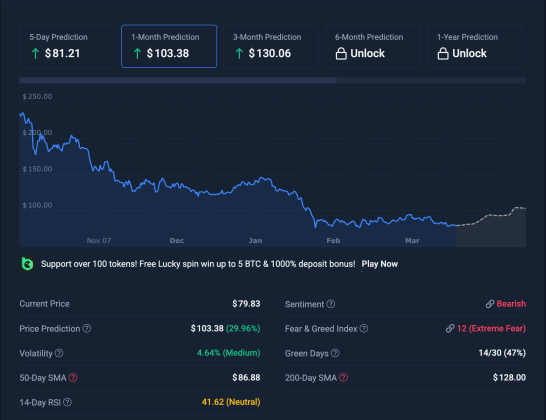
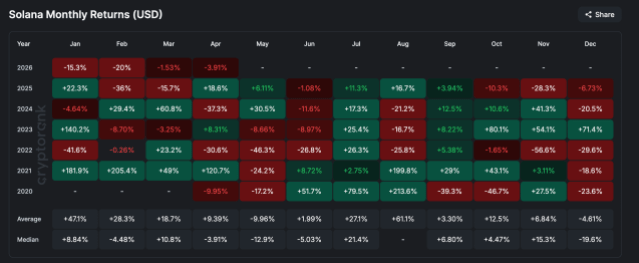
Based on historical trends and algorithmic predictions, the Solana (SOL) price could see a significant rebound in April 2026 after a prolonged period of decline that pushed it below the $100 mark. The prediction algorithm from CoinCodex forecasts a potential 30% rally for the month, targeting a price of $103.76. Furthermore, a 63% increase to $130 is projected over a three-month timeframe, suggesting a bullish third quarter. Historical data from CryptoRank supports this outlook, showing that April has typically been a positive month for SOL. Over the past five years, the cryptocurrency ended April in the green three times, with gains as high as 60.8%. While there have been negative Aprils, the average return for the month is a strong +18.7%. Despite this positive seasonal trend, the overall performance for the second quarter remains uncertain.

After an explosive two years between 2023 and 2024, the Solana price began to retrace, and that retracement has lasted into the year 2026. For the first time in more than a year, the Solana price has been consistently trading below the $100 mark as sell-offs ravage the cryptocurrency. However, with the new month, there might be some light at the end of the tunnel for SOL investors if April plays out as expected.

April Could Be A Green Month For The Solana Price

The prediction algorithm on the CoinCodex website has gone bullish in favor of the Solana price as the market ushered in the new month. Instead of following the set trend over the last few months and continuing to decline, it seems the Solana price might be headed for some respite.

The algorithm takes into account various indicators for a digital asset and uses that to predict a likely outcome for the asset. For Solana, the verdict is that the cryptocurrency might end up seeing a double-digit rally that would put it above the $100 level again.

In total, it predicts that the Solana price will rise by 30% to reach $103.76 by the time the month is over. On the medium-term (3-month timeframe), the algorithm predicts that the Solana price will rise by 63% to reach $130. This would mean that the third quarter is expected to be bullish for the price.

Source: CoinCodex

April Is An Historically Bullish Month

Looking at historical performance, the month of April has turned out to be more bullish than not for the Solana price. In cases where the month has ended in the red, the gains from the green months have outpaced those dominated by losses.

According to data from the CryptoRank website, in the last five years, Solana has ended a total of three months of April in the green, with the lowest return of these being +23.2% and the highest at +60.8%. Meanwhile for the years that the month ended in the red, the highest losses has been -15.7% and the lowest at -3.25%.

Source: CryptoRank

This brings the overall average for the month well into the positive, with the website’s data showing an average return of +18.7& and a median return of +10.8%. However, the second quarter of the year remains a mixed bag with as many red closes as there are green closes. So, it remains to be seen how the Solana price will perform in Q2.

SOL price continues to struggle | Source: SOLUSDT on Tradingview.com

Связанные с этим вопросы

QWhat is the predicted percentage increase for the Solana price in April according to the CoinCodex algorithm?

AThe CoinCodex algorithm predicts the Solana price will rise by 30% in April.

QWhat price level is the Solana price predicted to reach by the end of April?

AThe Solana price is predicted to reach $103.76 by the end of April.

QBased on historical data from CryptoRank, what is the average return for Solana in the month of April?

AThe historical average return for Solana in April is +18.7%.

QHow has the Solana price been performing recently, according to the article?

AThe Solana price has been consistently trading below the $100 mark due to sell-offs.

QWhat is the medium-term (3-month) price prediction for Solana from the algorithm?

AThe algorithm predicts the Solana price will rise by 63% to reach $130 in the medium-term (3-month timeframe).

Похожее

OpenAI Post-Training Engineer Weng Jiayi Proposes a New Paradigm Hypothesis for Agentic AI

OpenAI engineer Weng Jiayi's "Heuristic Learning" experiments propose a new paradigm for Agentic AI, suggesting that intelligent agents can improve not just by training neural networks, but also by autonomously writing and refining code based on environmental feedback. In the experiment, a coding agent (powered by Codex) was tasked with developing and maintaining a programmatic strategy for the Atari game Breakout. Starting from a basic prompt, the agent iteratively wrote code, ran the game, analyzed logs and video replays to identify failures, and then modified the code. Through this engineering loop of "code-run-debug-update," it evolved a pure Python heuristic strategy that achieved a perfect score of 864 in Breakout and performed competitively with deep reinforcement learning (RL) algorithms in MuJoCo control tasks like Ant and HalfCheetah. This approach, termed Heuristic Learning (HL), contrasts with Deep RL. In HL, experience is captured in readable, modifiable code, tests, logs, and configurations—a software system—rather than being encoded solely into opaque neural network weights. This offers potential advantages in explainability, auditability for safety-critical applications, easier integration of regression tests to combat catastrophic forgetting, and more efficient sample use in early learning stages, as demonstrated in broader tests on 57 Atari games. However, the blog acknowledges clear limitations. Programmatic strategies struggle with tasks requiring long-horizon planning or complex perception (e.g., Montezuma's Revenge), areas where neural networks excel. The future vision is a hybrid architecture: specialized neural networks for fast perception (System 1), HL systems for rules, safety, and local recovery (also System 1), and LLM agents providing high-level feedback and learning from the HL system's data (System 2). The core proposition is that in the era of capable coding agents, a significant portion of an AI's learned experience could be maintained as an auditable, evolving software system.

marsbit26 мин. назад

OpenAI Post-Training Engineer Weng Jiayi Proposes a New Paradigm Hypothesis for Agentic AI

marsbit26 мин. назад

Your Claude Will Dream Tonight, Don't Disturb It

This article explores the recent phenomenon of AI companies increasingly using anthropomorphic language—like "thinking," "memory," "hallucination," and now "dreaming"—to describe machine learning processes. Focusing on Anthropic's newly announced "Dreaming" feature for its Claude Agent platform, the piece explains that this function is essentially an automated, offline batch processing of an agent's operational logs. It analyzes past task sessions to identify patterns, optimize future actions, and consolidate learnings into a persistent memory system, akin to a form of reinforcement learning and self-correction. The article draws parallels to similar features in other AI agent systems like Hermes Agent and OpenClaw, which also implement mechanisms for reviewing historical data, extracting reusable "skills," and strengthening long-term memory. It notes a key difference from human dreaming: these AI "dreams" still consume computational resources and user tokens. Further context is provided by discussing the technical challenges of managing AI "memory" or context, highlighting the computational expense of large context windows and innovations like Subquadratic's new model claiming drastically longer contexts. The core critique argues that this strategic use of human-centric vocabulary does more than market products; it subtly reshapes user perception. By framing algorithms with terms associated with consciousness, companies blur the line between tool and autonomous entity. This linguistic shift can influence user expectations, tolerance for errors, and even perceptions of responsibility when systems fail, potentially diverting scrutiny from the companies and engineers behind the technology. The article concludes by speculating that terms like "daydreaming" for predictive task simulation might be next, continuing this trend of embedding the idea of an "inner life" into computational processes.

marsbit28 мин. назад

Your Claude Will Dream Tonight, Don't Disturb It

marsbit28 мин. назад

Торговля

Спот
Фьючерсы
活动图片