What Are Crypto Users Most Concerned About in 2025? 10 AI Models Give Different Answers

marsbitОпубликовано 2025-12-24Обновлено 2025-12-24

Введение

The article explores what cryptocurrency users might be most concerned about in 2025 by querying 10 major AI models with the same prompt. Each model was asked to list the top three questions crypto users would frequently ask in 2025, with instructions to avoid real-time searches and rely on their understanding of long-term discussion patterns. The models provided varied responses, reflecting their unique focuses and contextual training. For instance, ChatGPT emphasized market cycles and alpha opportunities, while Grok focused on narratives like Bitcoin halving and ETF inflows. Perplexity prioritized price trends and scams, and Claude highlighted risk management for beginners. Gemini leaned toward real-world assets and technical roadmaps like L2 and AI integration. Chinese models like Douban and Wenxin were more aligned with regulatory impacts and market cycles, whereas Kimi delved into practical on-chain issues like wallet security and MEV. Overall, the questions centered on three core themes: market cycle positioning, profit opportunities, and risk management. The diversity in responses suggests differences in model design, data training, and intended use cases, with more advanced models often providing more structured and specific questions. The findings reflect the crypto community’s persistent focus on volatility, narrative-driven markets, and the balance between seeking returns and avoiding risks.

Author: WuBlockchain

What are crypto users most concerned about in 2025? We conducted a user survey using AI large models by asking different models the same question: "What are the three most frequently asked questions about cryptocurrencies in 2025?"

To minimize homogenized answers due to real-time retrieval and considering that large models generally cannot—and are not allowed to—statistically verify or disclose their training data, we added a note to the question: "Please do not perform real-time searches or cite specific articles; answer based solely on your understanding of long-term discussion patterns."
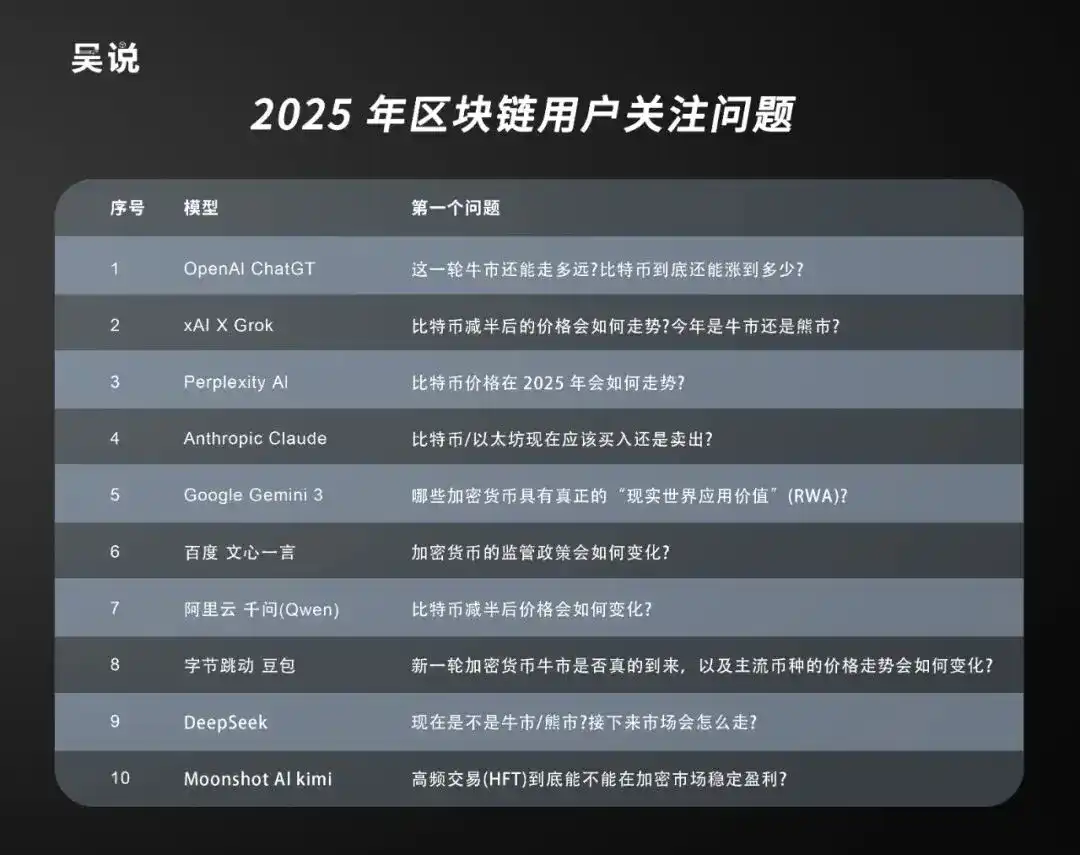
ChatGPT

1. How much further can this bull run go? Has Bitcoin already peaked?

2. Is there still genuine Alpha in this market cycle, and how can average users make money?

3. Do current hot projects or sectors have long-term viability, or are they structurally exploitative?

X Grok

1. Is the market in a bull or bear phase after the Bitcoin halving?

2. What are the most promising crypto assets or sectors to invest in for 2025?

3. How are Ethereum spot ETFs performing, and what is the inflow of institutional capital?

Perplexity AI

1. How might Bitcoin's price evolve in 2025?

2. How to identify and avoid cryptocurrency-related scams?

3. How will ETF and regulatory developments impact the crypto market?

Claude

1. Is now the right time to buy or sell Bitcoin or Ethereum?

2. Is a particular crypto project a scam, and is it trustworthy?

3. How should new users start investing in cryptocurrencies while managing risks?

Gemini 3

1. Which crypto projects have real-world application value (RWA)?

2. How will current and future regulatory policies affect personal asset security?

3. Among Ethereum L2, Solana, and AI+Crypto, which technological path is likely to emerge as the ultimate winner?

DeepSeek

1. Is the current market in a bull or bear phase?

2. Which crypto sectors or assets show the most potential in 2025?

3. How will changes in regulatory policies impact asset security and investment decisions?

Douban

1. Has a new cryptocurrency bull market arrived?

2. How will changes in regulatory policies across countries affect ordinary investors?

3. What does the Bitcoin halving trend mean for retail investment strategies?

Qianwen

1. How will Bitcoin's price trend evolve after the halving?

2. Have Ethereum and major public chains achieved substantive breakthroughs in practical applications?

3. How will regulatory policies in various countries affect the legitimate use of cryptocurrencies?

Wenxin Yiyan

1. How will global cryptocurrency regulatory policies change?

2. Do Bitcoin and mainstream crypto assets have long-term investment value?

3. Can real-world application scenarios for cryptocurrencies truly be realized?

Kimi

1. Can retail investors achieve stable profits through high-frequency trading in the crypto market?

2. What is the safest way to store private keys and wallet assets?

3. How should slippage be set in on-chain transactions to avoid MEV loss?

Summary

The reason these models provide slightly different "top three questions" may relate to their respective positioning and context. ChatGPT seems to adopt a trader's perspective, framing the discussion as a structured chain of anxiety: "How long will the cycle last — Is Alpha still available — Is there structural exploitation?" Grok aligns more with social media hotspots, focusing on narratives like halving, bull/bear markets, and ETF capital flows. Perplexity's style resembles a retrieval-based summary, concentrating on price trends, scam prevention, and ETF/regulatory progress. Claude is more cautious, emphasizing timing for buying/selling, project trustworthiness, and risk management for beginners. Gemini leans toward industry and technology, focusing on RWA, regulatory impacts on asset security, and the "final choice" among L2/Solana/AI. Chinese models overall focus more on cycles, halving, and regulation—these "most hardcore deterministic variables"—while Kimi is an exception, diving into on-chain execution details (wallet security, slippage/MEV, HFT), resembling real friction points for high-frequency on-chain users.

Another secondary but noteworthy possibility is that model capability differences also affect the "sharpness" of outputs. More capable models tend to frame the same topic more specifically and systematically; conversely, weaker models更容易 fall back on "price/regulation/scams"这类最大公约数式表达, making answers appear more similar with less informational增量. This factor may not be the main cause, but in macro open-ended questions, it could amplify the perception of homogeneity.

Overall, these questions highly concentrate on three core themes: cycle positioning, profit paths, and risk boundaries. The crypto market's notable features—high volatility and strong narrative drive—mean that "where are we in the bull/bear cycle" almost determines all subsequent user actions (holding, selling, swapping, leveraging, or exiting). As the market matures and becomes more crowded, users quickly shift from "is there an opportunity" to "where is the opportunity, and can I still capture it," making Alpha, sector selection, and institutional capital (ETFs) natural high-frequency topics. Meanwhile, scams, project credibility, asset security, and regulatory compliance reflect that crypto users长期 operate in a "high-reward/high-uncertainty" environment: chasing returns while fearing pitfalls, ultimately forming a typical behavioral structure—first assess the trend, then seek opportunities, finally control risks.


Связанные с этим вопросы

QWhat are the three main themes that cryptocurrency users are most concerned about in 2025, based on the AI model responses?

AThe three main themes are market cycle position (bull or bear market), profit-making opportunities (alpha, investment strategies, and institutional inflows), and risk management (scams, asset security, and regulatory impacts).

QHow do the concerns of Chinese-language models (like Douban and Qwen) differ from others in the survey?

AChinese-language models focus more on cyclical trends, halving events, and regulatory policies, which are seen as 'core deterministic variables,' while models like Kimi address more granular, on-chain execution details such as wallet security and MEV.

QWhich AI model emphasized technical and industry-focused questions, such as real-world asset (RWA) applications and layer-2 solutions?

AGemini 3 emphasized technical and industry-focused questions, including queries about real-world asset (RWA) value, regulatory impacts on asset security, and comparisons between Ethereum L2, Solana, and AI+Crypto technologies.

QWhat methodological constraint was added to the AI models' responses to avoid homogenized answers?

AThe models were instructed not to perform real-time searches or cite specific articles, relying solely on their understanding of long-term discussion patterns to generate responses.

QAccording to the summary, what behavioral structure do cryptocurrency users typically exhibit in high-uncertainty environments?

AUsers typically follow a behavioral structure: first assessing market trends, then seeking profit opportunities, and finally focusing on risk control to navigate the high-reward but high-uncertainty environment.

Похожее

North Korean Hackers Loot $500 Million in a Single Month, Becoming the Top Threat to Crypto Security

North Korean hackers, particularly the notorious Lazarus Group and its subgroup TraderTraitor, have stolen over $500 million from cryptocurrency DeFi platforms in less than three weeks, bringing their total theft for the year to over $700 million. Recent major attacks on Drift Protocol and KelpDAO, resulting in losses of approximately $286 million and $290 million respectively, highlight a strategic shift: instead of targeting core smart contracts, attackers are now exploiting vulnerabilities in peripheral infrastructure. For instance, the KelpDAO attack involved compromising downstream RPC infrastructure used by LayerZero's decentralized validation network (DVN), allowing manipulation without breaching core cryptography. This sophisticated approach mirrors advanced corporate cyber-espionage. Additionally, North Korea has systematically infiltrated the global crypto workforce, with an estimated 100 operatives using fake identities to gain employment at blockchain companies, enabling long-term access to sensitive systems and facilitating large-scale thefts. According to Chainalysis, North Korean-linked hackers stole a record $2 billion in 2025, accounting for 60% of all global crypto theft that year. Their total historical crypto theft has reached $6.75 billion. Post-theft, they employ specialized money laundering methods, heavily relying on Chinese OTC brokers and cross-chain mixing services rather than standard decentralized exchanges. Security experts, while acknowledging the increased sophistication, emphasize that many attacks still exploit fundamental weaknesses like poor access controls and centralized operational risks. Strengthening private key management, limiting privileged access, and enhancing coordination among exchanges, analysts, and law enforcement immediately after an attack are critical to improving defense and fund recovery chances. The industry's challenge now extends beyond secure smart contracts to safeguarding operational security at the infrastructure level.

marsbit55 мин. назад

North Korean Hackers Loot $500 Million in a Single Month, Becoming the Top Threat to Crypto Security

marsbit55 мин. назад

Circle CEO's Seoul Visit: No Korean Won Stablecoin Issuance, But Met All Major Korean Banks

Circle CEO Jeremy Allaire's recent activities in Seoul indicate a strategic shift for the company, moving away from issuing a Korean won-backed stablecoin and instead focusing on embedding itself as a key infrastructure provider within Korea’s financial and crypto ecosystem. Despite Korea accounting for nearly 30% of global crypto trading volume—with a market characterized by high retail participation and altcoin dominance—Circle has chosen not to compete for the role of stablecoin issuer. Instead, Allaire met with major Korean banks (including Shinhan, KB, and Woori), financial groups, leading exchanges (Upbit, Bithumb, Coinone), and tech firms like Kakao. This approach reflects a broader industry transition: the core of stablecoin competition is shifting from issuance rights to systemic positioning. With Korean regulators still debating whether banks or tech companies should issue stablecoins, Circle is avoiding regulatory uncertainty by strengthening its role as a service and technology partner. The company is deepening integration with trading platforms, building connections, and promoting stablecoin infrastructure. This positions Circle to benefit regardless of which entity eventually issues a won stablecoin. Allaire also noted the potential for a Chinese yuan stablecoin in the next 3–5 years, underscoring a regional trend of stablecoins becoming more regulated and integrated with traditional finance. Ultimately, Circle’s strategy highlights that future influence in the stablecoin market will belong not necessarily to the issuers, but to the foundational infrastructure layers that enable cross-system transactions.

marsbit1 ч. назад

Circle CEO's Seoul Visit: No Korean Won Stablecoin Issuance, But Met All Major Korean Banks

marsbit1 ч. назад

SpaceX Ties Up with Cursor: A High-Stakes AI Gambit of 'Lock First, Acquire Later'

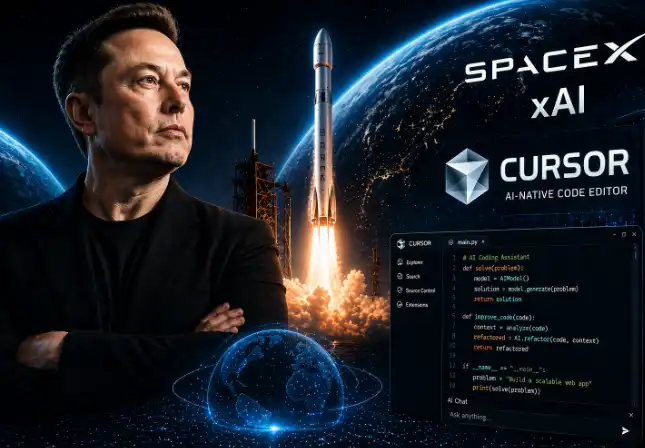
SpaceX has secured an option to acquire AI programming company Cursor for $60 billion, with an alternative clause requiring a $10 billion collaboration fee if the acquisition does not proceed. This structure is not merely a potential acquisition but a strategic move to control core access points in the AI era. The deal is designed as a flexible, dual-path arrangement, allowing SpaceX to either fully acquire Cursor or maintain a binding partnership through high-cost collaboration. This "option-style" approach minimizes immediate regulatory and integration risks while ensuring long-term alignment between the two companies. At its core, the transaction exchanges critical AI-era resources: SpaceX provides its Colossus supercomputing cluster—one of the world’s most powerful AI training infrastructures—while Cursor contributes its AI-native developer environment and strong product adoption. This synergy connects compute power, models, and application layers, forming a closed-loop AI capability stack. Cursor, founded in 2022, has achieved rapid growth with over $1 billion in annual revenue and widespread enterprise adoption. Its value lies in transforming software development through AI agents capable of coding, debugging, and system design—positioning it as a gateway to future software production. For SpaceX, this move is part of a broader strategy to evolve from a aerospace company into an AI infrastructure empire, integrating xAI, supercomputing, and chip manufacturing. Controlling Cursor fills a gap in its developer tooling layer, strengthening its AI narrative ahead of a potential IPO. The deal reflects a shift in AI competition from model superiority to ecosystem and entry-point control. With programming tools as a key battleground, securing developer loyalty becomes crucial for dominating the software production landscape. Risks include questions around Cursor’s valuation, technical integration challenges, and potential regulatory scrutiny. Nevertheless, the deal underscores a strategic bet: controlling both compute and software development access may redefine power dynamics in the AI-driven future.

marsbit2 ч. назад

SpaceX Ties Up with Cursor: A High-Stakes AI Gambit of 'Lock First, Acquire Later'

marsbit2 ч. назад

Торговля

Спот
Фьючерсы

Популярные статьи

Неделя обучения по популярным токенам (2): 2026 может стать годом приложений реального времени, сектор AI продолжает оставаться в тренде

2025 год — год институциональных инвесторов, в будущем он будет доминировать в приложениях реального времени.

1.8k просмотров всегоОпубликовано 2025.12.16Обновлено 2025.12.16

Неделя обучения по популярным токенам (2): 2026 может стать годом приложений реального времени, сектор AI продолжает оставаться в тренде

Обсуждения

Добро пожаловать в Сообщество HTX. Здесь вы сможете быть в курсе последних новостей о развитии платформы и получить доступ к профессиональной аналитической информации о рынке. Мнения пользователей о цене на AI (AI) представлены ниже.

活动图片