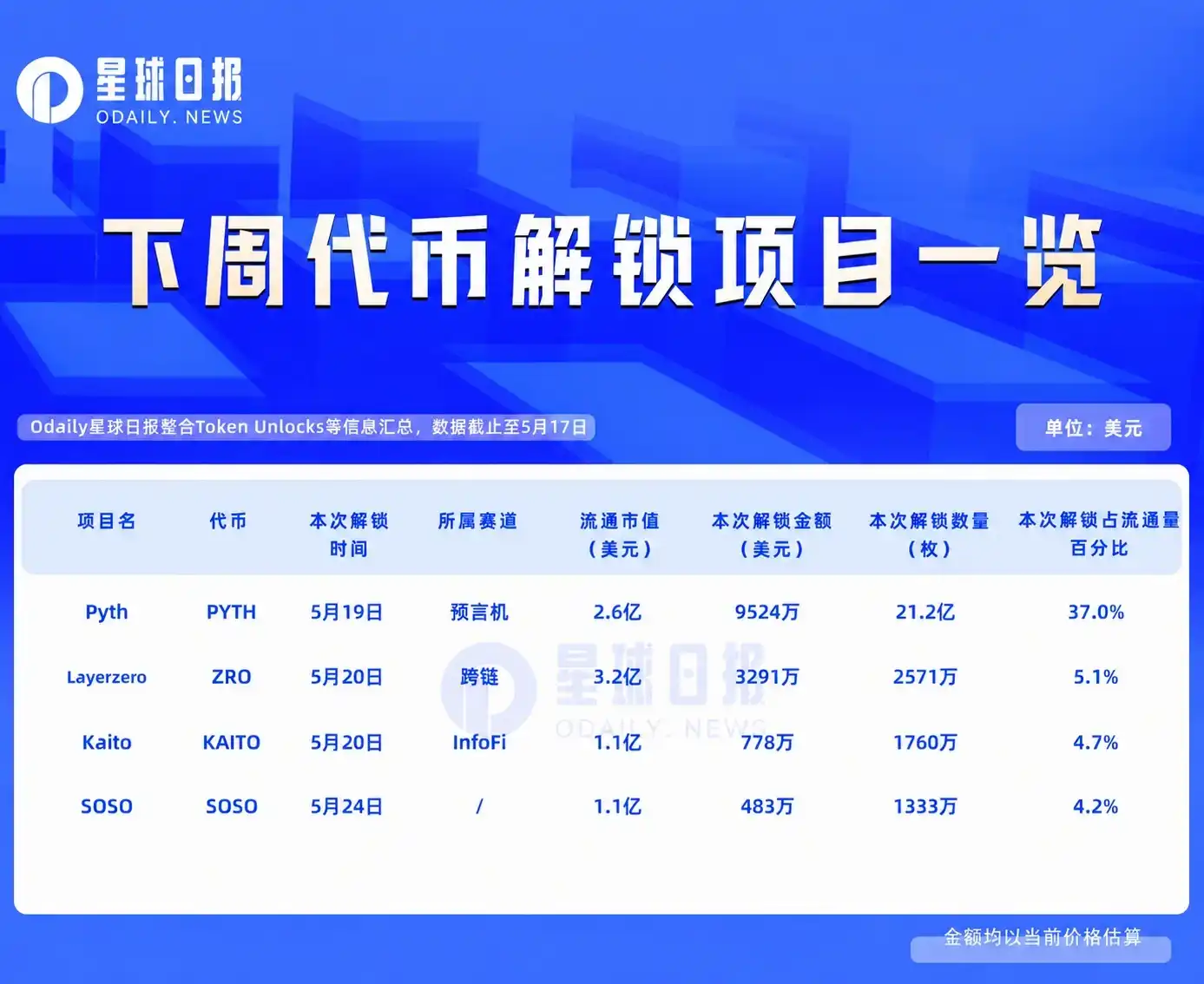
Weekly Token Unlocks: PYTH Unlocks Tokens Up to 37% of Circulating Supply

marsbitОпубликовано 2026-05-17Обновлено 2026-05-17

Введение

This week's major token unlocks feature three notable projects, each releasing a significant number of tokens into circulation. **Pyth Network** is set for the largest unlock, releasing 2.12 billion PYTH tokens valued at approximately $95.24 million. This amount represents a substantial portion of its circulating supply. Pyth is a decentralized oracle network providing real-time financial market data for DeFi applications. **LayerZero** will unlock 25.71 million ZRO tokens, worth around $32.91 million. LayerZero is a full-chain interoperability protocol designed for secure and configurable cross-chain messaging. **Kaito** will release 17.6 million KAI tokens, with an estimated value of $7.78 million. Kaito is an AI-driven platform that aggregates and analyzes fragmented Web3 information from various sources like social media and governance forums. Each project section includes links to their official Twitter and website, along with a chart depicting their specific token release schedule.

Pyth

Project Twitter: https://twitter.com/PythNetwork

Project Website: https://pyth.network/

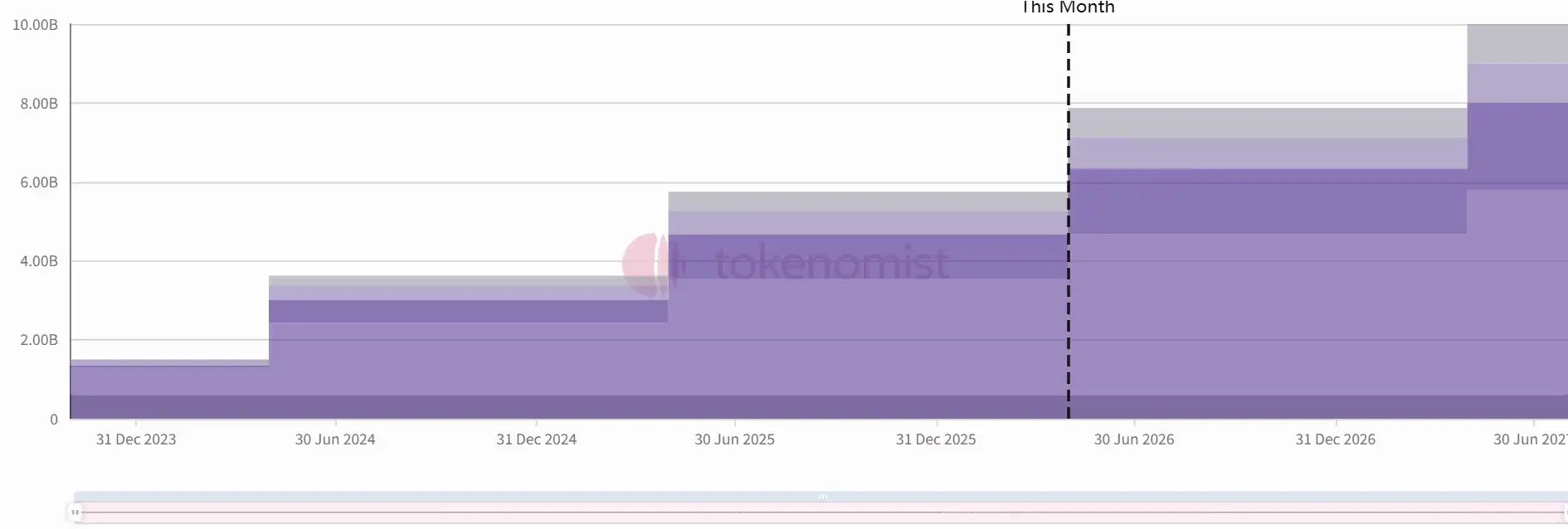
Tokens Unlocked This Time: 2.12 billion

Value Unlocked This Time: Approximately $95.24 million

Pyth Network is a decentralized oracle project, providing real-time and accurate financial market data covering DEXs, derivatives, DeFi lending, stablecoins, synthetic assets, etc. It aims to enhance the functionality and reliability of decentralized finance (DeFi) applications.

Specific release schedule is as follows:
Layerzero

Project Twitter: https://x.com/LayerZero_Core

Project Website: https://layerzero.network/

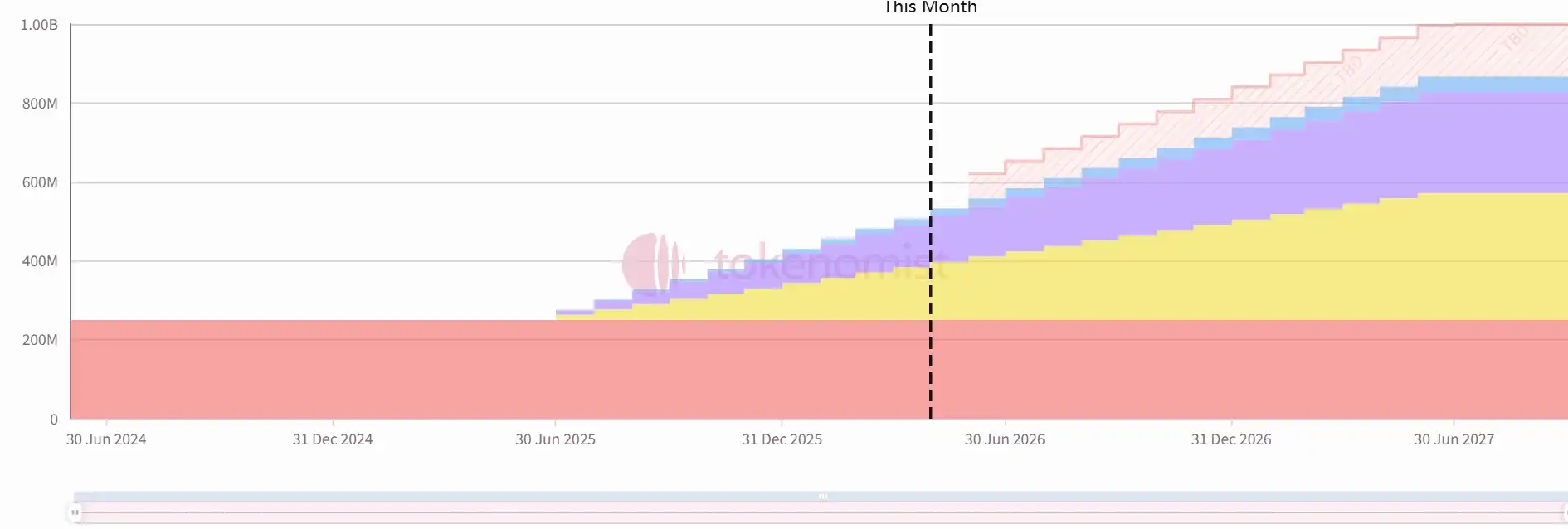
Tokens Unlocked This Time: 25.71 million

Value Unlocked This Time: Approximately $32.91 million

LayerZero is an omnichain interoperability protocol designed for lightweight message passing across chains. LayerZero provides trusted and guaranteed message delivery with configurable trustlessness.

Specific release schedule is as follows:
Kaito

Project Twitter: https://x.com/KaitoAI

Project Website: https://www.kaito.ai/

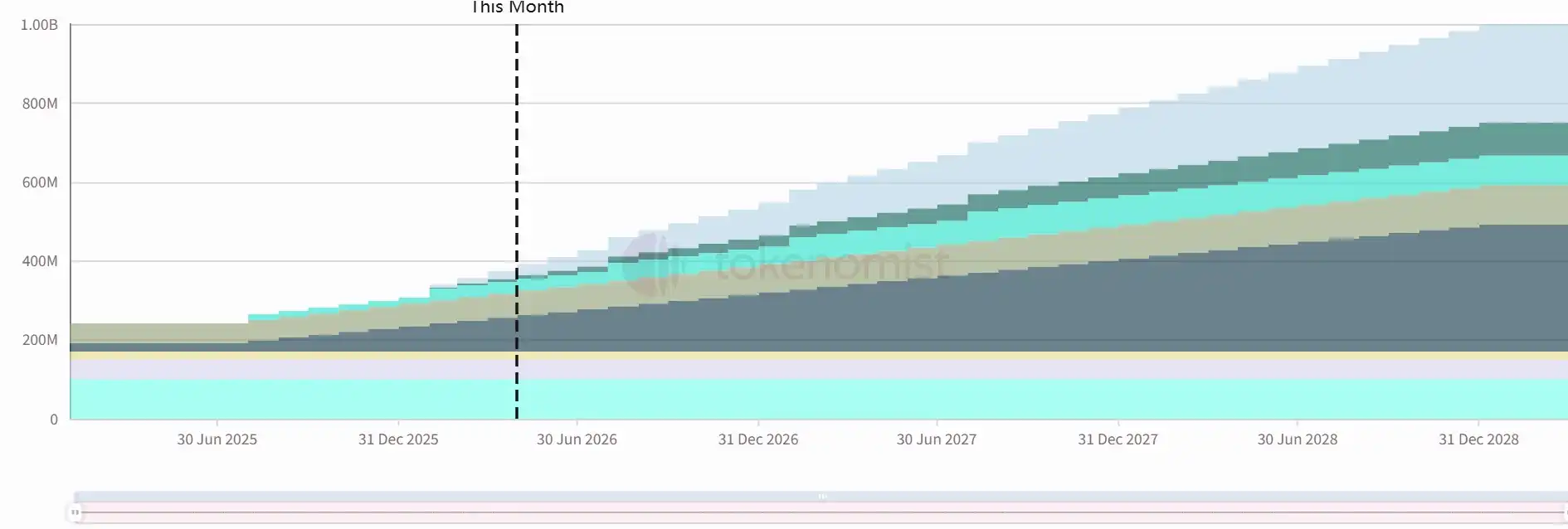
Tokens Unlocked This Time: 17.60 million

Value Unlocked This Time: Approximately $7.78 million

Kaito is an AI-driven Web3 information platform aimed at solving the issue of fragmented information in the crypto industry. By aggregating data from social media, governance forums, and other sources, Kaito uses AI technology to provide real-time search, sentiment analysis, and trend tracking.

Specific release schedule is as follows:
Связанные с этим вопросы

QWhat percentage of the circulating supply does PYTH unlock represent according to the article?

A37% of the circulating supply.

QWhat is the primary function of the Pyth Network described in the article?

AIt is a decentralized oracle project that provides real-time, precise financial market data to enhance the functionality and reliability of DeFi applications.

QHow many tokens is LayerZero scheduled to unlock in this event?

A25.71 million tokens.

QWhat is the core purpose of the Kaito project as mentioned in the text?

AKaito is an AI-driven Web3 information platform that aims to solve information fragmentation in the crypto industry by aggregating data sources and providing real-time search, sentiment analysis, and trend tracking.

QWhat is the approximate USD value of the Pyth token unlock mentioned in the article?

AApproximately $95.24 million.

Похожее

Will the Next Crypto Bull Run Start with On-Chain Trading of SpaceX?

This article presents a scenario-based forecast for the crypto industry from 2026 to 2029, arguing that the next major cycle will be driven not by technological narratives but by legal access to real-world assets. The author predicts that by mid-2026, pre-IPO perpetual contracts for top private companies like SpaceX, OpenAI, and Anthropic on platforms like Hyperliquid will become the primary gateway for accessing quality assets, as most crypto-native tokens fail to capture real value. The much-hyped AI x Crypto intersection largely fails except for prediction markets, which thrive on betting on AI model supremacy. By 2027, public blockchain foundations are forced to choose between catering to retail speculation or building compliant infrastructure for institutions, with many opting for the latter. Growth in stablecoins and tokenized private credit/equity hits a "triple ceiling" due to regulatory and political uncertainty rather than market demand. The pivotal shift is forecast for 2028. A major liquidation event in pre-IPO perpetuals exposes the structural flaw of synthetic markets lacking a real underlying asset anchor. In response, regulatory changes finally allow the public solicitation of private securities resales to verified accredited investors. This creates a legitimate secondary market for real company equity, which then becomes the core asset class of the new bull market, relegating synthetic perps to a niche role. By 2029, the industry becomes "boring" but foundational. Tokens without claims on real cash flows or assets cease trading. Stablecoin growth is steady but politically capped. Crypto infrastructure fades from view as it gets absorbed into traditional finance backends. The article's central thesis is that the key bottleneck for crypto's next phase is legal and regulatory channels for real asset ownership, not technology.

marsbit1 ч. назад

Will the Next Crypto Bull Run Start with On-Chain Trading of SpaceX?

marsbit1 ч. назад

The Value Distribution of Stablecoins

**Summary: The Value Distribution of Stablecoins** The article argues that stablecoins are evolving from mere trading tools into broader channels for dollar access. It divides the stablecoin ecosystem into four layers to analyze how value is distributed: 1. **Issuance Layer:** Mints stablecoins, holds reserve assets, and captures the spread between reserve yield and user costs (e.g., Tether, Circle). This layer currently earns the largest profit margin. 2. **Infrastructure Layer:** Connects stablecoins to the traditional financial system, handling fiat on/off-ramps, banking integration, compliance (KYC/AML), and asset management (e.g., Bridge, BVNK). This is the "unglamorous" but critical work, building the essential bridges between crypto and real-world finance. 3. **Acquiring/Distribution Layer:** Integrates stablecoins into merchant systems, manages payment flows, and provides enterprise financial software (e.g., Stripe, Coinbase). They act as the access point for businesses. 4. **Application Layer:** The end-users and businesses that ultimately use stablecoins for payments, settlements, or as a store of value. They benefit from convenience but have little pricing power. The core thesis is that while the issuance layer currently dominates profits, the often-overlooked **infrastructure layer holds significant long-term potential**. The real challenge and barrier to mass adoption is not the on-chain transfer of stablecoins (which is simple), but the complex "last mile" integration into existing business workflows, banking systems, and regulatory frameworks across different countries. Companies in this layer are currently in a "land grab" phase, investing heavily to build networks, secure bank partnerships, and establish compliance pathways. While their position is currently pressured by the profitable issuers above and distribution platforms below, the article suggests that if stablecoins become a default financial rail for businesses, the infrastructure providers who have done the hard work of integration will ultimately gain strong pricing power and become entrenched, essential players.

marsbit7 ч. назад

The Value Distribution of Stablecoins

marsbit7 ч. назад

The Value Distribution of Stablecoins

The Value Distribution of Stablecoins The article argues that stablecoins are evolving from a mere trading tool into a broad "dollar channel." It analyzes the industry's value chain through four layers: 1. **Issuance Layer (e.g., Tether, Circle):** The top layer that mints stablecoins, holds reserve assets, and captures the thickest interest rate spread. 2. **Infrastructure Layer (e.g., Bridge, BVNK):** Connects stablecoins to the traditional financial system, handling critical but complex "dirty work" like fiat on/off-ramps, banking integration, compliance (KYC/AML), and cross-border settlement. 3. **Acquiring/Distribution Layer (e.g., Stripe, Coinbase):** Embeds stablecoins into merchant systems, manages payment flows, and integrates with enterprise software. 4. **Application Layer:** End-users and businesses that ultimately use stablecoins for payments, settlement, or storing value. The author posits that while the issuance layer currently captures the most profit, the most overlooked and potentially critical layer is infrastructure. The core challenge for stablecoin adoption isn't the on-chain transfer (which is simple), but bridging the gap between blockchain and the real-world financial system. This involves solving practical problems for businesses: fiat conversion, reconciliation, tax handling, and user onboarding. Infrastructure companies are currently in a difficult "land-grab" phase—building networks, securing banking relationships, and achieving compliance country-by-country. They face pressure from both the profitable issuance layer above and distribution platforms below. However, the author suggests this layer is building a crucial moat. Once stablecoins become a default business rail, the infrastructure players who have done the hard work of integration may gain significant, durable value and pricing power.

链捕手7 ч. назад

The Value Distribution of Stablecoins

链捕手7 ч. назад

Торговля

Спот
Фьючерсы

Популярные статьи

Как купить PYTH

Добро пожаловать на HTX.com! Мы сделали приобретение Pyth (PYTH) простым и удобным. Следуйте нашему пошаговому руководству и отправляйтесь в свое крипто-путешествие.Шаг 1: Создайте аккаунт на HTXИспользуйте свой адрес электронной почты или номер телефона, чтобы зарегистрироваться и бесплатно создать аккаунт на HTX. Пройдите удобную регистрацию и откройте для себя весь функционал.Создать аккаунтШаг 2: Перейдите в Купить криптовалюту и выберите свой способ оплатыКредитная/Дебетовая Карта: Используйте свою карту Visa или Mastercard для мгновенной покупки Pyth (PYTH).Баланс: Используйте средства с баланса вашего аккаунта HTX для простой торговли.Третьи Лица: Мы добавили популярные способы оплаты, такие как Google Pay и Apple Pay, для повышения удобства.P2P: Торгуйте напрямую с другими пользователями на HTX.Внебиржевая Торговля (OTC): Мы предлагаем индивидуальные услуги и конкурентоспособные обменные курсы для трейдеров.Шаг 3: Хранение Pyth (PYTH)После приобретения вами Pyth (PYTH) храните их в своем аккаунте на HTX. В качестве альтернативы вы можете отправить их куда-либо с помощью перевода в блокчейне или использовать для торговли с другими криптовалютами.Шаг 4: Торговля Pyth (PYTH)С легкостью торгуйте Pyth (PYTH) на спотовом рынке HTX. Просто зайдите в свой аккаунт, выберите торговую пару, совершайте сделки и следите за ними в режиме реального времени. Мы предлагаем удобный интерфейс как для начинающих, так и для опытных трейдеров.

376 просмотров всегоОпубликовано 2024.03.29Обновлено 2026.06.02

Как купить PYTH

Обсуждения

Добро пожаловать в Сообщество HTX. Здесь вы сможете быть в курсе последних новостей о развитии платформы и получить доступ к профессиональной аналитической информации о рынке. Мнения пользователей о цене на PYTH (PYTH) представлены ниже.

活动图片