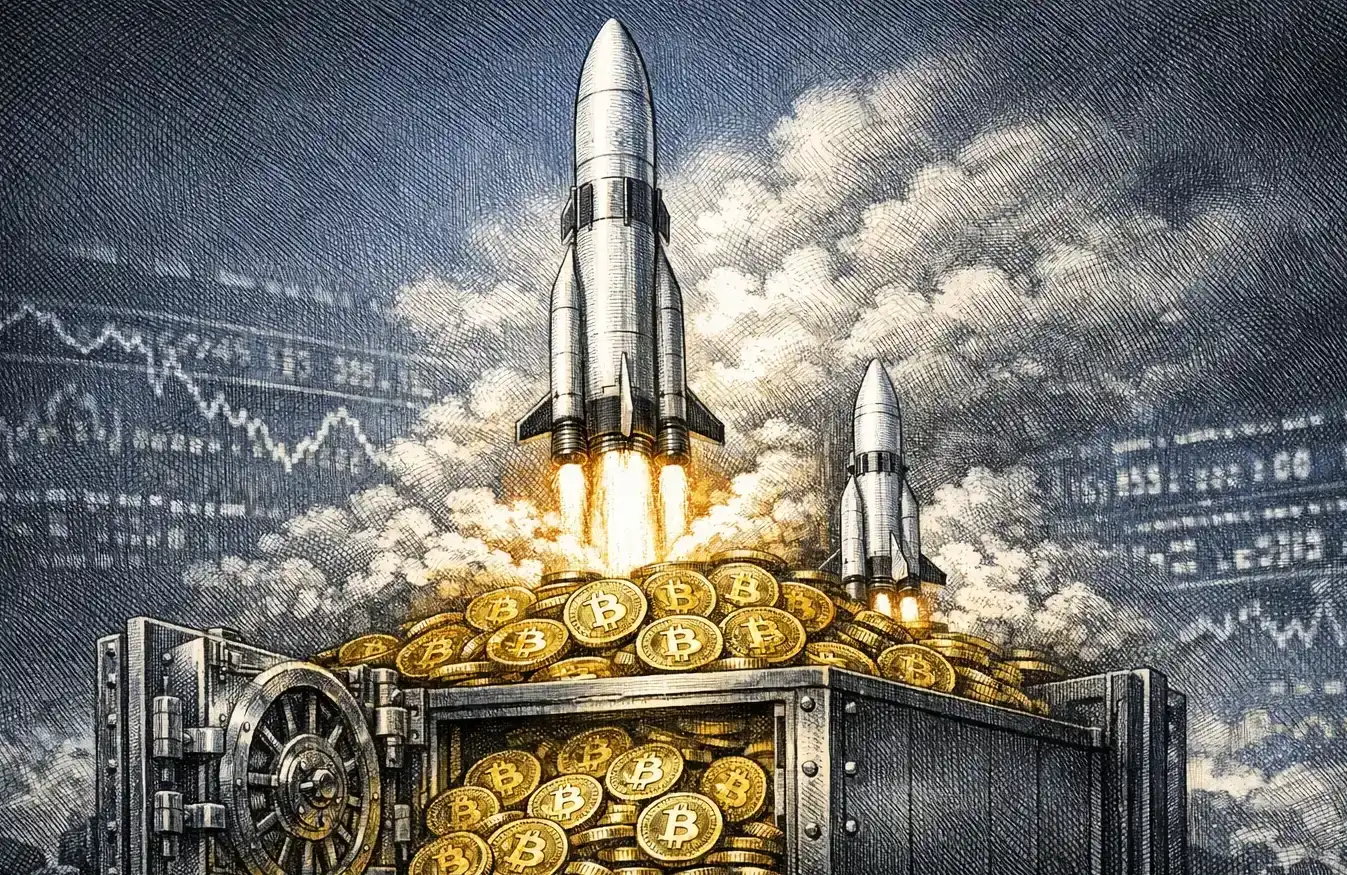
Weekly Editor's Picks (0509-0515)

marsbitОпубликовано 2026-05-16Обновлено 2026-05-16

Введение

Weekly Editor's Picks (0509-0515): A Weekly Digest to Filter Noise This weekly digest curates deep analysis often lost in fast information flows. Key highlights: * **Macro:** A new "NACHO" (Not A Chance Hormuz Opens) trade emerges on Wall Street, betting on a prolonged closure of the Strait of Hormuz, shifting focus from political rhetoric to fundamental oil market data. * **Investment & Startups:** * Justin Sun discusses his long-term investment theses, highlighting future opportunities in embodied AI, drones, spatial computing, and space exploration. * Anthropic and OpenAI's crackdown on unauthorized stock transfers disrupts the pre-IPO token market, prompting a re-evaluation of its boundaries. * Bitwise analyzes massive capital inflows into new, compliant blockchains like Arc, Canton, and Tempo, tailored for stablecoins and asset tokenization. * A skeptical view questions HYPE's potential for further price appreciation, citing high fully diluted valuation, unlocking token supply, and unclear new buyer demographics. * **AI:** The "Semiconductor Century" report outlines the 2026 AI investment landscape, identifying key players (Nvidia, TSMC, ASML) and catalysts across the semiconductor supply chain, from design to manufacturing. * **Policy & Stablecoins:** The potential CLARITY Act is analyzed for its impact on DeFi. It could trigger massive institutional capital inflows and redirect stablecoin yields, benefiting structured, compliant DeFi p...

The information flow is too fast, and in-depth analysis articles are easily drowned out by trending topics. The "Weekly Editor's Picks" column sifts through the sea of information to retrieve content of discernible value, filtering out the noise for you, leaving behind insights, and bringing inspiration.

Macro

'TACO' Is Outdated, 'NACHO' Trading Rises on Wall Street

NACHO, short for "Not A Chance Hormuz Opens," meaning there's no chance the Strait of Hormuz will reopen.

It is the opposite version of TACO (Trump Always Chickens Out). TACO bets on "people chickening out"—that Trump will back down at critical moments. NACHO bets on "things getting stuck"—this time, the Strait of Hormuz cannot be reopened with just one Truth Social post.

NACHO is not empty talk; it's the same bet placed with real money across three independent derivative markets: insurance, oil prices, and interest rate cuts.

The market is no longer trading on Trump's next Truth Social post; it's now trading on the Strait of Hormuz's early June inventory data.

Investment & Entrepreneurship

After 50x Storage, Justin Sun Always Looks to the Next Decade

"Shortage of chips in the short term, shortage of energy in the long term, and perpetual shortage of storage."

At the beginning of 2026, Justin Sun's prediction was: Embodied AI, Drones, Spatial Computing, Space Exploration.

Anthropic and OpenAI Personally Sever the Logic of Pre-market Crypto-Equities

Anthropic and OpenAI have taken stances one after another, clearly stating they "do not recognize unauthorized stock transfers." The risk of "layering" due to over-financialization of SPVs has begun to surface. Reflecting on the market level, pre-market stock tokens plummeted, while futures contracts remained relatively stable.

The public "crackdown" by Anthropic and OpenAI is, to some extent, also redefining the boundaries for this wildly growing new market. For speculators, this is a risk education; but for the industry's long-term development, the market might need such a "de-bubbling" moment.

Bitwise: Why Are Top-Tier Capital Firms Frantically Betting on New Public Blockchains?

The three public blockchains—Arc, Canton, and Tempo—are all tailor-made for stablecoin and asset tokenization scenarios.

A key takeaway from this wave of concentrated financing fervor is: Capital always follows regulatory legislation; Privacy protection may become a phenomenal core application.

Niche View: Why It's Hard for HYPE to Double Again

75% of the token supply remains unlocked, implying sustained selling pressure in the future; The current FDV is already approaching or even exceeding the valuation ranges of some traditional exchanges; And at this price point, it's still unclear whether new marginal buyers will come from retail investors, traditional institutions, or crypto funds.

More importantly, HYPE faces not only valuation issues but also risks such as regulation, hacker attacks, key-person dependency, and trader liquidity migration.

For an asset that has already gained significant market attention and is heavily promoted by KOLs, the real question is no longer "Does it have a narrative?" but rather "At this price, who will continue to buy?" When a crypto asset transitions from alpha to consensus, investors need to re-evaluate not just how excellent the project itself is, but whether the current price has already priced in the future.

AI

The Semiconductor Century: An Investment Roadmap Amid the 2026 AI Frenzy

High-value AI chips contribute to about half of the industry's revenue but account for less than 0.2% of total shipments. Semiconductors have evolved from consumer electronics components into strategic assets for companies with market caps exceeding $10 trillion.

The four key roles in the supply chain are: Designers (Architects), Foundries (Manufacturers), Equipment Suppliers (Toolmakers), and Memory Makers (Storage Layer).

Companies worth studying include: NVIDIA, TSMC, ASML, AMD, Broadcom (AVGO), SK Hynix.

Semiconductor ETFs include: SMH — VanEck Semiconductor ETF, SOXX — iShares Semiconductor ETF, SOXQ — Invesco PHLX Semiconductor ETF.

Key catalysts to watch: The Trillion Dollar Milestone, TSMC Arizona Fab Capacity Ramp-up, NVIDIA Vera Rubin Platform Deployment, AMD Market Share Progress, Memory Pricing & HBM4 Supply.

Policy & Stablecoins

When Stablecoins No Longer Earn Interest: 7 DeFi Protocols Benefiting from the CLARITY Act

Once the CLARITY Act is officially enacted, it will immediately trigger two major shifts: Institutional funds will have barriers to entry cleared. BlackRock, Apollo, Deutsche Bank, pension funds, corporate treasury funds, etc., which have been on the sidelines, could not previously get compliance teams to assess whether related assets were securities and dared not allocate large-scale. Now, with the CFTC clearly asserting jurisdiction and DeFi safe harbors established, institutions can finally enter in a big way. Profit-seeking funds will withdraw from idle stablecoin yield farming. The model where simply holding USDC on exchanges yielded around 5% annual interest will no longer exist. Hundreds of billions in funds seeking stable returns must find new allocation outlets.

Therefore, two massive waves of funds (institutional investors finally entering + retail investors seeking yield) will surge towards the same type of targets: compliant, yield-generating products with real business scenarios and structured frameworks.

Protocols tailor-made for this new regulatory landscape include: Underlying yield infrastructure layer Pendle, On-chain Prime Broker Morpho, Sky (USDS / sUSDS), On-chain credit trading desk Maple Finance, RWA asset native issuance layer Centrifuge, Related protocols leveraging STRC assets (a pathway in the fixed income track).

Also recommended: "Earnings, Legislation, the Fed... Circle Faces Three Major Tests This Week," "CLARITY Act Released: Is Ethereum the Biggest Winner?", "The New Order for XRP and Crypto Markets Under the CLARITY Act."

CeFi & DeFi

Has the Hook Summer Really Arrived? Sato, Lo0p, FLOOD Ignite the New Uniswap v4 Narrative

Since ASTEROID, ecosystem tokens backed by Uniswap v4 Hook protocols like sato, sat1, Lo0p, and FLOOD have gradually become the focus of market attention, with market caps ranging from millions to tens of millions of dollars, bringing much-needed concentrated liquidity to the narrative-dry crypto market.

Hook mechanism tokens drive Uniswap ecosystem development: UNI is bullish long-term but has limited short-term upside.

$3 Billion DeFi Fund Migration: LayerZero Stumbles, Chainlink Feasts

Rescue efforts for the Kelp DAO attack incident have also seen substantive progress recently. However, compared to financial recovery, the harder repair is restoring market trust.

At the center of this vortex, the cross-chain leader LayerZero is facing accelerated withdrawals by many protocols and was forced to make an abrupt shift in stance within just a few weeks—from initially shifting blame to now publicly apologizing and initiating reforms. Meanwhile, Chainlink has unexpectedly become a beneficiary of this crisis, with its CCIP protocol absorbing a large amount of migrated liquidity and showing significant growth in on-chain data.

Airdrop Opportunities & Interaction Guides

Hot Interactions Compilation | The Beacon Season 1 Pre-registration; GenLayer Latest Testnet Interaction (May 15th)

Circle Releases Arc Whitepaper, What Are the Early Interaction Opportunities?

Meme

From A9 Myth to Millions in Debt: A Meme Player's 5-Year Journey

Ethereum & Scaling

Grayscale: Ethereum's Staking Model Needs an Overhaul

Ethereum's current staking reward model faces two structural issues: L2s diverting activity lead to reduced token burns and increased net issuance; Staking barriers approaching zero may eventually lock nearly all ETH in staking.

The community is discussing implementing a staking reward cap curve, which Grayscale believes would be beneficial for ETH's price long-term. The Ethereum community is considering modifying the network's staking reward model, with the core idea being to incentivize staking only up to a certain ratio, with no additional rewards beyond that.

If implemented, stakers' nominal returns would decrease. But Grayscale believes this is good for ETH's price long-term for two reasons: controlling ETH inflation and strengthening ETH's narrative as a store-of-value asset.

Weekly Hot Topics Recap

Policy & Macro Markets

Trump conducts a state visit to China, accompanying entrepreneurs draw attention;

Trump's Q1 "stock trading operations" revealed, sparking heated discussion;

U.S. Senate votes to approve Kevin Warsh as Federal Reserve Chair;

U.S. Senate Banking Committee passes CLARITY Act (Analysis);

Some senators submit "anti-DeFi" amendments that could weaken protective clauses related to the CLARITY Act;

Opinions & Statements

Arthur Hayes: U.S.-China AI arms race combined with war inflation makes a return of BTC to $126K inevitable, the AI bubble is the biggest opportunity;

Wintermute: This round of BTC rise is clearly driven by leverage, open interest surges while spot trading volume remains sluggish;

New CZ Interview: Still dedicates 80% of his energy to blockchain, believes $10 million is enough for financial freedom;

Institutions, Major Companies & Leading Projects

Cerebras lists on Nasdaq, triggers strong upside circuit breaker on first day;

Solana Foundation partners with Google to launch Pay.sh (Analysis);

Data

ZEC up 15x year-to-date (Analysis); TON continues to rise (Analysis); L1 tokens gain strength (Analysis);

Circle Q1 revenue reaches $694 million, USDC on-chain transaction volume up 263% YoY (Earnings report details);

Gemini Q1 revenue grows 42%, after-hours stock price surges up to 30%;

Bitcoin long-term holders are accumulating heavily, institutional buying pushes price back above $80,000...

Attached are portals to the "Weekly Editor's Picks" series. See you next time~

Связанные с этим вопросы

QWhat does the trading term 'NACHO' stand for in the context of the article, and what does it signify compared to 'TACO'?

ANACHO stands for 'Not A Chance Hormuz Opens,' signifying a market bet that the Strait of Hormuz will remain closed, and a resolution will not be quickly reached via platforms like Truth Social. It is the opposite of 'TACO' (Trump Always Chickens Out), which bet on Trump backing down. NACHO reflects a shift in focus from political rhetoric to fundamental data like early June inventory figures.

QAccording to the article, what was the impact of Anthropic and OpenAI's public stance on unauthorized stock transfers?

AAnthropic and OpenAI publicly stated that they do not recognize unauthorized stock transfers. This action helped re-establish boundaries in a rapidly growing, unregulated market, leading to a sharp decline in pre-market stock tokens while contracts remained relatively stable. It served as a risk education for speculators and a potential 'de-bubbling' moment for the industry's long-term health.

QWhat are the four key roles identified in the AI-driven semiconductor supply chain, according to the '2026 AI狂飙下的投资路线图' section?

AThe four key roles in the AI-driven semiconductor supply chain are: Designers (the architects), Foundries (the manufacturers), Equipment Suppliers (the toolmakers), and Memory Makers (the storage layer).

QWhat are the two major shifts expected if the CLARITY Act is passed, as mentioned in the '政策和稳定币' section?

AIf the CLARITY Act is passed, two major shifts are expected: 1) Institutional capital (from firms like BlackRock, Apollo, pension funds) will have cleared regulatory hurdles to enter the DeFi market. 2) Yield-seeking capital will be forced to move away from idle stablecoin accounts (like those earning ~5% on USDC) and into structured, yield-generating products, creating a massive influx of funds into compliant DeFi protocols.

QWhat structural issue with Ethereum's staking model does Grayscale highlight, and what is the proposed solution?

AGrayscale highlights two structural issues with Ethereum's staking model: 1) L2 solutions divert transaction fees, reducing token burns and increasing net issuance. 2) The barrier to staking is nearing zero, potentially locking almost all ETH into staking. The proposed solution being discussed is implementing a staking reward cap curve, where rewards are only incentivized up to a certain staking ratio, which Grayscale argues would benefit ETH's long-term price by controlling inflation and strengthening its store-of-value narrative.

Похожее

Will the Next Crypto Bull Run Start with On-Chain Trading of SpaceX?

This article presents a scenario-based forecast for the crypto industry from 2026 to 2029, arguing that the next major cycle will be driven not by technological narratives but by legal access to real-world assets. The author predicts that by mid-2026, pre-IPO perpetual contracts for top private companies like SpaceX, OpenAI, and Anthropic on platforms like Hyperliquid will become the primary gateway for accessing quality assets, as most crypto-native tokens fail to capture real value. The much-hyped AI x Crypto intersection largely fails except for prediction markets, which thrive on betting on AI model supremacy. By 2027, public blockchain foundations are forced to choose between catering to retail speculation or building compliant infrastructure for institutions, with many opting for the latter. Growth in stablecoins and tokenized private credit/equity hits a "triple ceiling" due to regulatory and political uncertainty rather than market demand. The pivotal shift is forecast for 2028. A major liquidation event in pre-IPO perpetuals exposes the structural flaw of synthetic markets lacking a real underlying asset anchor. In response, regulatory changes finally allow the public solicitation of private securities resales to verified accredited investors. This creates a legitimate secondary market for real company equity, which then becomes the core asset class of the new bull market, relegating synthetic perps to a niche role. By 2029, the industry becomes "boring" but foundational. Tokens without claims on real cash flows or assets cease trading. Stablecoin growth is steady but politically capped. Crypto infrastructure fades from view as it gets absorbed into traditional finance backends. The article's central thesis is that the key bottleneck for crypto's next phase is legal and regulatory channels for real asset ownership, not technology.

marsbit15 мин. назад

Will the Next Crypto Bull Run Start with On-Chain Trading of SpaceX?

marsbit15 мин. назад

The Value Distribution of Stablecoins

**Summary: The Value Distribution of Stablecoins** The article argues that stablecoins are evolving from mere trading tools into broader channels for dollar access. It divides the stablecoin ecosystem into four layers to analyze how value is distributed: 1. **Issuance Layer:** Mints stablecoins, holds reserve assets, and captures the spread between reserve yield and user costs (e.g., Tether, Circle). This layer currently earns the largest profit margin. 2. **Infrastructure Layer:** Connects stablecoins to the traditional financial system, handling fiat on/off-ramps, banking integration, compliance (KYC/AML), and asset management (e.g., Bridge, BVNK). This is the "unglamorous" but critical work, building the essential bridges between crypto and real-world finance. 3. **Acquiring/Distribution Layer:** Integrates stablecoins into merchant systems, manages payment flows, and provides enterprise financial software (e.g., Stripe, Coinbase). They act as the access point for businesses. 4. **Application Layer:** The end-users and businesses that ultimately use stablecoins for payments, settlements, or as a store of value. They benefit from convenience but have little pricing power. The core thesis is that while the issuance layer currently dominates profits, the often-overlooked **infrastructure layer holds significant long-term potential**. The real challenge and barrier to mass adoption is not the on-chain transfer of stablecoins (which is simple), but the complex "last mile" integration into existing business workflows, banking systems, and regulatory frameworks across different countries. Companies in this layer are currently in a "land grab" phase, investing heavily to build networks, secure bank partnerships, and establish compliance pathways. While their position is currently pressured by the profitable issuers above and distribution platforms below, the article suggests that if stablecoins become a default financial rail for businesses, the infrastructure providers who have done the hard work of integration will ultimately gain strong pricing power and become entrenched, essential players.

marsbit6 ч. назад

The Value Distribution of Stablecoins

marsbit6 ч. назад

The Value Distribution of Stablecoins

The Value Distribution of Stablecoins The article argues that stablecoins are evolving from a mere trading tool into a broad "dollar channel." It analyzes the industry's value chain through four layers: 1. **Issuance Layer (e.g., Tether, Circle):** The top layer that mints stablecoins, holds reserve assets, and captures the thickest interest rate spread. 2. **Infrastructure Layer (e.g., Bridge, BVNK):** Connects stablecoins to the traditional financial system, handling critical but complex "dirty work" like fiat on/off-ramps, banking integration, compliance (KYC/AML), and cross-border settlement. 3. **Acquiring/Distribution Layer (e.g., Stripe, Coinbase):** Embeds stablecoins into merchant systems, manages payment flows, and integrates with enterprise software. 4. **Application Layer:** End-users and businesses that ultimately use stablecoins for payments, settlement, or storing value. The author posits that while the issuance layer currently captures the most profit, the most overlooked and potentially critical layer is infrastructure. The core challenge for stablecoin adoption isn't the on-chain transfer (which is simple), but bridging the gap between blockchain and the real-world financial system. This involves solving practical problems for businesses: fiat conversion, reconciliation, tax handling, and user onboarding. Infrastructure companies are currently in a difficult "land-grab" phase—building networks, securing banking relationships, and achieving compliance country-by-country. They face pressure from both the profitable issuance layer above and distribution platforms below. However, the author suggests this layer is building a crucial moat. Once stablecoins become a default business rail, the infrastructure players who have done the hard work of integration may gain significant, durable value and pricing power.

链捕手7 ч. назад

The Value Distribution of Stablecoins

链捕手7 ч. назад

Торговля

Спот
Фьючерсы

Популярные статьи

Как купить S

Добро пожаловать на HTX.com! Мы сделали приобретение Sonic (S) простым и удобным. Следуйте нашему пошаговому руководству и отправляйтесь в свое крипто-путешествие.Шаг 1: Создайте аккаунт на HTXИспользуйте свой адрес электронной почты или номер телефона, чтобы зарегистрироваться и бесплатно создать аккаунт на HTX. Пройдите удобную регистрацию и откройте для себя весь функционал.Создать аккаунтШаг 2: Перейдите в Купить криптовалюту и выберите свой способ оплатыКредитная/Дебетовая Карта: Используйте свою карту Visa или Mastercard для мгновенной покупки Sonic (S).Баланс: Используйте средства с баланса вашего аккаунта HTX для простой торговли.Третьи Лица: Мы добавили популярные способы оплаты, такие как Google Pay и Apple Pay, для повышения удобства.P2P: Торгуйте напрямую с другими пользователями на HTX.Внебиржевая Торговля (OTC): Мы предлагаем индивидуальные услуги и конкурентоспособные обменные курсы для трейдеров.Шаг 3: Хранение Sonic (S)После приобретения вами Sonic (S) храните их в своем аккаунте на HTX. В качестве альтернативы вы можете отправить их куда-либо с помощью перевода в блокчейне или использовать для торговли с другими криптовалютами.Шаг 4: Торговля Sonic (S)С легкостью торгуйте Sonic (S) на спотовом рынке HTX. Просто зайдите в свой аккаунт, выберите торговую пару, совершайте сделки и следите за ними в режиме реального времени. Мы предлагаем удобный интерфейс как для начинающих, так и для опытных трейдеров.

1.5k просмотров всегоОпубликовано 2025.01.15Обновлено 2026.06.02

Как купить S

Sonic: Обновления под руководством Андре Кронье – новая звезда Layer-1 на фоне спада рынка

Он решает проблемы масштабируемости, совместимости между блокчейнами и стимулов для разработчиков с помощью технологических инноваций.

2.3k просмотров всегоОпубликовано 2025.04.09Обновлено 2025.04.09

Sonic: Обновления под руководством Андре Кронье – новая звезда Layer-1 на фоне спада рынка

HTX Learn: Пройдите обучение по "Sonic" и разделите 1000 USDT

HTX Learn — ваш проводник в мир перспективных проектов, и мы запускаем специальное мероприятие "Учитесь и Зарабатывайте", посвящённое этим проектам. Наше новое направление .

1.8k просмотров всегоОпубликовано 2025.04.10Обновлено 2025.04.10

HTX Learn: Пройдите обучение по "Sonic" и разделите 1000 USDT

Обсуждения

Добро пожаловать в Сообщество HTX. Здесь вы сможете быть в курсе последних новостей о развитии платформы и получить доступ к профессиональной аналитической информации о рынке. Мнения пользователей о цене на S (S) представлены ниже.

活动图片